Quick Verdict: Can the Lightning Actually Tow?
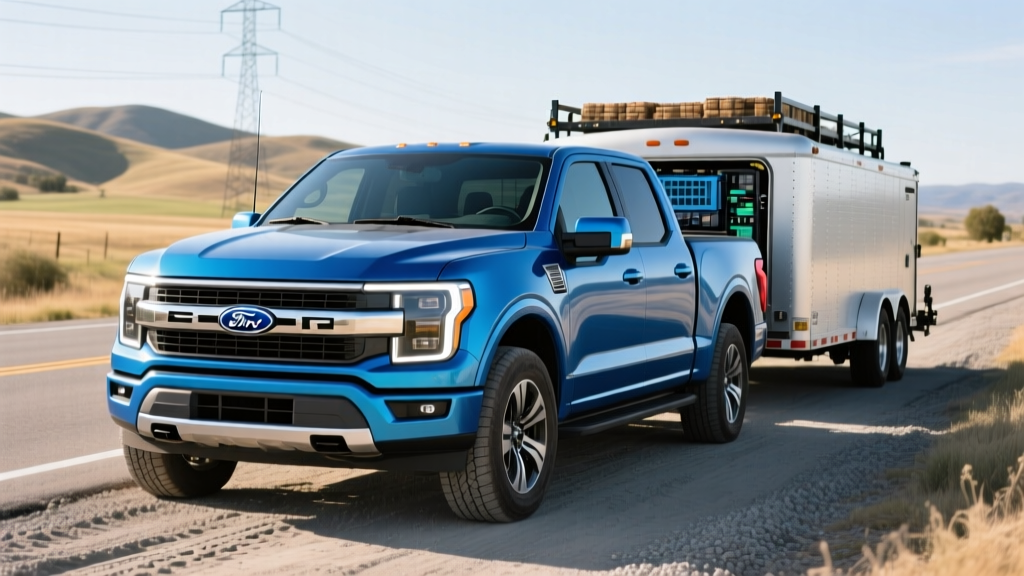
The Ford F-150 Lightning's maximum towing capacity reaches 10,000 pounds when properly equipped — matching many gas-powered half-ton trucks. But here's what spec sheets don't tell you: towing at or near that limit cuts your range by 40-60%, transforming a 320-mile Extended Range battery into a 130-190 mile reality. This isn't a dealbreaker for short hauls or boat launches, but it fundamentally changes the truck's utility profile for long-distance towing.
| Specification | Standard Range | Extended Range |
|---|---|---|
| Max Towing Capacity | 7,700 lbs | 10,000 lbs |
| EPA Range | 240 miles | 320 miles |
| Battery Capacity (usable) | 98 kWh | 131 kWh |
| Battery Chemistry | NMC (Nickel Manganese Cobalt) | NMC |
| Horsepower | 580 hp | 580 hp |
| Torque | 775 lb-ft | 775 lb-ft |
| 0-60 mph | ~4.0 seconds | ~3.8 seconds |
| Drivetrain | Dual-motor AWD | Dual-motor AWD |
| Max DC Fast Charge | 150 kW | 150 kW |
| 10-80% DC Fast Charge | ~44 minutes | ~41 minutes |
| Level 2 Home Charging | 11.3 kW (30 mi/hr) | 11.3 kW (30 mi/hr) |
| MPGe Combined | 78 MPGe | 73 MPGe |
| Efficiency | 49 kWh/100mi | 51 kWh/100mi |
| Base MSRP (2025) | $54,995 | $69,995 |
| Battery Warranty | 8 yr / 100,000 mi | 8 yr / 100,000 mi |
Real-World Range: What Towing Does to Your Battery
EPA Sticker: 240 mi (Standard Range) / 320 mi (Extended Range)
Real-World Unloaded: Expect 210-230 mi highway (Standard), 280-300 mi highway (Extended). City driving with regenerative braking often matches or exceeds EPA estimates.
Real-World Towing: 120-150 mi (Standard Range with 7,000+ lb trailer), 160-200 mi (Extended Range with 8,000+ lb trailer). Aerodynamic drag and weight crush efficiency — plan charging stops every 100-130 miles when towing heavy.
Cold Weather Impact: Below freezing, reduce all estimates by 20-30%. A 320-mile Extended Range truck towing in 20°F weather might deliver just 110-140 miles of practical range.
The Lightning's range degradation while towing isn't unique — every EV truck experiences this physics reality. The Rivian R1T and GMC Hummer EV Pickup face similar penalties. What matters is your use case: if you're towing a 5,000-pound boat 60 miles to the lake and back, the Extended Range Lightning handles it easily with room to spare. If you're pulling a 9,000-pound camper 300 miles to a campground, you'll stop to charge 2-3 times, each session lasting 30-45 minutes.
Ford's onboard scales and Intelligent Range system account for trailer weight and terrain, providing more accurate range estimates than the EPA sticker alone. The truck also preconditions the battery when you navigate to a DC fast charger, optimizing charge speed on arrival.
Towing Capacity Breakdown by Trim and Configuration
Not every F-150 Lightning can hit 10,000 pounds. Here's the actual breakdown:
- Pro (Standard Range): 7,700 lbs max towing
- XLT (Standard Range): 7,700 lbs max towing
- XLT (Extended Range): 10,000 lbs with Max Trailer Tow Package
- Lariat (Extended Range): 10,000 lbs with Max Trailer Tow Package
- Platinum (Extended Range): 10,000 lbs with Max Trailer Tow Package
The Max Trailer Tow Package includes an upgraded rear axle ratio, enhanced cooling, trailer brake controller, and integrated trailer hitch camera. Without it, Extended Range models are limited to 7,700 pounds. The Standard Range battery's lower tow rating stems from reduced structural reinforcement and thermal management capacity.
Payload capacity ranges from 1,800 to 2,235 pounds depending on configuration — competitive with gas F-150s but lower than heavy-duty trucks. The Lightning's 6,100-6,800 lb curb weight (batteries add mass) means you're closer to the 7,050-lb GVWR limit faster.
Charging Speed: Home, Public, and On the Road
The F-150 Lightning's charging capabilities reflect 2022-era architecture — functional but not class-leading in 2025. Here's what you can expect:
| Charging Method | Power | Speed | Notes |
|---|---|---|---|
| Level 1 (120V outlet) | 1.4 kW | ~3 mi/hr | Emergency/trickle only; full charge takes 4+ days |
| Level 2 (240V, 48A) | 11.3 kW | ~30 mi/hr | Full charge: 8 hr (Standard), 11 hr (Extended) |
| DC Fast Charge | 150 kW peak | ~130 mi in 30 min | 10-80%: 44 min (Std), 41 min (Ext); tapers above 80% |
The 150 kW peak charge rate means the Lightning won't match newer 800V architectures like the Hyundai Ioniq 5 (240 kW) or Rivian R1T Gen 2 (220+ kW). In real-world testing, the Lightning typically sustains 110-130 kW from 10-60% state of charge, then drops to 60-80 kW through 80%, and under 40 kW above 80%. This charge curve is conservative but protects long-term battery health.
For home charging, Ford includes a 30-amp Ford Mobile Charger with every Lightning. Most owners upgrade to a 48-amp Level 2 wall connector ($500-700 equipment) for the full 11.3 kW rate. Installation costs range from $500 (simple run near panel) to $2,500+ (panel upgrade, long conduit runs). The Lightning uses the CCS1 connector standard, compatible with Electrify America, EVgo, and ChargePoint networks. Ford provides BlueOval Charge Network access, though reliability varies by station.
Pro tip: If you regularly tow long distances, plan routes around 150+ kW chargers and expect 35-45 minute stops every 120-150 miles. The Lightning's large battery takes time to replenish.
Performance and Driving Dynamics
The Lightning's dual-motor all-wheel-drive powertrain delivers 580 horsepower and 775 lb-ft of instant torque — numbers that embarrassed the Raptor until the Raptor R arrived. The 0-60 mph sprint takes 3.8-4.0 seconds depending on battery size, making this the quickest production F-150 Ford has built.
But straight-line speed isn't why truck buyers choose the Lightning. The instant torque delivery transforms towing: no downshift hunting, no turbo lag, just linear pull from 0 mph. The low center of gravity (batteries mounted under the floor) reduces body roll compared to gas trucks, though the 6,500+ lb curb weight is noticeable in corners and during emergency maneuvers.
Ride quality is compliant but not plush — the independent rear suspension (a first for F-150) smooths out bed-empty harshness that plagues leaf-spring trucks. Off-road capability is limited to light trails; ground clearance is 8.9 inches, and there's no low-range gearing. For serious off-roading, the Rivian R1T or gas F-150 Tremor/Raptor are better choices.
The Lightning's party trick is Pro Power Onboard: 2.4 kW standard (outlets in bed and cabin) or 9.6 kW with the optional system. That's enough to run power tools at a job site, tailgate with multiple appliances, or provide emergency backup power to your home during an outage (with a transfer switch installed).
Pricing, Trims, and Federal Tax Credit Eligibility
Ford aggressively repositioned Lightning pricing for 2025 after initial demand cooled. Here's the current lineup:
| Trim | Battery | MSRP | Est. After §30D Credit |
|---|---|---|---|
| Pro | Standard Range (240 mi) | $54,995 | $47,495* |
| XLT | Standard Range (240 mi) | $59,995 | $52,495* |
| XLT | Extended Range (320 mi) | $69,995 | $62,495* |
| Lariat | Extended Range (320 mi) | $76,995 | $69,495* |
| Platinum | Extended Range (320 mi) | $86,995 | $79,495* |
*Assumes full $7,500 federal tax credit eligibility. See IRS rules below.
Federal Tax Credit (§30D) Eligibility: The F-150 Lightning qualifies for up to $7,500 in federal tax credits, but eligibility depends on three factors per current IRS rules:
- MSRP Cap: Trucks must be under $80,000 MSRP. The Platinum trim ($86,995) exceeds this and is ineligible.
- Buyer Income Limits: Modified AGI cannot exceed $300,000 (joint), $225,000 (head of household), or $150,000 (single).
- Battery Sourcing: A percentage of battery minerals must come from the U.S. or free-trade-agreement countries, and components cannot be sourced from "foreign entities of concern." Ford has worked to comply, but verify current-year eligibility on the IRS site before purchase.
As of 2025, the credit can be transferred to the dealer at point of sale, reducing your out-of-pocket cost immediately rather than waiting for tax refund. Consult a tax professional for your specific situation — rules change annually.
Interior, Tech, and Cargo
The Lightning's cabin mirrors the gas F-150: functional, spacious, and increasingly tech-forward. The 12-inch touchscreen (15.5-inch on Lariat/Platinum) runs Ford's SYNC 4 system with wireless Apple CarPlay and Android Auto. Physical knobs for volume and climate remain — a win for usability.
Passenger Space: SuperCrew cab only. Front legroom: 43.9 inches. Rear legroom: 43.6 inches. Three adults fit across the rear bench comfortably.
Cargo: 52.8-inch bed length (5.5 feet) with 52.8 cu ft volume. The Mega Power Frunk (front trunk) adds 14.1 cu ft of lockable, weather-sealed storage with 400 lb payload capacity — perfect for gear, groceries, or tools you want secure and accessible.
Driver Assistance: Ford Co-Pilot360 2.0 is standard (automatic emergency braking, blind-spot monitoring, lane-keeping). BlueCruise hands-free driving is available on 130,000+ miles of divided highways — it's a capable SAE Level 2 system, but requires driver attention and doesn't handle complex urban driving. Don't confuse it with full self-driving.
Notable Drawbacks: The Lightning lacks a spare tire (tire repair kit only), the touchscreen can lag on lower trims, and the regenerative braking is less aggressive than one-pedal-driving EVs like Tesla or Rivian. The Pro and XLT trims use cloth seats and basic interiors that feel dated at these prices.
Who Should Buy the F-150 Lightning?
Pros
- 10,000-lb towing capacity (Extended Range) matches gas half-tons
- Instant torque makes towing effortless — no gear hunting
- Pro Power Onboard (up to 9.6 kW) powers job sites and homes
- Mega Power Frunk adds secure, weatherproof storage
- Quiet, smooth daily driving with 320-mile range (Extended)
- Competitive pricing after tax credits vs. Rivian R1T
- Independent rear suspension improves ride quality
Cons
- Towing cuts range 40-60% — long hauls require multiple charge stops
- 150 kW max charge rate is slow vs. newer 800V platforms
- Heavy curb weight (6,500+ lbs) affects handling and efficiency
- Limited off-road capability vs. Raptor or R1T
- No spare tire included
- Platinum trim exceeds $80K tax credit cap
- DC fast charging 10-80% takes 40+ minutes
Buy the Lightning if: You need a full-size truck for work, light-to-moderate towing (under 7,000 lbs for 100+ miles), and daily driving. You have home Level 2 charging. You value Pro Power Onboard for job sites or emergencies. You want tax-credit-eligible pricing under $70K.
Skip the Lightning if: You regularly tow 8,000+ lbs over 200+ miles and can't tolerate 2-3 charge stops. You need serious off-road capability. You want the fastest charging available. You don't have reliable home charging access.
Consider the Rivian R1T instead if: You prioritize off-road performance, faster charging (220+ kW), and don't mind paying $75K+ (R1T doesn't qualify for the full $7,500 credit due to MSRP caps on most trims).
Warranty and Long-Term Ownership
Ford backs the Lightning with a competitive warranty package:
- Battery: 8 years / 100,000 miles (retains 70% capacity minimum)
- Powertrain (motors, reduction gears): 8 years / 100,000 miles
- Bumper-to-bumper: 3 years / 36,000 miles
- Corrosion: 5 years / unlimited miles
Real-world battery degradation data is still limited (Lightning launched in 2022), but Ford's NMC cells and active liquid thermal management should deliver 85-90% capacity retention at 100,000 miles based on similar platforms. The 70% warranty threshold is industry-standard but conservative — most owners won't approach that level of degradation within the warranty period.
Maintenance costs are lower than gas F-150s: no oil changes, spark plugs, or transmission fluid. Expect to replace brake pads less frequently (regenerative braking reduces wear), though the truck's weight accelerates tire wear — budget for new rubber every 30,000-40,000 miles.
Frequently Asked Questions
What is the real-world range of the F-150 Lightning while towing?
With a 7,000-8,000 lb trailer, expect 120-150 miles (Standard Range) or 160-200 miles (Extended Range). Aerodynamic trailers (enclosed car haulers) reduce range more than flat-bed utility trailers. Cold weather and mountain grades further cut range by 20-30%.
How fast does the Lightning charge at home and on the road?
Home Level 2 (240V, 48A) delivers 11.3 kW, adding about 30 miles per hour — a full charge takes 8-11 hours overnight. DC fast charging peaks at 150 kW, reaching 10-80% in 41-44 minutes. Above 80%, charging slows significantly to protect battery health.
Does the F-150 Lightning qualify for the $7,500 federal tax credit?
Most trims qualify, but the Platinum ($86,995 MSRP) exceeds the $80,000 truck cap and is ineligible. Buyer income limits apply ($150K single / $300K joint). Battery sourcing requirements must be met — verify current-year eligibility on the IRS website before purchase. The credit can be applied at point of sale in 2025.
Is the Lightning worth buying vs. the Rivian R1T or gas F-150?
The Lightning wins on value (lower MSRP, tax credit eligibility), Pro Power Onboard, and traditional truck familiarity. The R1T offers superior off-road capability, faster charging, and a quad-motor option but costs $20K+ more. A gas F-150 PowerBoost hybrid provides unlimited range and easier long-distance towing but higher fuel costs and maintenance. Choose based on your towing distance, off-road needs, and charging access.
What's the biggest drawback of the F-150 Lightning?
Range loss while towing is the Lightning's Achilles heel. If you regularly pull heavy trailers 200+ miles, the 40-60% range penalty and 40+ minute charge stops make gas or diesel trucks more practical. For daily driving and short tows, the Lightning excels — but long-haul towing remains an EV truck limitation industry-wide.
Can the Lightning power my home during an outage?
Yes, with Ford's 9.6 kW Pro Power Onboard and a professionally installed home transfer switch ($3,000-5,000). The Lightning can power essential circuits (refrigerator, lights, HVAC, internet) for 3-5 days depending on usage. This vehicle-to-home (V2H) capability is a genuine differentiator vs. gas trucks.