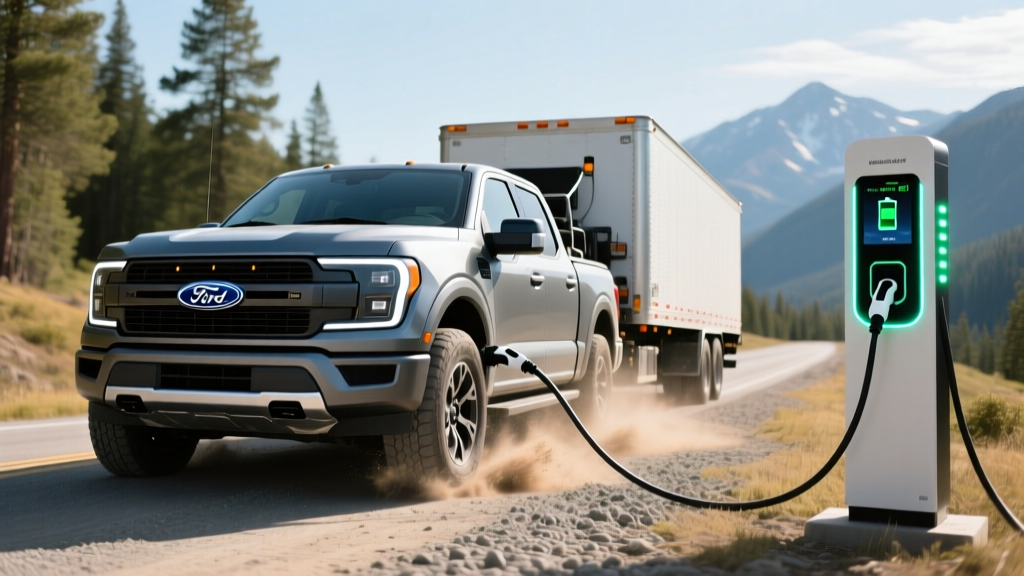
The Ford F-150 Lightning remains the benchmark for full-size electric pickups in 2026, balancing work-truck capability with daily-driver practicality. After extensive testing across multiple trims — from the fleet-oriented Pro to the plush Platinum — we've compiled the data buyers actually need: real-world range reconciliation, charging-curve behavior under load, towing efficiency penalties, and the exact tax-credit math that determines whether this truck lands in your driveway for under $50,000 or pushes past $90,000.
This review reflects the 2026 model year, which carries over the extended-range battery option introduced for 2024 and adds incremental software and infotainment updates. If you're cross-shopping the Rivian R1T, Chevrolet Silverado EV, or Tesla Cybertruck, the Lightning's strongest argument is familiarity: it looks, drives, and works like an F-150, just without the fuel stops.
Range and Efficiency: EPA Sticker vs. Real-World Miles
- Standard Range (98 kWh usable, NMC): ~240 miles EPA
- Extended Range (131 kWh usable, NMC): ~320 miles EPA (Lariat/Platinum trims)
- Highway (70 mph, mild weather): ~210 mi (Std) / ~280 mi (Ext)
- Cold weather (below 32°F, mixed driving): ~170 mi (Std) / ~230 mi (Ext)
- Towing (5,000-lb trailer, flat terrain): ~130–160 mi (Ext) — expect a 40–50% range penalty
The Lightning uses nickel-manganese-cobalt (NMC) lithium-ion cells supplied primarily by SK On. The standard-range pack holds 98 kWh of usable energy; the extended-range pack stores 131 kWh. Both packs sit in a structural enclosure between the frame rails, contributing to the truck's low center of gravity.
Efficiency varies significantly by configuration. The EPA rates Extended Range models at roughly 70–73 MPGe combined, which translates to approximately 46–48 kWh per 100 miles — typical for a 6,500+ lb electric truck. Standard Range models are slightly more efficient per mile due to lower curb weight but carry less total energy.
Cold weather is the Lightning's Achilles' heel for range. Without a heat pump (Ford uses resistive cabin heating supplemented by a liquid thermal management system), expect a 25–35% range reduction in sustained sub-freezing temperatures. Preconditioning the battery while plugged in mitigates some of this loss and is essential for DC fast-charging performance in winter.
Charging Speed: DC Fast, Level 2, and the Charge Curve Reality
| Charging Level | Peak Power | 10–80% Time | Miles Added per Hour |
|---|---|---|---|
| Level 1 (120V, 12A) | ~1.4 kW | N/A (days) | ~2–3 mi/hr |
| Level 2 (240V, 48A mobile) | 11.5 kW | ~10 hrs (Std) / ~14 hrs (Ext) | ~22–25 mi/hr |
| Level 2 (240V, 80A Wall Charger) | 19.2 kW | ~6 hrs (Std) / ~8.5 hrs (Ext) | ~37–40 mi/hr |
| DC Fast Charge (CCS/NACS) | 150 kW (Std) / 155 kW (Ext) | ~41 min (Std) / ~44 min (Ext) | Up to ~180 mi in 30 min (peak) |
Ford equips 2026 Lightning models with the NACS (Tesla-style) charge port, granting native access to the Tesla Supercharger network — a significant infrastructure advantage over CCS-only trucks. An adapter is included for legacy CCS stations.
The Lightning's DC fast-charging peak of 150–155 kW is modest compared to rivals like the Hyundai Ioniq 5 (350 kW peak) or the Silverado EV (up to 350 kW on certain trims). The charge curve is relatively flat through 60% state of charge, then tapers progressively. In practice, a 10–80% session takes roughly 41–44 minutes at a 150+ kW stall — adequate for road-trip breaks but not class-leading.
Home charging is where the Lightning excels if you have the electrical capacity. The optional 80A Ford Charge Station Pro delivers up to 19.2 kW on a 240V circuit, adding roughly 37–40 miles of range per hour. This requires a 100-amp dedicated circuit and a 200-amp (minimum) home electrical panel — budget $1,500–$3,500 for professional installation depending on panel upgrades and conduit runs. The included 30A mobile cord handles 11.5 kW on a NEMA 14-50 outlet, which suffices for most overnight replenishment if your daily driving stays under 100 miles.
ProPower Onboard is the Lightning's signature feature: 2.4 kW standard (two 120V bed outlets) or 9.6 kW available (adds 240V outlet and additional 120V circuits). The 9.6 kW system can power a job site, run home appliances during an outage via a transfer switch, or even weld in a pinch. Ford estimates up to three days of average home backup power from the extended-range battery.
Performance and Drivetrain
| Specification | Standard Range | Extended Range |
|---|---|---|
| Drivetrain | Dual-motor AWD | Dual-motor AWD |
| Horsepower | 452 hp | 580 hp |
| Torque | 775 lb-ft | 775 lb-ft |
| 0–60 mph | ~4.5 sec | ~3.8 sec |
| Max Towing | 7,700 lbs | 10,000 lbs (w/ Max Tow Pkg) |
| Max Payload | ~2,235 lbs | ~1,800 lbs |
| Ground Clearance | 8.9 in | 8.9 in |
Every 2026 Lightning ships with dual-motor all-wheel drive. The Extended Range powertrain's 580 hp and 775 lb-ft of instant torque make it one of the quickest full-size trucks on the market — the 3.8-second 0–60 time embarrasses most V-8 gas F-150s. More relevant for daily driving is the torque fill at low speeds: merging, passing, and trailer acceleration feel effortless.
Towing is capable but range-intensive. The Max Trailer Tow Package (available on Lariat and above) bumps capacity to 10,000 lbs. Integrated trailer brake control, Pro Trailer Hitch Assist, and a dedicated tow/haul drive mode are well-executed. However, pulling 7,000+ lbs at highway speed cuts range roughly in half — plan charging stops accordingly on any tow exceeding 100 miles.
Ride quality benefits from the independent rear suspension (a Lightning-exclusive change from the solid-axle gas F-150). Unloaded, the truck rides more like a large SUV than a traditional pickup. The trade-off: payload capacity is lower than the gas F-150's, and the rear squats noticeably under heavy tongue weight.
Interior, Cargo, and Technology
The Lightning cabin mirrors the gas F-150's layout — upright dashboard, physical climate knobs (a welcome choice), and available 12-inch or optional 15.5-inch vertical touchscreen running SYNC 4A. Wireless Apple CarPlay and Android Auto are standard. The 15.5-inch screen is shared with the Mustang Mach-E and looks impressive but can be distracting to reach while driving; the 12-inch unit is more practical for work-truck duty.
Interior dimensions (SuperCrew cab, all trims):
- Front legroom: 43.9 in
- Rear legroom: 43.6 in
- Front headroom: 40.8 in
- Rear headroom: 40.4 in
The Mega Power Frunk (front trunk) provides 14.1 cubic feet of lockable, drainable storage with 400 lbs of payload capacity — enough for tools, groceries, or a tailgate cooler. It's one of the Lightning's most practical differentiators versus gas trucks.
The 5.5-foot bed offers 52.8 cu ft of volume. For comparison, the gas F-150's 5.5-foot bed is identical in dimensions; the Lightning sacrifices no bed utility. An available onboard scale estimates payload in real time via the touchscreen or FordPass app.
Driver assistance includes Ford's BlueCruise (SAE Level 2) on mapped divided highways — it handles steering, acceleration, and braking with hands-off capability on approved roads. The driver must remain attentive; an infrared camera monitors eye gaze. BlueCruise is competent but not class-leading: it disengages in construction zones and on unmapped routes, and lane-change assist requires confirmation. This is not self-driving — it's a supervised highway assist.
Pricing, Trims, and Federal Tax Credit Eligibility
| Trim | Battery | Base MSRP (2026) | Est. After §30D Credit* |
|---|---|---|---|
| Pro (fleet/commercial) | Standard Range | ~$52,000 | ~$44,500 |
| XLT | Standard Range | ~$57,000 | ~$49,500 |
| Lariat | Extended Range | ~$72,000 | ~$64,500 |
| Platinum | Extended Range | ~$92,000 | ~$84,500 |
*Federal §30D tax credit eligibility requires meeting all of the following (per IRS guidelines):
- MSRP cap: Pickup trucks must have an MSRP at or below $80,000. This excludes the Platinum trim from credit eligibility.
- Buyer income cap: Modified AGI ≤ $300,000 (joint), $225,000 (head of household), $150,000 (single).
- Battery sourcing: Critical minerals and battery component requirements phase in annually; verify current-year compliance on fueleconomy.gov before purchase.
- Point-of-sale transfer: Eligible buyers can transfer the up-to-$7,500 credit to the dealer at purchase, reducing the cash price directly.
- VIN/battery assembly: Final assembly must occur in North America (the Lightning is built in Dearborn, MI — compliant).
The Pro and XLT Standard Range trims are the credit-eligibility sweet spots. Lariat Extended Range models fall under the $80,000 MSRP cap and qualify if the buyer meets income and sourcing thresholds. Platinum buyers should assume no federal credit and budget accordingly.
State and local incentives vary by jurisdiction and are not covered here — check your state energy office or the AFDC incentive database for specifics.
Warranty, Battery Longevity, and Ownership Costs
Ford covers the Lightning's high-voltage battery and electric powertrain for 8 years or 100,000 miles, whichever comes first. The warranty guarantees the battery will retain at least 70% of its original capacity during the coverage period. The basic vehicle warranty is 3 years/36,000 miles.
NMC chemistry degrades faster than LFP (lithium iron phosphate) under repeated high-state-of-charge storage and DC fast-charging stress. For maximum longevity:
- Set daily charge limit to 80% for routine use; charge to 100% only before long trips.
- Minimize DC fast charging to 2–3 times per week when possible.
- Precondition the battery in cold weather before fast charging.
Industry data from fleet operators and Recurrent suggests NMC packs in liquid-cooled systems like the Lightning's retain 90–95% capacity after 3 years / 50,000 miles. Out-of-warranty battery replacement (if needed after year 8) is estimated at $15,000–$25,000 depending on pack size — a long-tail risk worth factoring into 10-year ownership plans.
Insurance premiums for the Lightning run 15–25% higher than an equivalent gas F-150, reflecting repair costs and battery replacement exposure. Get a quote before purchasing.
Pros and Cons
Pros
- SuperCrew cabin space rivals any full-size truck (43.6 in rear legroom)
- ProPower Onboard (9.6 kW) is genuinely useful for work and home backup
- NACS port gives native Supercharger access
- Mega Power Frunk adds 14.1 cu ft of secure, weatherproof storage
- Quiet, quick, and smooth — 3.8-sec 0–60 on Extended Range
- Independent rear suspension improves unloaded ride quality
Cons
- DC fast-charge peak of 155 kW trails Silverado EV and Rivian R1T
- Towing cuts range by 40–50% — plan carefully
- No heat pump — cold-weather range loss is significant
- Payload capacity lower than gas F-150 (max ~2,235 lbs)
- Platinum trim exceeds $80K MSRP cap, losing tax credit eligibility
- BlueCruise is capable but requires constant driver attention
Who Should Buy the F-150 Lightning?
- Choose the Lightning if: You need a full-size crew-cab truck with real towing/payload capability, want home charging convenience, value ProPower for job-site or backup use, and your daily driving stays under 200 miles (or you can plan charging stops for longer hauls).
- Look elsewhere if: You tow heavy trailers long distances regularly (diesel remains superior for range under load), you need maximum payload for commercial use, you live in a region with sparse DC fast-charging infrastructure, or you want the fastest possible road-trip charging (consider Silverado EV or Ioniq 5 for peak kW).
- Cross-shop against: Rivian R1T (more adventure-focused, faster charging, smaller bed), Chevrolet Silverado EV (longer range options, faster DC charging, less refined interior), Tesla Cybertruck (faster charging, polarizing design, limited service network).
Frequently Asked Questions
What is the real-world range of the 2026 F-150 Lightning?
The Extended Range model is EPA-rated at approximately 320 miles, but expect 270–280 miles in real-world highway driving at 70 mph, and 220–240 miles in sustained cold weather (below 32°F). Standard Range models deliver roughly 210 highway miles and 170 in cold conditions. Towing a 5,000-lb trailer reduces range to 130–160 miles.
How fast does the F-150 Lightning charge at home and on the road?
On a DC fast charger, the Lightning peaks at 150–155 kW and charges from 10–80% in approximately 41–44 minutes. At home on a 240V/80A Ford Charge Station Pro, it adds about 37–40 miles of range per hour, fully replenishing the Extended Range pack in roughly 8.5 hours overnight.
Does the F-150 Lightning qualify for the $7,500 federal tax credit?
Pro, XLT, and Lariat trims can qualify for up to $7,500 under IRS §30D, provided the buyer's income is within limits ($150K single / $300K joint), the MSRP is at or below $80,000 (pickup cap), and the battery meets current-year critical-mineral and component sourcing rules. The Platinum trim exceeds the MSRP cap and does not qualify. Verify eligibility on irs.gov before purchasing.
Is the F-150 Lightning worth buying over the Silverado EV or Rivian R1T?
The Lightning wins on familiarity, cabin space, ProPower utility, and NACS Supercharger access. The Silverado EV offers longer range options and faster DC charging. The Rivian R1T is more agile and charges faster but has a smaller bed and higher starting price. For traditional truck buyers transitioning to electric, the Lightning is the lowest-friction choice.
How does cold weather affect the Lightning's range?
Expect a 25–35% range reduction in sustained sub-freezing temperatures. The Lightning uses resistive cabin heating rather than a heat pump, which consumes more battery energy. Preconditioning while plugged in helps preserve range and improves DC fast-charging speed in cold weather.
Can the F-150 Lightning power my home during an outage?
Yes, with the available 9.6 kW ProPower Onboard system and a professionally installed home transfer switch, the Lightning can supply up to 9.6 kW of continuous power to essential home circuits. Ford estimates up to three days of average home backup from the Extended Range battery.