Ford's decision to wind down F-150 Lightning production has sent ripples through the electric truck market. Whether you're a current owner wondering about long-term support, a prospective buyer eyeing remaining dealer inventory, or a fleet manager re-evaluating electrification plans, the Lightning's retirement demands a clear-eyed look at what this truck actually delivers — and what comes next.
As of early 2026, Ford has confirmed it will cease Lightning production to retool its Rouge Electric Vehicle Center for next-generation electric trucks built on a new platform. That means the 2024-2025 model years represent the final iterations of Ford's first-generation electric F-150. Here's a comprehensive review of what the Lightning offers in its twilight, and whether it still holds up against newer rivals.
Range, Battery, and Real-World Efficiency
The Ford F-150 Lightning was offered with two battery packs across its production run. The Standard Range pack delivers an EPA-estimated 240 miles, while the Extended Range pack pushes that figure to 320 miles on a full charge.
| Specification | Standard Range | Extended Range |
|---|---|---|
| EPA Range | 240 miles | 320 miles |
| Battery Capacity (usable) | 98 kWh | 131 kWh |
| Battery Chemistry | NMC (Nickel Manganese Cobalt) | NMC |
| MPGe (combined) | 76 MPGe | 70 MPGe |
| Efficiency (kWh/100 mi) | 44 kWh/100 mi | 48 kWh/100 mi |
| Horsepower | 563 hp | 580 hp |
| Torque | 775 lb-ft | 775 lb-ft |
| 0–60 mph | ~4.0 seconds | ~3.8 seconds |
| Drivetrain | Dual-motor AWD | Dual-motor AWD |
| Max Towing Capacity | 7,700 lbs | 10,000 lbs (w/ Max Trailer Tow) |
| Max Payload | 2,235 lbs | 1,800 lbs |
The NMC chemistry in both packs provides strong energy density but follows a typical degradation curve. Ford's battery management system includes a buffer to protect long-term health. According to fueleconomy.gov, the Extended Range model achieves 70 MPGe combined — respectable for a 6,500-pound truck, but noticeably less efficient than lighter EVs like the Rivian R1T or Tesla Cybertruck.
Charging Speed: DC Fast Charging and Home Setup
Charging speed was one of the Lightning's most debated attributes. The truck uses a CCS1 connector (pre-dating Ford's 2025 transition to NACS on new models) and supports DC fast charging at rates that trail newer competitors.
| Charging Level | Power / Rate | Time / Miles Added |
|---|---|---|
| Level 1 (120V, 12A) | ~1.4 kW | ~2–3 miles per hour |
| Level 2 (240V, 48A) | 11.5 kW | ~20–25 miles per hour; full charge in ~13 hrs (Extended Range) |
| Level 2 (240V, 80A — Ford Charge Station Pro) | 19.2 kW | ~30–35 miles per hour; full charge in ~8 hrs (Extended Range) |
| DC Fast Charge (peak) | 150 kW (Std Range) / 155 kW (Ext Range) | 15–80% in ~41 min (Std Range); ~44 min (Ext Range) |
The 150–155 kW peak DC charge rate is the Lightning's most significant limitation in 2026. Competitors like the Chevrolet Silverado EV (350 kW peak), Rivian R1T Gen 2 (220+ kW), and Tesla Cybertruck (250+ kW) replenish far faster on modern 350 kW chargers. The Lightning's charge curve also tapers substantially above 80% State of Charge, meaning the last 20% can take as long as the first 80%.
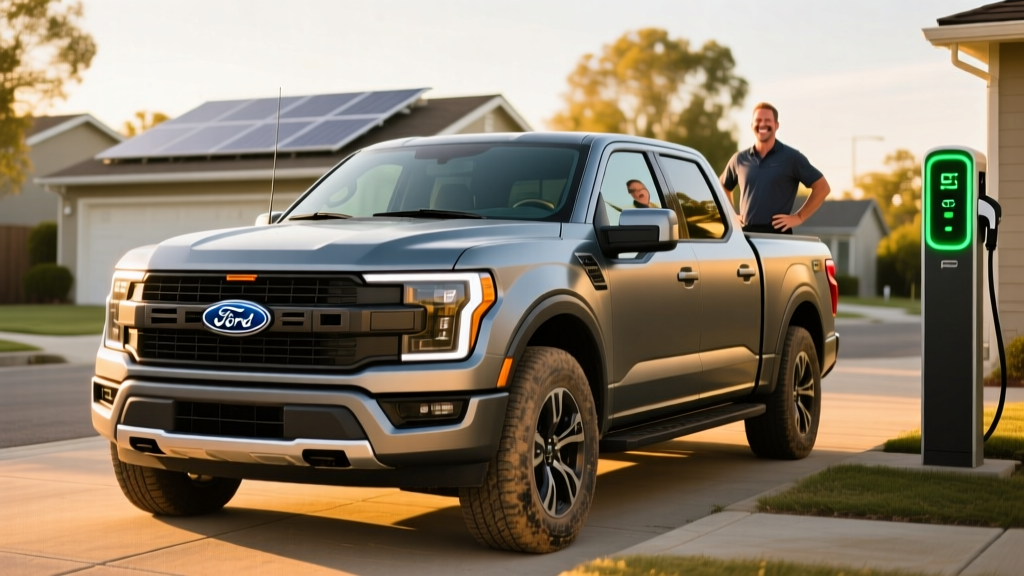
For home charging, the optional 80-amp Ford Charge Station Pro is a genuine advantage. If your electrical panel supports a 100-amp dedicated circuit, you can add roughly 30 miles of range per hour overnight — enough to fully replenish even the Extended Range pack while you sleep. Installation costs for an 80-amp circuit typically run $1,500–$3,500 depending on panel upgrades and conduit length. A standard 48-amp Level 2 setup on a 60-amp circuit is more common and costs $800–$2,000 installed.
Performance, Payload, and the Towing Question
The Lightning's dual-motor all-wheel-drive powertrain delivers supercar-rivaling acceleration in a full-size pickup. The Extended Range model's 3.8-second 0–60 mph time is genuinely thrilling for a vehicle with a 5.5-foot bed and 6,500-pound curb weight. Standard four-wheel independent rear suspension gives it surprisingly composed on-road manners — noticeably smoother over pavement imperfections than a live-axle gas F-150.
Payload capacity maxes at 2,235 pounds on Standard Range models (the lighter battery helps here). The Extended Range model sacrifices some payload — rated at 1,800 pounds — to carry its 3,000-pound battery pack.
Towing is where the Lightning demands honesty. While Ford rates it at 10,000 pounds (with the Max Trailer Tow package on XLT and Lariat trims), towing anywhere near that limit crushes range. Real-world testing shows 100–150 miles of range when towing 7,000–9,000 pounds at highway speeds. For frequent heavy towing, a diesel or hybrid F-150 remains more practical unless your route is well-served by DC fast chargers — and even then, charging stops with a large trailer attached are logistically awkward at most stations.
The Pro Power Onboard system deserves special mention: available in 2.4 kW or 9.6 kW outputs, it turns the Lightning into a mobile generator. The 9.6 kW version can power a job site's worth of tools, run a camper's appliances, or even back up essential home circuits during an outage (with the proper transfer switch installation). This feature alone justified the purchase for many commercial buyers.
Interior, Cargo, and Tech Features
Inside, the Lightning inherited the F-150's spacious cabin with a few EV-specific upgrades. The 15.5-inch vertical touchscreen (SYNC 4A) on Lariat and Platinum trims is visually impressive, though the interface can feel cluttered compared to Tesla's minimalism or Rivian's cleaner layout. Lower trims get a 12-inch horizontal display that's more conventional and arguably easier to use while driving.
| Dimension | Measurement |
|---|---|
| Front Legroom | 43.9 inches |
| Rear Legroom | 43.6 inches |
| Bed Length | 67.1 inches (5.5 ft) |
| Bed Volume | 52.8 cu ft |
| Front Trunk (Frunk) | 14.1 cu ft (400 lbs capacity) |
| Total Cargo Volume (bed + frunk) | 66.9 cu ft |
The 14.1-cubic-foot mega power frunk is the Lightning's party trick. With 400 pounds of load capacity, a drainable floor, and multiple power outlets, it's a lockable, weatherproof cargo area that no gas truck can match. Owners routinely use it for groceries, tools, or as a cooler for tailgating.
On the driver-assistance front, Ford's BlueCruise hands-free driving system is available on pre-mapped divided highways. It's a solid SAE Level 2 system — meaning the driver must remain attentive and a camera monitors your eyes. It handles lane centering and adaptive cruise competently, but it is not autonomous driving. Coverage maps have expanded significantly, but rural two-lane roads and construction zones still require full manual control.
Notable drawbacks include the absence of a rear trunk pass-through (unlike the Rivian R1T's Gear Tunnel), the relatively small 5.5-foot bed (no 6.5-foot option), and rear-seat comfort that, while spacious, doesn't recline as much as some competitors.
Pricing, Tax Credits, and the Retirement Discount
As Ford winds down production, remaining 2024 and 2025 Lightning inventory is subject to significant dealer discounts. Original MSRPs ranged widely across trims:
| Trim | Base MSRP | §30D Federal Credit Potential | Effective Price |
|---|---|---|---|
| Pro (Standard Range) | $54,995 | Up to $7,500* | ~$47,495 |
| XLT (Standard Range) | $59,995 | Up to $7,500* | ~$52,495 |
| Lariat (Extended Range) | $74,995 | Up to $7,500* | ~$67,495 |
| Platinum (Extended Range) | $96,874 | Up to $7,500* | ~$89,374 |
*Federal EV tax credit eligibility under IRS §30D depends on multiple requirements:
- MSRP cap: Trucks/vans/SUVs must have an MSRP at or below $80,000 (Platinum trim exceeds this and is ineligible)
- Buyer income cap: AGI must not exceed $150,000 (single), $225,000 (head of household), or $300,000 (joint)
- Battery sourcing: Critical minerals and battery components must meet phased-in domestic/free-trade sourcing thresholds that tighten annually through 2026
- Point-of-sale transfer: Eligible buyers can transfer the credit to the dealer for an immediate price reduction at purchase
The Platinum trim's MSRP above $80,000 disqualifies it from the federal credit entirely. Pro, XLT, and Lariat trims fall under the cap, but battery-sourcing compliance should be verified at the point of sale — Ford has generally met sourcing requirements, but rules tighten each year. Always confirm with your dealer and consult a tax professional before relying on credit eligibility.
Lightning vs. the Competition: Is It Still Worth It?
With the Lightning exiting the stage, how does it compare to electric trucks you can still buy new in 2026?
- Pro Power Onboard (9.6 kW) is unmatched for job-site and home backup use
- Massive 14.1 cu ft frunk with 400-lb capacity
- Familiar F-150 ergonomics and dealer network for service
- Smooth independent rear suspension ride quality
- Strong dealer discounts on remaining inventory
- BlueCruise hands-free highway driving available
- 150–155 kW DC fast charging is slow vs. 2026 competitors (Silverado EV: 350 kW)
- Real-world highway range ~250 mi (Extended Range) — below EPA sticker
- Towing decimates range to 100–150 miles
- Short 5.5-foot bed only; no 6.5-foot option
- CCS1 connector requires adapter for Tesla Superchargers
- Retirement creates uncertainty about long-term parts and software support
Choose the Lightning if: You value Pro Power Onboard for work or backup power, want a comfortable daily-driver truck with a massive frunk, can charge at home overnight, and find a well-discounted remaining unit at a good price. The familiar F-150 platform and Ford's extensive dealer network provide service peace of mind even as production ends.
Look elsewhere if: You need fast DC charging for frequent road trips, regularly tow heavy trailers long distances, want the latest battery and charging technology, or prefer a vehicle still in active production for guaranteed long-term parts availability. The Chevrolet Silverado EV, Rivian R1T, and Tesla Cybertruck all surpass the Lightning in charging speed, and Ford's own next-gen electric truck (expected 2027) will likely leapfrog it in every metric.
Warranty and Long-Term Ownership Outlook
Ford backs the Lightning's high-voltage battery and electric powertrain components with an 8-year/100,000-mile warranty, covering defects and capacity loss below 70% of original capacity. The basic vehicle warranty is 3 years/36,000 miles, with a 5-year/60,000-mile powertrain warranty on non-high-voltage components.
The retirement raises legitimate questions about long-term support. Ford has committed to honoring all warranties and maintaining parts supply, as it does for all discontinued models under federal regulations. However, as the fleet ages and production tooling is repurposed, certain Lightning-specific body panels, trim pieces, and proprietary components may become harder to source after the typical 10-year parts-support window. Current owners should not panic — but it's a factor for anyone buying a Lightning expecting 15+ years of easy serviceability.
Ford's next-generation electric truck, expected around 2027 on a dedicated EV platform, is the company's long-term answer. Until then, the Lightning remains a capable but aging pioneer — a truck that proved electric pickups could work, even if it won't be the one to perfect them.
Frequently Asked Questions
What is the real-world range of the Ford F-150 Lightning?
The Extended Range Lightning delivers an EPA-estimated 320 miles, but real-world highway driving at 70+ mph typically yields 250–275 miles. In cold weather below freezing, expect 190–220 miles. The Standard Range model's EPA 240 miles translates to roughly 180–200 miles in highway or cold-weather conditions.
How fast does the F-150 Lightning charge?
On a DC fast charger, the Lightning peaks at 150–155 kW, taking approximately 41–44 minutes to charge from 15% to 80%. At home on a 240V Level 2 charger, the 80-amp Ford Charge Station Pro delivers 19.2 kW (about 30–35 miles per hour), while a standard 48-amp unit provides 11.5 kW (about 20–25 miles per hour).
Does the F-150 Lightning qualify for the $7,500 federal EV tax credit?
Pro, XLT, and Lariat trims (MSRP at or below $80,000) can qualify for up to $7,500 under IRS §30D, provided the buyer meets income caps ($150K single / $300K joint) and the vehicle meets battery-sourcing requirements. The Platinum trim (MSRP above $80,000) does not qualify. Always verify current-year rules on irs.gov and consult a tax professional.
Is the F-150 Lightning still worth buying now that production is ending?
If you find a well-discounted remaining unit and your use case fits — primarily home-charged commuting, job-site power needs via Pro Power Onboard, and occasional light towing — the Lightning remains a capable truck. However, if you need fast road-trip charging, heavy towing range, or long-term parts certainty, consider the Rivian R1T, Chevrolet Silverado EV, or wait for Ford's next-gen electric truck expected in 2027.
What happens to warranty coverage after Ford discontinues the Lightning?
Ford is legally obligated to honor all existing warranty coverage — including the 8-year/100,000-mile battery warranty — regardless of production status. Parts availability for Lightning-specific components may diminish over the 10–15 year horizon, but consumables and shared F-150 parts will remain plentiful.