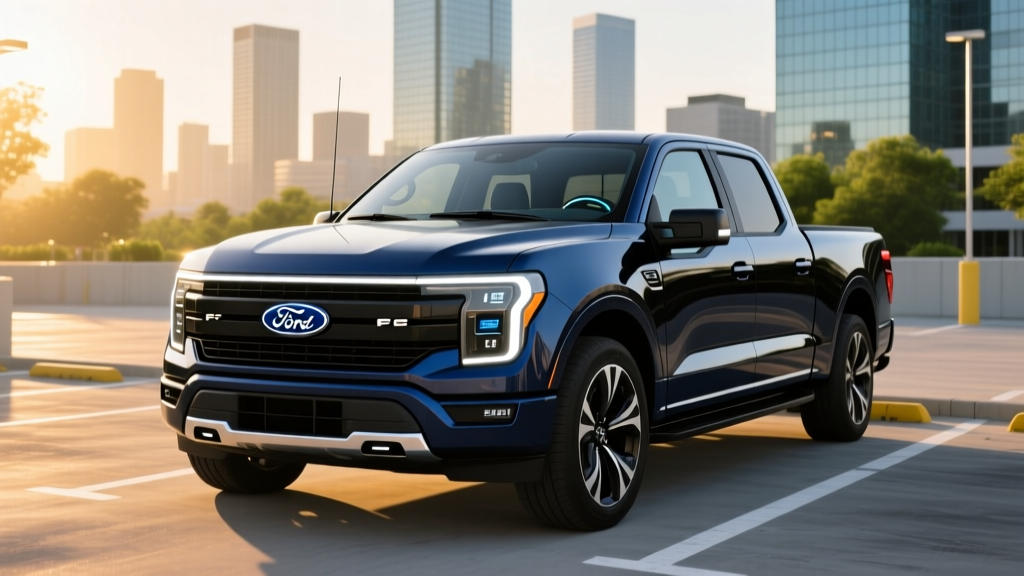
If you're researching Ford's new electric truck, you're likely looking at the 2026 F-150 Lightning — the only all-electric full-size pickup Ford currently sells. The quick answer: it offers 230 to 320 miles of EPA-estimated range depending on battery pack, tows up to 10,000 lbs, and costs roughly $5,000–$8,000 less to fuel and maintain over five years compared to a gas F-150 — but only if you have reliable home charging access. Base pricing starts near $55,000 before incentives, and real-world highway range drops 15–25% below the EPA sticker, especially in cold climates or when towing.
Quick Verdict: Is Ford's New Electric Truck Worth It?
Buy it if: You have Level 2 home charging, drive under 250 miles daily, want a work-capable truck with low running costs, and value the frunk and V2L/V2H power features.
Skip it if: You regularly tow over 7,000 lbs on long trips, live in an apartment without charging access, or need consistent 300+ mile range in sub-freezing winters.
2026 F-150 Lightning: Range, Battery & Charging Specs
The 2026 F-150 Lightning comes in two battery configurations. Understanding the difference between kWh (battery energy capacity — think of it as the "tank size") and kW (charging power — the "pump speed") is essential before comparing trims.
| Spec | Standard Range | Extended Range |
|---|---|---|
| Battery Chemistry | NMC (Nickel Manganese Cobalt) | NMC |
| Usable Battery Capacity | ~98 kWh | ~131 kWh |
| EPA Range | 230 miles | 320 miles |
| Real-World Highway Range* | ~185–200 miles | ~260–280 miles |
| Cold-Weather Range (20°F)* | ~150–170 miles | ~210–240 miles |
| Peak DC Fast Charge Rate | ~150 kW | ~150 kW |
| 10–80% DC Fast Charge Time | ~41 minutes | ~41 minutes |
| Level 2 Home Charge Rate | 11.3 kW (32A) / 19.2 kW (80A) | 19.2 kW (80A) |
| Horsepower | 452 hp (dual motor) | 580 hp (dual motor) |
| 0–60 mph | ~5.0 sec | ~3.8 sec |
| Max Towing Capacity | 7,700 lbs | 10,000 lbs |
| Max Payload | 2,235 lbs | 1,800 lbs |
| Starting MSRP (Pro trim) | ~$55,000 | ~$70,000 |
| Battery Warranty | 8 years / 100,000 miles (≥70% capacity retention) | |
*Real-world estimates based on highway driving at 70 mph, moderate climate. Cold-weather figures reflect 20°F without garage preconditioning. Source: fueleconomy.gov and manufacturer data.
⚡ Real-World Range Reality Check
The EPA 320-mile Extended Range figure assumes a mix of city and highway driving at moderate temperatures. In practice, sustained 75 mph highway driving reduces range to roughly 260–280 miles. Towing a 5,000-lb trailer can cut range by 40–50%, dropping effective range to 150–180 miles. In sub-20°F weather without preconditioning, expect a 25–35% range reduction. Always plan road trips around 60–70% of the EPA sticker to maintain a safety buffer.
Charging at Home vs. Public Networks: What Lightning Owners Face
Home charging is where the F-150 Lightning ownership experience is made or broken. The truck's large battery means Level 1 (120V) charging is impractical as a daily solution — adding only about 2–3 miles of range per hour, which means a full charge on the Extended Range pack would take over 50 hours.
| Level | Power (kW) | Miles of Range Per Hour | Full Charge Time (Extended Range) |
|---|---|---|---|
| Level 1 (120V) | ~1.4 kW | ~2–3 mi/hr | ~55+ hours |
| Level 2 (240V, 32A) | ~7.7 kW | ~16 mi/hr | ~17 hours |
| Level 2 (240V, 48A) | ~11.5 kW | ~24 mi/hr | ~11 hours |
| Level 2 (240V, 80A) | ~19.2 kW | ~40 mi/hr | ~7 hours |
| DC Fast Charge | Up to ~150 kW | ~150–200 mi in 30 min | 10–80% in ~41 min |
For the Extended Range pack, Ford recommends the 80A Ford Charge Station Pro for optimal overnight charging. This requires a 100-amp dedicated circuit — which means many homes will need an electrical panel upgrade.
| Item | Cost Range |
|---|---|
| Ford Charge Station Pro (80A) | $1,200–$1,300 |
| Electrician labor (standard install) | $800–$2,000 |
| Electrical panel upgrade (if needed, 200A service) | $2,000–$4,500 |
| Permit & inspection | $100–$400 |
| Total (no panel upgrade) | $2,100–$3,700 |
| Total (with panel upgrade) | $4,100–$8,200 |
Costs vary by region and home electrical configuration. Always get a quote from a licensed electrician before purchasing equipment.
Public DC fast charging is viable for road trips but not ideal as a primary strategy. The Lightning's ~150 kW peak charge rate is modest compared to competitors like the Rivian R1T or Hyundai Ioniq 5 (which peak above 200 kW). Expect the charge curve to taper significantly above 80% State of Charge — that last 20% can take as long as the first 70%. Plan road-trip stops to charge from 10–80% and move on rather than topping off.
F-150 Lightning vs. Gas F-150: 5-Year Cost of Ownership
The purchase price of Ford's new electric truck is higher than a comparably equipped gas F-150, but operating costs tilt the equation over time. Here's a realistic five-year comparison assuming 15,000 miles/year and national average energy/fuel prices.
| Cost Category | F-150 Lightning Ext. Range | F-150 Gas (2.7L EcoBoost, 4WD) |
|---|---|---|
| Base MSRP | ~$70,000 | ~$48,000 |
| Federal Tax Credit (§30D)* | Up to $7,500 | $0 |
| Home Charger Install | $3,000–$5,000 | $0 |
| Fuel/Energy (5 yrs, 75,000 mi) | $5,500–$8,000** | $13,000–$16,000 |
| Maintenance (5 yrs) | $1,500–$2,500 | $4,000–$6,000 |
| Insurance (5 yrs avg) | $10,000–$14,000 | $7,500–$10,000 |
| 5-Year Total (est.) | $83,000–$92,000 | $72,500–$80,000 |
| Cost Per Mile | ~$0.11–$0.14 (energy+maint) | ~$0.22–$0.29 (fuel+maint) |
*§30D credit eligibility depends on buyer income caps ($150K single / $300K joint), MSRP caps ($80K for trucks), and battery critical-mineral sourcing requirements. Rules are subject to change — verify at irs.gov before purchasing.
**Energy cost assumes 70% home charging at $0.16/kWh and 30% public DC at $0.40/kWh. Actual costs vary by utility rate and charging habits.
The Lightning's fuel and maintenance savings are substantial — typically $6,000–$10,000 over five years. However, the higher purchase price, charger installation, and insurance premiums (EVs cost roughly 15–25% more to insure due to repair complexity and parts costs) narrow the gap. The math works best if you qualify for the full §30D credit and charge primarily at home on cheap utility rates.
Federal Tax Credit & Incentive Reality for 2026
The §30D federal clean vehicle credit offers up to $7,500 for qualifying new EV purchases, but eligibility is not automatic. Here's the current checklist for the F-150 Lightning:
- MSRP Cap: Trucks must be under $80,000 MSRP — most Lightning trims qualify, but fully loaded Platinum/High trims may exceed this.
- Buyer Income Cap: Modified AGI must not exceed $150,000 (single), $225,000 (head of household), or $300,000 (joint filing).
- Battery Sourcing: The $7,500 credit is split into two halves — $3,750 for critical minerals and $3,750 for battery component assembly. Sourcing requirements tighten annually; check current compliance on the fueleconomy.gov tax credit page.
- Point-of-Sale Transfer: As of 2024, buyers can transfer the credit to the dealer for an immediate price reduction rather than waiting for a tax refund.
- Final Assembly: Must be assembled in North America (the Lightning is built in Dearborn, MI — qualifies).
State and local incentives may stack on top. Check your state's energy office or afdc.energy.gov for regional programs.
Common Misconceptions About Ford's New Electric Truck
| Myth | Fact |
|---|---|
| "It can't tow anything." | Max towing is 10,000 lbs (Extended Range) — competitive with many gas F-150 configs. However, towing at max capacity cuts range by 40–50%. |
| "The battery will need replacing in 5 years." | Ford warrants the battery for 8 years/100,000 miles at ≥70% capacity. Real-world data from 2022–2025 Lightnings shows ~5–8% degradation at 60,000 miles. Full replacement (if out of warranty) costs $15,000–$22,000. |
| "It's completely self-driving with BlueCruise." | BlueCruise is an SAE Level 2 driver-assistance system. It allows hands-free driving on pre-approved divided highways, but you must remain attentive and ready to take over immediately. It is not autonomous driving. |
| "I can just plug it into a regular outlet." | Level 1 (120V) adds ~2 miles/hour — insufficient for daily driving on the Extended Range pack. A Level 2 (240V) home charger is effectively mandatory. |
| "The frunk isn't practical." | The Mega Power Frunk offers 14.1 cu ft of lockable, drainable storage with 400 lbs payload capacity — genuinely useful for tools, groceries, or gear. |
🛡️ BlueCruise Is Not Self-Driving
Ford's BlueCruise (available on select Lightning trims) is an SAE Level 2 system. It provides hands-free steering, acceleration, and braking on mapped divided highways — currently over 130,000 miles of approved roads in the US and Canada. However, the driver must remain engaged, eyes on the road (monitored by a driver-facing camera), and ready to resume control at any time. This is fundamentally different from Level 4 robotaxi services like Waymo, which operate without any human driver. Never treat BlueCruise as a substitute for attentive driving.
Who Should Buy Ford's New Electric Truck? A Decision Framework
F-150 Lightning Purchase Decision Guide
✅ BUY the Lightning if:
- You have (or can install) a 240V Level 2 home charger — ideally a 48A or 80A circuit.
- Your daily driving is under 200 miles, with occasional 250–300 mile road trips.
- You want low per-mile operating costs (~$0.04–$0.06/mile energy with home charging).
- You value instant torque (580 hp Extended Range), near-silent operation, and the front trunk.
- You can use V2H (Vehicle-to-Home) backup power — the Lightning can supply up to 9.6 kW to your home during outages with the Ford Intelligent Backup Power system.
- You qualify for the §30D credit, reducing effective price by up to $7,500.
❌ SKIP the Lightning (or consider alternatives) if:
- You live in an apartment or rental without Level 2 charging access and rely on public infrastructure.
- You regularly tow 7,000+ lbs over long distances (range drops to 150–180 miles, requiring frequent 40-minute charge stops).
- You live in a region with extreme cold (sustained sub-10°F) and need reliable 250+ mile range year-round.
- You need a sub-$45,000 truck — the Lightning starts near $55,000 even before adding a home charger.
- Your utility charges above $0.25/kWh with no off-peak discount, eroding the fuel-cost advantage.
🔄 CONSIDER the Ford Maverick Hybrid or F-150 PowerBoost Hybrid if:
- You want truck utility without range or charging concerns.
- The Maverick Hybrid delivers 42 MPG combined city and starts under $30,000 — a strong value play for lighter-duty needs.
- The F-150 PowerBoost Hybrid offers 25 MPG combined, 12,000 lbs towing, and no charging dependency.
First-Time EV Buyer: What to Know Before Ordering a Lightning
If the F-150 Lightning will be your first electric vehicle, here are the practical ownership realities that spec sheets don't highlight:
- Preconditioning matters. Use the FordPass app to precondition the battery while plugged in before a DC fast-charge stop. A warm battery charges significantly faster — skipping preconditioning in cold weather can add 15–20 minutes to a 10–80% charge session.
- The charge curve is not linear. The Lightning peaks at ~150 kW only at low State of Charge (roughly 10–30%). From 50–80%, the rate tapers to 60–80 kW. Above 80%, it drops further. This is normal battery physics, not a defect — but it means "150 kW peak" does not mean 150 kW sustained.
- Plan for winter. Battery efficiency drops in cold weather due to cabin heating demands and electrochemical limitations. Garage parking and preconditioning mitigate this. If you live in Minnesota or Montana, budget 30% range loss into your daily planning.
- Tire costs are higher. The Lightning is heavy (~6,500 lbs for Extended Range) and delivers instant torque. Expect tire wear 15–25% faster than a gas F-150. Budget $1,200–$1,800 for a set of replacement tires every 30,000–40,000 miles.
- Insurance shopping is essential. Get quotes before ordering. EV insurance premiums average 15–25% higher than equivalent gas vehicles. Companies like Geico, Progressive, and USAA vary widely on EV pricing — shop at least three quotes.
- Public charging reliability varies. Networks like Electrify America and EVgo have improved, but downtime and broken stalls remain a reality. Apps like PlugShare and A Better Routeplanner help you identify reliable stations before trips.
Frequently Asked Questions
Does the 2026 F-150 Lightning qualify for the $7,500 federal tax credit?
Most trims do, but eligibility depends on your income (under $150K single / $300K joint), the truck's MSRP (under $80K for trucks), and battery mineral/component sourcing compliance. The credit can now be transferred to the dealer at point of sale for an immediate price reduction. Verify current eligibility on irs.gov before purchasing, as sourcing rules tighten annually.
How long does it take to charge the F-150 Lightning at home?
With the 80A Ford Charge Station Pro on a 100-amp circuit, the Extended Range pack charges from empty to full in roughly 7 hours — easily overnight. With a 48A charger, expect about 11 hours. Level 1 (standard 120V outlet) is not practical for daily use on the large battery, adding only ~2 miles per hour.
What happens to the F-150 Lightning battery after the warranty expires?
Ford's battery warranty covers 8 years or 100,000 miles with at least 70% capacity retention. Real-world data suggests NMC batteries in the Lightning degrade roughly 1.5–2% per year under normal use. At 150,000 miles, expect roughly 85–90% of original capacity. A full battery replacement out of warranty currently costs $15,000–$22,000 depending on pack size and labor — a significant but unlikely expense in the truck's first decade.
Can the F-150 Lightning power my house during an outage?
Yes, with the Ford Intelligent Backup Power system (requires the 80A Charge Station Pro and a home transfer switch, professionally installed). The Lightning can supply up to 9.6 kW of continuous power — enough to run essential circuits (refrigerator, lights, HVAC fan, well pump) for 3–7 days depending on usage and battery State of Charge. Total installation for V2H capability adds $3,000–$5,000 to your charger setup.
Is the Lightning a good truck for towing long distances?
It's capable but requires planning. Max towing is 10,000 lbs, and the truck handles trailers well thanks to instant torque and a low center of gravity. However, towing at 5,000+ lbs cuts range by 40–50%. On a 300-mile trip with a heavy trailer, expect 2–3 DC fast-charge stops of 30–40 minutes each. If you tow long distances weekly, a diesel or hybrid truck may be more practical.
How does the F-150 Lightning compare to the Rivian R1T or Chevy Silverado EV?
The Lightning prioritizes value and familiarity — it drives like a traditional F-150 and starts lower than the Rivian R1T (~$70,000 base). The R1T offers more range (up to 410 miles with Max pack), faster charging (~200+ kW peak), and a more adventure-oriented design, but at a premium. The Chevy Silverado EV offers up to 440 miles of EPA range (400-mile Ultium pack) and faster DC charging but is larger and heavier. The Lightning remains the most mainstream, dealership-serviceable option of the three.