Quick Verdict: The Platinum Lightning's Place in the Electric Truck Market
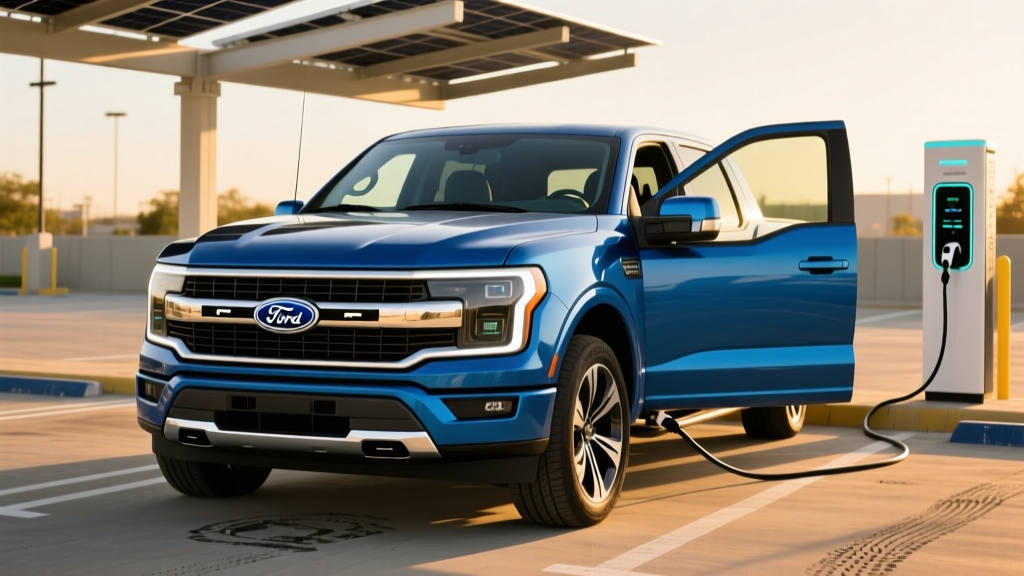
The Ford F-150 Lightning Platinum sits at the top of Ford's electric truck lineup, pairing a 131 kWh usable NMC battery with dual-motor all-wheel drive, 580 horsepower, and a $96,875 starting MSRP for the 2025 model year (pricing carries into 2026 production). It is the most luxurious, most tech-laden Lightning you can buy — and also the heaviest, which has direct consequences for real-world range, charging speed, and efficiency that every buyer should understand before signing.
This is not a stripped-down fleet truck. The Platinum trim targets buyers who want premium leather, Ford's largest infotainment screen, hands-free highway driving, and a 2,000-pound max payload with 7,700-pound towing capacity — all without visiting a gas station. But at nearly 7,000 pounds curb weight, physics is the Platinum's real competitor. Below, we break down every number that matters.
Range, Efficiency, and the Real-World Reality Check
The F-150 Lightning Platinum with the Extended Range battery pack carries an EPA-estimated 320 miles of range. That figure comes from the larger 131 kWh usable battery (NMC chemistry), which Ford pairs exclusively with the Platinum trim — the smaller Standard Range 98 kWh pack is reserved for lower trims.
EPA estimate: 320 miles (combined city/highway)
Highway-heavy driving (70-80 mph): Expect 250–280 miles. The Platinum's 6,800+ lb curb weight and boxy aerodynamic profile penalize highway efficiency significantly.
Cold weather (below 32°F): Expect 210–250 miles. NMC chemistry loses roughly 20–30% range in freezing temperatures, compounded by cabin heating demands.
City/regenerative driving: 300–330 miles possible. Regen braking recovers energy in stop-and-go traffic.
Towing (loaded trailer): 130–180 miles depending on trailer weight and terrain. Always plan conservatively.
The EPA rates the Lightning Extended Range at 70 MPGe combined (city 78 / highway 63), which translates to roughly 48 kWh per 100 miles — one of the highest energy-consumption figures among mainstream EVs. For context, a Tesla Model Y consumes about 28 kWh/100mi. The difference is mass: moving 6,800 pounds requires substantially more energy, especially at speed.
| Spec | Value |
|---|---|
| EPA Range | 320 miles (Extended Range) |
| Battery (usable) | 131 kWh, NMC chemistry |
| MPGe (combined) | 70 MPGe / 48 kWh/100mi |
| Peak DC Fast Charge | 150 kW |
| 10–80% DC Charge Time | ~41 minutes |
| Level 2 Home Charge Rate | 19.2 kW (80A) / ~14 mi/hr |
| Horsepower | 580 hp / 775 lb-ft torque |
| 0–60 mph | ~3.8 seconds |
| Drivetrain | Dual-motor AWD |
| Max Payload | 2,000 lbs |
| Max Towing | 7,700 lbs (w/ Max Trailer Tow Pkg) |
| Base MSRP (Platinum) | $96,875 |
| Battery/Powertrain Warranty | 8 years / 100,000 miles |
Charging Speed: DC Fast, Home Level 2, and the Charge Curve
The Lightning Platinum supports a peak DC fast-charge rate of 150 kW via its CCS connector. Ford quotes a 10–80% charge time of approximately 41 minutes at a compatible 150 kW or higher station. That number requires important context about the charge curve.
The 131 kWh Extended Range battery is massive — the largest in any mainstream electric truck. At 150 kW peak, the Platinum charges more slowly in absolute time than smaller-battery EVs like the Hyundai Ioniq 5 (which peaks at 240 kW and charges 10–80% in 18 minutes with a 77 kWh pack). The Lightning sustains roughly 120–140 kW through the middle of the charge curve before tapering sharply above 80% SoC. If you need a full charge on a road trip, plan for 55–65 minutes total including the taper.
| Level | Power (kW) | Miles Added per Hour | Notes |
|---|---|---|---|
| Level 1 (120V) | ~1.4 kW | ~2 mi/hr | Emergency/trickle only; full charge takes days |
| Level 2 (240V, 32A) | 7.7 kW | ~6 mi/hr | Standard mobile cord; overnight adds ~60 miles |
| Level 2 (240V, 48A) | 11.5 kW | ~9 mi/hr | Common wallbox; full charge in ~12 hours |
| Level 2 (240V, 80A) | 19.2 kW | ~14 mi/hr | Ford Charge Station Pro; full charge in ~8 hours |
| DC Fast Charge | 150 kW peak | — | 10–80% in ~41 min; CCS connector |
For home charging, the Platinum's onboard charger supports up to 19.2 kW (80 amps) when paired with Ford's Charge Station Pro on a dedicated 100-amp circuit. This is a significant advantage: most EVs cap at 11.5 kW (48A). At 19.2 kW, you can fully replenish the 131 kWh pack overnight in roughly 8 hours. The trade-off is installation cost — a 100-amp circuit often requires a panel upgrade in older homes, which can add $1,500–$3,500 to your electrical work. Always have a licensed electrician assess your panel capacity before purchasing.
One practical note: Ford includes Intelligent Range on the Lightning, which continuously recalculates your remaining range based on driving style, terrain, temperature, and payload — far more useful than a static guess-o-meter. On road trips, the built-in navigation will precondition the battery when a DC fast charger is set as your destination, warming the pack to optimize charge speed. Always use this feature; skipping preconditioning in cold weather can add 10–15 minutes to your charge stop.
Performance, Capability, and Daily-Drive Dynamics
The dual-motor AWD powertrain produces 580 horsepower and 775 lb-ft of torque, launching the Platinum from 0–60 mph in approximately 3.8 seconds. That is sports-car acceleration in a crew-cab pickup — and it never gets old, even at 6,800 pounds. The instant torque delivery makes merging onto highways effortless, and the low center of gravity (battery pack under the floor) keeps body roll surprisingly controlled for a truck this tall.
Payload capacity is rated at 2,000 pounds, and towing tops out at 7,700 pounds with the Max Trailer Tow Package. The Lightning's independent rear suspension (a first for the F-150 line) provides noticeably better ride quality than the solid rear axle on gas F-150s, especially when unloaded. The mega power frunk — a 14.1 cubic foot front trunk with 400 pounds of capacity — is genuinely useful for groceries, tools, or gear you want to keep separate from the bed.
Interior dimensions match the SuperCrew gas F-150: 43.3 inches of front legroom, 43.6 inches rear legroom, and 66.7 inches of rear hip room. Five adults fit comfortably. Behind the rear seats, you get 52.8 cubic feet of cargo volume in the 5.5-foot bed. The Platinum's 15.5-inch portrait touchscreen running SYNC 4A dominates the dash and includes wireless Apple CarPlay and Android Auto, navigation with EV route planning, and over-the-air update capability.
The Platinum includes Ford BlueCruise, which enables hands-free driving on over 130,000 miles of pre-mapped divided highways. BlueCruise is a SAE Level 2 system: you must remain attentive, and the driver-monitoring camera will issue warnings if your eyes leave the road. This is not autonomous driving. You are responsible for the vehicle at all times.
Pricing, Trims, and Federal Tax Credit Eligibility
The 2026 Ford F-150 Lightning Platinum starts at an MSRP of approximately $96,875 (including destination). Fully loaded with the Max Trailer Tow Package, mobile power cord upgrades, and accessories, expect an as-tested price near $102,000–$105,000.
The Platinum sits above the Lariat (~$69,995) and below the limited-edition Raptor-based trims. Ford's full Lightning lineup for 2026 includes the Pro (fleet/commercial), XLT, Lariat, and Platinum — all available with either the Standard Range (98 kWh, ~230 mi EPA) or Extended Range (131 kWh, ~320 mi EPA) battery, though the Platinum comes exclusively with Extended Range.
- Maximum credit: Up to $7,500 (if all requirements are met)
- MSRP cap: Trucks/vans/SUVs must have MSRP ≤ $80,000 — the Platinum at $96,875 exceeds this cap and does NOT qualify
- Buyer income cap: AGI ≤ $150,000 (single) / $300,000 (joint) / $225,000 (head of household)
- Battery sourcing: Critical minerals and battery components must meet phased-in domestic-content thresholds (increasing annually through 2030)
- Point-of-sale transfer: Eligible buyers can transfer the credit to the dealer for an upfront price reduction — but only if the vehicle itself qualifies
- Lower trims: The XLT and Lariat with Standard Range may fall under the $80,000 MSRP cap and could qualify — verify specific trim/build pricing against current IRS §30D rules
Rules are subject to change. Confirm eligibility with a tax professional before purchasing. Battery sourcing requirements tighten annually.
This is the critical pricing insight many buyers miss: the Platinum's MSRP puts it firmly above the $80,000 truck MSRP cap in the §30D tax credit rules. You will not receive the federal credit on this trim. If the tax credit is a deciding factor, you will need to step down to an XLT or Lariat build that stays under the cap — or explore your state's separate incentive programs, which have their own (often more generous) thresholds. Check fueleconomy.gov for the latest qualifying vehicle list.
Pros, Cons, and the Ownership Bottom Line
- 320-mile EPA range is among the longest of any electric truck
- 19.2 kW home charging (80A) — fastest in-class Level 2 acceptance
- 580 hp / 3.8-sec 0-60 with dual-motor AWD
- Massive 14.1 cu-ft front trunk (frunk) with 400-lb capacity
- BlueCruise hands-free highway driving included
- Independent rear suspension for superior ride quality
- Pro Power Onboard (up to 9.6 kW V2L) powers tools, camping gear, or home backup
- Full-size SuperCrew cabin — genuine 5-adult comfort
- 8-year/100,000-mile battery and powertrain warranty
- $96,875 MSRP exceeds §30D tax credit $80K cap — no federal credit
- 150 kW peak DC charging is slow vs. 800V competitors (Rivian, Hyundai)
- 48 kWh/100mi efficiency is poor; electricity costs add up on road trips
- Real-world highway range drops to 250–280 miles
- Cold-weather range loss of 20–30% is significant
- Towing range limited to 130–180 miles — requires careful trip planning
- 80A home charger requires 100-amp circuit — panel upgrade often needed
- CCS connector limits access to Tesla Supercharger network (without adapter)
- Insurance premiums run 15–25% higher than gas F-150 equivalents
Who Should Buy the F-150 Lightning Platinum?
The Platinum is the right truck for a specific buyer: someone who needs full-size pickup capability (crew cab, 5.5-foot bed, real towing), wants premium luxury features, has reliable home charging access (ideally a 240V/80A circuit), and primarily drives within a 200-mile daily radius with occasional longer road trips. It excels as a daily commuter that can also haul lumber on weekends and tow a boat to the lake.
It is not the right truck if you regularly tow heavy trailers long distances (towing range is a genuine limitation), if you live in an area with sparse DC fast-charging infrastructure, or if the $7,500 federal tax credit is essential to your purchase math. For those buyers, the Lariat Extended Range — which may qualify for the credit at a lower MSRP — or a Rivian R1T with its superior 800V charging architecture may be a better fit.
- You want the most range and power in a traditional full-size electric pickup
- Home charging is guaranteed (garage/driveway with 240V access)
- You value BlueCruise, Pro Power Onboard, and premium interior materials
- The $97K+ price point fits your budget without relying on the federal credit
- You need the $7,500 federal tax credit (look at XLT/Lariat builds under $80K)
- You frequently tow >5,000 lbs over long distances (range becomes impractical)
- You prioritize fastest possible DC charging (Rivian R1T peaks at 200+ kW on 800V)
- You lack home charging access and depend on public infrastructure
Battery Longevity, Warranty, and Degradation
Ford backs the Lightning's battery pack and electric powertrain with an 8-year / 100,000-mile warranty, guaranteeing the battery will retain at least 70% of its original capacity during that period. The 131 kWh NMC (nickel manganese cobalt) pack uses liquid thermal management to mitigate degradation — a critical feature for a battery this large operating across varied climates.
NMC chemistry offers higher energy density than LFP (lithium iron phosphate), which is why Ford uses it for the Extended Range pack. The trade-off is slightly faster long-term degradation and greater sensitivity to sustained high SoC. Best practice: charge to 80% for daily driving and reserve 100% charges for road trips. Ford's SYNC system lets you set a target charge limit to automate this. Based on industry data from similar NMC packs, expect roughly 8–12% degradation over 100,000 miles with normal use — well within the warranty threshold.
If you're concerned about out-of-warranty battery replacement, current estimates for the Extended Range pack run $20,000–$30,000 (parts and labor), though prices are expected to decline as battery manufacturing scales and module-level repairs become more common. Ford has not published official replacement pricing.
Frequently Asked Questions
What is the real-world range of the Ford F-150 Lightning Platinum?
The EPA estimates 320 miles combined, but real-world results vary significantly. In mixed city/highway driving at moderate temperatures, expect 280–310 miles. Highway-only driving at 75+ mph drops that to 250–280 miles. In freezing weather, plan for 210–250 miles. Towing a loaded trailer cuts range to 130–180 miles. Ford's Intelligent Range feature provides real-time adjustments based on your actual driving conditions, which is more reliable than the EPA sticker alone.
How fast does the F-150 Lightning Platinum charge at home and on the road?
On a DC fast charger, the Platinum peaks at 150 kW and charges from 10–80% in approximately 41 minutes. At home, the onboard charger accepts up to 19.2 kW (80 amps) on a 240V circuit with Ford's Charge Station Pro, adding roughly 14 miles of range per hour and fully recharging the 131 kWh battery in about 8 hours. A standard 48A Level 2 charger delivers 11.5 kW and a full charge in roughly 12 hours. Level 1 (120V) trickle charging adds only about 2 miles per hour and is not practical for daily use with this battery size.
Does the F-150 Lightning Platinum qualify for the $7,500 federal EV tax credit?
No. Under current IRS §30D rules, trucks and SUVs must have an MSRP at or below $80,000 to qualify. The Platinum starts at $96,875, well above that cap. Lower Lightning trims — specifically the XLT and certain Lariat builds — may fall under the $80,000 threshold and could qualify, subject to buyer income limits ($150K single / $300K joint) and battery-sourcing requirements. Always verify current eligibility on irs.gov or with a tax professional before purchasing.
How does the Lightning Platinum compare to the Rivian R1T and Chevrolet Silverado EV?
The Rivian R1T offers faster DC charging (200+ kW on its 800V architecture), a more compact form factor, and qualifies for the federal tax credit on certain builds — but it has a smaller bed and less traditional truck capability. The Chevrolet Silverado EV (4WT and RST trims) offers up to 440 miles of EPA range on its largest battery, but its crew-cab/bed configuration is unconventional and pricing on the top RST exceeds the Lightning Platinum. The Lightning wins on traditional truck familiarity, dealer network access, and the practical frunk. The Rivian wins on charging speed and adventure-oriented design. The Silverado EV wins on maximum range.
Can the F-150 Lightning power my home during an outage?
Yes, with the available Ford Intelligent Backup Power system (requires the 80A Charge Station Pro and a home transfer switch, installed by a licensed electrician). The Lightning can supply up to 9.6 kW of continuous power through its Pro Power Onboard system, enough to run essential circuits — refrigerator, lights, HVAC blower, well pump — for approximately 3 days on a full 131 kWh charge, according to Ford's estimates. This V2H (vehicle-to-home) capability is a genuine differentiator for buyers in areas prone to grid outages.
What does it cost to charge the Lightning Platinum vs. fueling a gas F-150?
At the national average electricity rate of ~$0.17/kWh, fully charging the 131 kWh battery costs roughly $22.30 and provides about 320 miles — approximately $0.07 per mile. A gas F-150 averaging 20 MPG at $3.40/gallon costs $0.17 per mile. Home charging saves roughly 60% per mile. However, DC fast charging on road trips costs $0.35–$0.50/kWh at many networks, which can push per-mile costs above gasoline for those trips. Your savings depend heavily on your home electricity rate and how often you rely on public fast chargers.