Quick Verdict: The Lightning Still Anchors the Electric Truck Segment
The Ford F-150 Lightning remains the electric pickup benchmark for buyers who need a full-size bed, usable payload, and a charging network that actually works. With a starting MSRP near $55,000 and real-world highway range pushing 280 miles on the extended-range pack, the Lightning competes directly with the Rivian R1T and the Chevrolet Silverado EV. For 2026, Ford continues to refine the software stack and has expanded BlueCruise hands-free zones, but the core powertrain and battery architecture carry over.
For many buyers, a Ford F-150 Lightning lease is the most financially sound path into the truck: lower monthly payments, the ability to capture the federal EV tax credit via the point-of-sale lease pass-through, and an exit ramp before long-term battery degradation becomes a personal concern.
Range and Efficiency: EPA Numbers vs. Reality
EPA Range vs. Real-World Expectations
Standard Range (98 kWh usable, LFP): EPA 240 miles. Expect ~200–220 miles on the highway at 70 mph, and roughly 170–190 miles in sub-30°F winter conditions.
Extended Range (131 kWh usable, NMC): EPA 320 miles. Expect ~270–290 miles highway, and roughly 220–250 miles in cold weather with the heat pump engaged.
Ford equips the Standard Range Lightning with a lithium iron phosphate (LFP) battery. LFP cells are heavier and slightly less energy-dense than the nickel-manganese-cobalt (NMC) chemistry in the Extended Range pack, but they tolerate frequent 100% charges better and exhibit slower long-term degradation. If your daily commute is under 100 miles round-trip and you charge at home nightly, the LFP pack is arguably the more durable choice.
Efficiency on the Extended Range AWD model sits at approximately 66 MPGe combined (roughly 49 kWh/100 mi) per EPA data on fueleconomy.gov. Towing a 5,000-lb trailer cuts range by 40–50%, a reality shared by every electric truck on the market.
Charging Speed and Home Setup
| Charging Level | Peak Power | Rate / Time |
|---|---|---|
| Level 1 (120V, 12A) | ~1.4 kW | ~2–3 miles per hour |
| Level 2 (240V, 48A) | 11.5 kW | ~19–23 miles per hour; 0–100% in ~10–14 hours |
| Level 2 (240V, 80A w/ Ford Charge Station Pro) | 19.2 kW | ~30 miles per hour; 0–100% in ~8 hours (Extended Range) |
| DC Fast Charge (Standard Range) | 120 kW peak | 10–80% in ~44 minutes |
| DC Fast Charge (Extended Range) | 150 kW peak | 10–80% in ~41 minutes |
The Lightning uses the CCS1 connector on 2023–2025 models. For 2026, Ford has confirmed NACS adoption on new production, with a CCS-to-NACS adapter provided for backward compatibility at Electrify America and other CCS networks. Tesla Supercharger access is now standard for all Ford EVs via the built-in NACS port or included adapter.
The DC fast-charging curve on the Extended Range pack peaks at 150 kW up to roughly 40% SoC, then tapers to ~100 kW by 60% and ~50 kW above 80%. This taper is why the 10–80% metric matters far more than peak kW claims. Preconditioning the battery via the FordPass app before arriving at a DC station shaves 5–8 minutes off the session in cool weather.
Performance, Payload, and Towing
| Spec | Standard Range AWD | Extended Range AWD |
|---|---|---|
| Drivetrain | Dual-motor AWD | Dual-motor AWD |
| Horsepower | 452 hp | 580 hp |
| Torque | 775 lb-ft | 775 lb-ft |
| 0–60 mph | ~5.0 sec | ~3.8 sec |
| Max Payload | 2,235 lbs | 1,952 lbs |
| Max Towing (w/ Max Tow Pkg) | 7,700 lbs | 10,000 lbs |
The Lightning's dual-motor AWD is standard across all trims — no RWD option exists. The Extended Range model's 3.8-second 0–60 time places it firmly in performance-truck territory, rivaling the Raptor on acceleration while running silently. Pro Power Onboard (available in 2.4 kW or 9.6 kW configurations) turns the bed into a mobile generator capable of running job-site tools or powering a home during an outage via Ford Intelligent Backup Power.
Pricing, Trims, and the Lease-vs-Buy Tax Credit Question
| Trim | Base MSRP | Est. Lease (36 mo/10.5k mi) |
|---|---|---|
| Pro (Standard Range) | $55,090 | $450–$550/mo |
| XLT (Standard Range) | $60,090 | $550–$650/mo |
| Lariat (Extended Range) | $72,090 | $700–$820/mo |
| Platinum (Extended Range) | $91,090 | $900–$1,050/mo |
Does the F-150 Lightning Qualify for the Federal EV Tax Credit?
Under IRS §30D rules, the F-150 Lightning qualifies for up to $7,500 in federal tax credits, but eligibility hinges on three conditions (per IRS clean vehicle credit guidance):
- MSRP cap: The truck must have an MSRP at or below $80,000. This eliminates most Platinum and some Lariat Extended Range builds.
- Buyer income cap: Modified adjusted gross income must not exceed $150,000 (single), $225,000 (head of household), or $300,000 (joint).
- Battery sourcing: Critical minerals and battery components must meet phased-in North American sourcing thresholds that tighten each year through 2029.
The lease loophole: When you lease an EV, the $7,500 credit technically goes to the lessor (the financing company). Many lessors pass this savings through as a capitalized-cost reduction, effectively lowering your monthly payment regardless of your personal income or the truck's MSRP. This "commercial clean vehicle credit" pass-through under §45W has made leasing the Lightning an attractive option for buyers who exceed the §30D income caps or who want a Platinum trim that tops the $80,000 MSRP limit. Always confirm the pass-through in writing with the dealer's finance office before signing.
Cargo, Interior Space, and Daily Practicality
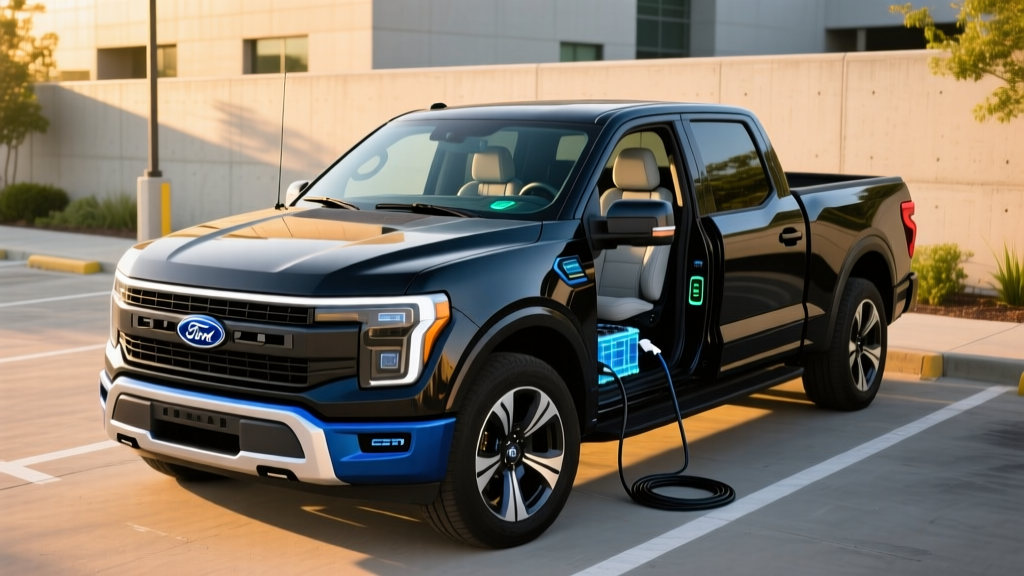
The Lightning retains the F-150 SuperCrew cab layout, offering seating for five with 43.6 inches of rear legroom — identical to the gas F-150. The 5.5-foot bed provides 52.8 cubic feet of cargo volume, and the front trunk (frunk) adds 14.1 cubic feet of lockable, weather-sealed storage with 400 lbs of payload capacity. The frunk alone is larger than the trunk of most midsize sedans and includes a drain plug for use as a cooler.
The 15.5-inch vertical touchscreen on Lariat and Platinum trims runs Ford's SYNC 4A system with wireless Apple CarPlay and Android Auto, over-the-air updates, and integrated Alexa. The Pro and XLT trims use a smaller 12-inch screen that is more glare-resistant and arguably easier to use while driving. BlueCruise hands-free driving is available on over 130,000 miles of divided highways, though it remains a SAE Level 2 system requiring active driver supervision.
Pros and Cons
Pros
- Full-size truck capability with genuine payload and towing numbers
- Pro Power Onboard (up to 9.6 kW) for job-site or home backup use
- Massive frunk with 400-lb capacity
- Access to Tesla Supercharger network via NACS
- LFP battery option (Standard Range) for long-term durability
- Lease pass-through can bypass §30D income and MSRP caps
Cons
- DC fast charging peaks at 150 kW — slower than the Silverado EV and Rivian R1T
- Extended Range pricing pushes past $80,000 MSRP cap on upper trims
- Highway range drops sharply when towing (expect 120–160 mi loaded)
- Heavy curb weight (~6,500 lbs) increases tire wear and braking distances
- BlueCruise requires a subscription after the trial period
Who Should Lease the F-150 Lightning?
The Lightning fits three buyer profiles especially well:
1. The home-charging commuter who occasionally tows. If you can install a Level 2 charger and your daily driving is under 150 miles, the Lightning's operating cost is dramatically lower than the gas F-150. Weekend towing within a 100-mile radius is manageable with route planning.
2. The job-site professional. Pro Power Onboard eliminates the need for a separate generator. The frunk stores tools securely, and the 9.6 kW onboard system can run welders, saws, and compressors directly from the truck's battery.
3. The lease-minded buyer who exceeds §30D income caps. The commercial credit pass-through on a lease makes the Lightning accessible to high-income buyers who would not qualify for the purchase credit, especially on higher-trim Extended Range models.
Warranty and Long-Term Ownership
Ford covers the Lightning's battery and electric powertrain for 8 years or 100,000 miles, whichever comes first, with a capacity-retention threshold of 70% of original capacity. The bumper-to-bumper warranty is 3 years/36,000 miles. For leased vehicles, the 36-month typical lease term means you will return the truck well within all warranty coverage periods — a significant risk-reduction advantage over buying for owners concerned about out-of-warranty battery replacement costs, which Ford estimates at $15,000–$25,000 depending on the pack.
Frequently Asked Questions
What is the real-world range of the F-150 Lightning?
The Extended Range model is EPA-rated at 320 miles, but expect 270–290 miles in mixed highway driving and 220–250 miles in freezing temperatures. The Standard Range LFP model delivers roughly 200–220 highway miles from its 240-mile EPA rating.
How fast does the F-150 Lightning charge at home and on the road?
On a 48-amp Level 2 home charger, the Lightning adds roughly 19–23 miles per hour. With Ford's 80-amp Charge Station Pro, that jumps to ~30 miles per hour. DC fast charging peaks at 150 kW (Extended Range), reaching 10–80% in about 41 minutes.
How much does a Ford F-150 Lightning lease cost after tax credits?
Lease payments vary by dealer, region, and credit tier. With the $7,500 federal credit passed through as a cap-cost reduction, expect roughly $550–$650/month for an XLT Standard Range and $700–$820/month for a Lariat Extended Range on a 36-month, 10,500-mile-per-year lease.
Is the F-150 Lightning worth leasing over the Rivian R1T or Silverado EV?
The Lightning offers the lowest starting price and the most traditional truck experience. The Rivian R1T is more off-road capable but starts ~$10,000 higher. The Silverado EV charges faster (up to 350 kW) but has a smaller dealer network and fewer trim options. If you need a proven full-size truck with broad service infrastructure, the Lightning is the safer lease.
Does the F-150 Lightning qualify for the federal EV tax credit?
Yes, up to $7,500 under IRS §30D, subject to buyer income limits ($300,000 joint), an $80,000 MSRP cap for trucks, and battery-sourcing requirements. Leasing can bypass the income and MSRP caps via the §45W commercial credit pass-through — confirm with your dealer's finance office.
Can I tow a travel trailer with the Lightning?
The Extended Range model with the Max Tow Package is rated for 10,000 lbs. However, towing a 7,000-lb trailer will cut range to roughly 120–160 miles depending on speed and terrain. Plan charging stops carefully and use the truck's built-in Intelligent Range estimator, which factors in trailer weight and route elevation.