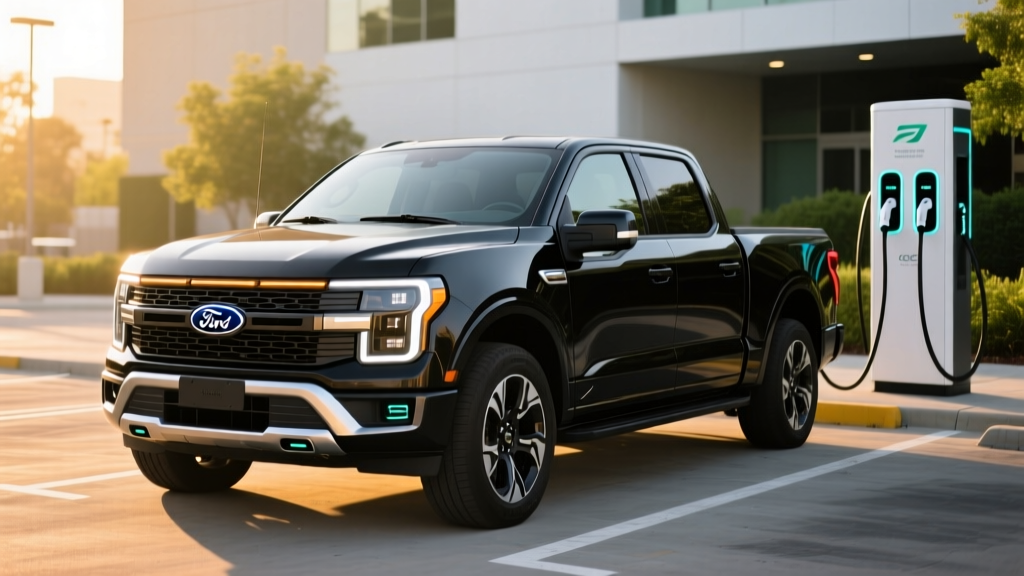
If you're hunting for Ford F-150 Lightning lease deals in 2026, you're not alone. Ford's full-size electric pickup remains one of the few EVs that can genuinely replace a gas truck for daily driving, job-site work, and family hauling — and leasing is often the smartest financial path into one. This review dissects the 2026 Lightning's specs, real-world range, charging behavior, pricing after federal incentives, and whether a lease beats buying outright.
2026 Ford F-150 Lightning: Key Specs at a Glance
| Spec | Standard Range | Extended Range |
|---|---|---|
| EPA Range | 230 miles | 320 miles |
| Battery Capacity | 98 kWh (usable), NMC | 131 kWh (usable), NMC |
| Peak DC Fast Charge | 150 kW | 150 kW |
| 10–80% DC Charge Time | ~36 min | ~41 min |
| Level 2 Home Charge Rate | 11.3 kW (~26 mi/hr) | 19.2 kW (~44 mi/hr) w/ 80A charger |
| Horsepower | 452 hp | 580 hp |
| 0–60 mph | ~5.0 sec | ~3.8 sec |
| Drivetrain | Dual-motor AWD | Dual-motor AWD |
| Max Towing | 7,700 lbs | 10,000 lbs |
| MPGe (Combined) | 78 MPGe | 70 MPGe |
| Efficiency | 43 kWh/100 mi | 48 kWh/100 mi |
Real-World Range: What the EPA Sticker Doesn't Tell You
EPA Estimate: 230 mi (Standard Range) / 320 mi (Extended Range)
Real-World Expectation: 190–210 mi highway for Standard Range; 260–290 mi highway for Extended Range. In sub-30°F weather, expect a 25–35% reduction from EPA figures, bringing the Extended Range model down to ~210–240 miles on a full charge.
The Lightning is a 6,000+ lb brick pushing through the air, and physics doesn't negotiate. At 75 mph on the interstate, the Extended Range model averages about 2.0–2.2 kWh/mile, which eats into the 131 kWh battery faster than city driving where regenerative braking recovers energy. If your daily commute is under 60 miles round-trip, either battery works fine. But if you regularly tow — say a 5,000-lb trailer — plan on range dropping to 100–130 miles on the Standard Range pack and 150–180 miles on Extended Range. Towing is where every electric truck shows its limits.
Charging Speed: DC Fast and Home Level 2
2026 Lightning Charging Levels
| Level | Power | Charge Rate | Notes |
|---|---|---|---|
| Level 1 (120V) | ~1.4 kW | ~2–3 mi/hr | Emergency/top-up only |
| Level 2 (240V, 32A mobile) | 7.7 kW | ~18 mi/hr | Included mobile charger; overnight use |
| Level 2 (240V, 48A wall unit) | 11.3 kW | ~26 mi/hr | Standard Range full in ~9 hrs |
| Level 2 (240V, 80A Ford Charge Station Pro) | 19.2 kW | ~44 mi/hr | Extended Range full in ~7 hrs; requires 100A circuit |
| DC Fast Charge | 150 kW peak | 10–80% in ~36–41 min | Tapers sharply above 85% SoC |
The Lightning peaks at 150 kW on DC fast chargers, which is competent but no longer class-leading. Competitors like the Rivian R1T and Chevrolet Silverado EV (with Ultium architecture) can accept 200+ kW. The practical implication: at a 150 kW Electrify America or Tesla Supercharger (with NACS adapter, now standard on 2026 models), the Extended Range pack adds roughly 120 miles of range in 20 minutes. The charge curve is relatively flat from 20–60% SoC, then tapers noticeably past 80%. For road trips, plan stops around the 70–80% mark rather than topping off — those last 20% can take as long as the first 60%.
At home, the 80A Ford Charge Station Pro is the gold standard for Lightning owners, but it demands a 100-amp dedicated circuit and a 200A (minimum) main service panel. Budget $1,200–$2,500 for professional installation depending on your panel's proximity to the garage. If your home has a 100A main panel, a panel upgrade to 200A will add $1,500–$3,000.
Performance and Drivetrain
Every 2026 F-150 Lightning comes with dual-motor all-wheel drive as standard — no base RWD model exists. The Standard Range powertrain delivers 452 hp and 775 lb-ft of torque, launching the truck to 60 mph in roughly 5.0 seconds. The Extended Range bumps output to 580 hp and the same 775 lb-ft, dropping the 0–60 sprint to about 3.8 seconds. For a truck that weighs over three tons, that acceleration is startling and genuinely useful for highway merging.
Ford's independent rear suspension (a first for the F-150 line) pays dividends in ride quality — the unloaded bed doesn't hop over bumps the way a solid-axle leaf-spring truck does. The trade-off: maximum payload is 2,235 lbs (Standard Range) and 1,952 lbs (Extended Range), lower than some gas F-150 configurations. If your work demands 3,000+ lbs of payload in the bed, you'll want to cross-shop the gas F-150 or the Silverado EV.
Pricing, Trim Levels, and Lease Deal Breakdown
2026 Ford F-150 Lightning Pricing by Trim
| Trim | Battery | Base MSRP | Est. Lease (36 mo / 10.5k mi/yr) | Federal Tax Credit (§30D) |
|---|---|---|---|---|
| Pro | Standard Range | $55,090 | ~$599–$699/mo | $7,500 (if eligible) |
| XLT | Standard Range | $63,090 | ~$699–$829/mo | $7,500 (if eligible) |
| Lariat | Extended Range | $77,090 | ~$849–$999/mo | $7,500 (if eligible) |
| Platinum | Extended Range | $96,090 | ~$1,049–$1,249/mo | $7,500 (if eligible) |
Lease payments vary significantly by region, dealer markup, money factor, and residual value. The figures above reflect estimated market averages for well-qualified buyers (Tier 1 credit) in early 2026. Ford Credit periodically offers lease cash incentives — typically $1,000–$3,000 — that can drop monthly payments by $30–$80/mo. Always check Ford's official Lightning page for current national offers and regional specials.
Federal Tax Credit: §30D Eligibility on Leases
Here's where leasing gets interesting. Under current IRS §30D rules, the F-150 Lightning qualifies for the full $7,500 federal tax credit — but only if you meet all criteria:
- MSRP Cap: Vans, SUVs, and pickup trucks have an $80,000 MSRP cap. The Pro and XLT trims qualify; the Lariat may qualify depending on options; the Platinum exceeds the cap.
- Income Limits: Modified AGI must not exceed $150,000 (single), $225,000 (head of household), or $300,000 (joint filers).
- Battery Sourcing: Critical minerals and battery components must meet phased-in domestic/free-trade sourcing thresholds. As of 2026, the Lightning's battery (assembled in Michigan with SK On) generally satisfies these requirements, but confirm with your dealer for the specific VIN.
- Point-of-Sale Transfer: You can transfer the credit to the dealer at purchase, reducing the sale price by $7,500 upfront — or apply it on your tax return.
Lease loophole: Under §45W (the commercial clean vehicle credit), the leasing company — not you — technically claims the credit. Most captive finance arms (including Ford Credit) pass this savings through as "lease cash" or a capitalized-cost reduction, effectively giving you the $7,500 benefit without needing to meet §30D income or sourcing requirements personally. This makes leasing the Lightning a particularly attractive path for buyers whose income exceeds §30D caps or who want to avoid sourcing-compliance uncertainty.
Cargo, Passenger Space, and the Mega Power Frunk
The Lightning retains the SuperCrew cab configuration, offering seating for five adults with 43.6 inches of front legroom and 43.6 inches of rear legroom. The rear seat is genuinely comfortable for long trips — not the cramped afterthought found in some midsize trucks.
Behind the rear seats, the 5.5-foot bed provides 52.8 cubic feet of cargo volume. The 6.5-foot bed option (available on Pro and XLT) bumps that to 65.2 cubic feet. But the headline feature is the Mega Power Frunk — a 14.1-cubic-foot front trunk where the engine bay used to live. It's lockable, weather-sealed, drainable (for use as a cooler), and includes four 120V outlets and two USB-C ports. For job-site use or tailgating, the frunk is a category-defining feature.
The Pro Power Onboard system turns the Lightning into a mobile generator. The base 2.4 kW system (Pro and XLT) provides two 120V bed outlets. The available 9.6 kW system (Lariat, Platinum) adds four 120V outlets and a 240V NEMA 14-50 outlet — enough to run power tools simultaneously, back up essential home circuits during an outage (with the Ford Intelligent Backup Power transfer switch), or even charge another EV in a pinch.
Tech, Driver Assists, and Drawbacks
The 2026 Lightning runs Ford's SYNC 4A infotainment on a 15.5-inch portrait touchscreen (12-inch on Pro trim) with wireless Apple CarPlay and Android Auto. The software supports over-the-air updates, and Ford has steadily improved the interface responsiveness since launch. The available BlueCruise hands-free driving system works on 130,000+ miles of pre-mapped divided highways — but make no mistake, this is SAE Level 2 driver assistance. You must keep your eyes on the road, and the system will not handle construction zones, unmapped roads, or complex interchanges autonomously.
Notable drawbacks:
- Charging speed (150 kW peak) trails rivals — the Silverado EV and Rivian R1T charge faster.
- Payload capacity (1,952–2,235 lbs) is lower than equivalent gas F-150 models.
- Extended Range models push past the §30D MSRP cap when optioned heavily.
- Real-world highway range on the Standard Range pack is tight for road trips exceeding 200 miles between chargers.
- Ford's build-quality consistency has drawn mixed owner reviews; panel gaps and 12V battery issues have been reported on earlier model years.
Who the F-150 Lightning Is For
Choose the Lightning if:
- You need a full-size truck bed and tow up to 10,000 lbs occasionally (not daily heavy towing).
- You have home Level 2 charging access and a daily commute under 150 miles.
- You value the frunk, Pro Power Onboard, and near-silent operation for job sites or suburban life.
- You want to leverage the lease §45W credit loophole to access $7,500 in savings without §30D income restrictions.
Look elsewhere if:
- You tow 8,000+ lbs daily over long distances — a diesel Super Duty is still the tool for that job.
- You live in a region with sparse DC fast-charging infrastructure and frequently road-trip beyond 250 miles.
- You need maximum payload (3,000+ lbs) for commercial work.
F-150 Lightning vs. Key Competitors
| Attribute | Ford F-150 Lightning (Ext. Range) | Rivian R1T (Dual-Motor Max) | Chevrolet Silverado EV (4WT) |
|---|---|---|---|
| EPA Range | 320 mi | 352 mi | 440 mi |
| Peak DC Charge | 150 kW | 200+ kW | 350 kW |
| 0–60 mph | 3.8 sec | ~3.5 sec | ~4.5 sec |
| Max Towing | 10,000 lbs | 11,000 lbs | 10,000 lbs |
| Starting MSRP | $55,090 | $79,900 | $55,000 (est.) |
| Bed Length | 5.5 ft / 6.5 ft | 4.5 ft (w/ Gear Tunnel) | 5.5 ft |
The Lightning wins on value and dealer accessibility. The Rivian R1T is more capable off-road and charges faster, but starts $25,000 higher and has limited service centers. The Silverado EV offers class-leading range and 350 kW charging, but its crew-cab-only layout and limited trim availability in 2026 make the Lightning the more accessible choice for most truck buyers today.
Warranty Coverage
Ford backs the Lightning with:
- Basic Vehicle: 3 years / 36,000 miles
- Powertrain: 5 years / 60,000 miles
- Battery: 8 years / 100,000 miles (retains ≥70% capacity)
- Corrosion Perforation: 5 years / unlimited miles
The 8-year/100,000-mile battery warranty is standard for the segment and aligns with EPA guidance on EV battery longevity. Ford's NMC chemistry has demonstrated moderate degradation in early-model-year Lightning packs — roughly 5–8% capacity loss over the first 50,000 miles based on owner-reported data. Regular DC fast charging and extreme heat exposure accelerate degradation; if you can charge primarily on Level 2 at home and set a daily charge limit of 80–90%, the battery should comfortably outlast the warranty period.
Pros
- Full-size truck capability with instant torque and AWD standard
- Mega Power Frunk is genuinely useful (14.1 cu ft, lockable, powered)
- Pro Power Onboard (up to 9.6 kW) replaces a job-site generator
- Competitive base pricing; lease loophole unlocks $7,500 credit broadly
- Quiet, smooth daily-driver experience unlike any gas truck
- Ford dealer network for service (2,800+ locations)
Cons
- 150 kW peak DC charging trails Rivian and Silverado EV
- Standard Range real-world highway range (~190–210 mi) limits road trips
- Payload lower than gas F-150 equivalents
- Heavy towing drastically cuts range (100–130 mi on Standard Range)
- Platinum trim exceeds $80k MSRP cap, ineligible for §30D credit
- Panel-gap and 12V battery complaints on earlier model years
Frequently Asked Questions
What is the real-world range of the 2026 F-150 Lightning?
The EPA rates the Extended Range model at 320 miles and the Standard Range at 230 miles. In real-world highway driving at 75 mph, expect 260–290 miles (Extended) and 190–210 miles (Standard). Cold weather below 30°F reduces these figures by 25–35%. Towing a trailer cuts range roughly in half.
How fast does the Lightning charge at home and on DC fast chargers?
On DC fast chargers, the Lightning peaks at 150 kW, reaching 10–80% in approximately 36–41 minutes depending on battery size. At home on a 240V Level 2 charger, the 80A Ford Charge Station Pro delivers 19.2 kW (~44 mi/hr), fully charging the Extended Range pack in about 7 hours. A standard 32A mobile charger provides roughly 18 mi/hr — sufficient for overnight top-ups if your daily driving is under 100 miles.
How much does a 2026 Lightning cost after tax credits?
The Pro trim starts at $55,090 MSRP. With the $7,500 federal credit applied (via purchase or lease pass-through), the effective price drops to ~$47,590 before destination, taxes, or dealer options. The XLT at $63,090 becomes ~$55,590 after credit. The Lariat and Platinum may exceed the $80,000 MSRP cap when optioned, disqualifying them from §30D — but leasing may still pass through savings via §45W commercial credit.
Is the Lightning worth buying vs. the Rivian R1T or Silverado EV?
If value, dealer accessibility, and the frunk/Pro Power Onboard features matter most, the Lightning is the strongest choice. If you prioritize maximum range (440 mi) and fastest charging (350 kW), the Silverado EV leads. If you want off-road capability, a Gear Tunnel, and don't mind a premium price, the Rivian R1T is the most adventurous option. For most truck buyers, the Lightning's price-to-capability ratio is hard to beat.
Does the F-150 Lightning qualify for the federal EV tax credit?
Yes — the Pro and XLT trims qualify for the full $7,500 under IRS §30D, provided the buyer meets income caps ($150k single / $300k joint) and the vehicle's battery satisfies critical-mineral and component-sourcing thresholds. The Lariat and Platinum may exceed the $80,000 MSRP cap for trucks. Leasing sidesteps §30D requirements entirely, as the leasing entity claims the commercial credit under §45W and typically passes savings through as a cap-cost reduction.
Can the Lightning power my home during an outage?
Yes, with the available Ford Intelligent Backup Power system (a home transfer switch installed by a licensed electrician) and the 9.6 kW Pro Power Onboard option. The Extended Range battery can power an average home's essential circuits for approximately 3–5 days, depending on load. This is a significant differentiator over gas trucks, which cannot provide home backup power without a separate generator.
The 2026 Ford F-150 Lightning occupies a unique position: it's the most accessible, dealer-supported, and work-capable electric pickup on the market, and current lease structures make it financially compelling even for buyers who wouldn't qualify for the purchase tax credit. If your use case aligns — suburban or job-site driving under 200 miles daily, home charging access, and occasional towing — the Lightning delivers a driving experience no gas truck can match, at a monthly cost that's increasingly competitive.