Quick Verdict: A Work Truck That Doubles as a Tech Lounge
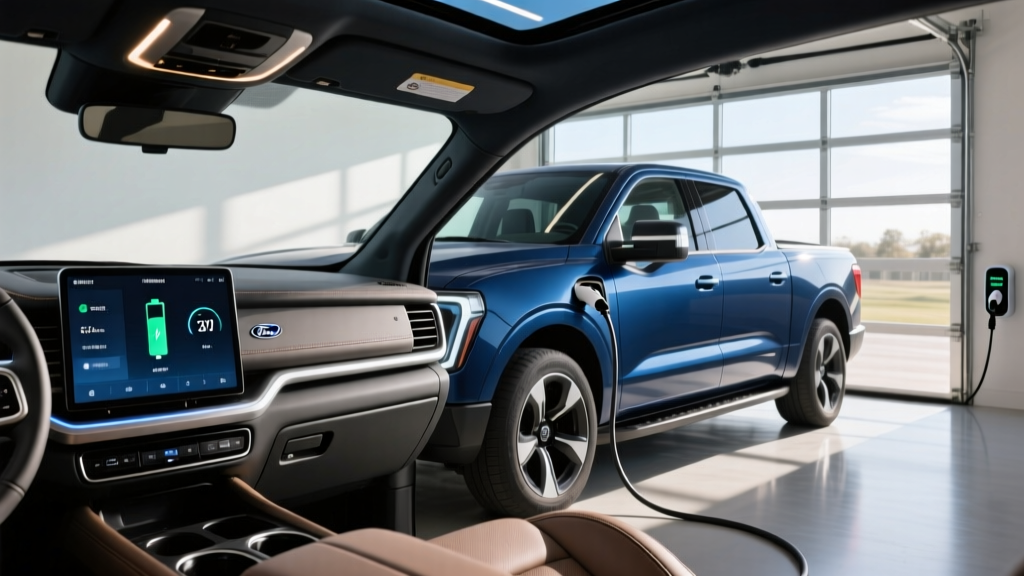
The Ford F-150 Lightning remains one of the most practical electric pickups on the market, and a big part of that story is what happens once you close the door. The Ford F-150 Lightning interior blends traditional truck utility with a massive digital cockpit, generous cabin space, and clever storage solutions that gas F-150s simply cannot match — starting with the 14.1-cubic-foot front trunk (frunk). For 2026, Ford continues to refine the Lightning with updated software, improved battery preconditioning for DC fast charging, and expanded BlueCruise hands-free zones.
But beyond the screens and the frunk, buyers need hard numbers: What is the real range on the highway? How fast does it actually charge? And does it still qualify for the federal tax credit? This review covers every spec that matters.
Ford F-150 Lightning Core Specs at a Glance
| Spec | Standard Range (SR) | Extended Range (ER) |
|---|---|---|
| EPA Range | 240 miles | 320 miles |
| Battery (usable) | 98 kWh (NMC) | 131 kWh (NMC) |
| Drivetrain | Dual-motor AWD | Dual-motor AWD |
| Horsepower | 452 hp | 580 hp |
| Torque | 775 lb-ft | 775 lb-ft |
| 0–60 mph | ~3.8 sec | |
| Max DC Fast Charge | 150 kW | 150 kW |
| 10–80% DCFC Time | ~36 min | ~41 min |
| Level 2 Home Charge | 11.3 kW (~22 mi/hr) | 19.2 kW (~38 mi/hr) w/ 80A charger |
| MPGe (combined) | 68 MPGe | 66 MPGe |
| Efficiency | 49 kWh/100 mi | 51 kWh/100 mi |
| Max Towing | 7,700 lbs | 10,000 lbs (w/ Max Trailer Tow) |
| Payload | ~2,235 lbs | ~1,952 lbs |
| Battery Warranty | 8 years / 100,000 miles (≥70% capacity retention) | |
The Ford F-150 Lightning Interior: Screens, Space, and the Mega Frunk
The headline feature inside the Lightning is the available 15.5-inch vertical touchscreen (standard on Lariat and above), running Ford's SYNC 4A system. It's the same portrait-oriented display found in the Mustang Mach-E, and it dominates the dashboard in a way that's both impressive and, frankly, a little overwhelming at first glance. Physical knobs and buttons remain for climate controls and volume — a welcome decision that keeps the cabin usable while driving.
Lower trims (Pro, XLT) come with a 12-inch touchscreen, which is still larger than what many competing trucks offer. Wireless Apple CarPlay and Android Auto are standard across all trims, along with wireless charging on Lariat and above.
Cabin Dimensions and Passenger Space
The Lightning is offered exclusively as a SuperCrew (four full doors), which means rear-seat space is genuinely generous:
- Front legroom: 43.9 inches
- Rear legroom: 43.6 inches
- Front headroom: 40.8 inches
- Rear headroom: 40.4 inches
- Rear hip room: 62.6 inches
Three adults can sit across the rear bench without complaint. The flat floor (no transmission tunnel) makes the middle seat far more usable than in a gas F-150.
The Frunk: 14.1 Cubic Feet of Bonus Storage
With no engine up front, Ford carved out a 14.1-cubic-foot Mega Power Frunk — lockable, weather-sealed, and equipped with four 120V outlets and two USB-C ports. It's rated to carry 400 pounds. In practice, this space swallows tool bags, groceries, or a full set of charging cables and still has room for a cooler. It's the single most practical differentiator between the Lightning and trucks like the Rivian R1T (which has a smaller front trunk) or the Chevrolet Silverado EV (which has a frunk but with less total volume).
Pro Power Onboard: Your Truck Is a Generator
Available Pro Power Onboard turns the Lightning into a mobile power source. The standard system offers 2.4 kW of output (via bed and frunk outlets), while the available 9.6 kW system adds a 240V NEMA 14-50 outlet in the bed — enough to run power tools at a job site, appliances during a blackout, or even a small welder. This feature alone has swayed commercial fleet buyers and homeowners in storm-prone regions.
Real-World Range: What the EPA Number Doesn't Tell You
Extended Range (EPA): 320 miles
Real-world highway (70–75 mph): Expect 250–275 miles. At sustained highway speeds, the Lightning's boxy aerodynamics and 6,500+ lb curb weight take a toll. Efficiency drops to roughly 2.0–2.2 mi/kWh on flat interstate.
Cold-weather impact (below 32°F): Range can drop 20–30%, putting real-world winter range for the ER model at roughly 220–250 miles. The Lightning uses a resistive heater on Standard Range trims; Extended Range trims get a heat pump, which helps mitigate cold-weather losses significantly.
Standard Range (EPA): 240 miles
Real-world highway: ~185–205 miles. This is adequate for daily commuting and short regional trips, but road-trippers should opt for the Extended Range battery.
Source: EPA fueleconomy.gov — Ford F-150 Lightning
Charging Speed: DC Fast Charging and Home Setup
Charging speed is where Lightning buyers need to set realistic expectations. The truck uses the CCS1 connector (Ford has announced future models will adopt NACS, but the current-generation Lightning uses CCS). Peak DC fast-charge rate is 150 kW — respectable but not class-leading. The Rivian R1T can accept up to 220 kW, and the Tesla Cybertruck peaks at 250 kW on V3 Superchargers.
| Charging Level | Power | Rate | Notes |
|---|---|---|---|
| Level 1 (120V) | ~1.4 kW | ~3 mi/hr | Emergency/trickle only |
| Level 2 (240V, 48A) | 11.3 kW | ~22 mi/hr | Standard home setup (Mobile Power Cord) |
| Level 2 (240V, 80A) | 19.2 kW | ~38 mi/hr | Ford Charge Station Pro; ER overnight full charge in ~8 hrs |
| DC Fast Charge | 150 kW peak | 10–80% in ~36–41 min | Rate tapers significantly above 80% SoC |
The Charging Curve Reality
The Lightning's charge curve peaks at 150 kW only at low states of charge (roughly 10–25% SoC). By 50% SoC, rates drop to approximately 100–110 kW, and above 80%, the rate falls below 40 kW. This is typical for large NMC battery packs but means your average charging speed over a 10–80% session is closer to 90–100 kW, not the 150 kW headline figure. Plan road-trip stops accordingly: a 30–40 minute stop gets you from 15% to about 80% on an Electrify America or EVgo 150+ kW station.
Home Charging Setup
The Ford Charge Station Pro (80A, hardwired) is the recommended home unit for Extended Range models and requires a 100-amp dedicated circuit. Expect installation costs of $1,200–$2,500 depending on panel proximity and whether your home's electrical panel needs an upgrade to 200A service. The 48A Mobile Power Cord (included) works on a standard NEMA 14-50 outlet and is sufficient for Standard Range owners who drive less than 100 miles daily.
Pricing, Trims, and Federal Tax Credit Eligibility
For 2026, the Ford F-150 Lightning lineup starts at $54,995 (Pro trim, Standard Range) and climbs to approximately $96,874 for a fully loaded Platinum Extended Range. Key trims:
- Pro SR: $54,995 — Fleet-oriented, 12-inch screen, basic cloth interior
- XLT SR: $59,995 — Most popular retail trim, adds alloy wheels, upgraded interior
- Lariat ER: $71,995 — 15.5-inch screen, leather, BlueCruise, premium audio
- Platinum ER: $96,874 — Fully loaded, massaging seats, BlueCruise 1.2
Does the F-150 Lightning Qualify for the §30D Federal Tax Credit?
Under current IRS rules for 2026, the F-150 Lightning may qualify for up to $7,500 in federal tax credits, but eligibility depends on several factors:
- MSRP cap: The Lightning qualifies as a truck/SUV, so the MSRP cap is $80,000. This means Pro, XLT, and most Lariat configurations qualify, but Platinum and heavily optioned Lariats above $80,000 do not.
- Buyer income cap: Adjusted gross income must not exceed $150,000 (single), $225,000 (head of household), or $300,000 (joint filers).
- Battery sourcing: The critical minerals and battery component requirements under §30D have tightened each year. Ford sources battery cells from SK On (with plants in Georgia and Kentucky), which helps meet domestic content thresholds, but exact credit amounts ($3,750 vs. $7,500) depend on the specific model year's sourcing compliance.
- Point-of-sale transfer: As of 2024, buyers can transfer the credit to the dealer at purchase, reducing the purchase price directly rather than waiting for a tax refund.
Always verify current eligibility on IRS.gov before purchasing, as sourcing requirements and qualifying VIN lists update periodically.
Performance and Driving Dynamics
The Lightning's dual-motor AWD powertrain delivers instant torque that makes this 6,500-pound truck feel genuinely quick. The Extended Range model's 3.8-second 0–60 mph time is sports-car territory and never stops being surprising from a full-size pickup. Even the Standard Range model at 5.0 seconds is faster than most gas V-8 F-150s.
Ride quality benefits from the independent rear suspension (a Lightning-specific upgrade over the gas F-150's solid rear axle). The truck is composed on pavement, quiet at highway speeds, and the low center of gravity (battery pack under the floor) reduces body roll compared to gas counterparts.
Towing: The Extended Range model with the Max Trailer Tow Package is rated for 10,000 pounds. However, towing heavy trailers cuts range dramatically — expect a 40–50% reduction, meaning roughly 160–190 real-world miles when pulling 8,000+ pounds. Ford's onboard range calculator adjusts estimates in real time when a trailer is connected, which helps with trip planning.
Driver Assistance and Smart Features
Ford BlueCruise is a Level 2 driver-assistance system. It provides hands-free driving on pre-mapped divided highways (over 130,000 miles of BlueCruise zones in North America as of 2026). The driver must remain attentive — an infrared camera monitors eye gaze and will issue warnings if you look away from the road. This is not autonomous driving. You are legally and operationally responsible for the vehicle at all times.
BlueCruise 1.2 (available on Lariat and standard on Platinum) adds lane-change assist and adaptive cruise with stop-and-go. It's competitive with GM's Super Cruise but requires more driver verification than Tesla's Autopilot. The system works well on long highway hauls — a genuine fatigue reducer on 400-mile road trips.
Standard safety features across all trims include Ford Co-Pilot360 2.0: automatic emergency braking, blind-spot monitoring, rear cross-traffic alert, lane-keeping assist, and reverse brake assist.
Pros and Cons
- Mega Power Frunk (14.1 cu ft) is the most useful front trunk in any EV truck
- Pro Power Onboard turns the truck into a 9.6 kW mobile generator
- Spacious SuperCrew cabin with flat rear floor and 43.6 inches of rear legroom
- Strong real-world towing capability with integrated range calculator
- Independent rear suspension gives better ride quality than gas F-150
- BlueCruise hands-free highway driving is genuinely useful on long trips
- Qualifies for up to $7,500 federal tax credit on trims under $80K MSRP
- 150 kW peak DC charging is slower than Rivian R1T (220 kW) and Tesla Cybertruck (250 kW)
- Highway range drops significantly — expect 250–275 miles from the 320-mile EPA ER model
- Cold-weather range loss of 20–30% is substantial in northern climates
- Curb weight exceeds 6,500 lbs — you feel it in corners and braking distances
- Platinum trim exceeds $80K MSRP cap, losing tax credit eligibility
- CCS connector (not NACS) limits Tesla Supercharger access without adapter
- Efficiency (49–51 kWh/100 mi) is poor compared to smaller EVs
Who Should Buy the Ford F-150 Lightning?
Choose the Lightning if: You need a full-size truck for work or towing, want the frunk and Pro Power Onboard for job-site or home-backup power, value a spacious cabin with the latest infotainment, and can charge at home most nights. The XLT Extended Range at ~$65,000 (before incentives) is the sweet spot for value.
Look elsewhere if: You need maximum road-trip charging speed (consider the Rivian R1T), want NACS/Supercharger access without an adapter, rarely need a truck bed (an SUV like the Hyundai Ioniq 9 is more efficient), or live in an area with sparse DC fast-charging infrastructure where the 150 kW peak rate becomes a bottleneck.
Frequently Asked Questions
What is the real-world range of the Ford F-150 Lightning?
The Extended Range model carries a 320-mile EPA estimate, but real-world highway driving at 70–75 mph typically yields 250–275 miles. In cold weather (below freezing), expect 220–250 miles. The Standard Range model's 240-mile EPA rating drops to roughly 185–205 miles on the highway.
How fast does the F-150 Lightning charge at home and on the road?
At home on a 240V/80A Ford Charge Station Pro, the Extended Range battery charges at 19.2 kW, adding about 38 miles of range per hour — a full charge takes roughly 8 hours. On a 150 kW DC fast charger, a 10–80% session takes about 36–41 minutes, though actual speed depends on battery temperature and state of charge.
Does the 2026 F-150 Lightning qualify for the $7,500 federal tax credit?
It can, provided the specific trim's MSRP is at or below $80,000 (truck/SUV cap), the buyer's income falls within IRS limits, and the battery meets current critical-mineral and component sourcing thresholds. Pro, XLT, and most Lariat configurations typically qualify. Always check the latest VIN eligibility list on fueleconomy.gov and IRS.gov before purchasing.
Is the F-150 Lightning worth buying over the Rivian R1T or Chevy Silverado EV?
The Lightning wins on interior space (SuperCrew cab vs. R1T's smaller cabin), frunk volume, Pro Power Onboard, and traditional truck familiarity. The Rivian R1T charges faster (220 kW), has a more adventurous off-road character, and offers a quad-motor option. The Chevy Silverado EV offers more range (up to 440 miles on the 4WT trim) but is larger, more expensive in upper trims, and has a less refined interior. For fleet buyers and homeowners who want a conventional truck experience with EV benefits, the Lightning remains the strongest all-around choice.
What is the battery warranty on the F-150 Lightning?
Ford covers the high-voltage battery and electric powertrain for 8 years or 100,000 miles, whichever comes first. The warranty guarantees at least 70% capacity retention over that period. Ford uses NMC (nickel-manganese-cobalt) chemistry in both battery sizes, supplied by SK On.
Can the F-150 Lightning power my home during an outage?
Yes, with the available 9.6 kW Pro Power Onboard and Ford's Home Integration System (a separate wall-mounted inverter, ~$3,895 plus installation), the Lightning can provide bidirectional power to your home's electrical panel during an outage — running essential circuits for up to three days depending on load. This is a Level 2 vehicle-to-home (V2H) feature, not full vehicle-to-grid (V2G).