Quick Answer: The Ford F-150 Lightning interior pairs a familiar truck cabin with EV-specific advantages: a massive 14.1-cubic-foot front trunk (frunk) with 400 lbs of payload capacity, up to 77.5 cubic feet of passenger volume, and Ford's SYNC 4A infotainment on a 12-inch (or available 15.5-inch) touchscreen. Material quality is durable but hard-plastic-heavy below the dash, and the flat floor creates generous rear legroom. The trade-off is a starting MSRP around $54,995 before incentives — roughly $10,000-$15,000 more than a comparably equipped gas F-150 — offset by lower fueling and maintenance costs over time.
Ford F-150 Lightning Interior at a Glance
The Lightning's cabin doesn't try to reinvent the truck interior. Instead, Ford leveraged the skateboard platform — where the battery sits beneath the floor — to unlock storage and space the gas F-150 simply cannot match. The most visible result is the Mega Power Frunk, but the flat floor also eliminates the transmission tunnel hump, giving rear passengers noticeably more footroom. Let's break down exactly what you get across the 2026 lineup.
| Spec | Value |
|---|---|
| Passenger Volume | 77.5 cu ft (SuperCrew) |
| Front Trunk (Frunk) Volume | 14.1 cu ft / 400 lbs max payload |
| Rear Legroom | 43.6 inches |
| Infotainment Screen | 12-inch standard; 15.5-inch (Platinum/Lariat available) |
| Digital Cluster | 12-inch configurable LCD |
| Standard Connectivity | Wireless Apple CarPlay & Android Auto, 5G Wi-Fi hotspot |
| Seating Capacity | 5 (SuperCrew) |
| Starting MSRP (Pro) | $54,995 |
| Battery Options | 98 kWh (Std Range) / 131 kWh (Ext Range), NMC |
| EPA Range | 240 mi (Std) / 320 mi (Ext) |
| Max DC Fast Charge | 150 kW (Std) / 155 kW (Ext), 10-80% in ~38-41 min |
| Powertrain Warranty | 8 years / 100,000 miles |
Source: Ford F-150 Lightning Specs, fueleconomy.gov
The Mega Power Frunk: 14.1 Cubic Feet of Bonus Storage
This is where the Lightning's interior story truly separates from the gas F-150. With no engine up front, Ford carved out a lockable, weather-sealed front trunk that holds 14.1 cubic feet — enough for two carry-on suitcases, a full set of groceries, or a couple of tool bags. The 400-pound payload rating means you can load it seriously, and the four built-in 120V outlets (two inside, two in the bed on higher trims) plus available USB-C ports turn it into a mobile workstation.
The frunk opens via key fob, the FordPass app, or the touchscreen, and it features a drain plug so you can hose it out after hauling muddy gear or ice for a tailgate. In practice, owners report using the frunk for daily grocery runs, secure tool storage on job sites, and as a cooler substitute during camping trips. It's the single most cited "why I went electric" feature among Lightning owners.
Infotainment and Digital Cockpit
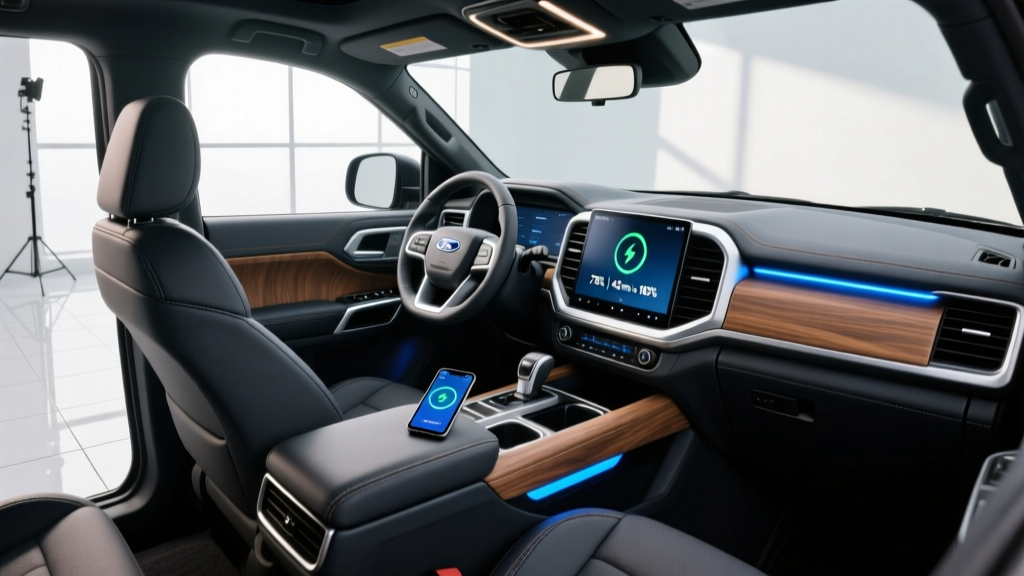
Ford's SYNC 4A system runs on the 12-inch landscape touchscreen standard on Pro and XLT trims, while the Platinum and available Lariat trims offer the portrait-oriented 15.5-inch display borrowed from the Mustang Mach-E. Both support wireless Apple CarPlay and Android Auto, over-the-air updates, and Ford's cloud-connected navigation with real-time charging station routing.
The 12-inch digital instrument cluster is standard across all trims and displays EV-specific data: remaining range, energy flow, regen braking intensity, and a "distance to empty" graphic that adjusts dynamically based on your recent driving efficiency. One practical advantage over the gas F-150: the cluster shows kW draw in real time, helping you understand how terrain, speed, and climate control affect range — a feature that genuinely changes how you drive.
BlueCruise, Ford's Level 2 hands-free highway driving assist, is available on Lariat and standard on Platinum trims. It works on over 130,000 miles of pre-mapped divided highways. Note: this is not self-driving. You must keep your eyes on the road, and the driver-monitoring camera will alert you if your gaze drifts.
Material Quality, Comfort, and Build
Here's where honest expectations matter. The Lightning interior is not a luxury truck — it's a workhorse. The upper dash and door panels use soft-touch materials on Lariat and Platinum trims, but hard plastics dominate below the beltline across the entire lineup. The Pro trim is decidedly utilitarian: vinyl floors, cloth seats, and basic door panels designed for fleet and job-site abuse.
Seat comfort is adequate for long drives, though the front cushions are flatter than what you'll find in a Ram 1500 or even the gas F-150 Lariat with the Max Recline option. The available Max Recline front seats (Lariat and above) fold nearly flat — useful for rest breaks during road trips or overnight camping. Rear seat comfort benefits enormously from the flat floor: three adults can sit across the back without anyone straddling a hump, and the 43.6 inches of legroom is class-competitive.
Build quality on early 2022-2023 models drew complaints about panel gaps and rattles, but Ford's 2024+ production runs at the Rouge Electric Vehicle Center have shown measurable improvement. The 2026 models we've seen exhibit tighter seam consistency, though it still doesn't match Rivian R1T fit-and-finish.
Lightning Interior vs. Gas F-150 Interior
| Feature | F-150 Lightning (EV) | F-150 Gas (3.5L EcoBoost) |
|---|---|---|
| Front Storage (Frunk) | 14.1 cu ft lockable | None (engine bay) |
| Flat Floor (Rear) | Yes — no tunnel hump | Transmission tunnel present |
| Onboard Power | Up to 9.6 kW (Pro Power Onboard) | Up to 7.2 kW (Pro Power Onboard) |
| Max Recline Seats | Available (Lariat+) | Available (Lariat+) |
| Idle Climate (No Emissions) | Yes — battery-powered, no exhaust risk | Engine idling required; CO risk in enclosed spaces |
| Starting MSRP | ~$54,995 | ~$38,965 (XL trim) |
Real-World Ownership: Costs, Charging, and Practicality
The interior is only part of the ownership equation. Here's what the numbers look like when you compare the Lightning to a gas F-150 over five years of typical use (15,000 miles/year).
| Cost Category | F-150 Lightning (Ext Range) | F-150 Gas (3.5L EcoBoost, 4WD) |
|---|---|---|
| Purchase Price (MSRP) | $69,995 (XLT) | $49,000 (XLT) |
| Estimated §30D Tax Credit | Up to $7,500 (subject to sourcing & income rules) | $0 |
| Fuel / Electricity (5 yrs) | ~$5,400 (home charging at $0.14/kWh) | ~$13,500 (18 MPG avg, $3.50/gal) |
| Maintenance (5 yrs) | ~$1,800 (no oil, fewer brake jobs due to regen) | ~$4,200 (oil changes, plugs, belts, brake wear) |
| Insurance (avg/5 yrs) | ~$12,000 | ~$9,500 |
| Estimated 5-Year Total | ~$81,695 | ~$76,200 |
Fuel costs based on EPA efficiency data. Tax credit eligibility depends on battery sourcing, buyer income caps, and MSRP limits — verify current rules at IRS.gov. Insurance premiums for the Lightning run 15-25% higher due to repair costs for aluminum body panels and battery proximity.
The Lightning costs roughly $5,500 more over five years in this scenario — but that gap narrows or reverses if you have access to free or cheap workplace charging, live in a state with additional rebates, or drive significantly more than 15,000 miles annually. At 25,000 miles/year, the fuel savings alone can erase the price premium.
Common Misconceptions About the Lightning Interior
| Myth | Fact |
|---|---|
| "The frunk is just a gimmick" | 14.1 cu ft with 400-lb capacity and 120V outlets makes it the most-used storage area for many owners. |
| "EVs can't idle for long — you'll run out of battery" | The 131 kWh Extended Range battery can power climate control for 30+ hours at moderate temperatures, with zero exhaust risk. |
| "The interior is a luxury space like a Tesla" | It's a truck interior. Durable, functional, and hard-plastic-heavy on lower trims. Platinum approaches premium; Pro is bare-bones fleet. |
| "You lose cabin space to the battery" | The opposite is true. The flat skateboard platform eliminates the transmission tunnel, creating more usable rear floor space than the gas F-150. |
| "Pro Power Onboard only works while driving" | Pro Power Onboard (up to 9.6 kW on Lightning) works while parked — you can run power tools, a job-site compressor, or a tailgate setup directly from the truck's battery. |
Decision Framework: Is the Lightning Interior Right for You?
Choose the F-150 Lightning if:
- You need secure, lockable front storage for tools, gear, or groceries (the frunk is unmatched in the truck segment).
- You regularly use onboard power for job-site equipment, camping, or tailgating (9.6 kW Pro Power Onboard runs a welder, circular saw, or full campsite).
- You can install a Level 2 home charger (a 240V/48A setup adds ~15-20 miles of range per hour, sufficient to replenish daily driving overnight).
- You want a quiet, vibration-free cabin for long highway commutes, with no idling emissions in garages or enclosed spaces.
- You drive under 300 miles between stops where DC fast charging is available.
Stick with the gas F-150 (or consider the F-150 PowerBoost hybrid) if:
- You regularly tow over 8,000 lbs on long highway trips (towing cuts EV range by 35-50%, making 320 EPA miles closer to 160-200 real-world).
- You live in an area with sparse DC fast charging infrastructure and lack reliable home charging access.
- Your budget tops out around $45,000 and you need a crew cab with 4WD — the gas F-150 XLT is $20,000+ cheaper before incentives.
- You frequently drive in sub-zero temperatures where range loss of 25-35% is routine and charging speeds drop significantly.
Frequently Asked Questions
Does the F-150 Lightning interior feel premium?
On Platinum trim with the 15.5-inch screen, leather-trimmed seats, and soft-touch surfaces, the Lightning approaches premium territory — but it doesn't match the Rivian R1T or the GMC Sierra EV's Denali cabin. On Pro and XLT trims, expect a functional, durable truck interior with more hard plastic than luxury.
Can I sleep in the Lightning's cabin?
Yes. With the available Max Recline front seats (Lariat and above), the front seats fold nearly flat. Combined with the battery-powered climate control — which runs all night without an engine or exhaust fumes — the Lightning is a legitimate camping platform. The 131 kWh Extended Range battery can sustain climate control for well over 24 hours in moderate weather.
How does the Lightning's rear seat compare to the gas F-150?
Rear legroom is essentially the same (43.6 inches), but the Lightning's flat floor eliminates the center tunnel hump, making the middle seat far more comfortable for a third adult. Headroom and seat cushion dimensions are nearly identical between the two powertrains.
What's the real-world range, and does it affect interior comfort?
The Extended Range battery (131 kWh, NMC chemistry) carries a 320-mile EPA rating, but expect 250-275 miles in mixed highway driving and as low as 200-220 miles in cold weather (below 30°F) or when towing. Running the cabin heater draws from the battery, reducing range by 10-20% in winter — but the heat pump on Extended Range models helps mitigate this. The Standard Range (98 kWh, 240 EPA miles) is best suited for commuters with reliable home charging.
Does the F-150 Lightning qualify for the federal tax credit?
Eligibility for the §30D New Clean Vehicle Credit (up to $7,500) depends on battery component sourcing, critical mineral requirements, buyer income caps ($150K single / $300K joint), and the MSRP cap for trucks ($80,000). Some Lightning trims qualify; others may receive partial credit or none depending on current IRS sourcing rules. Always verify at IRS.gov before purchasing, and consider the point-of-sale transfer option to reduce your upfront cost.
What home charging setup do I need for the Lightning?
Ford recommends a 240V Level 2 charger rated at 48 amps (hardwired) or 40 amps (NEMA 14-50 outlet). The Mobile Power Cord included with the truck handles both 120V (Level 1, ~2 mi/hr) and 240V (Level 2, ~13 mi/hr with a 30A outlet). A dedicated 48A wall connector (like the ChargePoint Home Flex or Ford Connected Charge Station) adds ~19-22 miles per hour and requires a 60A circuit. Budget $800-$2,500 for professional installation, plus a potential $500-$2,000 panel upgrade if your home's electrical service is under 200A.