The Ford F-150 Lightning proved that a full-size electric pickup doesn't have to look like a science experiment. It drives like an F-150, works like an F-150, and then surprises you with the one feature no gas truck can match: the Ford F-150 Lightning frunk — officially called the Mega Power Frunk. In this review, we break down the Lightning's real-world range, charging speeds, battery specs, pricing, and whether that lockable, drainable front trunk tips the scales against rivals like the Rivian R1T and Chevrolet Silverado EV.
The Ford F-150 Lightning Frunk: Why It Matters
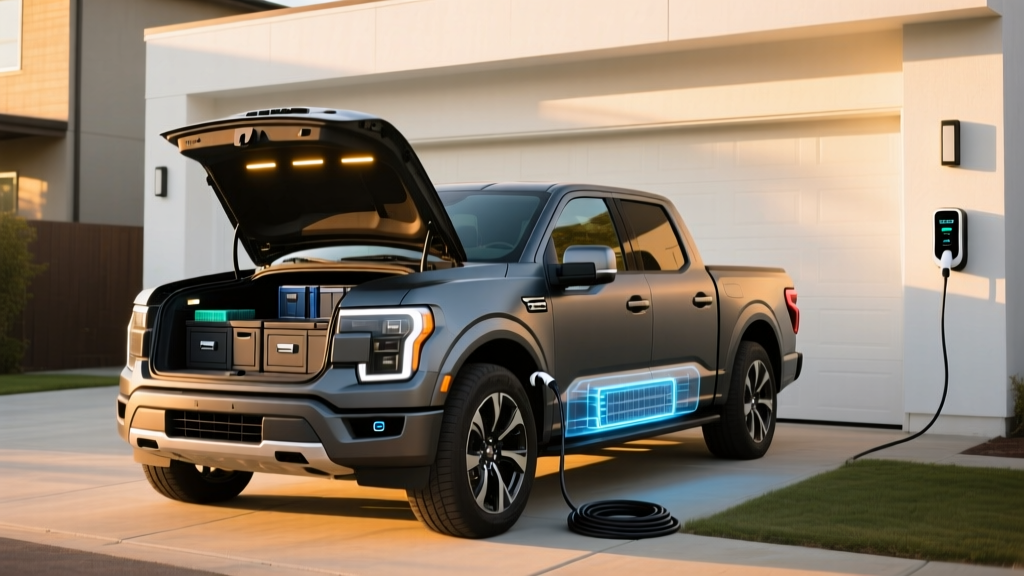
With the internal combustion engine removed, Ford carved out 14.1 cubic feet of front-trunk space — roughly the volume of a midsize sedan's rear trunk. The Mega Power Frunk is:
- Lockable and weather-sealed, with a composite liner and drain plug for wet gear or ice-filled coolers
- Rated to carry up to 400 lbs of payload
- Equipped with four 120V outlets and two USB-C chargers, turning it into a mobile workstation or tailgate power hub
- Opened via key fob, passcode, or the FordPass app — with a hands-free foot-activation option
For contractors, it's a secure, bed-independent tool locker. For families, it's a grocery zone separated from dirty bed cargo. For tailgating, it's a powered cooler and sound system staging area. No gas truck offers anything close.
Specs at a Glance: 2026 Ford F-150 Lightning
| Spec | Standard Range (SR) | Extended Range (ER) |
|---|---|---|
| EPA Range | 230 miles | 320 miles |
| Usable Battery | 98 kWh (NMC) | 131 kWh (NMC) |
| Drivetrain | Dual-motor AWD | |
| Horsepower | 452 hp | 580 hp |
| Torque | 775 lb-ft | |
| 0-60 mph | ~5.0 sec | ~3.8 sec |
| Max DC Fast Charge | 120 kW | 150 kW |
| 10-80% DC Time | ~44 min | ~41 min |
| Level 2 Home Rate | Up to 19.2 kW (~30 mi/hr) | |
| Max Towing | 7,700 lbs | 10,000 lbs |
| Max Payload | 2,235 lbs | |
| MPGe (Combined) | 76 MPGe | 70 MPGe |
| Starting MSRP | ~$55,000 | ~$70,000 |
Source: fueleconomy.gov and Ford Motor Company specifications.
Real-World Range: What the EPA Sticker Doesn't Tell You
The Lightning's 7,000+ lb curb weight and boxy aerodynamics mean efficiency suffers at highway speeds — roughly 48-50 kWh/100 mi on the ER model. City driving with regenerative braking recovers meaningful energy, so commuters with short loops will see figures closer to the EPA sticker. If towing a 5,000-lb trailer, range can fall 40-50%, putting ER models closer to 160-180 miles. Ford's onboard range estimator is notably accurate once it learns your driving pattern, but always plan charging stops conservatively on road trips.
Charging Speed: Home, Public, and the Curve
The Lightning uses the CCS1 connector (Ford has announced NACS adoption for future models, but 2026 Lightnings still ship CCS1 with Tesla Supercharger adapter access).
| Charging Level | Power | Speed (miles per hour) | Best For |
|---|---|---|---|
| Level 1 (120V) | ~1.4 kW | ~2-3 mi/hr | Emergency top-ups |
| Level 2 (240V, 32A) | 7.7 kW | ~13 mi/hr | Overnight (included mobile cord) |
| Level 2 (240V, 80A) | 19.2 kW | ~30 mi/hr | Fast home refill (Ford Charge Station Pro) |
| DC Fast Charge | 150 kW peak (ER) | N/A — 10-80% in ~41 min | Road trips |
Charging-curve reality: The 150 kW peak on Extended Range models only sustains from roughly 15-45% State of Charge. Above 60%, power tapers to ~90 kW, and above 80% it drops sharply to ~30 kW to protect the NMC cells. Standard Range models peak lower at 120 kW due to a smaller battery pack with fewer parallel cells.
For home charging, the Ford Charge Station Pro (80A hardwired) requires a 100-amp dedicated circuit. Installation by a licensed electrician typically runs $1,500-$3,500 depending on panel proximity and whether your home needs a 200A service upgrade. The Lightning's Pro Power Onboard system (available 9.6 kW) can back-feed your home during outages when paired with the Ford Home Integration System — a genuine differentiator in storm-prone regions.
Performance and Driving Dynamics
With 580 hp and 775 lb-ft of instant torque, the Extended Range Lightning hits 60 mph in roughly 3.8 seconds — making it the quickest production F-150 ever sold. The dual-motor AWD system provides confident traction in rain and snow, and the low center of gravity (battery pack under the floor) reduces body roll compared to gas F-150s.
Ride quality benefits from the independent rear suspension (a Lightning exclusive vs. the live axle on gas F-150s), delivering noticeably better on-road comfort. Off-road, the Lightning is competent for fire roads and trail access but isn't built for rock crawling — ground clearance is moderate, and the underbody battery pack warrants caution on severe terrain.
Interior, Tech, and Driver Assistance
The cabin mirrors the gas F-150's layout, dominated by a 12-inch touchscreen (15.5-inch portrait screen on Lariat and up) running SYNC 4A. Wireless Apple CarPlay and Android Auto are standard. Over-the-air updates continue to refine the interface.
Ford's BlueCruise hands-free driving system is available on divided highways — currently covering 130,000+ miles of qualified roads in North America. It's a Level 2 driver-assist system per SAE classification, meaning the driver must remain attentive and eyes-on (monitored by an infrared camera).
Notable tech includes the onboard scale (measures payload in real time), intelligent range prediction that factors in terrain and weather along your route, and the available Max Recline Seats for rest breaks during long hauls.
Pricing, Trims, and Federal Tax Credit Eligibility
The 2026 Lightning lineup spans Pro, XLT, Lariat, and Platinum trims. Pricing has stabilized after early-production markups:
| Trim | Standard Range MSRP | Extended Range MSRP |
|---|---|---|
| Pro | ~$55,000 | ~$70,000 |
| XLT | ~$60,000 | ~$75,000 |
| Lariat | N/A | ~$82,000 |
| Platinum | N/A | ~$96,000 |
Federal tax credit (§30D): The Lightning is assembled in Michigan with a domestically sourced battery pack, and as of 2026 it qualifies for the full $7,500 federal tax credit — available as a point-of-sale rebate at the dealer. However, eligibility depends on your situation:
- Income caps: $150,000 single / $225,000 head of household / $300,000 joint (modified AGI)
- MSRP cap: Trucks/vans must be under $80,000 — this excludes the Platinum trim and some fully optioned Lariat builds
- Battery sourcing: Ford's US-assembled packs currently meet critical-mineral and component requirements
Always verify current-year eligibility at irs.gov and consult a tax professional. Point-of-sale transfer lets you apply the credit directly to your down payment, effectively reducing a $60,000 XLT to ~$52,500 out of pocket (before state incentives).
Warranty and Battery Longevity
Ford covers the Lightning's battery and electric powertrain for 8 years or 100,000 miles, whichever comes first, with a capacity-retention threshold of 70%. The bumper-to-bumper warranty is 3 years/36,000 miles. NMC chemistry in the Lightning has shown modest degradation in fleet data — most owners report 92-95% State of Health after 50,000 miles, consistent with liquid-cooled packs managed conservatively by Ford's thermal system.
Pros and Cons
- 14.1 cu ft Mega Power Frunk — best-in-class lockable storage
- Pro Power Onboard turns the truck into a 9.6 kW generator
- Independent rear suspension = superior ride vs. gas F-150
- Full $7,500 tax credit eligibility (income/MSRP permitting)
- Quiet, torque-rich daily driving with 775 lb-ft
- Heavy: 7,000+ lbs hurts highway efficiency and tire wear
- 150 kW peak DC charging is outpaced by rivals (Rivian: 200+ kW, Silverado EV: 350 kW)
- Towing cuts range by 40-50%
- Platinum trim exceeds $80K MSRP cap — no tax credit
- CCS1 port requires adapter for Tesla Supercharger access
Who Should Buy the Ford F-150 Lightning?
- You need a secure, weather-sealed front cargo area (the frunk) for tools, gear, or groceries
- You want home backup power via Pro Power Onboard
- Your daily driving is under 200 miles with home Level 2 charging
- You value a familiar F-150 layout over futuristic styling
- You tow heavy trailers long distances (range loss is severe)
- You need the fastest possible DC charging for road trips — consider the Silverado EV or a NACS-native truck
- You want a smaller, more agile electric truck — see the Rivian R1T or Ford Maverick hybrid
Frequently Asked Questions
What is the real-world range of the Ford F-150 Lightning?
The Extended Range model is EPA-rated at 320 miles but delivers 260-280 highway miles in fair weather and 200-230 in cold conditions. Standard Range models deliver roughly 185-200 real-world highway miles.
How fast does the Lightning charge at home and on the road?
At home on a 19.2 kW Level 2 Ford Charge Station Pro, expect ~30 miles of range per hour — a full overnight refill. On DC fast chargers, the ER model peaks at 150 kW and charges 10-80% in about 41 minutes.
Does the F-150 Lightning qualify for the $7,500 federal tax credit?
Yes — trims under the $80,000 MSRP cap (Pro, XLT, and most Lariat builds) qualify for the full $7,500 under §30D, subject to buyer income limits and battery-sourcing rules. The Platinum trim does not qualify due to its MSRP. Verify at irs.gov before purchase.
How much cargo space does the Lightning frunk offer?
The Mega Power Frunk provides 14.1 cubic feet, supports up to 400 lbs, includes four 120V outlets, and features a drain plug. It is lockable and accessible via fob, app, or hands-free activation.
Is the Lightning worth buying vs. the Rivian R1T or Silverado EV?
The Lightning wins on frunk utility, home backup power, and tax-credit pricing. The Rivian R1T offers a smaller frunk but better off-road capability and faster charging. The Silverado EV charges at up to 350 kW and offers more range but starts higher and lacks the Lightning's mature dealer-service network. For most truck buyers wanting a daily-driver workhorse with secure front storage, the Lightning remains the most practical choice.