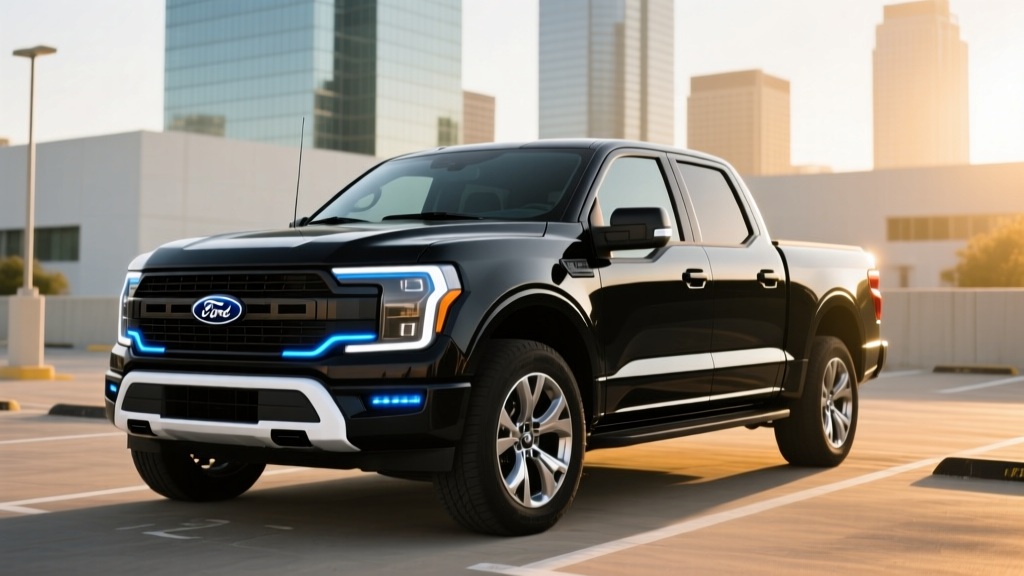
The Ford F-150 Lightning remains one of the most practical electric trucks on the market in 2026, blending work-truck capability with daily-driver comfort. But with MSRPs ranging from roughly $55,000 to over $96,000, finding the right Ford F-150 Lightning financing deal requires understanding the full cost picture — from federal tax credits and lease incentives to real-world efficiency and charging infrastructure. This review covers every spec, ownership cost, and financing angle you need before signing on the dotted line.
2026 Ford F-150 Lightning at a Glance: Key Specs
| Spec | Standard Range | Extended Range |
|---|---|---|
| EPA Range | 240 miles | 320 miles |
| Battery (Usable) | ~98 kWh (NMC) | ~131 kWh (NMC) |
| Drivetrain | Dual-Motor AWD | Dual-Motor AWD |
| Horsepower | 452 hp | 580 hp |
| Torque | 775 lb-ft | 775 lb-ft |
| 0–60 mph | ~5.0 sec | ~3.8 sec |
| Max DC Fast Charge | 150 kW | 150 kW |
| 10–80% DC Time | ~36 min | ~41 min |
| Level 2 Home Charge | 11.3 kW (30 mi/hr) | 11.3 kW (30 mi/hr) |
| MPGe (Combined) | 78 MPGe | 73 MPGe |
| Max Towing | 7,700 lbs | 10,000 lbs |
| Max Payload | 2,235 lbs | 1,800 lbs |
| Base MSRP (2026) | ~$55,090 (Pro) | ~$71,990 (Lariat) |
| Battery Warranty | 8 years / 100,000 miles (70% retention) | |
Real-World Range: What the EPA Number Doesn't Tell You
Real-World Expectation: Highway driving at 70+ mph drops range by 10–15%. Cold weather (below 32°F) can reduce range by 20–30% due to cabin heating and battery resistance. Expect roughly 200–215 miles from the Standard Range pack on a winter highway trip, and 250–280 miles from the Extended Range pack under similar conditions. City driving with regenerative braking recovers closer to the EPA sticker.
The Lightning's boxy aerodynamics work against it at highway speeds. In our experience, the Extended Range model averaging 65 mph on flat terrain in mild weather consistently delivers around 290–300 miles before needing a charge. Push it to 75–80 mph and that figure drops closer to 260. If you tow — say a 5,000-lb trailer — expect range to be cut roughly in half, landing around 140–160 miles for the Extended Range model. This is consistent with every electric truck on the market; towing is where EV trucks still face their biggest limitation.
According to fueleconomy.gov, the Standard Range Lightning achieves 78 MPGe combined (equivalent to about 43 kWh per 100 miles), while the Extended Range drops to 73 MPGe combined due to the heavier battery. For context, the gas F-150 4WD with the 2.7L EcoBoost gets about 22 MPG combined — the Lightning uses roughly one-third the energy cost per mile when charging at home on a standard utility rate.
Charging Speed: DC Fast, Home Level 2, and What to Expect
| Charging Level | Power | Miles Added per Hour | Notes |
|---|---|---|---|
| Level 1 (120V) | ~1.4 kW | ~2–3 mi/hr | Emergency/trickle only |
| Level 2 (240V, 48A) | 11.3 kW | ~30 mi/hr | Full overnight charge (~8–10 hrs) |
| Level 2 (240V, 80A)* | 19.2 kW | ~50 mi/hr | Requires optional onboard charger + 100A circuit |
| DC Fast Charge | Peak 150 kW | N/A | 10–80% in ~36–41 min; tapers above 80% |
*80A Level 2 charging requires the optional 19.2 kW onboard charger and a dedicated 100-amp circuit — most homes will need an electrical panel upgrade to support this.
The Lightning's peak DC fast-charging rate of 150 kW puts it behind newer competitors like the Rivian R1T and the Chevrolet Silverado EV, which can pull 200+ kW. At a 150 kW Electrify America or Tesla Supercharger (with NACS adapter), the Extended Range pack will add roughly 100 miles of range in 15 minutes under ideal conditions. However, charging curves taper significantly after 80% state of charge — that last 20% can take as long as the first 70%. For road trips, plan your stops around 10–80% charges to minimize time at the plug.
At home, the standard 11.3 kW onboard charger is adequate for most owners. Plug in when you get home, and the Standard Range pack will be full by morning. The Extended Range pack, with its larger 131 kWh battery, needs about 10–12 hours from near-empty on a 48-amp Level 2 station. Ford's Mobile Power Cord comes with the truck and includes adapters for both 120V and 240V outlets, though a hardwired Wall Connector-style station is recommended for daily use.
2026 Pricing, Trim Levels, and Ford F-150 Lightning Financing Deals
Understanding where each trim lands — and what incentives apply — is critical to evaluating financing offers from your local dealer or Ford Credit.
| Trim | Battery | Base MSRP | Est. Federal Credit* | Effective Price |
|---|---|---|---|---|
| Pro | Standard Range | $55,090 | Up to $7,500 | ~$47,590 |
| XLT | Standard Range | $62,090 | Up to $7,500 | ~$54,590 |
| Lariat | Extended Range | $71,990 | Up to $7,500 | ~$64,490 |
| Platinum | Extended Range | $96,874 | $0 (over MSRP cap) | $96,874 |
*Federal EV tax credit under IRS §30D is subject to MSRP caps ($80,000 for trucks/vans/SUVs), buyer income limits ($300K joint / $225K head of household / $150K individual AGI), and battery critical-mineral/component sourcing requirements that change annually. The Platinum trim exceeds the $80,000 MSRP cap and does not qualify. Always verify current-year eligibility at IRS.gov or consult a tax professional. As of 2026, the credit can be transferred to the dealer at point of sale for an instant price reduction.
Financing Strategies That Actually Save Money
Ford Credit APR Deals: Ford periodically offers promotional APR rates (e.g., 0.9%–2.9% for 36–60 months) on the Lightning through Ford Credit. These are typically available to well-qualified buyers (Tier 1 credit, 720+ FICO) and can save thousands in interest versus a standard auto loan at 6–7%.
Lease Incentives: Leasing can sometimes unlock additional manufacturer incentives not available on purchases. Critically, leased EVs may also qualify for the $7,500 commercial clean vehicle credit (§45W), which the leasing company can pass through as a lease cash reduction. This has been a common strategy for the Lightning, effectively making a lease cheaper than a purchase in some markets.
Stacking Incentives: Depending on your state, you may be able to stack the federal credit with state rebates (e.g., California's CVRP, Colorado's innovative motor vehicle credit, or utility company rebates for home charger installation). Check afdc.energy.gov for your state's current programs.
Performance, Capability, and Daily Driving
The Lightning's dual-motor all-wheel-drive setup is standard across all trims, giving it confident traction in rain, snow, and light off-road conditions. The Extended Range model's 580 hp and 775 lb-ft of torque deliver a 3.8-second 0–60 time — genuinely quick for a 6,500-lb truck. The Standard Range model isn't far behind at about 5.0 seconds.
Ride quality is a standout. The independent rear suspension (a first for the F-150) makes the Lightning noticeably smoother over bumps than the solid-axle gas F-150, especially when unloaded. The truck feels planted and composed on highway on-ramps, with minimal body roll for its size.
Towing capacity reaches 10,000 lbs with the Extended Range model and the Max Trailer Tow Package. However, towing near max capacity will cut range roughly in half — plan for 140–160 miles between charges when pulling heavy. The integrated Pro Power Onboard system (up to 9.6 kW available) turns the Lightning into a mobile generator, capable of powering job-site tools, a camper, or even backing up essential home circuits during an outage via Ford's Intelligent Backup Power system.
Cargo and Passenger Space
The SuperCrew cab offers 43.6 inches of rear legroom — class-leading and genuinely comfortable for three adults. The 5.5-foot bed provides 52.8 cubic feet of cargo volume. But the real differentiator is the Mega Power Frunk: 14.1 cubic feet of lockable, drainable front storage with a 400-lb payload capacity. It's large enough for groceries, tools, or two full-size coolers, and it's become one of the Lightning's most-loved features among owners.
Tax Credit Eligibility Checklist: Do You Qualify?
- MSRP Cap: Truck MSRP must be ≤ $80,000 (eliminates Platinum trim)
- Income Limits: Modified AGI ≤ $300K (joint) / $225K (head of household) / $150K (individual)
- Battery Sourcing: Critical minerals and battery components must meet escalating domestic-content thresholds — verify the specific VIN's compliance at fueleconomy.gov
- Assembly: Vehicle must undergo final assembly in North America (the Lightning is built in Dearborn, MI — qualifies)
- Point-of-Sale Transfer: As of 2024+, you can transfer the credit to the dealer for an instant price reduction at purchase, even if you have no tax liability
- One-Time Use: Each buyer is limited to one new EV credit and one used EV credit per calendar year
Because battery-sourcing rules tighten each year, a Lightning VIN that qualified for the full $7,500 in 2024 may qualify for less — or none — in 2026. Always run the VIN through the DOE's plug-in credit lookup tool before committing to a purchase.
Pros, Cons, and How It Compares
- Smooth, quiet ride with independent rear suspension
- Massive frunk (14.1 cu ft) — best in class
- Pro Power Onboard (up to 9.6 kW) for work and backup power
- Extended Range model hits 320 EPA miles — among the best for trucks
- Competitive pricing after tax credits vs. Rivian R1T and Silverado EV
- BlueCruise hands-free highway driving (SAE Level 2) on approved roads
- DC fast charging peaks at only 150 kW — slower than newer rivals
- Towing drastically reduces range (expect ~50% loss)
- Platinum trim exceeds the $80K tax-credit MSRP cap
- Large footprint makes tight parking garages challenging
- SYNC 4A infotainment is functional but feels dated vs. Tesla/Rivian
- Real-world highway range noticeably below EPA sticker
Lightning vs. Key Competitors (2026)
vs. Rivian R1T: The R1T offers faster charging (~200+ kW on the latest pack), a more adventurous off-road persona, and a smaller, more maneuverable footprint. But it starts at ~$70,000+ and has a smaller bed and no frunk comparable to the Lightning's. The Lightning wins on value, interior space, and work-truck utility.
vs. Chevrolet Silverado EV: The Silverado EV (particularly the 4WT and RST trims) offers up to 400+ miles of range on the largest battery and faster DC charging. However, it's larger, pricier in well-equipped trims, and lacks the Lightning's refined ride quality. Fleet buyers may prefer the Silverado EV's range; personal-use buyers often prefer the Lightning's driving dynamics.
vs. Tesla Cybertruck: The Cybertruck offers faster charging, a stainless-steel exoskeleton, and strong performance, but its polarizing design, limited bed utility, and higher starting price for AWD models make the Lightning a more practical choice for traditional truck buyers.
Who Should Buy the Ford F-150 Lightning?
Choose the F-150 Lightning if: You need a full-size crew-cab truck for daily driving, job-site power, and occasional towing under 200 miles round-trip. You can charge at home (Level 2). You value a smooth ride, a massive frunk, and available backup-power capability. You want the most value in an electric truck after tax credits.
Look elsewhere if: You regularly tow over 200+ miles in a single stretch (consider the Silverado EV's larger battery). You need the fastest possible DC charging for road-trip-heavy lifestyles (Rivian R1T or Hyundai/Kia 800V platforms charge faster). You don't have reliable home charging access — public-charging-only ownership with a 150 kW peak truck is frustrating.
Frequently Asked Questions
What is the real-world range of the Ford F-150 Lightning?
The Standard Range model delivers roughly 200–220 miles in mixed real-world driving, dropping to about 180 in cold highway conditions. The Extended Range model averages 270–300 miles in mild weather, with about 250 on the highway and 200–220 in freezing temperatures. Towing cuts range roughly in half.
How fast does the Lightning charge at home and on the road?
On a 48-amp Level 2 home charger (11.3 kW), expect about 30 miles of range per hour — a full overnight charge for the Standard Range pack, or 10–12 hours for Extended Range. DC fast charging peaks at 150 kW, reaching 10–80% in about 36–41 minutes depending on the pack size.
How much does the F-150 Lightning cost after tax credits?
The Pro trim with the Standard Range battery starts around $55,090 and can drop to approximately $47,590 after the full $7,500 federal credit — if your income and the vehicle's battery sourcing qualify. The XLT comes in around $54,590 after credit, and the Lariat Extended Range around $64,490. The Platinum exceeds the $80K MSRP cap and is ineligible for the federal credit.
Does the F-150 Lightning qualify for the federal EV tax credit?
Most trims qualify for up to $7,500 under IRS §30D, provided the buyer meets income caps ($300K joint / $150K individual), the MSRP is under $80,000 (which excludes the Platinum), and the battery meets current-year critical-mineral and component sourcing thresholds. Always verify with the specific VIN at fueleconomy.gov before purchasing.
Is the Lightning worth buying vs. the Rivian R1T or Silverado EV?
For value, interior space, ride comfort, and work-truck features like Pro Power Onboard, the Lightning leads the segment. The Rivian R1T charges faster and is more off-road capable but costs more. The Silverado EV offers longer range but at a higher price and larger footprint. For most buyers seeking a daily-driver electric truck under $65K after credits, the Lightning XLT or Lariat is the strongest pick.
What is the battery warranty on the F-150 Lightning?
Ford covers the Lightning's battery pack for 8 years or 100,000 miles, whichever comes first, against defects and capacity loss below 70% state of health. The powertrain carries the same 8-year/100,000-mile coverage.
Can the F-150 Lightning power my home during an outage?
Yes — with the available Ford Intelligent Backup Power system and the Home Integration System (an $800–$1,200 wall-mounted inverter, plus installation by a licensed electrician), the Extended Range Lightning can supply up to 9.6 kW of continuous power to your home's circuits for several days during an outage.
What financing deals are typically available for the Lightning?
Ford Credit periodically offers promotional APR rates (0.9%–3.9%) for qualified buyers, lease cash incentives, and loyalty/competitive-conquest rebates. Leasing may also unlock the $7,500 commercial clean vehicle credit (§45W) as a lease reduction. Check Ford's current offers page and compare with third-party lenders and credit unions to find the best deal for your credit profile.