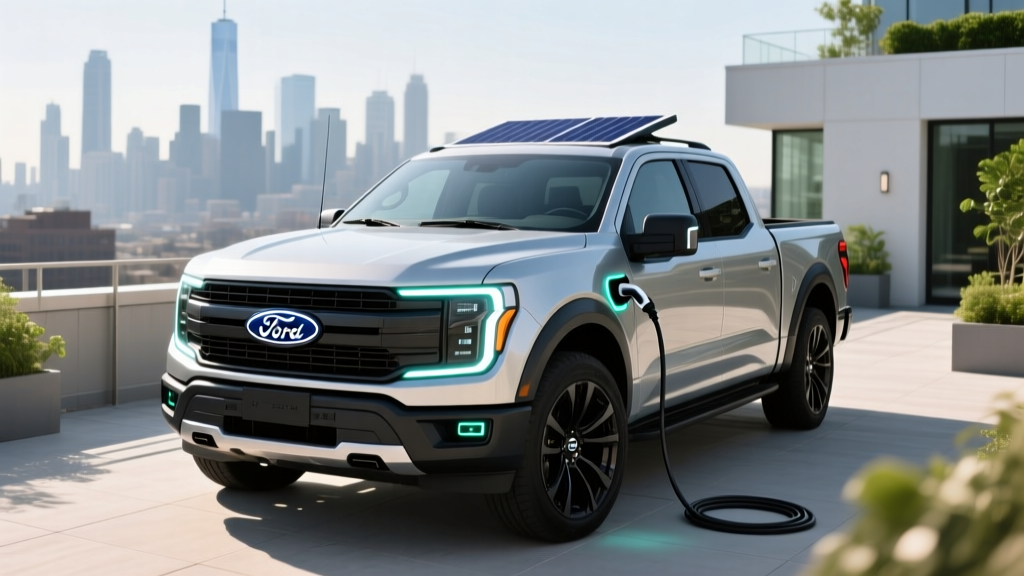
If you're researching the Ford new EV truck — primarily the F-150 Lightning, with the next-generation model on the horizon — here's the direct answer: the 2026 F-150 Lightning offers an EPA-estimated 240 to 320 miles of range depending on battery pack, starts around $54,995 before incentives, and can tow up to 10,000 pounds. It costs roughly 60-70% less to "fuel" per mile than a gas F-150 if you charge at home, but highway-heavy drivers and cold-climate owners should expect 20-30% less real-world range than the EPA sticker suggests. Federal tax credit eligibility under IRS §30D rules depends on your income, the truck's MSRP (must be under $80,000), and battery sourcing requirements that shift annually.
Quick Verdict: Is the Ford New EV Truck Right for You?
Buy it if: You have home Level 2 charging access, drive mostly under 250 miles daily, value the Pro Power Onboard feature for job-site or camping use, and qualify for some or all of the federal tax credit.
Wait or look elsewhere if: You regularly tow heavy loads over 300 miles (range drops to ~100-150 miles towing), lack reliable home charging, or live in an area with sparse DC fast-charging infrastructure.
F-150 Lightning 2026: Range, Battery & Real-World Expectations
The 2026 F-150 Lightning continues with two battery options built on NMC (nickel manganese cobalt) chemistry. The Standard Range pack delivers approximately 98 kWh of usable capacity, while the Extended Range pack provides roughly 131 kWh. Here's what the numbers look like on paper versus in practice:
| Spec | Standard Range | Extended Range |
|---|---|---|
| Usable Battery (kWh) | ~98 kWh (NMC) | ~131 kWh (NMC) |
| EPA Range | 240 miles | 320 miles |
| Real-World Highway (70 mph) | ~190-210 miles | ~250-275 miles |
| Cold Weather (below 30°F) | ~165-190 miles | ~220-255 miles |
| Towing (5,000-lb trailer) | ~100-130 miles | ~140-175 miles |
| 0-60 mph | ~4.5 sec (563 hp) | ~3.8 sec (563 hp) |
| Max Tow Capacity | 7,700 lbs | 10,000 lbs |
Real-World Range Reality Check
The EPA sticker is a blended cycle. On a 70-mph highway run in moderate temperatures, expect the Extended Range model to deliver 250-275 actual miles before needing a charge. In sub-freezing weather, battery preconditioning helps but you'll still lose 15-25% of range. If you tow frequently, plan your routes around charging stops every 100-150 miles — this is where gas F-150s still hold a clear advantage for long-haul towing.
Charging Speeds: Home and DC Fast Charging
Understanding the difference between kW (power — how fast energy flows) and kWh (energy — how much the battery holds) is essential for any EV truck buyer.
| Charging Level | Power (kW) | Miles Added per Hour | Typical Use |
|---|---|---|---|
| Level 1 (120V outlet) | ~1.4 kW | ~2-3 mi/hr | Emergency / overnight trickle |
| Level 2 (240V, 48A) | ~11.5 kW | ~20-25 mi/hr | Home daily charging |
| Level 2 (240V, 80A — Ford Charge Station Pro) | ~19.2 kW | ~35-40 mi/hr | Full overnight recharge; V2H backup |
| DC Fast Charge (peak) | ~150 kW (Std) / ~170 kW (Ext) | N/A | Road trips |
On a DC fast charger, the Extended Range Lightning peaks at roughly 170 kW and can charge from 10% to 80% in approximately 41 minutes. The Standard Range pack peaks around 150 kW with a 10-80% time of about 36 minutes. Note that charging speed tapers significantly above 80% — that last 20% can take as long as the first 60%. For road-trip planning, plan to charge to 80% and go.
According to fueleconomy.gov, the F-150 Lightning Extended Range achieves approximately 70 MPGe combined, translating to roughly 48 kWh per 100 miles driven.
Ford New EV Truck vs. Gas F-150: Cost & Ownership Breakdown
The upfront price of the Lightning is higher than a comparable gas F-150, but the total cost of ownership (TCO) equation shifts significantly when you factor in fuel, maintenance, and incentives. Here's a 5-year comparison assuming 15,000 miles per year, $3.50/gallon gas, and $0.14/kWh home electricity:
| Cost Category (5 Years) | F-150 Lightning Ext. Range | F-150 Gas (4x4, 3.5L EcoBoost) |
|---|---|---|
| Base MSRP (approx.) | $69,995 | $52,000 |
| Federal Tax Credit (§30D)* | Up to -$3,750 to -$7,500 | $0 |
| Fuel / Electricity | ~$5,250 (home charging) | ~$13,125 |
| Maintenance (oil, filters, brakes) | ~$1,200 | ~$3,800 |
| Insurance (avg.) | ~$11,500 | ~$9,000 |
| Estimated 5-Year Total | ~$78,195 – $82,945 | ~$77,925 |
*Federal EV tax credit eligibility under IRS §30D depends on buyer income caps ($150K single / $300K joint), vehicle MSRP under $80,000, and critical-mineral/battery-component sourcing requirements that tighten each year. Consult a tax professional. The credit can now be transferred at point of sale as an upfront discount.
The numbers reveal a near-parity scenario over five years. The Lightning's fuel and maintenance savings — roughly $10,500 combined — nearly close the $18,000 MSRP gap. The tax credit, if you qualify for the full $7,500, tips the scales in the EV's favor. However, insurance premiums on the Lightning run 15-25% higher than gas F-150s, and depreciation remains a wildcard as the used EV market stabilizes.
Common EV Truck Misconceptions — Fact-Checked
| Myth | Fact |
|---|---|
| "EV trucks can't tow anything." | The Lightning tows up to 10,000 lbs. Range drops sharply while towing (~100-175 mi), but capability is real. |
| "The battery will need replacing in 5 years." | Ford warranties the battery for 8 years / 100,000 miles against degradation below 70% capacity. NMC packs in liquid-cooled systems typically retain 85-90% at 100K miles. |
| "Charging takes forever." | Home Level 2 charging adds ~20-40 miles per hour — overnight is sufficient for daily use. DC fast charging reaches 80% in ~36-41 minutes. |
| "You'll save $10,000 a year on fuel." | Realistic annual fuel savings are $1,200-$2,000 depending on mileage and local electricity rates. Meaningful, but not miraculous. |
| "There's no tax credit anymore." | The §30D credit still exists but sourcing rules are stricter. Some Lightning trims may qualify for partial ($3,750) or full ($7,500) credit depending on the model year's battery component sourcing. |
Home Charging Setup: What First-Time EV Truck Buyers Need to Know
The single biggest ownership advantage of any EV is waking up to a full "tank" every morning — but only if you can install a Level 2 charger at home. Here's what that looks like for an F-150 Lightning owner:
| Item | Estimated Cost | Notes |
|---|---|---|
| Level 2 Charger (48A, hardwired) | $500 – $700 | Ford Charge Station Pro or third-party (Emporia, ChargePoint) |
| Electrical Panel Assessment | $0 – $200 | Many electricians include this free with a quote |
| 240V Circuit Installation (50-60A) | $800 – $2,500 | Depends on distance from panel, conduit run |
| Panel Upgrade (if needed, 200A) | $1,500 – $3,500 | Older homes with 100A panels may need this |
| Permit & Inspection | $100 – $400 | Varies by municipality |
| Total Typical Range | $1,400 – $4,500 | Average install: ~$2,000 for a straightforward setup |
A critical note: the Ford Charge Station Pro (80A) requires a 100-amp dedicated circuit and a hardwired connection. It enables the Lightning's Intelligent Backup Power (V2H) feature, which can power your home during an outage for up to three days. If you don't need backup power, a standard 48A Level 2 unit is sufficient and significantly cheaper to install. Always get a quote from a licensed electrician before committing — panel upgrades are the biggest cost variable.
What's Next: The Next-Gen Ford EV Truck Platform
Ford has announced a next-generation electric truck built on a new, dedicated EV platform — separate from the current Lightning, which shares its architecture with the gas F-150. This upcoming model (expected for the 2027 model year) is projected to offer improved range, a lower starting price, and enhanced manufacturing efficiency from Ford's BlueOval City facility. Specs remain preliminary and Ford has not confirmed final battery sizes or pricing.
If you don't need a truck immediately, waiting for the next-gen model could yield a more affordable entry point. If you need a truck now, the current Lightning is a proven, well-reviewed product with an established charging and service network.
Decision Framework: Should You Buy the Ford New EV Truck?
Choose the F-150 Lightning If:
- You have or can install a 240V Level 2 charger at home (garage or driveway)
- Your daily driving is under 200 miles and you can charge overnight
- You value Pro Power Onboard for tools, camping, or home backup
- You qualify for at least a partial §30D tax credit (check IRS guidelines)
- You want instant torque, near-silent operation, and a front trunk (frunk) with 14.1 cu ft of storage
Stick with a Gas or Hybrid F-150 If:
- You regularly tow heavy loads over distances exceeding 150 miles
- You live in an apartment or lack access to any home or workplace charging
- You drive in extreme cold (below 10°F) for extended distances frequently
- Your nearest DC fast charger is more than 30 minutes away and you drive high miles
- You plan to keep the truck 10+ years and want maximum long-range flexibility without route planning
Consider the F-150 PowerBoost Hybrid as a Middle Ground If:
- You want some electrification (25 mpg combined vs. the Lightning's 70 MPGe equivalent) without range limitations
- You tow frequently and can't afford the range penalty of electric towing
- Home charging installation isn't feasible for your situation
Frequently Asked Questions
Does the F-150 Lightning qualify for the $7,500 federal tax credit?
Eligibility depends on current-year IRS §30D rules. The Lightning's MSRP must be under $80,000 (most trims qualify, but high-end Platinum trims may not), your adjusted gross income must fall below caps ($150,000 single / $300,000 joint), and the battery must meet critical-mineral and component sourcing thresholds. These thresholds tighten each year. Check the latest eligibility on irs.gov or ask your dealer for the current credit status of the specific VIN you're considering. The credit can be applied as a point-of-sale discount.
How much does it cost to charge the F-150 Lightning at home?
At the US average electricity rate of ~$0.16/kWh, a full charge of the Extended Range pack (131 kWh) costs approximately $21. For the Standard Range pack (98 kWh), it's about $16. That translates to roughly $0.06-$0.08 per mile — compared to $0.17-$0.20 per mile for a gas F-150 at $3.50/gallon. Annual savings for a 15,000-mile driver: approximately $1,500-$1,800.
What happens to the Lightning's range in cold weather?
Expect a 15-30% reduction in range when temperatures drop below freezing, depending on severity and whether you precondition the battery. The Lightning's liquid thermal management system helps mitigate this, but physics is physics — cold slows the electrochemical reactions in the NMC cells and increases cabin heating demand. Using seat heaters and a heat pump (standard on Lightning) instead of cranking the cabin air helps preserve range.
Can I use the F-150 Lightning to power my house?
Yes — with the Ford Charge Station Pro (80A hardwired unit) and the Home Integration System, the Lightning's Intelligent Backup Power can supply up to 9.6 kW to your home during an outage. Ford estimates this can power an average home for up to three days. This requires professional installation and a compatible transfer switch.
How long will the F-150 Lightning battery last?
Ford warranties the high-voltage battery for 8 years or 100,000 miles (whichever comes first) against capacity loss below 70%. Real-world data from early Lightning owners and similar NMC-pack EVs suggests 85-92% capacity retention at 100,000 miles under normal use. Replacement costs, should they be needed out of warranty, are estimated at $15,000-$25,000 for the pack plus labor — a significant expense, though rarely needed in the first decade.
Is the Lightning good for daily commuting and worksite use?
Excellent, particularly for commutes under 100 miles round-trip. The instant torque (775 lb-ft), quiet cabin, and Pro Power Onboard (up to 9.6 kW of onboard AC power from bed outlets) make it one of the most capable worksite trucks available. The frunk adds secure, lockable storage. The main trade-off is range when hauling heavy payloads over long distances.
Sources: EPA range and efficiency data via fueleconomy.gov; federal tax credit rules via irs.gov; manufacturer specifications via Ford Motor Company press materials.