Quick Verdict: The F-150 Lightning EREV Explained
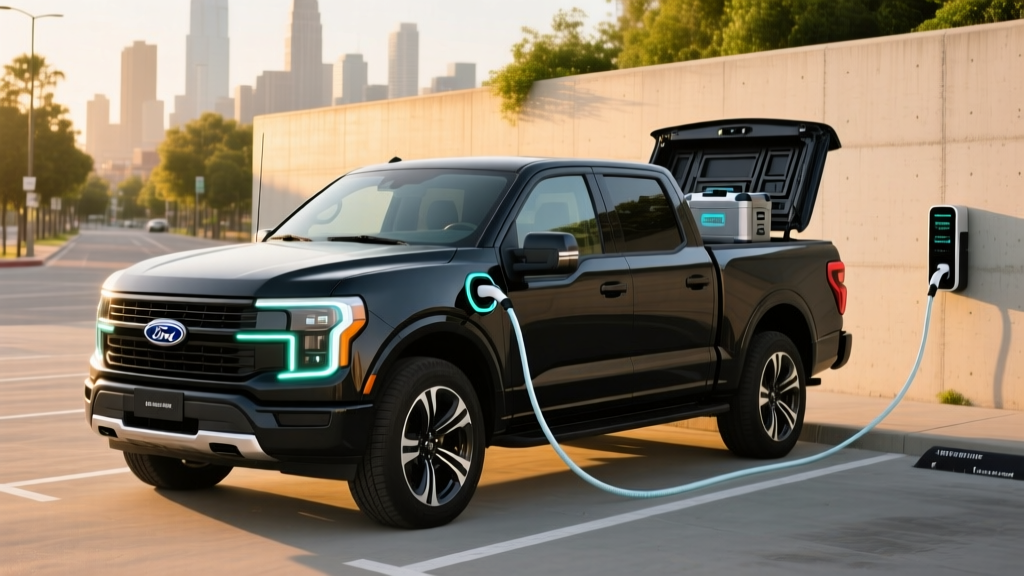
Ford introduced the F-150 Lightning EREV (Extended-Range Electric Vehicle) as a bridge solution for truck buyers who want electric drivetrain performance but aren't ready to fully commit to a battery-only pickup. Unlike the all-electric F-150 Lightning, the EREV pairs a smaller battery with an onboard gasoline generator that recharges the pack on the go — meaning you get electric torque for daily driving and a gas-fueled safety net for long hauls and heavy towing.
As of the 2026 model year, the F-150 Lightning EREV is announced but not yet available for purchase. Ford has shared preliminary specifications and pricing targets, but final EPA certification, exact battery chemistry confirmation, and real-world charging data remain pending. This review uses Ford's published preliminary figures and our analysis of the platform architecture to give buyers the most accurate picture available today.
An EREV like the F-150 Lightning EREV uses its gasoline engine only as a generator to charge the battery — the wheels are always driven by electric motors. This differs from a conventional PHEV (like the Toyota RAV4 Prime), where the gas engine can directly drive the wheels. The result is a smoother, more EV-like driving experience with extended total range.
EPA Range, Battery Specs, and Real-World Expectations
| Specification | 2026 F-150 Lightning EREV (Preliminary) |
|---|---|
| Electric-Only Range (EPA est.) | ~45 miles (target) |
| Total Range (electric + generator) | ~700+ miles (target) |
| Battery Capacity | ~20 kWh usable (preliminary) |
| Battery Chemistry | NMC (nickel manganese cobalt) — expected |
| Generator Engine | 2.7L EcoBoost V6 (onboard range extender) |
| Fuel Tank Capacity | ~26 gallons (preliminary) |
| Drivetrain | Dual-motor AWD (electric drive) |
| Combined Output | ~563 hp / 775 lb-ft torque (target) |
| 0-60 mph | ~4.5 seconds (est.) |
| Max Towing | ~10,000 lbs (target) |
| MPGe (electric mode) | TBD pending EPA certification |
| MPG (generator mode) | ~19-21 MPG combined (est.) |
Ford targets ~45 miles of pure electric range before the onboard generator kicks in. In real-world conditions, expect ~35-40 miles of electric-only driving in moderate temperatures with mixed city/highway use. Cold weather (below 32°F) could reduce electric-only range by 20-30%, dropping to ~28-35 miles. The generator will activate earlier in cold conditions to maintain cabin heat and battery warmth.
Total range of 700+ miles assumes a mix of electric driving and generator operation with a full tank — achievable on highway cruises at moderate loads. Heavy towing (8,000+ lbs) will significantly reduce total range, likely into the 400-500 mile range depending on terrain and speed.
Charging Speed: DC Fast Charging and Home Level 2
Because the F-150 Lightning EREV carries a smaller battery than its all-electric sibling, charging demands are lower — which is actually an advantage for home charging infrastructure.
| Charging Method | Power (kW) | Time / Rate |
|---|---|---|
| Level 1 (120V household outlet) | ~1.4 kW | ~14 hours for full charge; ~3 mi/hr |
| Level 2 (240V, 32A home charger) | ~7.7 kW | ~2.5 hours 0-100%; ~18 mi/hr |
| Level 2 (240V, 48A charger) | ~11.5 kW | ~1.7 hours 0-100%; ~27 mi/hr |
| DC Fast Charge (peak) | ~80 kW (est.) | 10-80% in ~18 minutes (preliminary) |
The smaller ~20 kWh battery means you can fully recharge overnight on even a basic 32A Level 2 home charger — a significant practical advantage over the full BEV Lightning, which requires a 48A or 80A circuit for reasonable overnight charging times. Most EREV owners will plug in nightly and wake up to a full battery for their daily electric-only commute.
On DC fast charging, expect a peak rate around 80 kW. While this sounds modest compared to the BEV Lightning's 150+ kW capability, the smaller battery means the 10-80% session completes in roughly 18 minutes — plenty fast for road-trip top-ups when the generator can handle the rest of the journey.
The EREV uses the NACS (North American Charging Standard) connector, giving it native access to Tesla Supercharger stations as well as Ford's growing network of NACS-equipped public chargers. No adapter required for Superchargers.
Pricing, Trims, and Federal Tax Credit Eligibility
Ford has announced preliminary pricing for the 2026 F-150 Lightning EREV, though final MSRP figures will be confirmed closer to the on-sale date.
| Trim Level | Preliminary MSRP | Est. After §30D Credit |
|---|---|---|
| Pro (base fleet/work) | ~$52,000 | ~$44,500 (if eligible) |
| XLT | ~$58,000 | ~$50,500 (if eligible) |
| Lariat | ~$67,000 | ~$59,500 (if eligible) |
| Platinum | ~$78,000 | ~$70,500 (if eligible) |
The EREV may qualify for up to $7,500 under IRS §30D Clean Vehicle Credit, but eligibility depends on multiple factors that change frequently:
- MSRP Cap: Trucks/vans must be under $80,000 MSRP — the Pro, XLT, and Lariat trims should qualify; Platinum may exceed the cap depending on options.
- Buyer Income Limits: AGI must not exceed $150,000 (single), $225,000 (head of household), or $300,000 (joint filers).
- Battery Sourcing: Critical minerals and battery components must meet phased-in domestic-content thresholds. As an EREV, the smaller battery may more easily meet sourcing requirements than the BEV Lightning's large pack — but Ford must certify compliance per IRS rules.
- Point-of-Sale Transfer: Eligible buyers can apply the credit as an instant rebate at the dealership, reducing the purchase price directly.
Always verify current-year eligibility with a tax professional and the IRS Clean Vehicle Credit page before purchasing. Rules are subject to legislative change.
Performance, Towing, and Payload
The EREV retains the dual-motor electric drivetrain from the F-150 Lightning, delivering all-wheel drive and the instant torque that makes electric trucks feel surprisingly quick. Ford targets approximately 563 horsepower and 775 lb-ft of combined torque — figures in line with the extended-range BEV Lightning.
The 0-60 mph time of roughly 4.5 seconds makes this one of the quickest trucks in its class, whether running on battery power alone or with the generator active. Because the wheels are always electrically driven, there's no transmission shift lag or turbo spool-up — just immediate, linear acceleration.
Towing capacity targets around 10,000 pounds, slightly below the BEV Lightning's max rating due to the added weight of the generator system and fuel tank. Payload is estimated at approximately 1,800 pounds. When towing near max capacity, expect the generator to run nearly continuously, and fuel economy will drop to approximately 12-15 MPG depending on speed and grade.
Interior, Cargo, and Technology
The F-150 Lightning EREV carries over the SuperCrew cab configuration with four full doors and seating for five (or six with the front bench option). Interior dimensions mirror the standard F-150 SuperCrew:
- Front legroom: 43.9 inches
- Rear legroom: 43.6 inches
- Bed length: 5.5-foot Styleside (standard)
- Bed cargo volume: ~52.8 cu ft
One key difference from the BEV Lightning: the EREV does not have a front trunk (frunk). The space under the hood is occupied by the 2.7L EcoBoost generator engine and associated power electronics. This is a notable trade-off — the BEV Lightning's 14.1 cu ft Mega Power Frunk is one of its most popular features for lockable, weather-sealed storage.
Technology highlights include:
- SYNC 4A infotainment with 12-inch touchscreen (15.5-inch on Lariat and above)
- Ford BlueCruise 1.5 — hands-free highway driving on pre-mapped divided highways (SAE Level 2; driver must remain attentive)
- Pro Power Onboard — up to 9.6 kW of exportable 120V/240V power from the bed, usable as a jobsite generator or backup home power source
- Over-the-air updates via Ford Power-Up platform
- Intelligent Range system that factors in weather, terrain, and payload to predict remaining range
Ford BlueCruise is an SAE Level 2 driver-assistance system. It is not self-driving. The driver must keep eyes on the road at all times, and the system uses a driver-facing camera to verify attentiveness. BlueCruise operates only on approximately 130,000+ miles of pre-mapped divided highways. It does not handle construction zones, unmapped roads, or severe weather conditions. You are legally responsible for the vehicle at all times.
Battery Warranty and Long-Term Ownership
Ford is expected to carry over its EV powertrain warranty structure to the EREV:
- High-voltage battery: 8 years / 100,000 miles (whichever comes first), with a minimum 70% capacity retention threshold
- Electric powertrain components: 8 years / 100,000 miles
- Generator engine: 5 years / 60,000 miles (standard powertrain warranty)
- Bumper-to-bumper: 3 years / 36,000 miles
The smaller battery in the EREV is a potential longevity advantage. Because the pack is smaller, it cycles more frequently — but the generator prevents deep discharges, keeping the battery in a healthier state-of-charge window (typically 20-80%). NMC chemistry in this application should provide reliable service well beyond the warranty period, though long-term degradation data specific to the EREV platform is not yet available.
F-150 Lightning EREV vs. Competitors
The EREV occupies a unique niche. Here's how it stacks up against key alternatives:
| Model | Type | Electric Range | Total Range | Base MSRP (est.) |
|---|---|---|---|---|
| F-150 Lightning EREV | EREV | ~45 mi | ~700+ mi | ~$52,000 |
| F-150 Lightning (BEV Std Range) | BEV | 240 mi | 240 mi | ~$52,000 |
| Ram 1500 REV | BEV | 350 mi | 350 mi | ~$58,000 |
| Chevy Silverado EV | BEV | 380 mi | 380 mi | ~$55,000 |
| Ford F-150 PowerBoost Hybrid | HEV | 0 mi (no EV mode) | ~700 mi | ~$52,000 |
The EREV's closest conceptual rival isn't another truck — it's the F-150 PowerBoost hybrid. Both offer ~700 miles of total range and similar pricing. The difference is driving experience: the EREV delivers electric-only daily commuting and instant electric torque, while the PowerBoost is a conventional hybrid with no plug-in capability and a gas-engine driving feel.
Pros and Cons
✅ Pros
- Electric-only daily commuting (~45 mi) eliminates gas use for most trips
- 700+ mile total range eliminates range anxiety on road trips
- Full electric torque and AWD performance regardless of battery state
- Smaller battery = easier home charging (standard 32A circuit sufficient)
- Pro Power Onboard for jobsite/home backup power
- BlueCruise hands-free highway assist
- May qualify for full $7,500 §30D credit (easier battery sourcing)
❌ Cons
- No front trunk (frunk) — generator occupies the space
- Two systems to maintain: electric drivetrain + gasoline engine
- Gasoline engine requires oil changes, filters, and emissions service
- Towing capacity reduced vs. BEV Lightning (~10,000 vs. 10,000+ lbs)
- Electric-only range may be insufficient for some commuters (45 mi)
- Generator noise under heavy load or low battery
- Model not yet on sale — final specs and pricing unconfirmed
Who Should Buy the F-150 Lightning EREV?
The EREV is the right choice if:
- Your daily commute is under 40 miles round-trip and you can charge at home nightly
- You regularly take road trips of 300+ miles where charging infrastructure is uncertain
- You need a full-size truck for work but want to reduce daily fuel costs
- You want electric driving feel but aren't confident in BEV charging reliability in your area
- You need onboard power (Pro Power Onboard) for jobsites or camping
Look elsewhere if:
- Your daily commute exceeds 50 miles — a BEV with 300+ mile range or a diesel may serve better
- You want zero gasoline maintenance — the EREV still requires oil changes and engine service
- You need maximum frunk storage — the BEV Lightning or Rivian R1T offers front cargo space
- You want the longest electric-only range in a plug-in truck — wait for the Ram 1500 REV with its optional range-extender configuration
Frequently Asked Questions
What is the real-world electric-only range of the F-150 Lightning EREV?
Ford targets ~45 miles of EPA-estimated electric-only range. In real-world mixed driving at moderate temperatures, expect approximately 35-40 miles before the generator activates. Cold weather (below freezing) may reduce this to 28-35 miles due to battery efficiency loss and cabin heating demands.
How fast does the EREV charge at home and on DC fast chargers?
On a 32A Level 2 home charger (7.7 kW), the ~20 kWh battery charges from empty to full in about 2.5 hours. On a 48A charger (11.5 kW), that drops to roughly 1.7 hours. DC fast charging at ~80 kW peak delivers a 10-80% charge in approximately 18 minutes. The smaller battery makes home charging far simpler than the full BEV Lightning.
How much does the F-150 Lightning EREV cost after tax credits?
Preliminary MSRP starts around $52,000 for the Pro trim. If the vehicle qualifies for the full $7,500 §30D federal tax credit (subject to income limits, MSRP caps, and battery sourcing requirements), the effective price drops to approximately $44,500. Higher trims (Lariat, Platinum) may approach or exceed the $80,000 MSRP cap, reducing or eliminating credit eligibility. Always verify current-year rules with a tax professional.
Is the F-150 Lightning EREV worth buying vs. the BEV Lightning or a hybrid?
The EREV fills a specific gap: drivers who want electric daily commuting but need unlimited total range without charging stops. If you can charge at home and your trips rarely exceed 240 miles, the BEV Lightning offers a simpler, lower-maintenance solution with a frunk. If you don't want to plug in at all, the PowerBoost hybrid is proven and similarly priced. The EREV is the compromise play — and for many truck buyers, that compromise is exactly right.
Does the EREV qualify for the federal EV tax credit?
It may qualify for up to $7,500 under IRS §30D, but eligibility depends on: (1) MSRP under $80,000 for trucks, (2) buyer adjusted gross income within limits ($300k joint / $150k single), and (3) battery critical-mineral and component sourcing meeting current-year thresholds. The EREV's smaller battery may make sourcing compliance easier than the BEV Lightning, but Ford must certify each model year. Point-of-sale transfer is available for eligible buyers.
Does the generator engine require regular maintenance?
Yes. Unlike the BEV Lightning, the EREV has a gasoline engine that requires oil changes, air filter replacement, spark plug service, and emissions system maintenance. Ford recommends following the standard F-150 EcoBoost maintenance schedule for the generator engine, even if it runs infrequently. Expect annual oil changes at minimum, regardless of generator use.
Can the EREV power my home during an outage?
Yes, through Ford's Pro Power Onboard system with up to 9.6 kW of exportable power via 120V and 240V outlets in the bed. With the available Ford Intelligent Backup Power system and a compatible home transfer switch (installed by a licensed electrician), the EREV can power essential home circuits during an outage — functioning as both a battery and a generator, running on gasoline when the battery depletes.