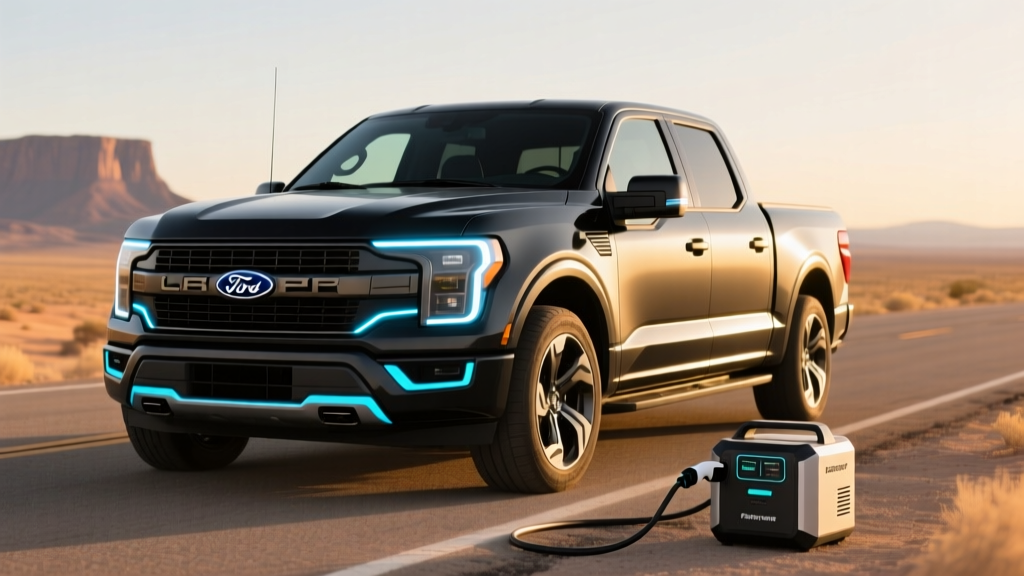
Ford's all-electric F-150 Lightning proved that a full-size pickup could go battery-electric without sacrificing capability — but it also exposed the limitations of pure EV trucking when towing heavy loads or venturing into charging deserts. Now, the Blue Oval is preparing a new variant that aims to split the difference: the Ford F-150 Lightning EREV, an extended-range electric vehicle that pairs a battery pack with an onboard gasoline generator to push total range well beyond what any current EV pickup offers.
As of mid-2026, Ford has confirmed the EREV powertrain is in development but has not yet released final specifications, pricing, or an on-sale date. Everything below reflects Ford's official statements, patent filings, supplier disclosures, and informed projections based on the current BEV Lightning platform. We'll update this review the moment Ford publishes final specs.
What Is an EREV, and How Does It Differ From the BEV Lightning?
An EREV — extended-range electric vehicle — is not a conventional hybrid or plug-in hybrid. In an EREV architecture, the gasoline engine never drives the wheels directly. Instead, it functions solely as a generator, producing electricity to feed the battery and electric motors. The wheels are always driven by the electric drivetrain.
This is fundamentally different from:
- The current BEV F-150 Lightning: Pure battery-electric, no onboard combustion engine. Relies entirely on plug-in charging.
- Traditional PHEVs (like the F-150 PowerBoost hybrid): The gas engine can mechanically drive the wheels, blending electric and combustion power.
- Mild/full hybrids: Smaller batteries, engine drives wheels, limited or no plug-in capability.
The EREV approach gives you the instant torque, smooth acceleration, and regenerative braking of an EV for daily driving — while a compact, efficient gas engine kicks in to generate electricity when the battery depletes, eliminating range anxiety on long hauls or remote job sites.
The most prominent EREV in the U.S. market today is the Rivian R1T (pure BEV, not EREV — Rivian has no EREV variant), though BMW's upcoming X5 eDrive and Ram's previously discussed (then shelved) Ramcharger concept explored similar architectures. Internationally, vehicles like the BYD Yangwang U8 use EREV setups in heavy-duty applications.
Projected Range, Battery, and Efficiency
Ford has not published official EPA figures for the Lightning EREV. However, based on the current BEV Lightning's architecture and industry EREV benchmarks, here are the working projections:
| Spec | Projected / Estimated | Current BEV Lightning (2025) |
|---|---|---|
| Battery Capacity (usable) | ~98–110 kWh (est.) | 98 kWh (Std) / 131 kWh (Ext) |
| Battery Chemistry | NMC (projected) | NMC (LG Energy Solution) |
| Electric-Only Range | ~200–240 mi (est.) | 240–320 mi (EPA) |
| Total Range (EREV mode) | ~500–600+ mi (est.) | N/A — BEV only |
| Onboard Generator | ~2.0–3.5L gasoline (est.) | None |
| MPGe (electric-only, est.) | ~65–75 MPGe | 66–70 MPGe combined |
The key efficiency question is how Ford tunes the range extender. EREV generators typically run at a fixed, optimal RPM for maximum thermal efficiency — often achieving 35–40% brake thermal efficiency versus ~25–30% in a conventional engine that must operate across a wide RPM band. This means the EREV may actually deliver better fuel economy in generator mode than a comparable gas F-150 gets in combined driving (~20–22 mpg).
Charging Speed and Home Setup
Ford has not confirmed charging specifications for the EREV variant. Based on the current Lightning platform and the likelihood that the EREV will share the BEV's charging architecture, here is what we project:
| Charging Level | Power | Estimated Speed | Notes |
|---|---|---|---|
| Level 1 (120V) | ~1.4 kW | ~3–4 mi/hr | Emergency/trickle only |
| Level 2 (240V, 48A) | ~11.5 kW | ~25–30 mi/hr | Standard home charging; ~8–10 hr for full charge |
| Level 2 (240V, 80A) | ~19.2 kW | ~42–50 mi/hr | Ford Charge Station Pro; requires 100A circuit |
| DC Fast Charge (CCS/NACS) | ~150 kW peak (est.) | 10–80% in ~40 min (est.) | Charge curve tapers significantly above 80% |
A critical advantage of the EREV architecture: you don't need to DC fast-charge on road trips. The range extender eliminates the 30–40 minute charging stops that BEV Lightning owners face on long highway drives. You would primarily plug in at home overnight and use the generator for long-distance travel — fundamentally changing the ownership pattern.
The current BEV Lightning uses the NACS (Tesla-style) connector starting with the 2025 model year, granting access to Tesla Superchargers via Ford's adapter program. We expect the EREV to carry the same NACS port, though this is unconfirmed. Home charging on a Level 2 Ford Charge Station Pro at 19.2 kW remains the gold standard for Lightning owners, but requires a dedicated 100-amp circuit — budget $1,200–$2,500 for professional installation depending on your panel capacity, per Ford's home charging guidance.
Performance and Drivetrain
The BEV F-150 Lightning has set a high bar for electric truck performance. The EREV variant will need to match or approach these benchmarks to remain competitive:
| Metric | BEV Lightning (2025 Ext. Range) | EREV (Projected) |
|---|---|---|
| Drivetrain | Dual-motor AWD | Dual-motor AWD (likely) |
| Horsepower | 580 hp | ~500–580 hp (est.) |
| Torque | 775 lb-ft | ~700–775 lb-ft (est.) |
| 0–60 mph | ~3.8 seconds | ~4.0–5.0 sec (est.) |
| Max Towing | 10,000 lbs | ~10,000 lbs (target) |
| Max Payload | ~2,235 lbs | ~1,800–2,200 lbs (est.) |
The EREV's added weight — the gasoline engine, fuel tank, exhaust system, and associated hardware will likely add 200–400 lbs over the BEV — could modestly reduce acceleration and payload. However, because the electric motors still provide all propulsion, the instant-torque character that makes the Lightning feel so responsive should carry over. The range extender engine, likely a turbocharged four-cylinder optimized for generator duty, would not contribute to peak power output but would sustain it over long highway grades where a BEV's battery might otherwise deplete rapidly under towing loads.
One area where the EREV could outshine the BEV: sustained high-power towing. BEV Lightnings towing near max capacity see range drop to 120–160 miles, requiring frequent charging stops. An EREV could theoretically tow 400+ miles between fuel stops, a transformative advantage for contractors, horse trailers, and RV haulers.
Pricing, Trims, and Federal Tax Credit Eligibility
Ford has not announced pricing for the Lightning EREV. For context, the 2025 BEV F-150 Lightning starts at $54,995 (Pro trim) and climbs to over $96,000 for the Platinum trim with Extended Range battery. Based on the added complexity of the EREV powertrain, we project:
| Trim (Projected) | Est. MSRP | After Potential §30D Credit |
|---|---|---|
| XLT | ~$60,000–$65,000 | ~$52,500–$57,500 |
| Lariat | ~$70,000–$75,000 | ~$62,500–$67,500 |
| Platinum | ~$85,000–$95,000 | ~$77,500–$87,500 |
Federal Tax Credit Considerations (§30D)
The IRS §30D clean vehicle credit offers up to $7,500 for qualifying new EVs and EREVs, but eligibility depends on several factors that will be critical for the Lightning EREV:
- MSRP Cap: Trucks and SUVs must have an MSRP at or below $80,000. This means higher EREV trims (Platinum) may exceed the cap.
- Buyer Income Limits: Modified adjusted gross income cannot exceed $150,000 (single), $225,000 (head of household), or $300,000 (joint filers).
- Battery Component & Critical Minerals Sourcing: Increasingly strict North American sourcing requirements apply. As an EREV with a smaller battery than the Extended Range BEV, the sourcing math may differ.
- Point-of-Sale Transfer: As of 2024+, qualifying buyers can transfer the credit to the dealer at purchase, reducing the out-of-pocket price immediately rather than waiting for tax filing.
Important caveat: Because the EREV has not been formally certified by the EPA as meeting §30D requirements, we cannot confirm credit eligibility. Ford will need to submit the vehicle for IRS qualification once production begins. Always consult a tax professional and check fueleconomy.gov for the latest eligible vehicle list before purchasing.
Cargo, Interior, and Utility
The EREV is expected to ride on the same F-150 platform as the BEV Lightning, which means interior dimensions and bed configurations should carry over largely unchanged. The current BEV Lightning offers:
- Bed length: 5.5 ft (standard on Lightning) with 52.8 cu ft of cargo volume
- Mega Power Frunk: 14.1 cu ft front trunk with 400 lbs payload capacity — the EREV's gas engine will likely eliminate or significantly reduce the frunk, as the range extender occupies that space
- Rear-seat legroom: 43.6 inches (SuperCrew cab)
- Pro Power Onboard: Up to 9.6 kW of onboard power export — the EREV could potentially increase this, since the gas generator provides continuous power generation beyond the battery's stored energy
Driver Assistance, Tech, and Software
The current Lightning comes equipped with Ford's SYNC 4A infotainment on a 12-inch touchscreen (15.5-inch on Lariat and above), wireless Apple CarPlay/Android Auto, and the Ford Co-Pilot360 2.0 suite of driver-assistance features.
Expected tech for the EREV variant includes:
- BlueCruise: Ford's hands-free highway driving system (SAE Level 2) — requires driver attention at all times and is operational on pre-mapped divided highways. BlueCruise is not autonomous driving.
- Pro Power Onboard: Likely upgraded to leverage the range extender for continuous power output, potentially exceeding the BEV's 9.6 kW cap for extended job-site use
- Over-the-air updates: Ford's software platform supports OTA improvements to powertrain management, range estimation, and infotainment
- Trailer integration: Pro Trailer Hitch Assist, trailer reverse guidance, and onboard scales — all expected to carry over
Warranty and Long-Term Ownership
Based on the current BEV Lightning's warranty structure and Ford's standard coverage, we project:
- Battery warranty: 8 years / 100,000 miles (minimum 70% capacity retention) — consistent with federal requirements for advanced batteries
- Powertrain warranty: 5 years / 60,000 miles (may be extended for EREV-specific components)
- Bumper-to-bumper: 3 years / 36,000 miles
- Range extender engine: Likely covered under the powertrain warranty, though Ford may introduce a separate EREV-component warranty
One long-term ownership consideration: the EREV introduces both an electric drivetrain and a combustion engine, which means maintenance will include oil changes, spark plugs, and fuel-system service in addition to EV-specific items like coolant loops and battery health monitoring. This is more complex than the BEV Lightning (which has no engine maintenance) but simpler than a conventional F-150 (which lacks the high-voltage system).
Who Should Wait for the Lightning EREV?
- Choose the BEV Lightning if: You can charge at home, your daily commute is under 200 miles, you rarely tow more than 5,000 lbs long-distance, and you want the lowest maintenance burden and the frunk.
- Wait for the EREV if: You regularly tow heavy trailers over 200+ miles, you operate in areas with sparse DC fast-charging infrastructure, you need 500+ mile total range without trip planning, or you use your truck for remote job sites where fuel is easier to source than electrons.
- Consider the F-150 PowerBoost hybrid if: You need a truck now, want proven technology, and don't need the EV driving experience or Pro Power Onboard at high kW levels.
Pros and Cons (Projected)
✓ Projected Pros
- 500+ mile total range eliminates charging-desert anxiety
- Electric drivetrain delivers instant torque for daily driving
- Far better towing range than BEV under heavy loads
- Potentially enhanced Pro Power Onboard with continuous generation
- Reduced fuel consumption vs. gas F-150 for mixed use
✗ Projected Cons
- Likely loses the front trunk (frunk) to the gas engine
- Added mechanical complexity — engine + electric drivetrain maintenance
- Higher projected starting price vs. BEV Lightning
- Added weight may reduce payload capacity
- Unreleased — availability timeline uncertain
Frequently Asked Questions
What is the real-world range of the Ford F-150 Lightning EREV?
Since the EREV is not yet in production, no real-world testing data exists. Based on projections, expect approximately 200–240 miles of electric-only range in mixed driving (dropping to ~170–190 miles in cold weather or highway-heavy use), with the range extender adding an estimated 300–400 additional miles on a full tank of gasoline. Total combined range is projected at 500–600+ miles.
How fast does it charge at home and on DC fast chargers?
Projected Level 2 home charging is 11.5–19.2 kW depending on equipment (25–50 miles of electric range added per hour). DC fast charging is estimated at ~150 kW peak, with a 10–80% charge in roughly 40 minutes. However, EREV owners will likely rely on DC fast charging far less than BEV owners, since the range extender covers long-distance travel.
Does the Lightning EREV qualify for the $7,500 federal tax credit?
Not yet confirmed. EREVs can qualify under §30D if they meet the same battery capacity, MSRP ($80,000 cap for trucks), buyer income, and critical-mineral sourcing requirements as BEVs. Ford will need to certify the vehicle with the IRS before eligibility is confirmed. Check fueleconomy.gov closer to launch for official qualification status.
Is the Lightning EREV worth waiting for vs. buying the BEV now?
If your use case involves frequent long-distance towing, remote job-site work, or travel through areas with limited charging infrastructure, the EREV's 500+ mile range is a compelling reason to wait. If you primarily commute locally and can charge at home, the current BEV Lightning is a proven, available product with strong range, instant torque, and the practical frunk that the EREV will likely sacrifice.
Will the EREV still have Pro Power Onboard?
Yes — and it may be even more capable. Because the onboard generator can produce electricity continuously (not just from stored battery energy), Ford could offer an upgraded Pro Power Onboard system with sustained output exceeding the BEV's 9.6 kW. This would make the EREV an exceptionally powerful mobile generator for job sites and emergency backup.
When will the Ford F-150 Lightning EREV be available?
Ford has confirmed the EREV powertrain is in development but has not announced a specific model year or on-sale date. Industry analysts project a 2027 or 2028 model-year debut. We will update this article as Ford provides official timing.