Why the Ford F-150 Lightning to Cybertruck Swap Is Trending in 2026
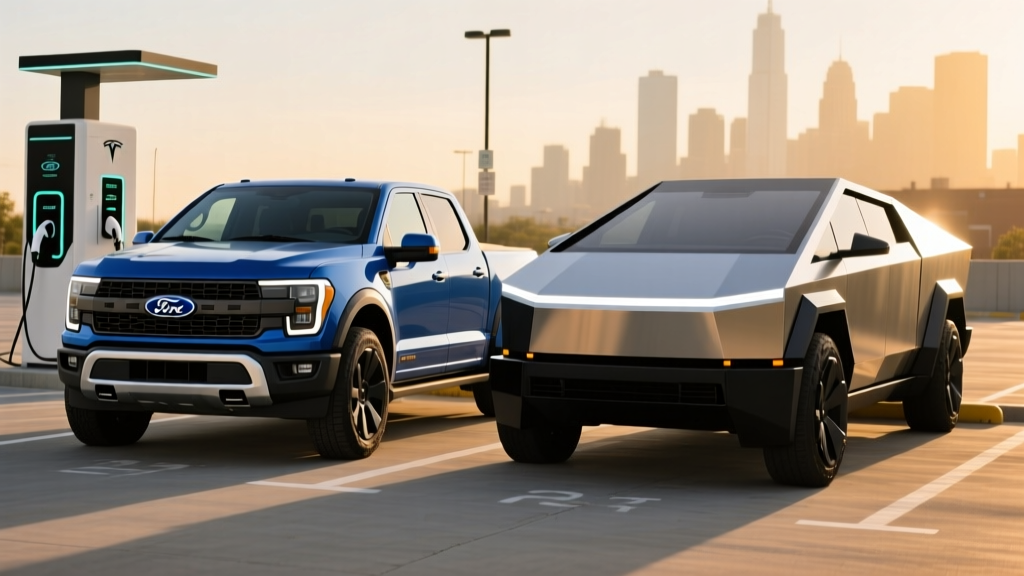
The electric truck segment has matured fast. Ford's F-150 Lightning has been on sale since 2022 and has accumulated years of real-world ownership data, while Tesla's Cybertruck — after its rocky 2023-2024 launch — has settled into a more stable production rhythm for 2026. For buyers who already own a Lightning and are eyeing Tesla's stainless-steel wedge, or vice versa, the decision comes down to hard numbers: range efficiency, charging infrastructure, towing capability, and total cost. This guide breaks down the F-150 Lightning and Cybertruck head-to-head so you can determine whether a swap makes financial and practical sense.
Side-by-Side Spec Comparison
| Spec | 2026 Ford F-150 Lightning (Ext. Range) | 2026 Tesla Cybertruck AWD |
|---|---|---|
| EPA Range | 320 miles | 318 miles (est.) |
| Battery Capacity | 131 kWh usable (NMC) | ~123 kWh usable (NMC, 4680 cells) |
| Peak DC Fast Charge | 150 kW | 250 kW (V3 Supercharger) |
| 10-80% DC Charge Time | ~41 min | ~28 min |
| Level 2 Home Charge Rate | 19.2 kW (80A) / ~30 mi/hr | 11.5 kW (48A) / ~18 mi/hr |
| 0-60 mph | 3.8 sec (Extended Range) | 3.9 sec (AWD Dual Motor) |
| Horsepower | 580 hp | 600 hp |
| Drivetrain | Dual-motor AWD | Dual-motor AWD |
| Max Towing Capacity | 10,000 lbs | 11,000 lbs |
| Payload | 2,235 lbs | 2,500 lbs |
| Bed Length | 5.5 ft (67 in) | 6.0 ft (72 in) |
| Cargo Volume (Bed + Frunk) | 52.8 cu ft bed + 14.1 cu ft frunk | ~67 cu ft bed + 7.1 cu ft frunk |
| MPGe (Combined) | 70 MPGe | 68 MPGe (est.) |
| Efficiency (kWh/100 mi) | 48 kWh/100mi | ~50 kWh/100mi |
| Base MSRP | $59,990 (Lariat Ext. Range) | $79,990 (AWD) |
| Battery Warranty | 8 yr / 100,000 mi | 8 yr / 120,000 mi |
Sources: fueleconomy.gov, Ford.com, Tesla.com. 2026 model-year specs; Cybertruck figures may adjust as EPA certifies final trims.
Real-World Range: What the EPA Sticker Doesn't Tell You
F-150 Lightning Extended Range: EPA 320 mi — Expect ~260-280 mi at sustained 75 mph highway speeds; ~220-240 mi in sub-30°F winter conditions.
Cybertruck AWD: EPA 318 mi (est.) — Expect ~250-270 mi highway; the angular stainless-steel body creates more aerodynamic drag than the Lightning's conventional shape, which hurts efficiency above 65 mph. Cold-weather loss: ~230-250 mi.
Both trucks are heavy — over 6,500 lbs curb weight — and that mass shows up at highway speed. The Lightning's more traditional aerodynamics give it a slight efficiency edge on flat interstate runs. The Cybertruck's 4680 cells offer better thermal management in extreme heat, but the wedge profile is a liability above 70 mph. If your commute is mostly city and suburban driving under 55 mph, both trucks will land closer to their EPA numbers thanks to regenerative braking recapturing energy in stop-and-go traffic.
For towing, plan on losing 40-50% of range regardless of which truck you choose. A 5,000-lb trailer at highway speed will drop the Lightning to roughly 160-180 miles between charges. The Cybertruck's slightly higher tow rating doesn't overcome the physics of moving that much air resistance.
Charging Speed and Infrastructure: Where the Swap Gets Complicated
| Charging Level | F-150 Lightning | Cybertruck |
|---|---|---|
| Level 1 (120V, 12A) | ~3 mi/hr | ~3 mi/hr |
| Level 2 (240V, 48A) | ~19 mi/hr (11.5 kW) | ~18 mi/hr (11.5 kW) |
| Level 2 (240V, 80A — Lightning only) | ~30 mi/hr (19.2 kW) | N/A |
| DC Fast Charge (Peak) | 150 kW (CCS/NACS adapter) | 250 kW (NACS native) |
| 10-80% DC Time | ~41 min | ~28 min |
| Connector (2026) | NACS (adapter) or CCS (older builds) | NACS native |
This is where the F-150 Lightning to Cybertruck swap decision gets tangible. The Lightning charges at a maximum of 150 kW on DC fast chargers, which means a 10-80% session takes roughly 41 minutes. The Cybertruck leverages Tesla's V3 Supercharger network at up to 250 kW, cutting that time to about 28 minutes. On a road trip, that 13-minute gap per stop adds up — especially with a 131 kWh battery that takes longer to fill at lower peak rates.
However, Ford's 2025+ Lightning models now ship with the NACS charge port, granting native access to Tesla Superchargers (over 20,000 stalls in North America as of 2026). Earlier CCS-equipped Lightnings use a Ford-supplied NACS adapter. The practical result: Lightning owners can already access the same Supercharger network that Cybertruck owners use. The Cybertruck's advantage is purely charge speed, not network exclusivity.
At home, the Lightning's available 80A onboard charger (19.2 kW) is a significant edge. If your electrical panel supports a 100A circuit, you'll add roughly 30 miles of range per hour of Level 2 charging — enough to fully replenish the 131 kWh pack overnight in about 8 hours. The Cybertruck's 48A (11.5 kW) onboard charger means a full charge takes closer to 13-14 hours on the same circuit. For daily commuters who plug in overnight, both are fine. For high-mileage drivers who need a full pack by morning, the Lightning's faster home charging is a practical win.
Pricing, Tax Credits, and Total Cost of the Swap
| Cost Factor | F-150 Lightning (Lariat Ext. Range) | Cybertruck AWD |
|---|---|---|
| Base MSRP | $59,990 | $79,990 |
| As-Tested (Typical Options) | $68,000-$74,000 | $85,000-$95,000 |
| Federal §30D Tax Credit | Up to $7,500 (see eligibility below) | Up to $7,500 (see eligibility below) |
| Effective Price After Credit | ~$52,490 (if eligible) | ~$72,490 (if eligible) |
| Destination Charge | $2,095 | $1,995 |
Federal tax credit eligibility (§30D) for 2026: Both trucks may qualify for the full $7,500 credit, but eligibility depends on three factors per IRS rules:
- MSRP Cap: Pickup trucks must have an MSRP at or below $80,000. The Lightning Lariat Extended Range clears this; the Cybertruck AWD at $79,990 base just squeaks under. Higher trims (Cybertruck Foundation Series, Lightning Platinum) may exceed the cap.
- Buyer Income Cap: Modified AGI must not exceed $150,000 (single), $225,000 (head of household), or $300,000 (joint).
- Battery Sourcing: Critical minerals and battery components must meet escalating domestic-content thresholds. Both manufacturers have adjusted supply chains, but eligibility can shift by model year and build date. Verify at fueleconomy.gov before purchasing.
The credit can now be transferred to the dealer at point of sale, effectively reducing your purchase price upfront rather than waiting for a tax refund. Consult a tax professional to confirm your specific eligibility.
The swap economics: If you currently own a 2023-2024 Lightning (purchased around $60,000-$70,000) and are considering a Cybertruck at ~$80,000+, you're looking at a $15,000-$25,000 out-of-pocket gap after trade-in value and potential credit. The Lightning's lower entry price and proven reliability record make the financial case for swapping weak unless the Cybertruck's specific capabilities (stainless exoskeleton, higher tow rating, faster DC charging) directly serve your use case.
Performance, Towing, and Daily Drivability
Both trucks deliver sports-car acceleration in a full-size pickup body. The Lightning Extended Range hits 0-60 in 3.8 seconds with 580 hp and 775 lb-ft of torque. The Cybertruck AWD matches at 3.9 seconds with 600 hp. In practice, the difference is imperceptible — both will surprise you at stoplights and merge onto highways with authority.
Towing: The Cybertruck's 11,000-lb rating edges the Lightning's 10,000-lb limit. For boat owners or those hauling heavy equipment trailers, the extra 1,000 lbs matters. Both trucks include integrated trailer brake controllers and trailer-assist camera systems. Ford's Pro Power Onboard (up to 9.6 kW of 120V/240V outlet power in the bed) is a standout for job-site use and tailgating — it can run power tools, a welder, or even provide backup home power during outages. Tesla does not offer an equivalent bed-power system as of 2026.
Daily driving: The Lightning drives like a conventional F-150 — familiar seating position, traditional mirrors, physical controls mixed with the SYNC 4A touchscreen. The Cybertruck demands adaptation: yoke steering (on some builds), a minimalist interior with all controls funneled through an 18.5-inch center display, and camera-based visibility due to the angular rear profile. The Lightning's Mega Power Frunk (14.1 cu ft) is lockable, drainable, and includes 120V outlets — genuinely useful as a mobile workstation. The Cybertruck's smaller 7.1 cu ft frunk is less practical.
Driver-Assist Technology: BlueCruise vs Autopilot
Both Ford BlueCruise and Tesla Autopilot/FSD (Supervised) are SAE Level 2 driver-assistance systems. The driver must remain attentive, keep hands on or near the wheel, and be prepared to take over at any moment. Neither system is autonomous (Level 4/5). Misuse of these systems has led to serious crashes documented by NHTSA.
Ford BlueCruise (available on Lightning): Hands-free driving on over 130,000 miles of pre-mapped divided highways in the US. A driver-facing camera monitors eye gaze. The system is conservative — it disengages in construction zones, inclement weather, and unmapped roads. Annual subscription: ~$75/year after the initial trial.
Tesla Autopilot / FSD Supervised (Cybertruck): Autopilot (included) handles adaptive cruise and lane-keeping. FSD Supervised ($8,000 one-time or $99/month as of 2026) adds automated lane changes, traffic-light recognition, and city-street navigation. Despite the name, FSD still requires active supervision. Tesla's vision-only approach (no lidar or radar) has drawn scrutiny; the system performs well in clear conditions but can struggle with heavy rain, direct sun glare, and faded lane markings.
Pros and Cons of Each Truck
- Lower base price ($59,990 vs $79,990)
- Pro Power Onboard (up to 9.6 kW bed power)
- Faster home Level 2 charging (80A / 19.2 kW available)
- Conventional truck ergonomics — easy transition from gas F-150
- Mega Power Frunk (14.1 cu ft, lockable, drainable)
- Proven reliability record over 3+ model years
- BlueCruise hands-free on mapped highways
- Slower DC fast charging (150 kW peak vs 250 kW)
- 10-80% charge takes ~41 min (vs ~28 min Cybertruck)
- Lower tow rating (10,000 lbs vs 11,000 lbs)
- Shorter bed (5.5 ft vs 6.0 ft)
- Less distinctive design — blends in with gas F-150s
- Faster DC charging (250 kW, 10-80% in ~28 min)
- Higher tow rating (11,000 lbs)
- Stainless-steel exoskeleton — dent and corrosion resistant
- Native NACS port — seamless Supercharger access
- Larger bed (6.0 ft / 72 in)
- 48-month / 120,000-mi battery warranty (vs 100,000 mi)
- Tesla OTA updates and expanding FSD capability
- $20,000+ higher base price
- Slower home Level 2 charging (48A / 11.5 kW max)
- Minimalist interior — learning curve for controls
- Smaller frunk (7.1 cu ft)
- No bed power outlets (no Pro Power equivalent)
- Build-quality inconsistencies reported in early production
- High insurance premiums due to stainless-steel repair costs
Who Should Make the Swap — and Who Shouldn't
Swap to Cybertruck if:
- You regularly tow 8,000+ lbs and need the extra 1,000-lb margin
- You take frequent road trips where 28-min vs 41-min DC charging saves meaningful time
- You value the stainless exoskeleton for job-site durability or off-trail brush resistance
- You're already deep in the Tesla ecosystem (Powerwall, solar, Supercharger route planning)
- You use bed power for tools, job-site equipment, or home backup (Pro Power Onboard)
- Budget matters — the $20K price gap is significant even after tax credits
- You prefer physical controls, conventional ergonomics, and a familiar truck driving position
- You charge primarily at home and want faster Level 2 replenishment (80A option)
- You want a proven platform with established service-center support nationwide
Frequently Asked Questions
What is the real-world range of the Ford F-150 Lightning?
The Extended Range model carries an EPA estimate of 320 miles. In real-world highway driving at 75 mph, expect 260-280 miles. In cold weather (below 30°F), range drops to approximately 220-240 miles due to battery chemistry limitations and cabin heating load. The Standard Range model (98 kWh) is EPA-rated at 240 miles with proportionally lower real-world figures.
How fast does the Cybertruck charge compared to the Lightning?
The Cybertruck peaks at 250 kW on DC fast chargers (Tesla V3 Superchargers), reaching 10-80% in about 28 minutes. The Lightning peaks at 150 kW, taking roughly 41 minutes for the same 10-80% session. Both trucks add approximately 3 miles per hour on a standard 120V outlet. At home on 240V, the Lightning's available 80A charger adds ~30 mi/hr, while the Cybertruck's 48A charger adds ~18 mi/hr.
Does the Ford F-150 Lightning qualify for the federal EV tax credit?
Yes, the Lightning is eligible for up to $7,500 under IRS §30D, provided the buyer meets income caps ($150K single / $300K joint), the truck's MSRP is at or below $80,000 (trucks category), and the battery meets critical-mineral and component-sourcing thresholds for the 2026 model year. The credit can be transferred to the dealer at point of sale. Verify current eligibility at fueleconomy.gov and consult a tax professional.
Is it worth swapping from a Lightning to a Cybertruck in 2026?
For most owners, the swap is not financially compelling. The Cybertruck costs $20,000+ more, offers only marginally more range, and lacks the Lightning's Pro Power Onboard and larger frunk. The swap makes sense if you specifically need the Cybertruck's 11,000-lb tow rating, faster DC charging for frequent road trips, or the stainless-steel body for durability. For daily commuting, home charging, and general truck use, the Lightning remains the more practical and affordable choice.
Can the Lightning use Tesla Superchargers?
Yes. 2025 and later F-150 Lightnings ship with a native NACS charge port, providing direct access to Tesla's Supercharger network. 2022-2024 Lightning models with CCS ports can use a Ford-provided NACS adapter. As of 2026, Tesla's Supercharger network includes over 20,000 stalls across North America.
What's the battery warranty on each truck?
Ford covers the Lightning's battery for 8 years or 100,000 miles (whichever comes first) with a minimum 70% capacity retention threshold. Tesla covers the Cybertruck's battery for 8 years or 120,000 miles with the same 70% threshold. Both warranties cover defects and excessive degradation but do not cover damage from accidents, flooding, or improper modifications.