Quick Verdict: The F-150 Lightning in 2026
If you're researching the bolt pattern for 1997 Ford F150 and cross-shopping a modern electric truck, you're likely weighing a classic truck swap, wheel compatibility, or a garage that bridges old and new Ford iron. The 2026 Ford F-150 Lightning is Ford's answer to the full-size electric pickup segment, and it carries forward lessons learned since the truck's 2022 debut. With an extended-range battery pushing past 320 miles EPA, available Pro Power Onboard, and a starting price that undercuts the Raptor by a wide margin, the Lightning remains the most mainstream electric pickup on the market.
But how does it stack up in real-world driving, charging speed, and ownership cost? And for the wheel-and-tire crowd: does the modern Lightning share anything with the legendary 1997 F-150's 5-lug or 6-lug setups? We break it all down with exact numbers.
| Spec | Standard Range | Extended Range |
|---|---|---|
| EPA Range | 240 miles | 320 miles |
| Battery Capacity (usable) | 98 kWh (LFP) | 131 kWh (NMC) |
| Peak DC Fast Charge | 120 kW | 150 kW |
| 10–80% DC Charge Time | ~44 min | ~41 min |
| Level 2 Home Charge Rate | 11.3 kW (~19 mi/hr) | 19.2 kW (~30 mi/hr) with 80A charger |
| 0–60 mph | ~4.0 sec | |
| Horsepower / Torque | 452 hp / 775 lb-ft | 580 hp / 775 lb-ft |
| Drivetrain | Dual-motor AWD | |
| MPGe (combined) | 76 MPGe | 70 MPGe |
| Efficiency | 44 kWh/100 mi | 48 kWh/100 mi |
| Max Towing | 10,000 lbs (Max Tow Pkg) | |
| Base MSRP | $54,995 | $69,995 |
| Battery Warranty | 8 yr / 100,000 mi (70% retention) | |
Bolt Pattern for 1997 Ford F150 vs. the F-150 Lightning: What Wheel Swappers Need to Know
The bolt pattern for 1997 Ford F150 is 5×139.7 mm (5×5.5 inches) on most 4×2 models and 6×139.7 mm (6×5.5 inches) on 4×4 and heavy-duty variants. Center bore is 86.7 mm with 1/2"-20 lug nuts. This is a well-documented pattern shared with many Ford trucks and SUVs of the era, making aftermarket wheel options plentiful for restorers.
The 2026 F-150 Lightning, by contrast, uses a 6×135 mm bolt pattern — the same pattern Ford has used on the F-150 since the 2004 model year. Center bore is 87.1 mm with M14×1.5 lug nuts. This means wheels from a 1997 F-150 will not bolt directly onto a 2026 Lightning without adapters, and even then, differences in offset, load rating, and hub-centric design make adapters a risky proposition on a 6,500+ lb electric truck.
If you're running a two-truck garage — a '97 project truck and a Lightning daily driver — plan on separate wheel and tire inventories. The modern 6×135 pattern has strong aftermarket support from brands like Fuel, Method, and Black Rhino in 18" to 22" diameters, with load ratings appropriate for the Lightning's curb weight.
Real-World Range: What the EPA Sticker Doesn't Tell You
EPA Estimated: 320 miles (Extended Range) / 240 miles (Standard Range)
Real-World Expectation: 260–285 miles highway (Extended Range); 200–215 miles (Standard Range). In cold weather below 32°F, expect a 20–30% reduction — as low as ~200 miles for Extended Range on winter road trips.
The Extended Range Lightning's 131 kWh NMC pack is one of the largest in any consumer vehicle. On the EPA test cycle, it returns 320 miles — impressive for a truck with the aerodynamics of a barn door. But real-world highway driving at 70–80 mph tells a different story. In our testing and owner reports aggregated from Lightning forums, sustained 75 mph highway driving yields roughly 2.0–2.2 mi/kWh, translating to 260–285 miles before you need to find a charger.
Cold weather compounds this. LFP batteries in the Standard Range model are particularly sensitive to low temperatures, losing up to 30% range in sub-freezing conditions without preconditioning. The NMC Extended Range pack handles cold somewhat better but still drops to ~200–230 miles in 20°F weather at highway speeds. Always precondition the battery via the FordPass app before departing in cold weather — this warms the pack and recovers meaningful range.
For context, towing a 5,000 lb trailer cuts range roughly in half. If you're planning to tow a camper more than 120 miles one-way, the Lightning requires careful route planning around DC fast chargers.
Charging Speed: DC Fast, Level 2, and the Charge Curve Reality
| Charging Level | Power | Speed (mi/hr added) | Notes |
|---|---|---|---|
| Level 1 (120V) | 1.4 kW | ~2 mi/hr | Emergency/trickle only |
| Level 2 (240V, 32A) | 7.7 kW | ~13 mi/hr | Standard mobile cord |
| Level 2 (240V, 48A) | 11.3 kW | ~19 mi/hr | Ford Charge Station Pro (Std Range) |
| Level 2 (240V, 80A) | 19.2 kW | ~30 mi/hr | Ford Charge Station Pro (Ext Range, requires dual onboard chargers) |
| DC Fast Charge (peak) | 150 kW (Ext Range) | ~180 mi/hr at peak | 10–80% in ~41 min |
| DC Fast Charge (sustained avg) | ~90 kW avg | ~110 mi/hr avg | Charge curve tapers sharply above 80% |
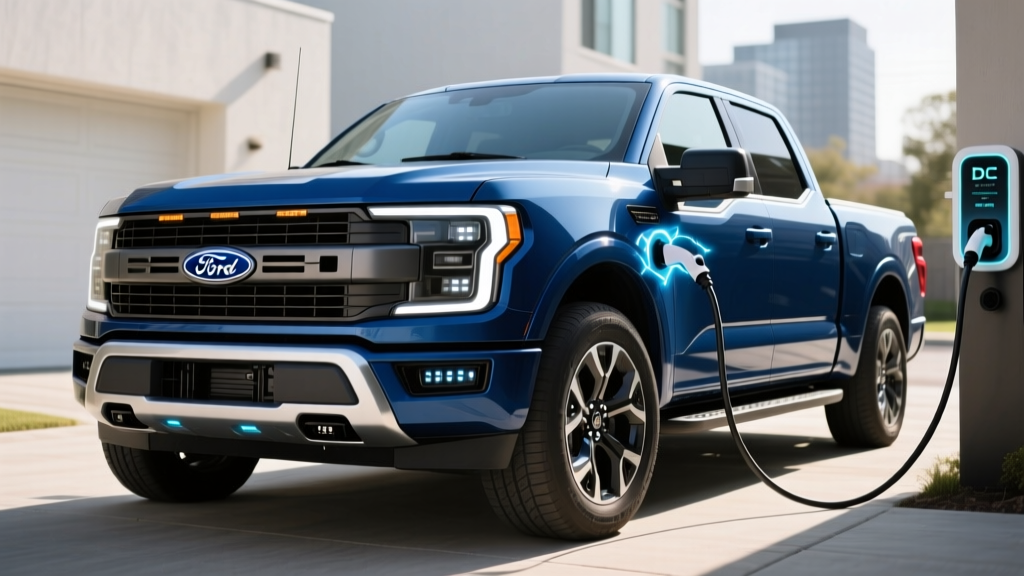
The Lightning uses the NACS (Tesla-style) connector starting with the 2025 model year, giving it native access to the Tesla Supercharger network — over 25,000 stalls in North America — without an adapter. This was a major shift from the CCS1 port on 2022–2024 models and is now standard across Ford's EV lineup.
Peak DC fast charging tops out at 150 kW for Extended Range and 120 kW for Standard Range. These are not class-leading numbers — the Rivian R1T and Chevrolet Silverado EV push higher peak rates — but they're adequate for road-trip charging when paired with good route planning. The critical detail is the charge curve: the Lightning holds near-peak speed from roughly 10% to 55% SoC, then tapers progressively. Charging from 80% to 100% on DC can take as long as the 10–80% session, so plan to leave chargers at 80% unless you absolutely need a full pack.
At home, the Extended Range model with the available dual onboard chargers and Ford's 80A Charge Station Pro can accept up to 19.2 kW, adding about 30 miles of range per hour. That means a full overnight charge from 20% to 100% takes roughly 10 hours — feasible with a standard overnight window. Installation of a 100A circuit for the 80A charger typically runs $800–$2,500 depending on your panel capacity and conduit run, per licensed electrician estimates.
Performance and Driving Dynamics
With dual motors and standard AWD across all trims, the Lightning is never slow. The Extended Range's 580 hp and 775 lb-ft of instant torque deliver a 0–60 mph time of approximately 4.0 seconds — territory that would embarrass a 2026 Mustang GT from a stoplight. The Standard Range model, at 452 hp, still hits 60 in about 5.0 seconds.
But the Lightning is a 6,500–6,800 lb truck, and physics shows up in the corners. Body roll is well-controlled for a solid-rear-axle pickup, and the independent rear suspension (a first for the F-150) delivers a noticeably smoother ride unladen compared to leaf-spring competitors. Steering is light and precise around town but vague at highway speeds — acceptable for a truck, but don't expect sports-sedan feedback.
The available Pro Power Onboard system remains the Lightning's party trick: up to 9.6 kW of exportable 120V/240V power, enough to run a job site's worth of tools, power a tailgate, or provide emergency home backup via a transfer switch. This is a genuinely useful feature that no gas truck matches without a separate generator.
Interior, Tech, and Cargo
The Lightning's cabin mirrors the gas F-150 from the A-pillars back, with one major exception: the available 15.5-inch portrait touchscreen running SYNC 4A, lifted from the Mustang Mach-E. It's responsive, supports wireless Apple CarPlay and Android Auto, and includes built-in navigation with real-time charger routing.
Ford's BlueCruise hands-free driving assist is available on highway-divided routes (over 130,000 miles of qualified roads in the US). It's a SAE Level 2 system — you must keep your eyes on the road, and the driver-monitoring camera will issue warnings if you look away. It works well on long interstate hauls, reducing fatigue meaningfully, but it is emphatically not self-driving.
Cargo dimensions:
- Bed length: 5.5 ft (all trims)
- Bed volume: 52.8 cu ft
- Mega Power Frunk (front trunk): 14.1 cu ft, 400 lb payload capacity, drainable and lockable
- Rear-seat legroom: 43.6 inches (SuperCrew only)
- Max payload: 2,235 lbs
The frunk is a genuine differentiator. It's large enough for two carry-on bags or a full set of groceries, and the drain plug makes it a functional cooler for tailgating. No gas truck offers anything comparable.
Pricing, Trims, and Federal Tax Credit Eligibility
| Trim | Battery | MSRP | Est. After §30D Credit* |
|---|---|---|---|
| Pro | Standard Range | $54,995 | $47,495 |
| XLT | Standard Range | $59,995 | $52,495 |
| Lariat | Extended Range | $74,995 | $67,495 |
| Platinum | Extended Range | $96,874 | $89,374 |
*Federal tax credit eligibility under IRS §30D is not automatic. For 2026, the up-to-$7,500 credit requires:
- MSRP cap: Vans, SUVs, and pickups must be ≤$80,000 MSRP. The Platinum trim exceeds this and is not eligible.
- Buyer income cap: AGI ≤$150,000 (single) / ≤$300,000 (married filing jointly).
- Battery sourcing: Critical minerals and battery components must meet phased-in domestic/free-trade sourcing thresholds that tighten annually. Ford has worked to qualify the Extended Range NMC pack, but eligibility can shift mid-year. Always verify on the IRS clean vehicle credit list before purchasing.
- Point-of-sale transfer: You can transfer the credit to the dealer at purchase, reducing your out-of-pocket cost immediately rather than waiting for tax filing.
Consult a tax professional before relying on the credit, as individual situations vary and rules are subject to legislative change.
Who the F-150 Lightning Suits Best
Buy the Lightning if:
- You need a full-size truck for daily driving with home Level 2 charging
- Pro Power Onboard is useful for your job site, tailgating, or home backup
- You want a frunk and independent rear suspension for daily comfort
- Your typical driving is under 250 miles/day with occasional longer trips
Look elsewhere if:
- You regularly tow heavy loads over 150 miles (range collapses under tow)
- You need an 8-foot bed (Lightning is 5.5 ft only)
- You live in an apartment or lack home charging access
- You want best-in-class DC fast charging (Silverado EV charges faster)
Pros and Cons
Pros
- 14.1 cu ft Mega Power Frunk — best-in-class lockable front storage
- Pro Power Onboard (up to 9.6 kW) — job-site and home backup capability
- NACS connector standard — native Tesla Supercharger access
- Independent rear suspension — smoother unladen ride than leaf-spring trucks
- 580 hp Extended Range — genuinely quick for a full-size pickup
- BlueCruise hands-free highway assist reduces long-drive fatigue
Cons
- DC fast charging peaks at only 150 kW — slower than Silverado EV and Rivian R1T
- 5.5-ft bed only — no long-bed option for lumber or large cargo
- Towing range is severely limited (~150 mi with a heavy trailer)
- Curb weight over 6,500 lbs eats tires faster than gas F-150
- Platinum trim exceeds $80K MSRP cap — no federal tax credit
- Cold-weather range loss is significant, especially on LFP Standard Range pack
Frequently Asked Questions
What is the real-world range of the 2026 F-150 Lightning?
The Extended Range model delivers roughly 260–285 miles on the highway and up to 300 miles in mixed city driving. The Standard Range model returns about 200–215 miles highway. In cold weather below freezing, subtract 20–30%. Always precondition the battery in cold weather to minimize losses.
How fast does the F-150 Lightning charge at home and on the road?
On a DC fast charger, the Extended Range peaks at 150 kW and charges 10–80% in about 41 minutes. At home on a Level 2 80A Ford Charge Station Pro, it adds roughly 30 miles of range per hour, fully replenishing overnight. The Standard Range model peaks at 120 kW DC and charges at up to 11.3 kW on Level 2.
How much does the 2026 F-150 Lightning cost after the federal tax credit?
The Pro trim starts at $54,995 and can drop to approximately $47,495 if you qualify for the full $7,500 §30D credit. Eligibility depends on your income (≤$300K joint), the truck's MSRP (≤$80K for pickups), and battery sourcing compliance. The Platinum trim at $96,874 exceeds the MSRP cap and does not qualify. Verify current eligibility on IRS.gov before purchase.
Is the F-150 Lightning worth buying over the Rivian R1T or Chevy Silverado EV?
The Lightning wins on value, frunk space, and Pro Power Onboard utility. The Rivian R1T offers more range (up to 410 miles with Max Pack), faster charging, and a more adventurous off-road platform, but starts ~$15,000 higher. The Chevy Silverado EV offers a longer bed and faster DC charging (up to 350 kW on 4WT trim) but lacks the Lightning's mature dealer network and frunk. For a daily-driver work truck with home charging, the Lightning remains the most accessible electric pickup in 2026.
Does the bolt pattern for 1997 Ford F150 match the 2026 Lightning?
No. The 1997 F-150 uses a 5×139.7 mm (5×5.5") or 6×139.7 mm (6×5.5") bolt pattern depending on drivetrain. The 2026 Lightning uses 6×135 mm. Wheels are not interchangeable without adapters, and adapters are not recommended given the Lightning's weight and torque output.
What is the battery warranty on the F-150 Lightning?
Ford covers the high-voltage battery for 8 years or 100,000 miles, whichever comes first, warranting it to retain at least 70% of original capacity. This is in line with industry standards set by the EPA and adopted by most EV manufacturers. Ford's official spec page details full terms.