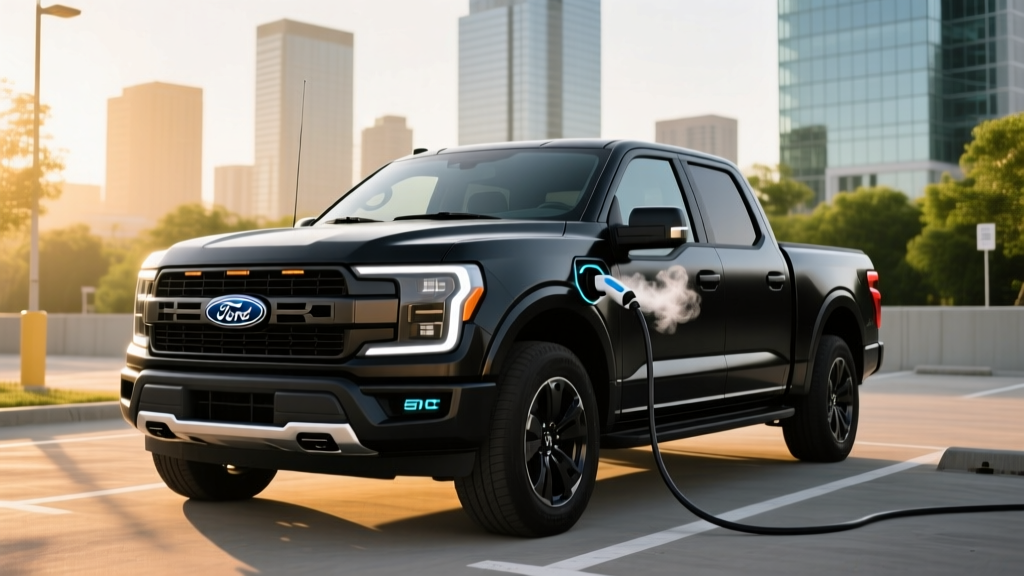
Quick Verdict: The F-150 Lightning in 2026
If you've been searching for a 97 Ford F-150 bolt pattern to swap wheels on a classic truck, you already know Ford's full-size pickups have long used a 6-lug layout. The good news? The 2026 Ford F-150 Lightning carries forward the same 6x135mm bolt pattern that Ford has used on the F-150 since the 1997 model year. That continuity matters for owners who want to carry over aftermarket wheels or simply understand the platform's lineage. But the Lightning is a fundamentally different machine underneath. This review covers the 2026 Lightning's real-world range, charging behavior, pricing after federal tax credits, and whether it's the right electric truck for your driveway.
Range and Efficiency: What the EPA Says vs. Reality
• Standard Range (98 kWh usable, LFP): 240 miles
• Extended Range (131 kWh usable, NMC): 320 miles
Real-World Expectation: Highway driving at 70+ mph typically yields 200–220 mi (Standard) and 270–290 mi (Extended). In sub-30°F winter conditions without preconditioning, expect a 20–30% reduction — bringing Extended Range down to roughly 220–250 mi. Towing a 5,000-lb trailer cuts range roughly in half regardless of battery pack.
The 2026 Lightning continues to offer two battery packs. The Standard Range pack uses lithium iron phosphate (LFP) chemistry, which trades energy density for longevity and the ability to routinely charge to 100% without accelerating degradation. The Extended Range pack uses NMC (nickel manganese cobalt) chemistry, which packs more kWh into a similar physical footprint but is best kept between 20–80% for daily use.
Efficiency on the Extended Range model lands around 66 MPGe combined (roughly 51 kWh/100 mi) per fueleconomy.gov. That's typical for a full-size electric truck pushing 6,500+ lbs. The Standard Range model is slightly more efficient per mile due to less mass, but the smaller battery means more frequent stops on road trips.
| Spec | Standard Range | Extended Range |
|---|---|---|
| Battery (usable) | 98 kWh (LFP) | 131 kWh (NMC) |
| EPA Range | 240 mi | 320 mi |
| Horsepower | 452 hp | 580 hp |
| Torque | 775 lb-ft | 775 lb-ft |
| 0-60 mph | ~4.8 sec | ~3.8 sec |
| Drivetrain | Dual-motor AWD | Dual-motor AWD |
| Max DC Charge Rate | 150 kW | 150 kW (peak, tapering) |
| 10-80% DC Time | ~36 min | ~41 min |
| Level 2 Home Rate | 11.5 kW (~27 mi/hr) | 19.2 kW (~45 mi/hr) w/ 80A charger |
| Max Towing | 7,700 lbs | 10,000 lbs |
| MPGe (combined) | 68 MPGe | 66 MPGe |
| Base MSRP | $54,995 | $69,995 |
Charging Speed: DC Fast, Level 2, and the Curve Reality
The Lightning uses the NACS (North American Charging Standard) connector natively, giving it seamless access to Tesla Supercharger stalls via Ford's integrated network agreement — a major advantage over CCS-only trucks. Peak DC fast-charge rate is 150 kW for both battery packs. That's not class-leading (the Silverado EV and Rivian R1T can accept more), but it's adequate for highway travel when paired with route planning.
| Level | Power | Miles Added/Hour | Use Case |
|---|---|---|---|
| Level 1 (120V) | 1.4 kW | ~3 mi/hr | Emergency / trickle |
| Level 2 (240V, 32A) | 7.7 kW | ~18 mi/hr | Standard home install |
| Level 2 (240V, 80A) | 19.2 kW | ~45 mi/hr | Ford Charge Station Pro |
| DC Fast (peak) | 150 kW | ~300+ mi/hr (initial) | Road trips |
A critical ownership note: the Extended Range pack's charge curve tapers significantly above 80% SoC. You'll hit 80% in roughly 41 minutes at a 150 kW stall, but pushing from 80–100% can add another 25+ minutes. For road trips, plan to charge in the 10–80% window and skip topping off unless it's your final stop. The Standard Range LFP pack, by contrast, handles regular 100% charges without degradation concerns, making it simpler for daily drivers who can charge at home overnight.
Performance, Payload, and Towing
Every 2026 Lightning ships with dual-motor all-wheel drive. The Extended Range's 580 hp and 775 lb-ft of instant torque deliver a 0-60 mph time around 3.8 seconds — genuinely quick for a vehicle that weighs over 6,500 lbs. The Standard Range model's 452 hp still manages roughly 4.8 seconds.
Towing capacity tops out at 10,000 lbs (Extended Range, Max Trailer Tow Package), but real-world range while towing drops dramatically. In independent testing, a 7,000-lb trailer reduced highway range to approximately 130–150 miles on the Extended Range pack. If towing more than 200 miles is a regular requirement, a diesel or PHEV alternative may be more practical until DC charging infrastructure catches up for truck-sized loads.
The Lightning's independent rear suspension improves ride quality over the solid rear axle on gas F-150s, particularly when the bed is empty. Payload capacity ranges from 1,800–2,235 lbs depending on configuration — competitive with gas equivalents but reduced by the battery mass.
Bolt Pattern, Wheels, and Platform Continuity
For owners cross-shopping wheels or coming from older F-150s: the 2026 Lightning retains the 6x135mm bolt pattern — the same specification Ford has used since the 1997 F-150 redesign. If you've been researching the 97 Ford F-150 bolt pattern for a wheel swap, you'll find the lug count and bolt circle diameter are identical on the Lightning. However, critical differences exist:
- Offset and backspacing differ due to the Lightning's wider track and independent rear suspension.
- Wheel load rating must accommodate the Lightning's higher curb weight (6,500–6,800 lbs vs. ~4,300 lbs for a '97 F-150).
- Center bore is 87.1mm on both generations, but hub-centric spacers should be verified for aftermarket fitment.
- Lug nut thread pitch is M14x1.5 on the Lightning (vs. M12x1.75 on many '97-era trucks).
Bottom line: the bolt circle matches, but always confirm offset, load rating, and thread pitch before mounting any wheel from a different model year.
Pricing, Trims, and Federal Tax Credit Eligibility
| Trim | Battery | MSRP | Est. After §30D Credit* |
|---|---|---|---|
| Pro | Standard Range | $54,995 | $47,495 |
| XLT | Standard Range | $59,995 | $52,495 |
| Lariat | Extended Range | $74,995 | $67,495 |
| Platinum | Extended Range | $84,995 | $77,495 |
*Federal tax credit estimates assume eligibility. See rules below.
- Credit amount: Up to $7,500 (point-of-sale transfer available at participating dealers)
- MSRP cap (trucks/vans): Vehicle MSRP must not exceed $80,000
- Buyer income cap: AGI ≤ $150,000 (single) / $300,000 (joint) / $225,000 (head of household)
- Battery sourcing: Critical minerals and battery component percentages must meet phased-in thresholds per IRS guidelines — confirm current-year compliance with your dealer
- Assembly: Vehicle must undergo final assembly in North America (Lightning qualifies — built in Dearborn, MI)
Consult a tax professional before relying on credit eligibility. Rules change annually and are subject to manufacturer sourcing updates.
The Platinum trim at $84,995 exceeds the $80,000 MSRP cap and therefore does not qualify for the §30D credit. The Pro and XLT trims with Standard Range are the credit-optimized choices. Lariat Extended Range may qualify depending on final option packaging — verify the window sticker MSRP before purchase.
Interior, Tech, and Cargo
The Lightning's cabin mirrors the gas F-150's layout but benefits from the absence of a transmission tunnel, creating a flat floor and generous front legroom (43.9 inches). Rear legroom measures 43.6 inches in the SuperCrew configuration. The 12-inch touchscreen (15.5-inch on Lariat and above) runs Ford's SYNC 4A with wireless Apple CarPlay and Android Auto.
Cargo dimensions:
- Bed length: 67.1 inches (5.5-ft box, SuperCrew)
- Bed volume: 52.8 cu ft
- Front trunk (frunk): 14.1 cu ft — lockable, drainable, and equipped with 2.4 kW of Pro Power Onboard outlets
- Max payload: 2,235 lbs (Pro trim)
The Pro Power Onboard system is a standout feature: 2.4 kW standard (up to 9.6 kW available on higher trims) turns the Lightning into a mobile generator capable of running job-site tools, tailgate equipment, or essential home circuits during outages via the available Ford Intelligent Backup Power (V2H) system.
Driver-assistance tech includes Ford's BlueCruise hands-free highway driving on pre-mapped divided highways. Important: BlueCruise is an SAE Level 2 system — the driver must remain attentive and is responsible for the vehicle at all times. It is not self-driving. The system monitors eye gaze and will issue escalating warnings if attention lapses.
Warranty and Long-Term Ownership
Ford covers the Lightning's battery and electric powertrain for 8 years or 100,000 miles, whichever comes first. The battery warranty guarantees the pack will retain at least 70% of original capacity during that period. The bumper-to-bumper warranty is 3 years/36,000 miles.
For the LFP Standard Range pack, real-world degradation data from early high-mileage Lightning fleets suggests 5–8% capacity loss over 100,000 miles with regular 100% charging — well within warranty limits. The NMC Extended Range pack shows similar or slightly higher degradation if routinely charged to 100%, reinforcing the case for 80% daily limits on that chemistry.
Insurance costs run 15–25% higher than a comparable gas F-150, driven by repair complexity and parts pricing. Get quotes before committing.
- Class-leading frunk volume (14.1 cu ft)
- Pro Power Onboard up to 9.6 kW — genuine job-site utility
- 6x135mm bolt pattern continuity with F-150s back to 1997
- BlueCruise hands-free on 130,000+ miles of mapped highways
- Qualifies for up to $7,500 §30D credit (below MSRP cap trims)
- Independent rear suspension — superior empty-bed ride
- 150 kW peak DC charge rate trails Rivian R1T and Silverado EV
- Towing slashes range to ~130–150 mi (Extended Range)
- Platinum trim exceeds $80k MSRP cap — no federal credit
- Insurance premiums 15–25% above gas F-150
- Extended Range NMC pack not ideal for routine 100% charging
- Heavy: 6,500+ lbs affects tire wear and braking distances
Who Should Buy the 2026 F-150 Lightning?
- You need a full-size truck bed and frunk for daily work or weekend projects
- Most of your driving is under 250 miles round-trip with home charging available
- You value Pro Power Onboard for job-site or tailgate use
- You want hands-free highway driving (BlueCruise) for commutes
- You regularly tow over 200+ miles without overnight stops
- You lack access to home Level 2 charging (public-only charging is costly and inconvenient for a truck this size)
- You need a sub-$50,000 price point (consider the Chevy Silverado EV Work Truck or wait for next-gen platforms)
Lightning vs. Key Competitors
The Lightning's closest rivals in 2026 are the Chevrolet Silverado EV (up to 400 mi range on 4WT trim, available 4-Wheel Steer), the Rivian R1T (tri-motor option, faster DC charging at ~200 kW, but smaller bed and higher starting price), and the Tesla Cybertruck (stainless steel body, 48V architecture, but polarizing design and limited service network). The Lightning wins on familiarity, dealer network breadth, and Pro Power Onboard utility. It loses on peak charging speed and maximum range to the Silverado EV.
Frequently Asked Questions
What is the real-world range of the 2026 F-150 Lightning?
Expect 200–220 miles highway on the Standard Range pack and 270–290 miles on the Extended Range pack in mild weather. Cold temperatures (below 30°F) can reduce these figures by 20–30%. City driving with regenerative braking often exceeds EPA estimates slightly.
How fast does the Lightning charge at home and on the road?
At home on a 240V/80A Ford Charge Station Pro, the Extended Range pack adds roughly 45 miles of range per hour (19.2 kW). On a 150 kW DC fast charger, expect a 10–80% charge in 36–41 minutes depending on pack size. Charging slows significantly above 80% SoC.
Does the 2026 Lightning qualify for the $7,500 federal tax credit?
Trims with an MSRP at or below $80,000 (Pro, XLT, and some Lariat configurations) can qualify, provided the buyer meets IRS income caps and the battery sourcing requirements are satisfied for the current year. The Platinum trim exceeds the MSRP cap and does not qualify. Verify with your dealer and a tax professional per IRS §30D rules.
Is the F-150 Lightning bolt pattern the same as a 1997 F-150?
Yes — both use a 6x135mm bolt circle. However, offset, center bore load requirements, and lug nut thread pitch (M14x1.5 on the Lightning vs. M12x1.75 on many '97 models) differ. Verify all dimensions before swapping wheels across generations.
Is BlueCruise self-driving?
No. BlueCruise is an SAE Level 2 driver-assistance system. It provides hands-free steering and speed control on compatible highways, but the driver must remain fully attentive and is legally responsible for the vehicle at all times.
What is the battery warranty on the Lightning?
Ford covers the battery and electric powertrain for 8 years or 100,000 miles with a minimum 70% capacity retention guarantee. The LFP Standard Range pack is generally more tolerant of frequent full charges than the NMC Extended Range pack.
Sources: EPA fueleconomy.gov, Ford Motor Company, IRS §30D Clean Vehicle Credits. Specifications reflect 2026 model year data available at time of publication. Confirm final pricing and credit eligibility with your dealer.