The Quick Answer: There Is No Ford F-100 Electric
If you're searching for a Ford F-100 electric, here's the reality: Ford never produced a factory-electric F-100 pickup at any point in the nameplate's history (1948–1983). The F-100 was discontinued after the 1983 model year, long before Ford committed to electrification. What you'll find instead are aftermarket EV conversions of classic F-100s (typically $40,000–$80,000+ depending on the shop and battery pack) and Ford's actual modern electric truck: the F-150 Lightning, starting at approximately $54,995 MSRP for the 2025 model year with up to 320 miles of EPA-estimated extended-range capability.
If you want a Ford electric truck today, the F-150 Lightning is your production option. If you want a classic F-100 with an EV powertrain, you're looking at the custom conversion market. Below, we break down both paths with real numbers.
Why the Ford F-100 Electric Doesn't Exist (And What Does)
The Ford F-100 was a half-ton pickup produced from 1948 through 1983, spanning seven generations. When Ford retired the F-100 badge, it consolidated its light-duty truck line under the F-150 name. Ford did not begin serious electric vehicle development until decades later, with the Focus Electric (2011), followed by the Mustang Mach-E (2021) and the F-150 Lightning (2022).
The confusion around a "Ford F-100 electric" likely stems from two sources:
- Classic EV conversion shops like Zero Labs, Icon, and smaller boutique builders who drop modern electric powertrains into restored F-100 bodies. These are one-off or limited-run custom vehicles, not Ford production models.
- Naming confusion with the F-150 Lightning, Ford's actual electric full-size pickup.
Let's look at what you can actually buy or build.
Option 1: The Ford F-150 Lightning — Ford's Real Electric Truck
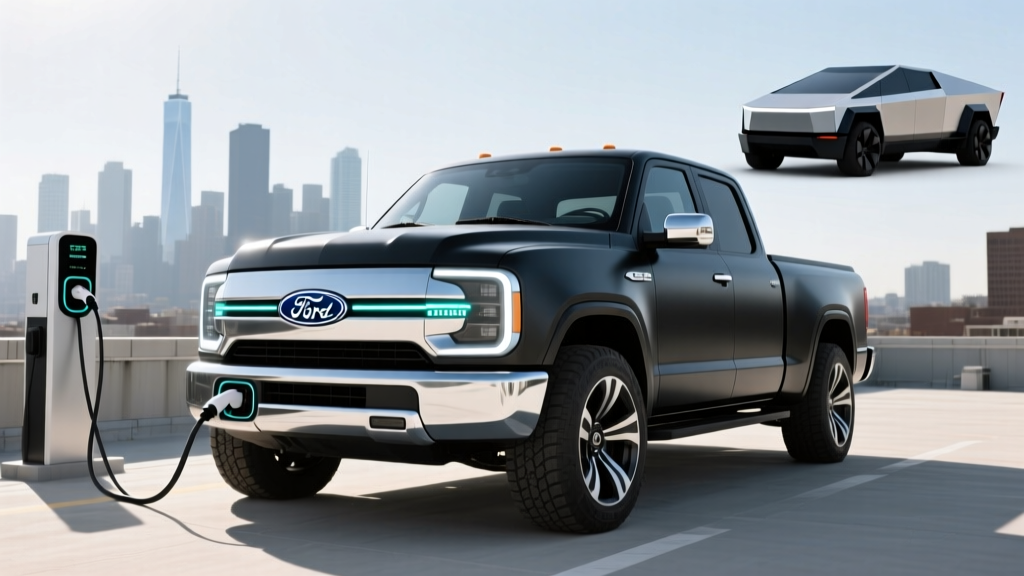
The F-150 Lightning is a full-size, four-door electric pickup built on a dedicated EV platform with a body-on-frame architecture. Here are the core specifications for the current production model:
| Specification | Standard Range | Extended Range |
|---|---|---|
| EPA Range | ~240 miles | ~320 miles |
| Battery Capacity (usable) | ~98 kWh (LFP) | ~131 kWh (NMC) |
| Horsepower | 563 hp | 563 hp |
| Torque | 775 lb-ft | 775 lb-ft |
| 0–60 mph | ~4.5 sec | ~3.8 sec |
| Max DC Fast Charge Rate | ~150 kW | ~150 kW |
| 10–80% DC Charge Time | ~36 min | ~41 min |
| Level 2 Home Charge Rate | 11.3 kW (~19 mi/hr) | 11.3 kW (~30 mi/hr) |
| Max Payload | ~2,235 lbs | ~1,800 lbs |
| Max Towing | ~7,700 lbs | ~10,000 lbs |
| Starting MSRP (Pro trim) | ~$54,995 | |
| Battery Warranty | 8 years / 100,000 miles | |
Real-World Range Reality Check
The 320-mile EPA figure for the Extended Range applies to mixed city/highway driving in moderate temperatures. Expect roughly 250–275 miles on sustained highway driving at 70+ mph, and potentially 200–230 miles in sub-freezing winter conditions without consistent preconditioning. Towing a trailer can cut range by 40–50%. These are physics, not defects — all EVs behave similarly. Source: fueleconomy.gov.
F-150 Lightning Federal Tax Credit Eligibility
Under the current IRS §30D rules, the F-150 Lightning's eligibility for the up-to-$7,500 federal tax credit depends on battery-component and critical-minerals sourcing requirements, buyer income caps ($150K single / $300K joint MAGI), and MSRP limits ($80,000 for trucks). The credit can now be transferred at the point of sale as a price reduction. Always verify current eligibility on IRS.gov's qualified vehicles list, as sourcing rules shift annually.
Option 2: Aftermarket F-100 EV Conversions
If you specifically want the classic F-100 aesthetic with an electric drivetrain, several shops offer conversions. This is a niche, high-cost path with very different ownership economics than a production EV.
| Factor | F-150 Lightning (Production) | F-100 EV Conversion (Custom) |
|---|---|---|
| Vehicle Cost | $54,995–$96,000 | $60,000–$120,000+ |
| Federal Tax Credit | Potential up to $7,500 (§30D) | None (not a new qualified vehicle) |
| Warranty | 3yr/36K bumper + 8yr/100K battery | Shop-dependent; often 1–3 years limited |
| EPA Certification | Full EPA range testing | None — range is shop-estimated |
| Safety Ratings | NHTSA/IIHS tested | No crash testing (classic body) |
| Insurance | Standard EV rates (~$1,800–$2,500/yr) | Specialty classic/agreed-value ($2,500–$5,000+/yr) |
| Service Network | Ford dealers nationwide | Conversion shop or specialist only |
| Resale Liquidity | Broad market | Collector niche; slower sale |
Typical conversion specs from reputable shops include a 60–100 kWh battery pack (often salvaged or new NMC modules), 150–300 miles of estimated range, 200–400 hp, and CCS or NACS charging ports. Charge speeds vary wildly — some conversions lack DC fast charging entirely, relying on Level 2 only. Always ask a conversion shop for the exact pack kWh, charge rate in kW, and whether thermal management is active (liquid-cooled) or passive (air-cooled), as this drastically affects battery longevity and charge speed.
F-150 Lightning vs. Gas F-150: 5-Year Cost Comparison
For buyers cross-shopping the Lightning against a conventional gas F-150, here's a 5-year / 75,000-mile ownership estimate. Assumptions: $0.14/kWh home electricity (national average), $3.50/gallon gas, 15 MPG combined for a gas F-150 4WD, 2.0 kWh/mile for the Lightning Extended Range.
| Cost Category | F-150 Lightning Ext. Range | Gas F-150 4WD (2.7L EcoBoost) |
|---|---|---|
| Purchase Price (MSRP) | ~$72,000 (XLT) | ~$52,000 (XLT) |
| Est. Federal Tax Credit | Up to $7,500 | $0 |
| Effective Purchase | ~$64,500 | ~$52,000 |
| Fuel/Energy (75K miles) | ~$2,100 (home charging) | ~$17,500 (gas) |
| Maintenance (5 yr) | ~$1,500 | ~$4,500 |
| Insurance (5 yr est.) | ~$11,000 | ~$8,500 |
| 5-Year Total Cost | ~$79,100 | ~$82,500 |
The Lightning's higher purchase price is partially offset by dramatically lower energy costs and reduced maintenance (no oil changes, fewer brake replacements due to regenerative braking, no transmission fluid). However, insurance premiums run 15–30% higher on average for EVs due to repair costs and battery replacement risk. Your actual numbers depend on local electricity rates, driving patterns, and whether you qualify for the full tax credit.
Real-World Ownership Considerations for EV Trucks
Home Charging Is Essential
A Level 2 home charger (240V, 40–48 amps) delivers roughly 19–30 miles of range per hour for the Lightning, meaning an overnight charge easily replenishes a full day's driving. Expect $500–$2,500 for a professional Level 2 installation depending on your panel capacity and conduit run. If your home has a 100-amp electrical panel, you may need a $1,500–$3,000 panel upgrade to 200 amps to support a 48-amp EVSE. Always get a quote from a licensed electrician before purchasing a charger.
Public Charging on Road Trips
The Lightning uses the NACS (Tesla-style) connector on newer model years, granting access to the Tesla Supercharger network (17,000+ stalls in the US) via adapter or native port. On a road trip, a 10–80% DC fast charge takes approximately 36–41 minutes. Plan stops around 200-mile intervals to stay within the charge curve's efficient zone — charging slows significantly above 80% state of charge.
Cold Weather and Towing
Battery chemistry matters here. The Standard Range Lightning uses LFP (lithium iron phosphate), which handles cold slightly less efficiently than NMC but offers superior long-term cycle life. The Extended Range uses NMC. In sub-freezing temperatures, precondition the battery while plugged in — this warms the pack using grid power rather than battery energy, preserving range. When towing, plan for roughly half your unloaded range.
Common Misconceptions About Electric Trucks
| Myth | Fact |
|---|---|
| "Electric trucks can't tow." | The F-150 Lightning Extended Range is rated for up to 10,000 lbs. Range drops significantly while towing (expect ~150 miles), but the capability exists. |
| "Batteries need replacing every few years." | Ford warranties the Lightning battery for 8 years/100,000 miles with a minimum 70% capacity retention threshold. Real-world data from fleets shows most packs retain 85–90%+ capacity at 100K miles. |
| "Charging takes too long." | At home on Level 2, you plug in overnight and wake up full — it's faster than a gas station for daily use. Road-trip DC fast charging adds 150+ miles in 20 minutes. |
| "EVs are worse in cold weather." | EVs start instantly in any cold (no cranking a frozen engine), and preconditioning while plugged in means a warm cabin and battery before departure. Range does drop 15–30% in extreme cold — plan accordingly. |
| "There's no Ford F-100 electric, so Ford doesn't do electric trucks." | The F-100 was discontinued in 1983. The F-150 Lightning is Ford's current electric truck and has been in production since 2022. |
Decision Framework: Should You Buy the Lightning or Convert an F-100?
Choose the F-150 Lightning If:
- You need a daily-driver truck with modern safety, warranty, and dealer service
- You want federal tax credit eligibility and predictable ownership costs
- You need NHTSA crash-test ratings and ADAS features (BlueCruise hands-free driving, automatic emergency braking)
- You tow regularly and need rated tow/payload figures
- Your budget is $55,000–$96,000 and you want a new vehicle with financing options
Choose an F-100 EV Conversion If:
- You want a classic show/resto-mod truck and budget is $80,000–$150,000+
- You accept no crash-test ratings, limited warranty, and niche resale
- You want a unique vehicle and understand the trade-offs in service access and insurance
- This is a secondary/weekend vehicle, not your primary daily driver
- You value aesthetics and nostalgia over practicality and efficiency
What First-Time EV Truck Buyers Must Know
If the Lightning is your first EV, here's what changes from a gas truck:
- Fueling becomes charging. Install a Level 2 home charger before or immediately after delivery. Budget $500–$2,500 for installation.
- Plan road trips around chargers. Use the FordPass app or A Better Routeplanner (ABRP) to map DC fast-charging stops. The Supercharger network is the most reliable.
- Regenerative braking changes how you drive. One-pedal driving mode recaptures energy during deceleration. Expect to use the friction brakes far less.
- Maintenance drops significantly. No oil changes, no spark plugs, no transmission service. Rotate tires, replace cabin filters, top off washer fluid — that's most of it.
- Insurance may cost more. Get quotes before purchasing. EV insurance premiums average 15–30% higher than comparable gas vehicles.
- The tax credit isn't guaranteed. Verify your income, the vehicle's MSRP, and current battery-sourcing rules on IRS.gov before counting on $7,500 off.
Frequently Asked Questions
Did Ford ever make an electric F-100?
No. The Ford F-100 was produced from 1948 to 1983 as a gasoline-powered pickup. Ford did not manufacture any electric F-100 variant. Electric F-100s available today are aftermarket conversions performed by independent shops.
How much does it cost to convert a classic F-100 to electric?
A professional EV conversion of a classic F-100 typically costs $40,000–$80,000 for the conversion work alone, on top of the donor vehicle cost ($5,000–$30,000 depending on condition). Total project costs of $60,000–$120,000+ are common for quality builds with 150+ miles of range and DC fast charging.
Is the F-150 Lightning eligible for the $7,500 tax credit?
Eligibility depends on current IRS §30D rules including battery-component sourcing, critical-minerals requirements, buyer income limits ($150K single / $300K joint), and the $80,000 MSRP cap for trucks. The credit can be applied at the point of sale. Check the current qualified vehicle list on IRS.gov before purchasing.
What's the real-world range of the F-150 Lightning?
The Extended Range model carries a 320-mile EPA estimate. Real-world highway driving at 70+ mph typically yields 250–275 miles. In sub-freezing weather, expect 200–230 miles. Towing can reduce range to approximately 150 miles depending on trailer weight and aerodynamics.
Can I charge the F-150 Lightning at a Tesla Supercharger?
Yes. Ford has adopted the NACS (North American Charging Standard) connector for the Lightning, providing direct access to Tesla's Supercharger network. Older CCS-equipped models can use a Ford-provided NACS adapter.
How long does the F-150 Lightning battery last?
Ford warranties the battery pack for 8 years or 100,000 miles against degradation below 70% of original capacity. Based on fleet data and battery chemistry projections, most Lightning packs should retain 80–90% capacity at 150,000+ miles with normal use. Full battery replacement, if ever needed, is estimated at $15,000–$25,000+ out of warranty.