Ford EVs 2025: Quick Answer
Ford's 2025 EV lineup includes the Mustang Mach-E (250-320 miles EPA range, $37,995-$65,995) and F-150 Lightning (240-320 miles EPA range, $54,995-$96,874). Both qualify for the full $7,500 federal tax credit under current §30D rules for eligible buyers. Real-world highway range typically runs 10-15% below EPA estimates, with additional 20-30% loss in cold weather. Home Level 2 charging adds 20-30 miles per hour; DC fast charging peaks at 150 kW (Mach-E) or 155 kW (Lightning), delivering 10-80% in 45-52 minutes.
Current Ford EV Lineup: Models and Specifications
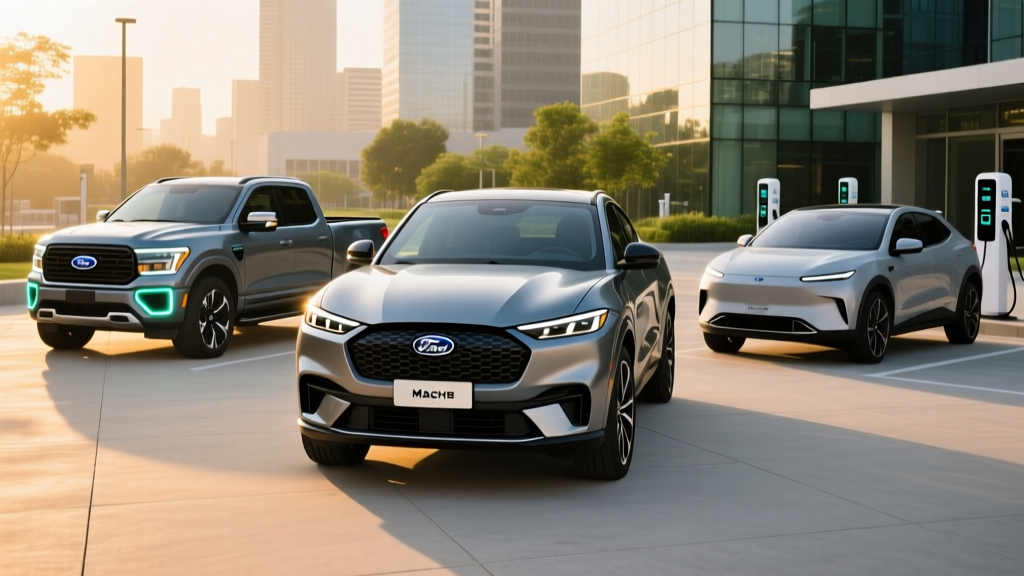
Ford offers two battery-electric vehicles for 2025, both built on dedicated EV platforms with distinct use cases. The Mustang Mach-E targets crossover buyers seeking performance and efficiency, while the F-150 Lightning serves truck buyers needing payload, towing, and job-site capability.
| Specification | Mustang Mach-E (2025) | F-150 Lightning (2025) |
|---|---|---|
| EPA Range | 250-320 miles | 240-320 miles |
| Battery Capacity (usable) | 70 kWh (Standard) / 91 kWh (Extended) | 98 kWh (Standard) / 131 kWh (Extended) |
| Battery Chemistry | NMC (Nickel Manganese Cobalt) | NMC (Nickel Manganese Cobalt) |
| Peak DC Fast Charge Rate | 150 kW | 155 kW |
| 10-80% DC Fast Charge Time | ~45 minutes | ~41-52 minutes |
| Level 2 Charging Rate | 10.5 kW (48A) | 11.5 kW (48A) / 19.2 kW (80A option) |
| 0-60 mph | 3.5s (GT) / 5.1-6.1s (other trims) | 3.8s (Extended Range) / 4.5s (Standard) |
| Horsepower | 266-480 hp | 563-580 hp |
| Starting MSRP | $37,995 (Select RWD) | $54,995 (Pro 4x4) |
| Battery/Powertrain Warranty | 8 years / 100,000 miles | 8 years / 100,000 miles |
Real-World Range vs. EPA Estimates
EPA sticker: Mach-E Extended Range AWD: 290 miles | F-150 Lightning Extended Range: 320 miles
Real-world expectation: Highway driving at 70-75 mph typically yields 250-260 miles (Mach-E) and 270-285 miles (Lightning). Cold weather (below 32°F) reduces range by 20-30%, dropping the Mach-E to ~200-210 miles and the Lightning to ~220-240 miles. Preconditioning the battery while plugged in mitigates some cold-weather loss.
Ford EVs vs. Gas Equivalents: Cost and Efficiency Comparison
The decision between Ford's EVs and their gas counterparts hinges on driving patterns, fuel costs, and ownership timeline. Here's how the math works for typical use cases.
| Metric | Mustang Mach-E (AWD Extended) | Ford Escape (AWD 2.0T Gas) | F-150 Lightning (Extended) | Ford F-150 (4x4 3.5L V6 Gas) |
|---|---|---|---|---|
| MSRP (base comparable trim) | $45,995 | $35,495 | $69,995 | $52,000 |
| Federal Tax Credit | -$7,500* | $0 | -$7,500* | $0 |
| Effective Purchase Price | $38,495 | $35,495 | $62,495 | $52,000 |
| EPA Efficiency | 98 MPGe (2.9 mi/kWh) | 26 MPG combined | 70 MPGe (2.1 mi/kWh) | 19 MPG combined |
| Energy Cost per Mile** | $0.045 (home charging) | $0.13 (gas at $3.40/gal) | $0.062 (home charging) | $0.18 (gas at $3.40/gal) |
| Annual Fuel/Energy (15k miles) | $675 | $1,950 | $930 | $2,700 |
| 5-Year Fuel/Energy Cost | $3,375 | $9,750 | $4,650 | $13,500 |
| Maintenance (5 years)*** | $2,200 | $4,500 | $2,800 | $5,200 |
| 5-Year Total (purchase + fuel + maint) | $44,070 | $49,745 | $69,945 | $70,700 |
*Federal tax credit eligibility requires meeting income caps ($150k single / $300k joint), MSRP caps ($55k cars / $80k trucks), and battery sourcing requirements. Verify current eligibility at IRS.gov. Credit can be transferred to dealer at point of sale as of 2024.
**Based on national average electricity rate of $0.16/kWh and gas at $3.40/gallon. Your rates vary by state and utility.
***EV maintenance excludes oil changes, spark plugs, transmission fluid. Includes tire rotation, cabin air filter, brake fluid check. EVs use regenerative braking, extending brake pad life significantly.
Charging Infrastructure: Home Setup and Public Networks
Ford EVs use the CCS1 connector for DC fast charging and J1772 for Level 2 AC charging. Starting in 2025, Ford provides NACS adapters for Tesla Supercharger access, expanding the public charging network significantly.
| Charging Level | Power (kW) | Miles Added per Hour | Typical Use Case | Equipment Cost |
|---|---|---|---|---|
| Level 1 (120V) | 1.4 kW | 3-5 miles | Overnight trickle, emergencies | $0 (included cord) |
| Level 2 (240V, 32A) | 7.7 kW | 20-25 miles | Home daily charging | $300-$600 (charger) |
| Level 2 (240V, 48A) | 10.5-11.5 kW | 28-35 miles | Home fast charging | $500-$800 (charger) |
| DC Fast Charge | 50-155 kW | 150-250 miles in 30 min | Road trips, public stations | $0.30-$0.50/kWh public |
Home Charging Installation Costs
Most Ford EV owners install a Level 2 home charger on a 240V circuit. Installation costs vary dramatically based on your electrical panel's capacity and distance from the panel to the garage.
| Scenario | Equipment | Electrician Labor | Permit | Total Range |
|---|---|---|---|---|
| Simple install (panel has capacity, short run) | $500-$700 | $300-$600 | $50-$150 | $850-$1,450 |
| Moderate install (longer wire run, conduit) | $500-$700 | $800-$1,500 | $50-$150 | $1,350-$2,350 |
| Panel upgrade required (100A → 200A service) | $500-$700 | $2,000-$4,000 | $100-$300 | $2,600-$5,000 |
Critical: Have a licensed electrician assess your panel's available amperage before purchasing a charger. A 48A charger requires a 60A circuit (80% continuous load rule). If your panel is maxed out, you'll need a panel upgrade or a lower-amperage charger.
Real-World Ownership Considerations
Who Should Buy a Ford EV (and Who Shouldn't)
Decision Framework: Is a Ford EV Right for You?
Choose a Ford EV if:
- You have home charging access (garage or driveway with 240V outlet capability)
- Your daily driving is under 200 miles round-trip
- You live in a moderate climate or have garage parking (cold-weather range loss is real)
- You want lower operating costs and plan to keep the vehicle 4+ years
- You qualify for the federal tax credit (income and MSRP caps apply)
- For Lightning buyers: You need a truck for payload/towing but drive mostly local/regional
Consider a hybrid or gas vehicle if:
- You lack home charging and rely solely on public infrastructure
- You regularly drive 300+ miles in a day (road trips, rural routes)
- You live in extreme cold climates and park outside (Alaska, northern Minnesota)
- You need maximum towing capacity (Lightning's range drops 40-50% when towing heavy loads)
- Your budget is tight and you can't absorb higher upfront cost even with tax credits
Common Misconceptions About Ford EVs
| Myth | Fact |
|---|---|
| "EV batteries need replacement every few years" | Ford's battery warranty covers 8 years/100,000 miles with a 70% capacity retention threshold. Real-world data shows modern NMC batteries degrade 10-15% over 8-10 years with normal use. Replacement cost (if needed out of warranty): $15,000-$22,000 for Mach-E, $20,000-$30,000 for Lightning. |
| "Charging takes too long for road trips" | DC fast charging adds 150-200 miles in 30 minutes. With preconditioning and route planning (using Ford's built-in navigation or A Better Routeplanner), a 500-mile trip takes ~1.5 hours of charging stops. This aligns with typical rest/meal breaks. |
| "EVs are worse in cold weather" | Range drops 20-30% in sub-freezing temps, but EVs start reliably (no cold-cranking issues) and can precondition the cabin while plugged in, preserving range. The Mach-E and Lightning both offer heat pumps (standard on 2025 models) to improve cold-weather efficiency. |
| "The F-150 Lightning can't tow" | The Lightning tows up to 10,000 lbs (Extended Range with Max Trailer Tow Package). However, towing at max capacity reduces range by 40-50%. For frequent heavy towing over long distances, a diesel or gas Super Duty remains more practical. |
| "I'll save money immediately with an EV" | Break-even timeline depends on mileage and fuel costs. With 15,000 miles/year and the $7,500 tax credit, most buyers break even in 2-4 years vs. gas equivalents. If you drive less than 10,000 miles/year, the payback extends to 5+ years. |
Insurance, Depreciation, and Long-Term Costs
EV insurance premiums run 10-20% higher than gas equivalents due to higher repair costs and vehicle values. Expect to pay $1,800-$2,400/year for Mach-E insurance and $2,200-$3,000/year for Lightning (varies by state, driving record, coverage levels).
Depreciation data for Ford EVs is still emerging (Mach-E launched 2021, Lightning 2022). Early indicators show EVs depreciate faster than Toyota/Honda gas vehicles but comparable to other domestic brands. The federal tax credit effectively reduces your purchase price, partially offsetting steeper depreciation curves.
What First-Time EV Buyers Need to Know
- Install your home charger before delivery day. Scheduling electricians can take 2-6 weeks. Don't rely on Level 1 (120V) charging as your primary strategy—it's too slow for daily use.
- Learn to precondition. Set departure times in the FordPass app while plugged in. This warms/cools the cabin and battery using grid power, preserving range and enabling faster DC charging.
- Download charging apps before your first road trip. Ford's built-in navigation integrates with charging networks, but having PlugShare, ChargePoint, and Electrify America apps provides backup options and real-time station status.
- Understand the charging curve. DC fast chargers peak at 150-155 kW only between 10-50% state of charge. Above 80%, charging slows dramatically to protect battery health. Plan to charge to 80% and go, rather than waiting for 100%.
- Check your utility's EV rate plan. Many utilities offer time-of-use rates with cheaper electricity overnight (10pm-6am). This can cut your charging cost by 30-50%.
Frequently Asked Questions
Do Ford EVs qualify for the $7,500 federal tax credit in 2025?
Both the Mustang Mach-E and F-150 Lightning currently qualify for the full $7,500 credit, but eligibility depends on your income (under $150k single / $300k joint), the vehicle's MSRP (under $55k for Mach-E trims, under $80k for Lightning), and battery component sourcing. Credit can be transferred to the dealer at point of sale, reducing your purchase price directly. Verify current eligibility at IRS.gov before purchasing, as sourcing requirements phase in through 2025.
Can I use Tesla Superchargers with a Ford EV?
Yes. Starting in 2025, Ford provides a NACS adapter (included with new vehicles, available for purchase for existing owners) that enables access to Tesla's Supercharger network. This adds ~15,000 charging locations nationwide. You'll need the adapter and must activate access through the FordPass app.
How long does it take to charge a Ford EV at home?
With a 48A Level 2 charger (240V), the Mach-E Extended Range (91 kWh battery) charges from empty to full in ~9 hours. The Lightning Extended Range (131 kWh) takes ~12-13 hours. Most owners charge overnight and wake to a full battery daily. A 32A charger extends these times to ~13 hours (Mach-E) and ~18 hours (Lightning).
What's the real-world range when towing with the F-150 Lightning?
The Lightning Extended Range (320 miles EPA) drops to 160-190 miles when towing 7,000-10,000 lbs at highway speeds. Standard Range (240 miles EPA) falls to 120-140 miles under similar loads. For comparison, a gas F-150 with the 3.5L EcoBoost and 36-gallon tank maintains ~350-400 miles towing the same weight.
Are Ford EVs reliable compared to gas vehicles?
Early reliability data (Consumer Reports, J.D. Power) shows mixed results for the Mach-E and Lightning, with common issues around build quality, software glitches, and 12V battery failures—not traction battery problems. EVs have fewer moving parts than gas vehicles (no transmission, exhaust system, or engine), reducing long-term mechanical failure risk. Ford's 8-year/100,000-mile battery warranty provides protection against major battery degradation.
Should I buy the Standard Range or Extended Range battery?
Choose Extended Range if: your daily driving exceeds 150 miles, you live in a cold climate, you plan frequent road trips, or you tow regularly (Lightning). Choose Standard Range if: you have reliable home charging, drive under 100 miles daily, live in a moderate climate, and want to minimize purchase price. The $8,000-$10,000 premium for Extended Range pays off in flexibility and resale value.
Sources: EPA Fuel Economy, Ford Motor Company, IRS Clean Vehicle Credits