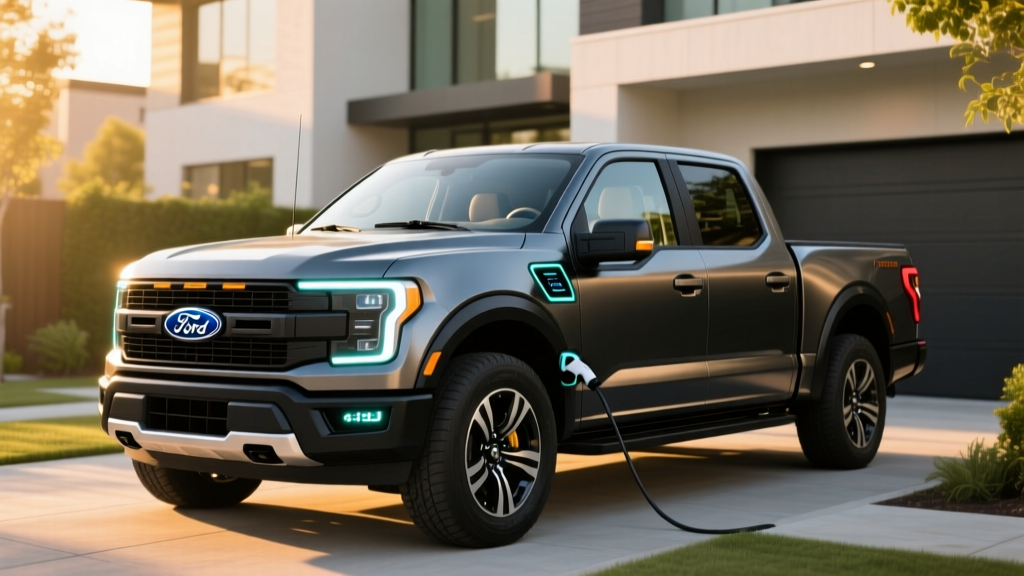
If you're researching a Ford EV pickup, you're almost certainly looking at the F-150 Lightning — Ford's full-size electric truck that has been in production since 2022 and continues into the 2026 model year. The short answer on whether it's worth buying: the Lightning delivers 230–320 miles of EPA range depending on battery pack, can tow up to 10,000 lbs, and costs roughly $55,000–$96,000 before incentives. It charges at up to 150 kW on DC fast chargers (10–80% in about 41 minutes for the extended-range pack). For truck buyers with home charging access and daily commutes under 200 miles, it slashes fuel and maintenance costs dramatically. For those who regularly tow long distances or lack reliable charging, a gas or hybrid F-150 may still make more sense.
Quick Verdict: Who Should Buy the Ford F-150 Lightning?
Buy it if: You have Level 2 home charging, drive under 250 miles daily, want instant torque for worksite use, and value low running costs.
Skip it if: You frequently tow over 300 miles between stops, live in an apartment without charging access, or need maximum payload capacity (the Lightning carries less than gas F-150 variants).
F-150 Lightning Specs: Range, Battery, and Charging Numbers
The 2026 F-150 Lightning continues with two battery options built on NMC (nickel manganese cobalt) lithium-ion chemistry. Here's what the spec sheet actually looks like:
| Specification | Standard Range | Extended Range |
|---|---|---|
| Battery Capacity (usable) | 98 kWh | 131 kWh |
| EPA Range | ~230 miles | ~320 miles |
| Real-World Highway Range | ~185–200 miles | ~260–280 miles |
| Peak DC Fast Charge Rate | 120 kW | 150 kW |
| 10–80% DC Charge Time | ~38 minutes | ~41 minutes |
| Level 2 Charge Rate | 11.3 kW (mobile) / 19.2 kW (station) | 11.3 kW / 19.2 kW |
| Horsepower | 452 hp | 580 hp |
| Torque | 775 lb-ft | 775 lb-ft |
| 0–60 mph | ~4.5 sec | ~3.8 sec |
| Max Towing Capacity | 7,700 lbs | 10,000 lbs |
| Max Payload | ~2,235 lbs | ~1,800 lbs |
A few critical real-world notes that the EPA sticker doesn't tell you:
- Highway range drops significantly. The Lightning's boxy aerodynamics hit efficiency hard above 70 mph. Expect 15–20% less range than the EPA combined figure on sustained highway trips.
- Cold weather cuts range 20–30%. In sub-freezing temperatures, the 320-mile Extended Range pack may deliver only 225–255 miles. Ford includes a battery preconditioning feature that mitigates this somewhat when navigating to a charger.
- Towing slashes range roughly in half. Pulling a 7,000-lb trailer at highway speeds can drop effective range to 130–160 miles on the Extended Range pack. Plan charging stops accordingly.
- Charging curve taper matters. The 150 kW peak rate only holds up to roughly 55–60% state of charge. From 80–100%, charging slows dramatically to protect the battery. Plan fast-charging stops to 80% for the best time efficiency.
What Does the Ford EV Pickup Actually Cost?
Pricing for the 2026 F-150 Lightning varies substantially by trim. Here's the current MSRP landscape before any incentives:
- Pro (Standard Range): ~$55,000
- XLT (Standard Range): ~$60,000
- XLT (Extended Range): ~$70,000
- Lariat (Extended Range): ~$78,000
- Platinum (Extended Range): ~$96,000
Because the F-150 Lightning is classified as a pickup truck under IRS §30D rules, the MSRP cap for federal tax credit eligibility is $80,000 (trucks have a higher cap than sedans). This means Pro, XLT, and Lariat trims can potentially qualify for up to $7,500 in federal tax credits — but eligibility depends on several factors:
§30D Federal Tax Credit Eligibility Checklist
- Buyer adjusted gross income must not exceed $150,000 (single) / $300,000 (joint filing)
- Vehicle MSRP must be at or below $80,000 (truck classification)
- Battery components and critical minerals must meet domestic sourcing thresholds (these requirements tighten annually)
- Credit can be transferred to the dealer at point of sale for an immediate price reduction, or claimed on your tax return
- Always verify current-year rules at IRS.gov before purchasing — sourcing requirements change yearly
Check with your tax professional and the dealer to confirm exact credit eligibility for the specific VIN you're considering. Battery sourcing compliance varies by production batch.
Ford EV Pickup vs. Gas F-150: Real Cost Comparison
The Lightning carries a higher upfront price than a comparable gas F-150, but running costs tell a different story. Here's a 5-year ownership comparison for a driver covering 15,000 miles annually:
| Cost Category | F-150 Lightning (Extended Range, Lariat) | F-150 Gas (3.5L EcoBoost, Lariat) |
|---|---|---|
| Base MSRP | ~$78,000 | ~$62,000 |
| Federal Tax Credit | -$7,500 (if eligible) | $0 |
| Effective Purchase Price | ~$70,500 | ~$62,000 |
| Fuel/Energy (5 yrs, 75k mi) | ~$5,250 (home charging @ $0.14/kWh) | ~$12,750 (gas @ $3.50/gal, 20 MPG combined) |
| Maintenance (5 yrs) | ~$1,500 | ~$4,500 |
| Insurance (5 yrs est.) | ~$12,000 | ~$9,500 |
| 5-Year Total Cost | ~$89,250 | ~$88,750 |
| Cost Per Mile | ~$0.07 (energy) | ~$0.17 (fuel) |
Key takeaways from this comparison:
- Energy savings are massive. Home charging at typical residential rates costs roughly $0.07 per mile vs. $0.17 for gas. Over 75,000 miles, that's $7,500 in fuel savings.
- Maintenance is minimal. No oil changes, no transmission fluid, no spark plugs, and regenerative braking extends brake pad life significantly. Expect to spend on tire rotations, cabin air filters, and wiper fluid.
- Insurance costs more. EV pickups typically carry 15–25% higher insurance premiums due to repair complexity and parts costs. Get quotes before buying.
- Break-even timeline: With the tax credit, the Lightning's higher purchase price is largely offset within 5 years through fuel and maintenance savings — and savings continue to compound in years 6+.
Source: Efficiency data cross-referenced with fueleconomy.gov EPA ratings.
Home Charging Setup: What Lightning Owners Actually Need
The F-150 Lightning's ownership experience is defined by your home charging situation. Here's the practical reality:
| Charging Level | Power | Miles Added Per Hour | Equipment Needed |
|---|---|---|---|
| Level 1 (120V outlet) | 1.4 kW | ~3–4 miles | Included mobile cord |
| Level 2 (240V, 32A) | 7.7 kW | ~20–23 miles | Ford Mobile Power Cord or wall station |
| Level 2 (240V, 80A) | 19.2 kW | ~45–52 miles | Ford Charge Station Pro (hardwired) |
| DC Fast Charging | Up to 150 kW | N/A (minutes-based) | Public CCS/NACS stations |
For the 131 kWh Extended Range battery, a full charge on a 32-amp Level 2 circuit takes roughly 17 hours — fine for overnight replenishment if you drive under 200 miles daily. The 80-amp Ford Charge Station Pro cuts that to about 7 hours, which is the setup most Lightning owners want.
Installation costs: Expect $500–$1,500 for a straightforward Level 2 install (240V circuit near your panel). If your electrical panel needs a service upgrade from 100A to 200A, budget an additional $1,500–$3,000. Always hire a licensed electrician and pull permits — your insurance may require it.
Without home charging? Public DC fast charging at networks like Electrify America or EVgo costs $0.35–$0.50 per kWh, which raises your per-mile cost to $0.12–$0.16 — close to gas truck territory. Exclusive public charging also means 40+ minute stops every 200–250 miles. Home charging access is strongly recommended before purchasing a Lightning.
Common Misconceptions About the Ford EV Pickup
| Myth | Fact |
|---|---|
| "Electric trucks can't tow." | The Lightning tows up to 10,000 lbs (Extended Range). However, towing cuts range roughly in half — plan for 130–160 mile intervals between charges when hauling heavy. |
| "The battery will need replacing in a few years." | Ford warranties the battery for 8 years / 100,000 miles against degradation below 70% capacity. Real-world data from 2022–2025 Lightning owners shows typical degradation of 5–8% over the first 60,000 miles. |
| "Charging takes too long for road trips." | At 150 kW DC fast chargers, 10–80% takes ~41 minutes. With route planning using Ford's built-in navigation, most road trips add 30–45 minutes of charging per 250 miles of driving. |
| "It's not a real work truck." | 775 lb-ft of instant torque, Pro Power Onboard (up to 9.6 kW of AC power from the bed), and a front trunk (frunk) with 400 lbs of lockable storage make it uniquely capable for job-site use. |
| "You can't drive it in winter." | Cold reduces range 20–30%, but the Lightning's AWD, heated seats/steering wheel, and battery preconditioning make it fully functional in snow and cold. Just plan for reduced range. |
Should You Buy the Ford EV Pickup? A Decision Framework
Choose the F-150 Lightning If:
- You have access to Level 2 home charging (garage or driveway with 240V circuit)
- Your daily driving is under 250 miles (covers 90%+ of American drivers)
- You value low per-mile energy costs ($0.07/mi vs $0.17/mi for gas)
- You want worksite power capability (Pro Power Onboard eliminates the need for a separate generator)
- You qualify for the federal tax credit (income and MSRP requirements met)
- You live in a region with moderate winters or accept 20–30% cold-weather range loss
Choose a Gas or Hybrid F-150 Instead If:
- You regularly tow trailers over 200+ miles between stops (range and charging time become major constraints)
- You live in an apartment or condo without reliable charging access
- You need maximum payload capacity (gas F-150 variants offer up to 3,325 lbs vs. the Lightning's ~2,235 lbs)
- You frequently drive in remote areas with limited DC fast-charging infrastructure
- Your budget is firmly under $55,000 (the Lightning's starting price is higher than entry-level gas F-150s)
Frequently Asked Questions
Does the Ford F-150 Lightning qualify for the $7,500 federal tax credit?
It can, but eligibility depends on your income (under $150K single / $300K joint), the trim's MSRP (must be under $80,000 for trucks), and the battery's critical-mineral and component sourcing meeting current-year IRS thresholds. The credit can now be transferred to the dealer at point of sale for an immediate discount. Verify current rules at IRS.gov and confirm with your dealer for the specific VIN.
How long does the Lightning battery last?
Ford warranties the high-voltage battery for 8 years or 100,000 miles, guaranteeing it retains at least 70% of original capacity. NMC chemistry in the Lightning typically shows 5–8% degradation over the first 60,000 miles based on owner reports. Most EV batteries outlast their warranty periods significantly — replacement before 150,000 miles is uncommon but would cost approximately $15,000–$25,000 if needed out of warranty.
Can I use the Lightning to power my home during an outage?
Yes, with the available Ford Intelligent Backup Power system (requires the 80A Charge Station Pro and a home transfer switch, professionally installed). The 131 kWh Extended Range battery can power an average home for approximately 3 days. This is a genuine advantage over gas trucks, which cannot provide home backup power without a separate generator setup.
What's the real-world range on a road trip?
On the Extended Range pack (320 miles EPA), expect 260–280 miles in warm weather at 70 mph, and 225–255 miles in freezing temperatures. At 80 mph, subtract another 10%. Plan charging stops at 200–220 mile intervals for comfort, which aligns well with typical rest-stop frequency.
Is the Lightning good for off-road use?
The Lightning offers decent ground clearance (8.4 inches) and standard AWD with drive modes including off-road. It handles forest roads and light trail use competently. However, it's heavier than gas F-150s (~6,500 lbs), which limits its capability in deep sand or extreme rock-crawling scenarios. It's a capable light off-roader, not a purpose-built trail rig.
For the latest F-150 Lightning safety ratings, check NHTSA.gov and IIHS.org before purchasing.