Quick Answer: Are Ford EVs Safe in a Crash?
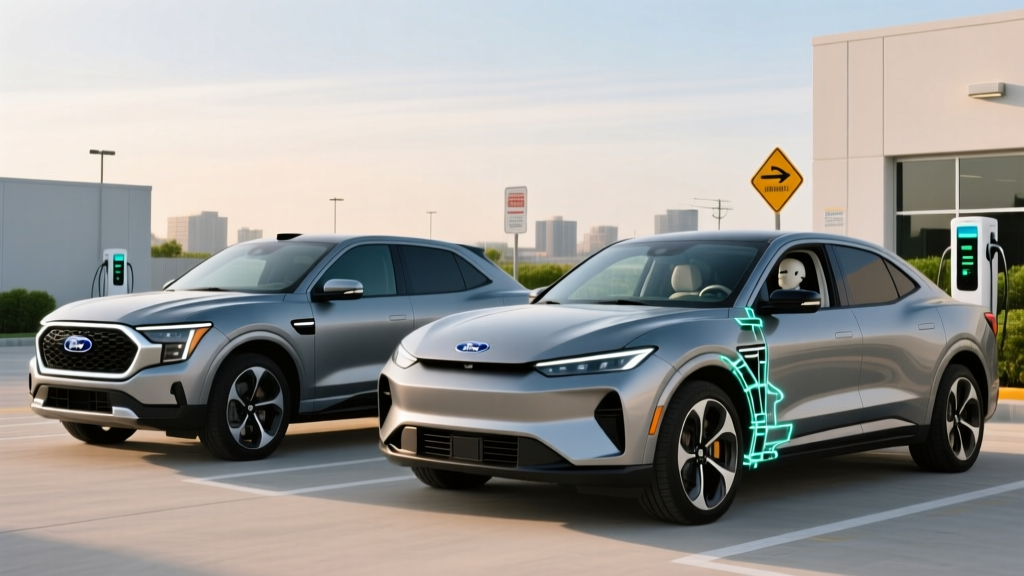
Both the Ford F-150 Lightning and Ford Mustang Mach-E earn top marks in federal crash testing. The F-150 Lightning holds a 5-Star Overall NHTSA rating, while the Mustang Mach-E has earned the IIHS Top Safety Pick designation in recent model years. Ford's electric platform places the battery low in the chassis, creating a broad crumple zone and a lower center of gravity that reduces rollover risk. However, post-crash battery repair costs remain a legitimate ownership concern — a damaged high-voltage pack can push total-loss thresholds lower than on comparable gas trucks and SUVs.
Searches around "Ford EV crash" tend to cluster around three concerns: How well do these vehicles protect occupants in a collision? What happens to the battery in a serious wreck? And how do repair costs compare to gas-powered equivalents? This guide answers all three with data from NHTSA, IIHS, and real-world ownership patterns as of the 2025–2026 model years.
F-150 Lightning Crash-Test Performance
The F-150 Lightning rides on a dedicated EV adaptation of Ford's full-size truck platform. The 131 kWh usable battery pack (extended-range models) sits between the frame rails, shielded by high-strength steel. Here's how it scored:
| Test Category | F-150 Lightning | Gas F-150 (SuperCrew) |
|---|---|---|
| Overall Rating | ★★★★★ (5 Stars) | ★★★★☆ (4 Stars) |
| Frontal Crash — Driver | ★★★★★ | ★★★★★ |
| Frontal Crash — Passenger | ★★★★★ | ★★★★☆ |
| Side Crash | ★★★★★ | ★★★★★ |
| Rollover Risk | 19.9% (~★★★★★) | 24.5% (~★★★★☆) |
The Lightning's lower center of gravity — a direct result of that floor-mounted battery — gives it a measurable rollover advantage. At approximately 6,500 lbs for the extended-range model, the mass also works in its favor in multi-vehicle collisions: heavier vehicles transfer less energy to occupants. That said, the same mass increases braking distances and tire wear, real-world trade-offs that don't show up in star ratings.
IIHS Testing
The IIHS has evaluated the F-150 Lightning in its updated moderate overlap front test (which now includes rear-seat dummy measurements). Results have been solid but not class-leading — buyers should check the latest IIHS F-150 Lightning page for the most current scores, as testing protocols tighten annually.
Mustang Mach-E Crash-Test Performance
The Mustang Mach-E, Ford's electric crossover built on the Global Electrified Platform (GE1), has been one of the better-performing EVs in crash testing since its launch. The 2025 extended-range model carries a 91 kWh usable NMC battery.
| Organization | Rating / Award |
|---|---|
| NHTSA Overall | ★★★★★ (5 Stars) |
| IIHS | Top Safety Pick (varies by headlight trim) |
| Euro NCAP (non-US reference) | 5 Stars (2021 protocol) |
The Mach-E benefits from a stiff passenger cell and a large front crumple zone — without a gas engine under the hood, the frunk area absorbs significant crash energy. In side-impact tests, the battery structure between the axles adds lateral rigidity, reducing cabin intrusion.
Post-Crash Battery Repair: The Cost Reality
This is where "Ford EV crash" searches often lead — and where EV ownership diverges sharply from gas vehicles. A damaged high-voltage battery is the single largest repair variable after any significant collision.
| Vehicle | Battery Capacity | Estimated Pack Replacement Cost | Total-Loss Threshold (Example) |
|---|---|---|---|
| F-150 Lightning (Extended Range) | 131 kWh (NMC) | $22,000–$32,000 | ~$65,000–$75,000 vehicle value |
| Mustang Mach-E (Extended Range) | 91 kWh (NMC) | $16,000–$24,000 | ~$40,000–$50,000 vehicle value |
| Gas F-150 (Comparable Trim) | N/A | Engine: $5,000–$10,000 | ~$45,000–$55,000 vehicle value |
Ford has moved toward modular battery repair — replacing individual modules rather than the entire pack when damage is localized. A single module replacement runs roughly $2,000–$5,000 depending on the pack configuration. But if structural damage compromises the battery enclosure itself, a full pack swap is usually required, and insurers often total the vehicle at lower damage thresholds than they would for a gas equivalent.
Insurance implication: EV insurance premiums for Ford models run 10–20% higher than comparable gas vehicles, largely due to these repair-cost dynamics. Average annual premiums for the F-150 Lightning sit around $2,400–$3,200 depending on state and driver profile, versus $1,800–$2,400 for a gas F-150 XLT.
Ford EV Crash Safety vs. Gas Equivalents: Full Ownership Cost
Crash safety is one input; total ownership cost puts it in context. Here's a 5-year comparison factoring in crash-related risk, fuel, and maintenance:
| Cost Category | F-150 Lightning (Lariat ER) | Gas F-150 (Lariat SuperCrew) |
|---|---|---|
| MSRP (2025 base) | $69,995 | $55,960 |
| Federal Tax Credit (§30D) | Up to $7,500 (eligibility varies — see IRS rules) | $0 |
| 5-Year Fuel / Energy | $4,200–$6,500 (home charging) | $12,500–$15,000 |
| 5-Year Maintenance | $1,500–$2,200 | $3,800–$5,000 |
| 5-Year Insurance | $13,000–$16,000 | $9,500–$12,000 |
| Estimated Depreciation | $28,000–$35,000 | $18,000–$24,000 |
| 5-Year Total (approx.) | $92,000–$110,000 | $82,000–$98,000 |
The Lightning's higher insurance and steeper depreciation (a market-wide EV trend) partially offset its fuel and maintenance savings. In crash-related scenarios, the risk of a total-loss declaration at lower damage thresholds remains a financial wildcard that gas-vehicle owners rarely face.
Common Misconceptions About Ford EV Crashes
| Myth | Fact |
|---|---|
| "EV batteries explode in crashes" | Lithium-ion packs can experience thermal runaway if severely compromised, but Ford's structural shielding and cell-level fire barriers make this extremely rare. NHTSA data shows EV fire rates are lower per vehicle than gas cars. |
| "Any fender-bender will total an EV" | Minor collisions that don't touch the battery enclosure are repaired like any other vehicle. Total-loss risk rises only when structural damage reaches the high-voltage system. |
| "First responders can't handle EV crashes" | Ford provides detailed Emergency Response Guides for every EV model, and most US fire departments now train on high-voltage vehicle protocols. Disconnect loops and clearly marked HV cables are standard. |
| "The heavy battery makes EVs more dangerous to other cars" | The Lightning's extra mass does increase momentum in a collision, which is a legitimate concern for lighter vehicles. This is a physics trade-off, not unique to Ford — all large trucks and SUVs present the same issue. |
ADAS Features That Help Prevent Crashes
Crash avoidance matters as much as crash protection. Ford's Co-Pilot360 suite is standard on both models and includes:
- Pre-Collision Assist with Automatic Emergency Braking (AEB) — detects vehicles, pedestrians, and cyclists
- Blind Spot Information System (BLIS) with Cross-Traffic Alert
- Lane-Keeping System with lane-centering assist
- Evasive Steering Assist (available on higher trims)
BlueCruise has been well-reviewed for reducing highway fatigue, but it does not eliminate crash risk. IIHS research consistently shows that Level 2 systems reduce certain crash types (rear-end, lane-departure) but can introduce new risks if drivers over-trust the automation.
Decision Framework: Should Crash Safety Affect Your Ford EV Choice?
Choose the F-150 Lightning if:
- You need truck utility (towing up to 10,000 lbs, 2,235 lb payload) and want top NHTSA ratings
- You have home Level 2 charging (the 131 kWh pack needs an 80A circuit for full 19.2 kW AC charging; a standard 48A Level 2 adds ~20 miles/hour)
- Your annual mileage is 12,000+ — the fuel savings justify the insurance premium gap
Choose the Mustang Mach-E if:
- You want a crossover with strong IIHS credentials and lower insurance costs (~$1,800–$2,400/year)
- Your daily driving is under 80 miles — the 91 kWh pack delivers EPA 312 miles (extended range), real-world ~260–280 highway
- You want DC fast charging at up to 150 kW (10–80% in ~38 minutes) for road trips
Consider a Gas or Hybrid F-150 if:
- You lack reliable home charging access — public-only charging erodes both convenience and cost savings
- You operate in extreme cold regularly — expect 25–35% range loss below 20°F
- Your budget can't absorb the higher insurance and potential post-crash repair exposure
Frequently Asked Questions
Has a Ford EV ever caught fire after a crash?
There have been isolated incidents involving EVs across all brands in severe collisions, but Ford's F-150 Lightning and Mustang Mach-E have not been subject to NHTSA fire-risk recalls related to crash-induced battery failures as of early 2026. The battery enclosures are engineered to survive severe deformation without cell puncture.
How much does insurance cost for a Ford EV after an at-fault crash?
An at-fault accident typically raises EV insurance premiums 25–45%, similar to gas vehicles. However, because base EV premiums are already higher, the dollar increase is steeper. A Lightning owner with a clean record paying $2,600/year might see $3,400–$3,800 after an at-fault claim.
Can the F-150 Lightning battery be repaired after minor underbody damage?
Yes, in many cases. Ford's battery pack uses a modular design — if damage is limited to one or two modules and the enclosure isn't compromised, a certified EV technician can replace individual modules for $2,000–$5,000 rather than the full pack. A post-repair high-voltage safety inspection is mandatory.
Does the federal tax credit apply if I'm replacing a totaled Ford EV?
Possibly. The §30D New Clean Vehicle Credit applies to new EV purchases that meet current-year MSRP caps ($80,000 for trucks/vans/SUVs), buyer income limits ($300,000 joint / $150,000 single), and battery-sourcing requirements. If your totaled vehicle was purchased before 2023 under different rules, you may now qualify for the credit on a replacement. Consult a tax professional and check IRS §30D guidance for current eligibility.
Are Ford EVs heavier than gas versions, and does that affect crash outcomes?
Yes. The F-150 Lightning weighs approximately 6,200–6,500 lbs depending on trim and battery — roughly 1,000–1,500 lbs more than a comparable gas F-150. In a collision with a lighter vehicle, the heavier EV transfers more energy to the other car. For the Lightning's own occupants, the extra mass is protective. For surrounding traffic, it's a legitimate concern that applies to all large, heavy vehicles.
Bottom Line
Ford's electric vehicles perform well — and often better than their gas counterparts — in standardized crash testing. The F-150 Lightning's 5-star NHTSA rating and the Mach-E's IIHS recognition are backed by solid engineering: low centers of gravity, reinforced battery enclosures, and generous crumple zones. The real ownership risk isn't occupant safety in a crash — it's the financial exposure from battery-related repair costs and higher insurance premiums. Buyers who understand that trade-off and have home charging access will find Ford's EVs among the safest and most practical electrified options on the market.