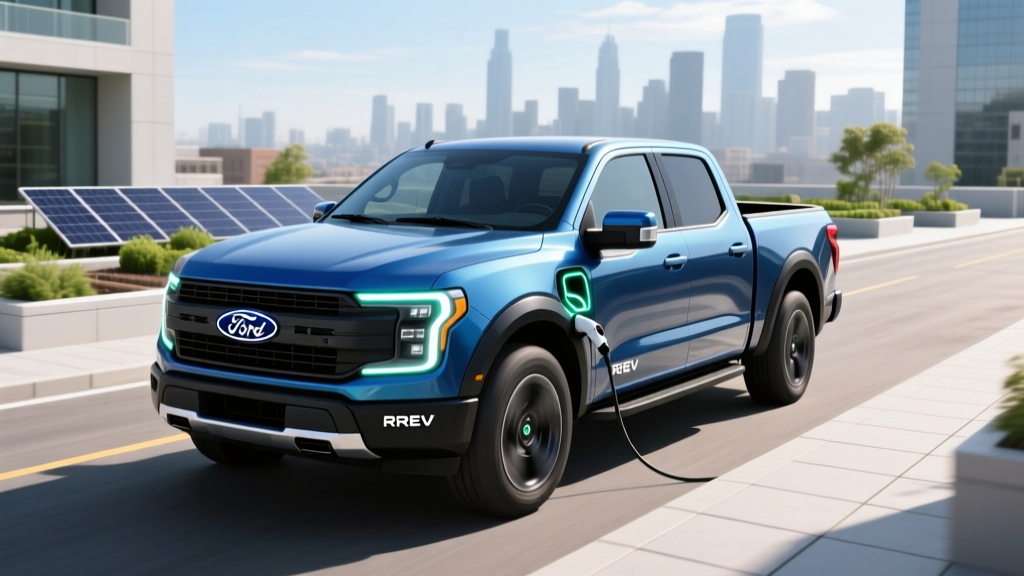
Ford's pivot toward extended-range electric vehicles (EREVs) represents a pragmatic middle ground between pure battery-electric vehicles (BEVs) and traditional hybrids. As of early 2026, Ford has signaled its intent to introduce EREV technology—most likely in a next-generation pickup platform—though the company has not yet released a production model available for purchase. This profile examines what Ford's EREV strategy entails, what preliminary specifications suggest, and how an EREV differs fundamentally from the PHEVs and BEVs already on the market.
What Is an EREV and Why Is Ford Pursuing It?
An extended-range electric vehicle (EREV) is propelled exclusively by its electric motor at all times. Unlike a plug-in hybrid (PHEV) such as the Ford Escape PHEV—where the gasoline engine can mechanically drive the wheels—an EREV's onboard gasoline engine functions solely as a generator to recharge the battery when it depletes. The driver never feels a mechanical handoff between power sources because there isn't one. The wheels are always turning via electric torque.
This architecture offers distinct advantages for a truck buyer:
- Full electric torque from standstill with no engine lag or transmission shift
- Extended total range combining a moderate battery (40-80 miles electric-only) with a fuel tank providing hundreds of additional miles
- No range anxiety on long hauls or in remote areas where DC fast chargers are scarce
- Simpler drivetrain than a PHEV with its mechanical coupling, clutches, and multi-speed transmission
Ford CEO Jim Farley has publicly discussed the company's interest in EREVs, and industry reporting indicates Ford has allocated engineering resources toward an EREV pickup—potentially slotting between the F-150 Lightning (BEV) and the conventional F-150 (ICE) in the lineup. As of this writing, Ford has not confirmed a model name, on-sale date, or final specifications. All figures below are based on industry analysis, Ford's public statements, and comparable EREV architectures from competitors like the Ram 1500 Ramcharger.
Estimated Powertrain, Battery, and Range
Based on Ford's existing electrification architecture and the EREV segment's emerging standards, here is what a Ford EREV pickup will likely deliver:
| Specification | Estimated / Preliminary |
|---|---|
| Powertrain Type | EREV (series hybrid — electric motor drives wheels exclusively) |
| Electric Motor Output | ~400-500 hp (estimated, dual-motor AWD likely) |
| 0-60 mph | ~5.5-6.5 seconds (estimated) |
| Battery Capacity (usable) | ~60-90 kWh (estimated, likely NMC chemistry) |
| Electric-Only Range | ~50-80 miles EPA (estimated) |
| Total Range (battery + fuel) | ~500-700 miles (estimated) |
| Onboard Generator | Gasoline engine, likely V6, ~100-150 kW output |
| Drivetrain | AWD (dual-motor, estimated) |
| Towing Capacity | ~7,000-10,000 lbs (estimated, pending final rating) |
| MPGe (electric mode) | TBD — expected ~80-100 MPGe combined |
| MPG (generator mode) | TBD — expected ~20-25 MPG combined |
Battery chemistry: Ford has used both NMC (nickel manganese cobalt) and LFP (lithium iron phosphate) across its lineup. The F-150 Lightning standard-range uses LFP for its lower cost and longer cycle life, while extended-range variants use NMC for higher energy density. An EREV, which cycles its battery more frequently (daily depletion and recharge in electric mode), may benefit from LFP's superior cycle longevity—potentially 3,000+ cycles before significant degradation versus ~1,500-2,000 for NMC. However, packaging constraints in a pickup may push Ford toward NMC for its higher energy density. The final chemistry choice will significantly affect long-term battery health and warranty confidence.
Real-World Range Expectations
EREV range is a two-part equation: electric-only miles before the generator kicks in, and total combined range once the generator is active.
Electric-only mode (estimated 50-80 miles EPA): This is the range most daily commuters will experience. A 70-mile EPA electric range covers the average American's round-trip commute with margin to spare. Real-world expectations:
- City/suburban driving: Near or slightly above EPA rating thanks to regenerative braking recapturing energy in stop-and-go traffic
- Highway driving at 70+ mph: Expect 15-20% less than EPA—roughly 40-65 miles electric-only before the generator starts
- Cold weather (below 30°F): Battery capacity temporarily reduced 20-30%, yielding ~35-55 miles electric-only; cabin heating further draws from the pack unless a heat pump is equipped
Total range (estimated 500-700 miles): Once the gasoline generator activates, the EREV functions similarly to a series hybrid. The generator maintains battery state of charge while the electric motors continue to drive the wheels. Total range depends on fuel tank size (likely 25-30 gallons in a full-size pickup) and generator efficiency. Unlike a BEV, an EREV does not suffer catastrophic range loss in cold weather because the generator's waste heat can warm the cabin and battery without drawing from stored electricity.
Charging Speed: DC Fast and Home Level 2
Because an EREV's battery is smaller than a comparable BEV's, charging dynamics differ meaningfully. A ~70 kWh battery fills faster than a 130 kWh pack, but peak charge rates may be lower to protect cell longevity.
| Charging Level | Estimated Power | Estimated Speed |
|---|---|---|
| Level 1 (120V household) | ~1.4 kW | ~4-5 miles of electric range per hour |
| Level 2 (240V home/public) | ~11.5-19.2 kW | ~30-55 miles of electric range per hour; full charge in 4-7 hours |
| DC Fast Charge | ~120-170 kW peak (estimated) | 10-80% in ~25-35 minutes (estimated) |
Charging-curve reality check: Peak DC fast-charge rates (e.g., 170 kW) are sustained only between approximately 10-40% state of charge. Above 60%, the rate tapers to protect the battery—potentially dropping to 50-70 kW by 80%. This is standard behavior across all lithium-ion EV batteries and is managed by the vehicle's battery management system (BMS). For an EREV, DC fast charging is less critical than for a BEV because the gasoline generator provides backup range. Most EREV owners will charge at home on Level 2 overnight and rarely need DC fast charging for daily use.
Home charging setup: A Level 2 home charger (240V, 48-amp circuit) is strongly recommended for EREV ownership. Installation costs typically range from $500-$2,000 depending on panel capacity and run length from the electrical panel to the garage. If your home has a 200-amp service panel with available capacity, expect the lower end. A panel upgrade to 200A can add $1,500-$3,000. Consult a licensed electrician for a site-specific quote.
Pricing, Trims, and Federal Tax Credit Eligibility
Ford has not announced official pricing for its EREV pickup. However, based on the F-150 Lightning's pricing structure and the Ram 1500 Ramcharger's positioning, we can estimate the following:
| Trim (Estimated) | Estimated MSRP | After Potential §30D Credit |
|---|---|---|
| Base (XLT equivalent) | ~$55,000-$60,000 | ~$47,500-$52,500 |
| Mid (Lariat equivalent) | ~$65,000-$72,000 | ~$57,500-$64,500 |
| Premium (Platinum/King Ranch equivalent) | ~$75,000-$85,000 | ~$67,500-$77,500 |
Federal tax credit (§30D) eligibility is complex and not guaranteed. Under current IRS rules, a new plug-in vehicle (which includes EREVs) may qualify for up to $7,500 in federal tax credits, subject to these requirements:
- MSRP cap: Vans, SUVs, and pickups must have an MSRP at or below $80,000 (sedans: $55,000)
- Buyer income cap: Modified adjusted gross income (MAGI) must not exceed $150,000 (single), $225,000 (head of household), or $300,000 (joint filers)
- Battery sourcing: A percentage of critical minerals and battery components must be sourced from the U.S. or free-trade-agreement countries—these thresholds increase annually
- Point-of-sale transfer: As of 2024, buyers can transfer the credit to the dealer at purchase, reducing the purchase price directly rather than waiting for a tax refund
- Final assembly: Vehicle must undergo final assembly in North America
EREVs present an interesting tax-credit question: because they contain both a battery pack and a gasoline engine, the battery capacity must still meet the minimum 7 kWh threshold (which a Ford EREV will easily exceed). However, battery-sourcing requirements could disqualify certain trims or model years depending on Ford's supply chain. Always verify current eligibility at IRS.gov and consult a tax professional before relying on the credit in your purchase decision.
Interior, Cargo, and Technology
A Ford EREV pickup would likely share its cabin architecture with the F-150 Lightning and refreshed F-150 ICE models. Expect:
- Infotainment: 12-inch touchscreen with SYNC 4A, wireless Apple CarPlay and Android Auto, over-the-air (OTA) update capability
- Driver assistance: Ford Co-Pilot360 suite including adaptive cruise control, lane-keeping, automatic emergency braking, and available BlueCruise (SAE Level 2 hands-free highway driving on pre-mapped divided highways — not self-driving; driver must remain attentive)
- Cargo bed: Full-size 5.5-ft or 6.5-ft bed, estimated 50-65 cu ft of bed volume; no frunk (front trunk) since the engine bay houses the generator, unlike the F-150 Lightning's 14.1 cu ft Mega Power Frunk
- Pro Power Onboard: Likely available with 2.0-7.2 kW of exportable power via bed-mounted and cabin outlets—ideal for job sites and tailgating
- Passenger space: SuperCrew (four-door) configuration with ~43-45 inches of rear legroom, matching the F-150 SuperCrew
Notable drawback: The absence of a frunk is a meaningful loss compared to the F-150 Lightning. The Lightning's front trunk is one of its most praised features for secure, weatherproof cargo storage. An EREV's engine bay is occupied by the gasoline generator, eliminating this advantage.
Warranty and Long-Term Ownership
Ford's current electrified-vehicle warranty sets the baseline expectation:
- Battery warranty: 8 years / 100,000 miles (whichever comes first), covering capacity retention below 70% of original capacity
- Powertrain warranty: 5 years / 60,000 miles for the electric motor and generator components
- Bumper-to-bumper: 3 years / 36,000 miles
For an EREV, the battery warranty is particularly important because the pack undergoes more frequent charge-discharge cycles than a BEV's larger battery (which is rarely depleted below 20%). An EREV owner who drives 50 miles daily on electric power and recharges nightly will accumulate approximately 365 full equivalent cycles per year. Over 8 years, that's ~2,900 cycles—well within LFP chemistry's typical 3,000+ cycle lifespan, but potentially approaching the upper range for some NMC formulations. Ford's 70% capacity-retention threshold at 8 years/100,000 miles would provide reasonable protection, though buyers should monitor state-of-health (SoH) readings via the vehicle's battery management interface.
Maintenance advantage: EREVs have fewer maintenance requirements than ICE vehicles (no transmission fluid changes, no spark plugs on the electric drive side) but more than pure BEVs because the gasoline generator still requires oil changes, air filter replacement, and fuel system maintenance—albeit at longer intervals since the generator operates at steady-state RPM rather than varying loads.
Pros, Cons, and Who Should Consider a Ford EREV
Pros
- Full electric driving for daily commutes (50-80 mi) with zero tailpipe emissions in EV mode
- No range anxiety on long trips—gas generator provides 500+ total miles
- Full electric torque for towing and hauling with no turbo lag
- Lower daily fuel costs if you charge at home overnight
- Cold-weather resilience: generator waste heat warms cabin without draining battery
- Pro Power Onboard for job-site and recreation use
Cons
- More complex than a pure BEV—two powertrains to maintain
- No frunk (front trunk) due to generator occupying engine bay
- Gasoline engine still requires oil changes and fuel-system maintenance
- Higher upfront cost than a conventional F-150 (estimated $10,000-$15,000 premium)
- Fuel economy in generator mode likely mediocre (~20-25 MPG) compared to a diesel or efficient ICE
- Tax credit eligibility uncertain pending battery-sourcing final rules
Who Should Wait for a Ford EREV?
- Choose an EREV if: You want electric daily driving but regularly tow, haul, or drive to remote areas where DC fast chargers are unreliable or nonexistent. An EREV eliminates the planning burden of BEV road trips.
- Choose the F-150 Lightning (BEV) if: Your daily driving stays within 230-320 miles (EPA), you have reliable home charging, and you value the Lightning's frunk and lower mechanical complexity.
- Choose the F-150 PowerBoost Hybrid if: You want proven hybrid technology at a lower price point, don't need plug-in electric-only range, and prioritize immediate availability.
- Choose the Ram 1500 Ramcharger if: You want an EREV pickup now—the Ramcharger is already in production and available for order as of 2025-2026.
Competitive Landscape: Ford EREV vs. Alternatives
The Ford EREV will not enter an empty segment. Key competitors include:
- Ram 1500 Ramcharger: The first mainstream EREV pickup, featuring a 92 kWh battery, ~145 miles of electric-only range (EPA), and a 3.6L V6 generator providing ~690 miles of total range. Priced from ~$60,000. This is the direct benchmark Ford must match or beat.
- Ford F-150 Lightning: Ford's own BEV pickup with 230-320 miles of EPA range depending on battery pack. Lacks the range-extending generator but offers a frunk and simpler maintenance profile.
- Chevrolet Silverado EV: GM's BEV pickup with up to 450 miles EPA range (max battery). No EREV variant announced.
- Ford F-150 PowerBoost Hybrid: A conventional full hybrid (not plug-in) delivering ~22-24 MPG combined with no electric-only range. Lower cost, proven reliability, but no plug-in benefits.
Ford's challenge is clear: the Ramcharger has established the EREV pickup category with impressive electric-only range. A Ford EREV will need competitive pricing, comparable or superior electric range, and the brand loyalty that F-Series buyers demonstrate year after year.
Frequently Asked Questions
Is the Ford EREV pickup available to buy in 2026?
No. As of early 2026, Ford has announced its EREV strategy and allocated engineering resources, but no production model is available for purchase or reservation. Ford has not confirmed a model name, on-sale date, or final specifications. The Ram 1500 Ramcharger is the only EREV pickup currently in production.
How is an EREV different from a plug-in hybrid (PHEV)?
In a PHEV like the Ford Escape PHEV, the gasoline engine can mechanically drive the wheels through a transmission. In an EREV, the gasoline engine never turns the wheels—it only generates electricity to recharge the battery. The electric motor is the sole source of propulsion at all times. This means driving feel is identical to a pure EV: instant torque, no shifting, no engine noise during light-load driving.
Will a Ford EREV qualify for the $7,500 federal tax credit?
Possibly, but eligibility depends on multiple factors under IRS §30D rules: the vehicle's MSRP must be at or below $80,000 (pickup/SUV cap), the buyer's income must be within limits ($150K single / $300K joint), battery minerals and components must meet U.S./FTA sourcing thresholds, and final assembly must occur in North America. These rules are subject to change. Verify at IRS.gov before making a purchase decision.
What happens when the battery runs out in an EREV?
The gasoline generator automatically starts and begins producing electricity to power the electric motors and maintain battery charge. You can continue driving as long as there is fuel in the tank—there is no "stranding" scenario like a depleted BEV. You refuel at any gas station and keep driving.
Can I drive an EREV on electricity alone without ever using gas?
Yes, for trips within the battery's electric-only range (estimated 50-80 miles for a Ford EREV). If your daily driving stays within that range and you charge at home every night, you could go weeks or months without the generator activating. However, Ford's engine-maintenance protocol will likely run the generator briefly on a periodic basis to prevent fuel degradation and lubricate internal components—a common practice in PHEVs and EREVs.
How does cold weather affect an EREV compared to a BEV?
Significantly better. A BEV can lose 20-40% of its EPA range in sub-freezing temperatures because battery chemistry slows and cabin heating draws from the traction battery. An EREV's gasoline generator produces waste heat that can warm the cabin and precondition the battery without depleting stored electricity. Once the generator is running in cold weather, total range impact is minimal.
Sources: fueleconomy.gov (EPA ratings for comparable vehicles), IRS.gov (§30D clean vehicle credit rules), Ford Media Center (corporate strategy disclosures). All specifications for the Ford EREV are preliminary estimates pending official release.