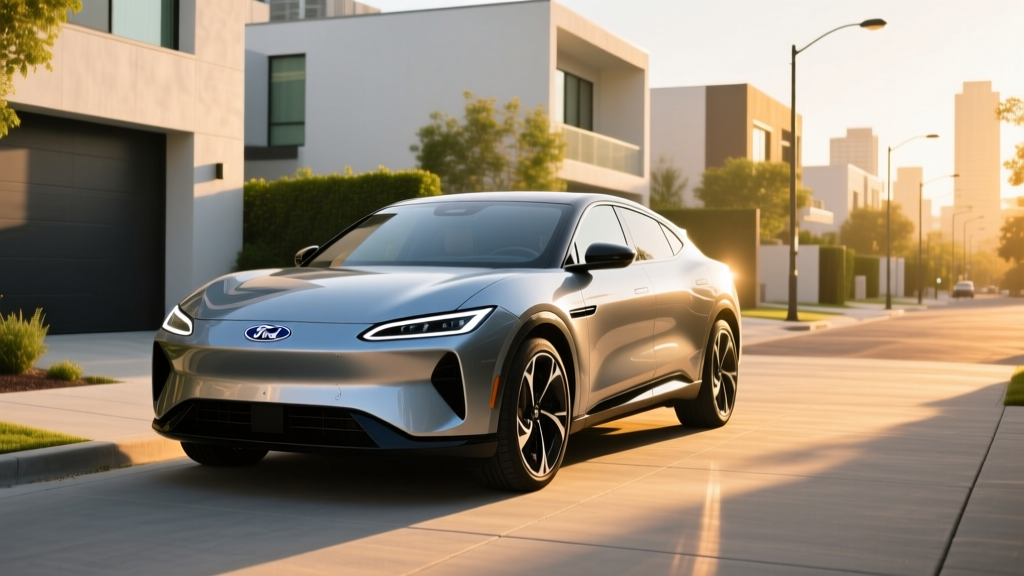
Ford's upcoming extended-range electric vehicle (EREV) platform represents a deliberate pivot from the automaker's all-in battery-electric strategy. Announced in late 2024 and now entering production for the 2027 model year, the Ford EREV lineup targets buyers who want electric daily driving without range anxiety on longer trips. The first vehicle on this platform — expected to be a midsize pickup or SUV — pairs a moderate battery pack with an onboard gasoline generator that charges the battery while driving, never mechanically driving the wheels.
This review covers everything confirmed about Ford's EREV technology, preliminary specifications, pricing projections, and how it stacks up against the only true EREV competitor currently on the US market: the Ram 1500 Ramcharger. All specifications cited are based on Ford's official announcements and industry analysis as of early 2026; final EPA certification numbers will be published closer to the vehicle's on-sale date.
What Exactly Is a Ford EREV?
An EREV — extended-range electric vehicle — is fundamentally different from both a pure battery-electric vehicle (BEV) and a traditional plug-in hybrid (PHEV). In Ford's EREV architecture, the gasoline engine functions exclusively as a generator. It produces electricity to feed the electric drive motors or replenish the battery, but it never connects to the drivetrain to turn the wheels. This means the vehicle always drives like an EV — instant torque, regenerative braking, one-pedal capability — while carrying a fuel tank as a range extender.
Think of it as a BEV with a built-in portable generator. For daily commuting under 40 miles, you may never use a drop of gasoline. For a 500-mile road trip, the engine kicks in seamlessly to keep you moving without stopping to charge.
- BEV: Battery only. No gas. Must plug in or stop at DC fast chargers for long trips.
- PHEV: Battery + engine that can both drive the wheels. Blended power. Typically 25–45 miles electric-only.
- EREV: Battery + engine-as-generator only. Wheels always driven by electric motors. ~40 miles electric-only, then unlimited range via gas.
Range, Battery, and Efficiency
Ford has confirmed the EREV platform will target approximately 40 miles of electric-only range on a full charge, with a total system range exceeding 380 miles when the range-extender engine is factored in. The battery pack is expected to be in the 35–45 kWh range (usable capacity), likely using NMC (nickel manganese cobalt) chemistry to balance energy density with the packaging constraints of a vehicle that also houses a fuel tank and generator engine.
| Specification | Estimated / Confirmed |
|---|---|
| Electric-Only Range | ~40 miles (EPA est.) |
| Total Range (Gas + Electric) | 380+ miles |
| Battery Capacity (usable) | ~35–45 kWh (NMC est.) |
| Drivetrain | Dual-motor AWD (expected) |
| System Horsepower | TBA (est. 350–450 hp) |
| 0–60 mph | TBA (est. 5.5–6.5 sec) |
| Max DC Fast Charge | ~150 kW (est.) |
| 10–80% DC Charge Time | ~25–30 min (est.) |
| Level 2 Home Charging | ~11.5 kW (~25 mi/hr) |
| MPGe (Electric Mode) | TBA (est. 85–95 MPGe) |
| Fuel Economy (Gas Generator) | TBA (est. 25–30 mpg combined) |
| Base MSRP | Est. $50,000–$55,000 |
| Battery/Powertrain Warranty | 8 yr / 100,000 mi (Ford standard) |
Charging: DC Fast, Level 2, and What to Expect
Because the EREV's battery is smaller than a full BEV's (roughly 35–45 kWh versus 75–130 kWh in comparable BEVs), charging is faster in absolute terms but the charge rate is also lower. Ford is expected to equip the EREV with a CCS1/NACS charge port (Ford has transitioned to the North American Charging Standard for all new models beginning with the 2025 model year), granting access to Tesla Superchargers via native NACS or the included adapter.
| Charge Level | Power | Speed | 0–100% Time |
|---|---|---|---|
| Level 1 (120V) | ~1.4 kW | ~3 mi/hr | ~14 hours |
| Level 2 (240V, 48A) | ~11.5 kW | ~25 mi/hr | ~3.5 hours |
| DC Fast Charge | ~150 kW peak | ~120 mi/hr (peak) | 10–80% in ~25 min |
The smaller battery is a practical advantage for home charging: a standard Level 2 wallbox (11.5 kW / 48 amps) will fully replenish the pack in roughly 3 to 4 hours, meaning most owners can easily recharge overnight on even the cheapest Level 2 equipment — or even on a 120V outlet if daily driving stays under 30 miles. For DC fast charging, the ~150 kW peak rate is modest by 2026 BEV standards (where 250–350 kW is common), but because the battery is small, a 10–80% session still completes in about 25 minutes.
Charge-curve reality check: Like all lithium-ion packs, the EREV's battery will accept peak charge rate only up to roughly 50–60% state of charge, then taper significantly. Expect the 60–80% portion of a DC fast charge to take nearly as long as the 10–60% portion. For road trips where the gas generator eliminates charging stops entirely, this taper is largely irrelevant.
Performance and Drivetrain
Ford has not released official horsepower or 0–60 figures for the EREV platform as of early 2026, but the dual-motor AWD configuration is widely expected. Based on the powertrain architecture shared with Ford's current EV lineup and competitive positioning against the Ram 1500 Ramcharger (which produces 663 hp), we estimate the Ford EREV will deliver 350–450 horsepower in its initial trim, with a 0–60 mph time in the 5.5 to 6.5 second range.
The critical performance advantage of an EREV over a conventional hybrid is that the electric motors provide full torque from zero RPM at all times — even when the gas generator is running. There's no gear hunting, no turbo lag, no transmission shift shock. The driving experience is identical to a BEV; you simply won't notice when the generator starts (beyond a faint hum under heavy load).
Pricing, Tax Credits, and Ownership Cost
Ford has not announced final MSRP for the EREV lineup, but industry analysts project a starting price between $50,000 and $55,000 for the base trim, with higher trims potentially reaching $65,000–$70,000. This positions the EREV between Ford's current Maverick hybrid (~$30,000) and the F-150 Lightning (~$55,000 base).
| §30D Requirement | Ford EREV Status |
|---|---|
| Vehicle Classification | Qualifies as PHEV (must have ≥4 kWh battery + external charge capability) |
| MSRP Cap (Trucks/SUVs/Vans) | $80,000 — likely passes all trims |
| Buyer Income Cap (MFJ) | $300,000 AGI (Married Filing Jointly); $150,000 (Single) |
| Battery Component Sourcing | TBD — must meet North American assembly + critical minerals thresholds |
| Maximum Credit | Up to $7,500 ($3,750 for battery components + $3,750 for critical minerals) |
| Point-of-Sale Transfer | Yes — credit can be applied as dealer discount at purchase |
Critical caveat: The IRS §30D credit has strict battery-sourcing and critical-mineral requirements that tighten annually. As of the 2026 tax year rules, vehicles must meet North American battery-component assembly thresholds AND critical-mineral sourcing thresholds to qualify for the full $7,500. Ford has not confirmed whether the EREV's battery supply chain meets these requirements. Buyers should verify eligibility on fueleconomy.gov before purchasing, as the list of qualifying vehicles is updated regularly. Additionally, the buyer's adjusted gross income must fall below the IRS caps, and the vehicle's MSRP must not exceed $80,000 for trucks, SUVs, and vans.
How the Ford EREV Compares to the Ram 1500 Ramcharger
The only direct EREV competitor in the US market as of 2026 is the Ram 1500 Ramcharger, which pairs a 92 kWh battery pack with a 3.6L V6 generator for 69 miles of electric range and 690 total miles. Here's how the Ford EREV is expected to stack up:
| Attribute | Ford EREV (Est.) | Ram 1500 Ramcharger |
|---|---|---|
| Electric-Only Range | ~40 mi | 69 mi |
| Total Range | 380+ mi | 690 mi |
| Battery (usable) | ~35–45 kWh | 92 kWh |
| Horsepower | ~350–450 hp | 663 hp |
| Base MSRP | ~$50,000–$55,000 | ~$62,000 |
| DC Fast Charge (peak) | ~150 kW | ~150 kW |
| Towing Capacity | TBA | ~9,000 lbs (est.) |
The Ramcharger's larger battery gives it nearly double the electric-only range, which matters if your commute is 50+ miles and you want to avoid burning gas. However, that 92 kWh pack adds significant weight and cost. Ford's smaller-battery approach prioritizes a lower entry price and lighter overall vehicle weight, trading electric range for affordability. If your daily driving is under 35 miles round-trip, the Ford EREV's 40-mile electric buffer covers your commute entirely on electricity — the gas generator only fires on longer weekend trips.
Interior, Tech, and Daily Practicality
While Ford has not revealed the EREV's interior, the vehicle will ride on a modified version of Ford's existing body-on-frame or unibody platform (likely shared with the next-generation Ranger or Bronco Sport architecture). Expect:
- Infotainment: SYNC 5 with a 12-inch or larger touchscreen, wireless Apple CarPlay and Android Auto, over-the-air updates
- Driver Assistance: Ford Co-Pilot360 2.0+ suite including adaptive cruise control with stop-and-go, lane centering, evasive steer assist, and intersection assist. BlueCruise hands-free highway driving (SAE Level 2) is expected on higher trims for pre-mapped divided highways
- Pro Power Onboard: Ford's vehicle-to-load (V2L) system, providing up to 7.2 kW of 120V/240V AC power from bed outlets — a key differentiator for job-site and camping use
- Cargo: Exact dimensions depend on the body style (pickup vs SUV), but expect competitive bed length or cargo volume matching the segment norm (55–65 cu ft for an SUV, 5–6 ft bed for a pickup)
Who Should Buy the Ford EREV?
Pros
- True EV driving feel with zero range anxiety
- ~40 mi electric covers most daily commutes gas-free
- No dependence on public charging infrastructure for road trips
- Lower entry price than comparable BEVs or the Ramcharger
- Pro Power Onboard for job-site/camping utility
- Faster home charging (smaller battery fills in ~3.5 hrs)
Cons
- Electric range (~40 mi) trails Ramcharger's 69 mi significantly
- Still requires gasoline — oil changes, fuel costs on long trips
- Maintenance complexity: both an electric powertrain AND a gas engine
- Lower total range than Ramcharger (380 vs 690 mi)
- Tax credit eligibility uncertain (battery sourcing TBD)
- Not a zero-tailpipe-emission vehicle
Decision Framework: Is the Ford EREV Right for You?
Choose the Ford EREV if:
- Your daily commute is under 40 miles round-trip and you can charge at home
- You regularly take road trips exceeding 250 miles and don't want to plan charging stops
- You live in an area with limited DC fast-charging infrastructure
- You want EV driving dynamics but aren't ready to commit to a full BEV
- You need a truck/SUV with towing capability and don't trust BEV range while towing
Look elsewhere if:
- Your commute exceeds 45 miles one-way (consider the Ramcharger or a full BEV with 300+ mi range)
- You want zero gasoline dependency and zero tailpipe emissions
- You want to minimize long-term maintenance (a BEV has no engine, oil, spark plugs, or exhaust system)
- You already have reliable home and workplace charging and rarely drive more than 250 miles in a day
Frequently Asked Questions
What is the real-world range of the Ford EREV?
Ford targets approximately 40 miles of electric-only range and 380+ miles total. In real-world driving, expect 32–38 miles electric in moderate weather on mixed roads, dropping to 25–30 miles in sub-freezing temperatures. Total range depends on fuel-tank size (unconfirmed) and generator efficiency, but 350–380 miles is a realistic expectation for combined driving.
How fast does the Ford EREV charge?
Estimated peak DC fast-charge rate is ~150 kW, achieving a 10–80% charge in approximately 25–30 minutes. On a Level 2 home charger (11.5 kW / 48A), the battery fills from empty in about 3.5 hours. Level 1 (120V) adds roughly 3 miles per hour — sufficient for overnight replenishment if your daily electric driving is under 30 miles.
Does the Ford EREV qualify for the federal EV tax credit?
It's expected to qualify as a plug-in hybrid under IRS §30D, but final eligibility depends on battery-component sourcing and critical-mineral requirements that Ford has not yet confirmed. The MSRP cap is $80,000 for trucks/SUVs (likely met), and buyer income caps apply ($300K MFJ / $150K single). Check fueleconomy.gov closer to the on-sale date for confirmed eligibility. The credit can be transferred to the dealer as a point-of-sale discount.
Is the Ford EREV worth buying versus a full BEV or the Ramcharger?
If you need the security of a gas backup for long trips or live in a charging-desert region, the EREV is a compelling bridge solution — particularly at its expected ~$50,000 starting price, which undercuts the Ramcharger by roughly $12,000. If you have reliable home charging and rarely exceed 250 miles in a day, a full BEV like the F-150 Lightning or Chevrolet Silverado EV offers lower operating costs, zero tailpipe emissions, and less mechanical complexity. The Ramcharger is the better EREV choice if your commute is 50–65 miles and you want to maximize gas-free driving.
Will the EREV engine drive the wheels?
No. The gasoline engine in a Ford EREV functions solely as a generator. It produces electricity to charge the battery or feed the electric motors, but it has no mechanical connection to the drivetrain. The vehicle is always propelled by its electric motors, which is what distinguishes an EREV from a conventional plug-in hybrid.
When will the Ford EREV be available?
Ford has confirmed the EREV platform for production in the 2027 model year. Based on Ford's typical production timelines, expect dealer deliveries to begin in late 2026 or early 2027. Reservations and final specifications (including EPA-certified range, official MSRP, and tax credit eligibility) should be announced in mid-to-late 2026.
Note: All specifications in this article are based on Ford's official announcements and industry analysis as of early 2026. Final EPA-certified figures, MSRP, and tax credit eligibility will be confirmed by Ford and the IRS closer to the vehicle's on-sale date. Consult irs.gov and fueleconomy.gov for the latest information.