Ford's 2025 EV Lineup: Quick Verdict
Ford offers three main electric vehicles for 2025: the F-150 Lightning pickup (EPA range 240-320 miles, $54,995-$96,874), Mustang Mach-E SUV (250-320 miles, $42,995-$65,995), and E-Transit commercial van (126 miles, $45,995+). All qualify for the full $7,500 federal tax credit if you meet income caps ($150K single/$300K joint) and MSRP limits ($80K trucks/$55K cars). Real-world range typically runs 15-25% below EPA estimates in highway or cold-weather driving.
What Ford Electric Vehicles Are Available in 2025?
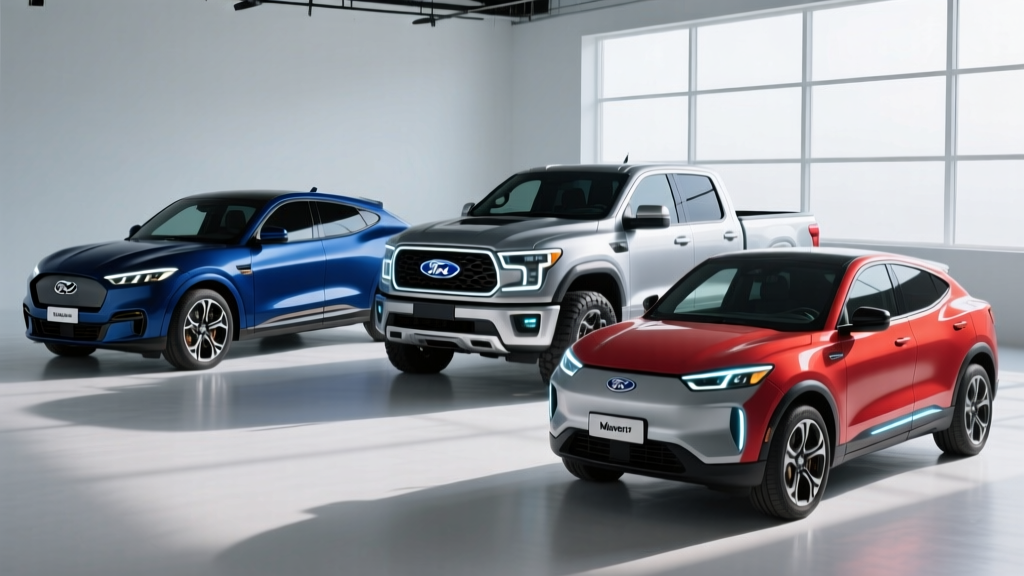
Ford's current EV portfolio targets three distinct use cases: work trucks, family SUVs, and commercial fleets. Here's the complete breakdown:
| Model | EPA Range | Battery (kWh) | Peak DC Charge | 10-80% Time | 0-60 mph | Base MSRP |
|---|---|---|---|---|---|---|
| F-150 Lightning (Std Range) | 240 mi | 98 kWh usable | 120 kW | ~44 min | ~6.0 sec | $54,995 |
| F-150 Lightning (Ext Range) | 320 mi | 131 kWh usable | 150 kW | ~41 min | ~5.5 sec | $67,495 |
| Mustang Mach-E (Std Range) | 250 mi | 70 kWh usable | 115 kW | ~36 min | ~6.1 sec | $42,995 |
| Mustang Mach-E (Ext Range) | 320 mi | 91 kWh usable | 150 kW | ~39 min | ~5.8 sec | $48,995 |
| Mustang Mach-E GT | 280 mi | 91 kWh usable | 150 kW | ~39 min | 3.5 sec | $65,995 |
| E-Transit (Commercial) | 126 mi | 68 kWh usable | 115 kW | ~45 min | N/A | $45,995 |
Real-world range reality: Expect 200-260 miles from extended-range models in mixed highway driving at 70+ mph. Cold weather (below 32°F) can reduce range by 20-30% due to battery heating demands and cabin climate control. The F-150 Lightning's larger battery buffer helps mitigate this, but towing cuts range roughly in half regardless of battery size.
Ford EV vs Gas: The Real Cost Comparison
The sticker shock of EVs fades when you calculate total ownership costs. Here's a 5-year comparison based on 15,000 miles/year:
| Cost Factor | F-150 Lightning (Ext Range) | F-150 Gas (3.5L EcoBoost) | 5-Year Difference |
|---|---|---|---|
| Purchase Price (after tax credit) | $59,995 | $55,000 | +$4,995 |
| Fuel/Energy (15K mi/yr) | $1,875/yr (home charging) | $3,375/yr (gas @ $3.50/gal) | -$7,500 |
| Maintenance | $400/yr | $900/yr | -$2,500 |
| Insurance | $2,200/yr | $1,800/yr | +$2,000 |
| 5-Year Total | $75,495 | $78,500 | -$3,005 |
The math changes based on your situation:
- Home charging access: If you rely on public DC fast charging (average $0.40/kWh), your annual fuel cost jumps to ~$3,000, erasing most savings.
- Electricity rates: At $0.20/kWh (California average), Lightning charging costs ~$2,500/year. At $0.10/kWh (national average), it's ~$1,250.
- Driving patterns: Towing or heavy payload work dramatically increases energy consumption, potentially doubling charging costs.
Federal Tax Credit Eligibility: Who Actually Gets $7,500?
Not every Ford EV buyer qualifies for the full federal tax credit. Here's what you need to know for 2025:
- Income caps: Modified AGI under $150,000 (single), $225,000 (head of household), or $300,000 (joint filing)
- MSRP limits: F-150 Lightning must be under $80,000; Mustang Mach-E under $55,000 (this eliminates the GT trim from credit eligibility)
- Battery sourcing: Vehicles must meet critical minerals and battery component requirements that phase in through 2025-2026
- Point-of-sale transfer: You can now transfer the credit to the dealer for an immediate price reduction instead of waiting for tax refund
Check the IRS Clean Vehicle Credits page for current sourcing requirements, as these change quarterly based on supply chain compliance.
Real-World Ownership: What First-Time EV Buyers Miss
| Common Misconception | Reality |
|---|---|
| "I'll charge at public stations like I get gas" | Public DC charging costs 2-3x more than home Level 2, and reliability varies wildly by network |
| "320 miles range means I can drive 320 miles" | Highway driving at 75 mph, cold weather, and HVAC use reduce usable range to 240-270 miles |
| "Fast charging takes 30 minutes" | Peak 150 kW rate only lasts 15-20 minutes; full 10-80% session is 35-45 minutes including taper |
| "I need a 200-amp electrical panel upgrade" | Most homes can support 40-amp Level 2 charging (9.6 kW) without panel upgrades |
| "EVs are maintenance-free" | Tires wear 20-30% faster due to instant torque and vehicle weight; cabin air filters still need replacement |
Home Charging Setup: The Make-or-Break Factor
Level 2 home charging is essential for convenient EV ownership. Here's what installation typically costs:
| Component | Cost Range | Notes |
|---|---|---|
| Level 2 Charger (40-amp) | $500-$800 | Ford Mobile Charger included; hardwired units more reliable |
| Electrician Labor | $800-$2,000 | Varies by distance from panel and local rates |
| Permit & Inspection | $100-$300 | Required in most jurisdictions |
| Panel Upgrade (if needed) | $1,500-$3,000 | Only if you have 100-amp service or insufficient breaker slots |
| Total Typical Install | $1,400-$3,100 | Most homes don't need panel upgrades |
Pro tip: Install a 60-amp circuit with 48-amp charger capability even if you buy a 40-amp charger now. Future EVs may support faster Level 2 charging, and the wire cost difference is minimal during initial installation.
Decision Framework: Which Ford EV (If Any) Fits Your Life?
Choose the F-150 Lightning if:
- You need a work truck for towing (under 7,700 lbs) or job-site power (Pro Power Onboard)
- You have home charging and drive under 200 miles/day
- You qualify for the tax credit (under $80K MSRP and income caps)
- You value instant torque and quiet operation over maximum range
Choose the Mustang Mach-E if:
- You want a family SUV with car-like handling and 250+ mile range
- You prioritize charging speed (150 kW peak on extended-range models)
- You're comparing against Tesla Model Y, Hyundai Ioniq 5, or Kia EV6
- You want BlueCruise hands-free driving on mapped highways
Consider a hybrid (Ford Maverick Hybrid or Escape Hybrid) instead if:
- You lack reliable home charging access
- You regularly drive 400+ miles in a day or tow heavy loads
- You live in an apartment or street-park without charging options
- Upfront cost is a primary concern (hybrids start $10-15K lower)
Wait or look elsewhere if:
- You need 400+ mile range without stopping (no current Ford EV delivers this in real-world conditions)
- You live in extreme cold climates and can't accept 30% winter range loss
- You frequently tow over 8,000 lbs (Lightning max towing is 10,000 lbs but range drops to ~100 miles)
Charging Infrastructure: Ford's Network Access
Ford EVs use the CCS connector standard but gained Tesla Supercharger access in 2024 via included adapters. This gives you access to:
- Tesla Superchargers: 15,000+ locations with NACS adapters (included with new Ford EVs)
- Electrify America: 800+ stations, integrated into FordPass app
- EVgo, ChargePoint: Thousands of locations with CCS connectors
Charging curve reality: Ford's advertised "150 kW peak" charging rate only applies between 10-35% state of charge. The rate tapers to ~100 kW by 50% and ~50 kW above 80%. Plan for 40-45 minute charging stops, not 20-minute ones.
FAQ: Common Questions About Ford Electric Vehicles
Do Ford EVs qualify for state incentives too?
Many states offer additional rebates ($2,000-$7,500) on top of the federal credit. California's CVRP, Colorado's innovative motor vehicle credit, and New York's Drive Clean Rebate are examples. Check your state's energy office or fueleconomy.gov for current programs.
What's the battery warranty coverage?
Ford covers EV batteries for 8 years or 100,000 miles against defects and capacity loss below 70% of original capacity. This is industry-standard and matches most competitors.
Can I tow or haul heavy loads with the F-150 Lightning?
Yes, with caveats. Max towing is 10,000 lbs (Extended Range models), but expect range to drop to 100-150 miles when towing near capacity. Payload capacity ranges from 1,800-2,235 lbs depending on configuration.
How does cold weather affect Ford EV range?
Expect 20-30% range reduction below freezing. The F-150 Lightning's larger battery provides more buffer, but using cabin heat and battery preconditioning still consumes significant energy. Preconditioning while plugged in at home mitigates this substantially.
Is BlueCruise actually self-driving?
No. BlueCruise is a Level 2 driver-assist system that allows hands-off driving on pre-mapped divided highways, but you must remain attentive and ready to take over immediately. It's not autonomous driving and doesn't work on local streets.
What happens if the battery fails after warranty?
Replacement costs range from $15,000-$25,000 depending on model and battery size. However, data from similar EVs suggests most batteries retain 85-90% capacity at 150,000 miles. Catastrophic failure is rare; gradual degradation is more common.
Should I buy or lease a Ford EV?
Leasing makes sense if you're uncertain about long-term battery health, want to upgrade every 3 years, or don't qualify for the tax credit (lessors can pass the credit through as a cap cost reduction). Buying makes sense if you plan to keep the vehicle 5+ years and want to build equity.