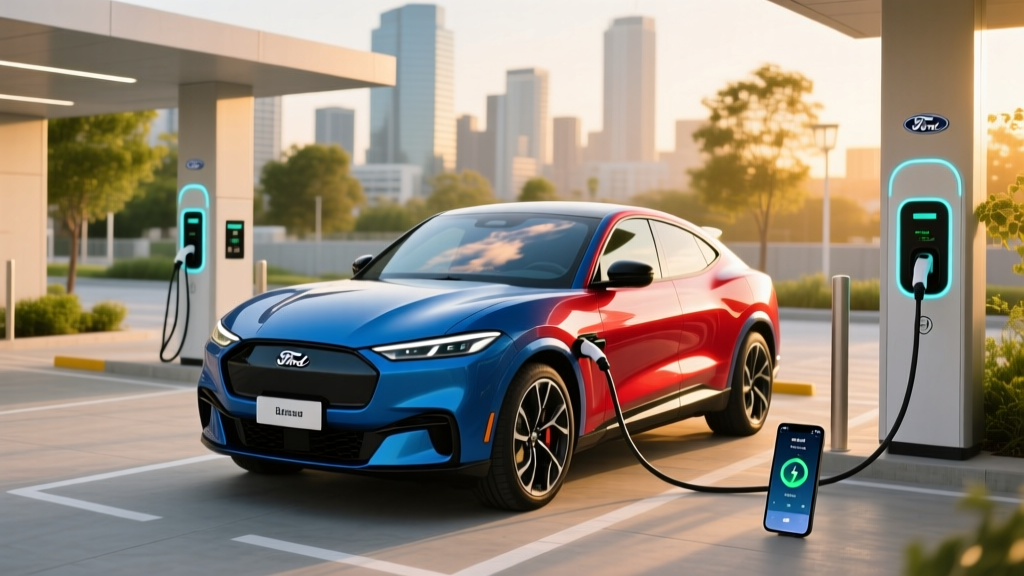
Shoppers searching for Ford electric lease deals in 2026 are often drawn by low monthly payments and the promise of cheap fueling. But a low lease payment only tells part of the story. The real question is what you'll spend over five years once you factor in electricity, insurance, maintenance, depreciation, and the shifting landscape of federal tax incentives.
Ford's two core EVs — the Mustang Mach-E crossover and the F-150 Lightning pickup — sit in very different cost brackets, and their lease economics diverge further when you account for how the IRS §30D clean vehicle credit applies (or doesn't) to a lease structure. Below, we model the true 5-year total cost of ownership (TCO) for both, unpack the current tax-credit rules, and show where Ford electric lease deals genuinely save money — and where they quietly cost more than a gas alternative.
The 2026 Ford EV Lineup: What's Actually Leasable
As of the 2026 model year, Ford's battery-electric lineup available for lease in the U.S. centers on two vehicles:
- Mustang Mach-E: Available in Select, Premium, California Route 1, and GT trims. Battery options include a 75.7 kWh usable Standard Range pack (LFP chemistry) and a 98.8 kWh usable Extended Range pack (NMC chemistry). EPA range spans from 250 miles (SR RWD) to 320 miles (ER RWD), per fueleconomy.gov.
- F-150 Lightning: Offered in Pro, XLT, Lariat, and Platinum trims. The Standard Range battery is 98 kWh usable (LFP, ~240 mi EPA) and the Extended Range is 131 kWh usable (NMC, ~320 mi EPA). Towing capacity peaks at 10,000 lbs on properly equipped Extended Range models.
| Model / Trim | Battery (kWh usable) | Chemistry | EPA Range | Peak DC Charge kW | 10–80% Time | 0–60 mph | Base MSRP |
|---|---|---|---|---|---|---|---|
| Mach-E Select SR RWD | 75.7 | LFP | 250 mi | 150 kW | ~36 min | 6.3 sec | $42,995 |
| Mach-E Premium ER RWD | 98.8 | NMC | 320 mi | 150 kW | ~42 min | 5.8 sec | $49,995 |
| Mach-E GT ER AWD | 98.8 | NMC | 280 mi | 150 kW | ~42 min | 3.5 sec | $62,995 |
| Lightning Pro SR | 98 | LFP | 240 mi | 150 kW | ~40 min | 5.8 sec | $54,995 |
| Lightning Lariat ER | 131 | NMC | 320 mi | 150 kW | ~45 min | 4.5 sec | $71,995 |
Real-world range caveat: EPA figures assume mixed driving at moderate temperatures. Expect 15–25% range loss in sustained highway driving above 70 mph, and 20–35% reduction in sub-freezing winter conditions. A Mach-E Premium ER rated at 320 miles EPA may deliver 240–260 miles on a cold winter highway run.
Ford Electric Lease Deals vs. Buying: How the Tax Credit Changes the Math
The most important nuance in any Ford electric lease deal is how the federal EV tax credit interacts with the lease structure. Under IRS §30D, the clean vehicle credit has strict requirements for purchasers — but when you lease, the credit technically goes to the lessor (the finance company), not to you. Many automakers, including Ford Credit, have historically passed some or all of that value into the lease as a "lease cash" incentive, but this is not guaranteed and varies by month and model.
IRS §30D Federal Tax Credit Requirements (2026 Rules)
If you purchase (not lease) a new Ford EV, here's what you must meet to claim up to $7,500:
- Income caps: Modified AGI ≤ $150,000 (single), $225,000 (head of household), $300,000 (joint filers)
- MSRP caps: ≤ $80,000 for SUVs/pickups/vans (Lightning qualifies); ≤ $55,000 for sedans/other (Mach-E classified as SUV — qualifies up to $80K)
- Battery sourcing: Must meet critical-mineral and battery-component requirements that tighten annually; as of 2026, a percentage of critical minerals must be sourced from the U.S. or FTA partners, and battery components cannot be manufactured by a "foreign entity of concern" (FEOC)
- Point-of-sale transfer: Buyers can transfer the credit to the dealer at purchase for an immediate price reduction rather than waiting to claim it on their tax return
- One vehicle per SSN: You can only claim the credit once every 3 years per taxpayer
Source: IRS.gov — Credits for New Clean Vehicles. Rules are subject to legislative change; consult a tax professional for your specific situation.
The lease loophole: Commercial clean vehicle credits under §45W have different rules that can apply to leased vehicles. Some lessors structure leases to capture this credit and pass savings to the lessee through reduced monthly payments or capitalized cost reductions. However, the amount passed through is at the lessor's discretion. Always ask your Ford dealer exactly how much "lease cash" or incentive is applied to the specific deal you're reviewing — don't assume the full $7,500 flows through.
5-Year Total Cost of Ownership: Mach-E vs. Gas SUV Baseline
To model real ownership costs, we compare a 2026 Mustang Mach-E Premium ER RWD against a comparably priced gas crossover (2026 Ford Edge ST-Line AWD, ~$49,000 MSRP, 24 MPG combined). We assume 12,000 miles/year, 5-year ownership, and national average energy prices.
| Cost Category | Mach-E Premium ER | Gas SUV (24 MPG) | Difference |
|---|---|---|---|
| Purchase Price (after incentives) | $49,995 (−$7,500 credit = $42,495) | $49,000 | −$6,505 EV |
| 5-Year Fueling | $3,456 (home charging, $0.16/kWh) | $9,000 (gas, $3.00/gal, 24 MPG) | −$5,544 EV |
| 5-Year Insurance | $10,200 (avg $204/mo) | $7,800 (avg $156/mo) | +$2,400 EV |
| 5-Year Maintenance | $1,200 | $3,500 | −$2,300 EV |
| Depreciation (est. 50% retained) | $24,998 | $19,600 | +$5,398 EV |
| Total 5-Year Cost | $82,349 | $78,900 | +$3,449 EV |
| TCO if §30D Credit Applied | $74,849 | $78,900 | −$4,051 EV |
Key takeaway: With the full $7,500 federal credit applied at purchase, the Mach-E comes out ~$4,000 ahead over 5 years. Without the credit (or with only partial lease pass-through), the EV costs more, driven primarily by higher insurance and steeper depreciation. This is why understanding exactly what incentive is baked into your Ford electric lease deal is critical before signing.
Charging Cost vs. Gas: The Per-Mile Reality
The Mach-E Premium ER averages about 33 kWh/100 miles (roughly 3.0 miles per kWh) in mixed driving, per EPA data on fueleconomy.gov. Here's what that translates to in real dollars:
| Scenario | Cost per kWh / Gallon | Cost per Mile (EV) | Cost per Mile (Gas, 24 MPG) | Savings per Mile (EV) |
|---|---|---|---|---|
| Home Level 2 (national avg.) | $0.16/kWh | $0.053 | $0.125 | $0.072 |
| Home Level 2 (high-cost state, e.g. CA) | $0.30/kWh | $0.099 | $0.125 | $0.026 |
| Public DC fast charging | $0.40/kWh | $0.132 | $0.125 | −$0.007 (gas wins) |
| Gas at $3.50/gal | $3.50/gal | $0.053* | $0.146 | $0.093 |
*Assumes home charging at national average. If you rely primarily on public DC fast charging, the EV can actually cost more per mile than a 24 MPG gas vehicle. Home charging access is the single biggest variable in EV fuel economics.
At 12,000 miles per year with home charging, the Mach-E saves roughly $864/year in fuel compared to the gas SUV. Over 5 years, that's $4,320. But if your electricity rate is $0.30/kWh or higher (common in California, New York, and Hawaii) and you use public DC charging more than 25% of the time, your savings narrow dramatically or disappear entirely.
Maintenance Savings: Where EVs Genuinely Win
This is where the Ford EVs consistently save money with no trade-offs. Battery electric vehicles eliminate the entire internal-combustion maintenance schedule:
| Service Item | Mach-E (EV) | Gas SUV |
|---|---|---|
| Oil changes (every 7,500 mi) | $0 | $600–$800 |
| Brake pads (regen extends life 2–3×) | $0–$200 | $600–$900 |
| Transmission fluid | $0 | $150–$300 |
| Engine air filter | $0 | $100–$150 |
| Coolant flush | $100 (at ~100K mi) | $200–$300 |
| Cabin air filter | $100–$150 | $100–$150 |
| Tire rotation/replacement | $800–$1,000 (heavier vehicle, instant torque wears tires faster) | $600–$800 |
| 5-Year Total | $1,000–$1,450 | $2,350–$3,600 |
Ford's EV battery and powertrain warranty covers 8 years / 100,000 miles, with a capacity retention threshold of 70%. This means if your battery degrades below 70% of original capacity within that window, Ford replaces it at no cost. For most owners driving 12,000 miles/year, this warranty covers the entire ownership period.
Insurance Costs: The Uncomfortable Truth
EV insurance premiums run 15–30% higher than comparable gas vehicles, according to data from the Insurance Information Institute and major carriers. For the Mach-E, expect to pay $180–$240/month depending on your state, driving record, and coverage level — compared to $140–$180/month for a gas Edge.
Why the premium?
- Higher repair costs: EV collision repair requires high-voltage-certified technicians and specialized parts. Even minor rear-end damage can trigger battery-pack inspection protocols that add thousands to a claim.
- Higher vehicle value: The Mach-E's MSRP is comparable, but total-loss valuations and parts availability still carry a premium for EV-specific components.
- Torque and weight: EVs are heavier and accelerate faster, which actuarial models associate with higher severity claims.
The F-150 Lightning is even more expensive to insure — expect $220–$300/month for the Lariat ER. Before committing to a lease, get an actual insurance quote for the exact VIN. Some insurers (Geico, Progressive, State Farm) have narrowed the EV premium gap, while others still charge a steep surcharge.
Depreciation and Resale: EVs Are Catching Up, but Lag Gas
EV depreciation has been the most volatile ownership cost in recent years. In 2023–2024, aggressive price cuts from Tesla and a surge in new EV inventory drove used EV values down sharply — some models lost 50–60% of their value in two years. By 2026, the market has stabilized somewhat, but EVs still generally depreciate faster than gas vehicles.
For the Mustang Mach-E, industry data from sources like Kelley Blue Book and iSeeCars suggests a 5-year retained value of approximately 45–52%, compared to 55–62% for a comparably equipped gas crossover like the Ford Edge. The F-150 Lightning has held value better than the Mach-E, retaining roughly 50–55% over 5 years, buoyed by strong demand in the truck segment and fewer direct competitors.
What this means for leases: Lease payments are calculated partly on the residual value (what the car is predicted to be worth at lease end). If Ford Credit sets the Mach-E residual conservatively (say, 48% at 36 months), your monthly payment will be higher to cover the larger depreciation gap. A lease deal that seems expensive on paper may actually be fairly priced if the residual is realistic. Always ask for the residual percentage and money factor on any Ford electric lease deal you're evaluating.
State, Local & Utility Incentives
Beyond the federal §30D credit, many states and utilities offer additional rebates that can dramatically improve the economics of a Ford EV lease or purchase:
- California (CVRP): Up to $7,000 for income-qualified buyers; utility rebates of $500–$1,500 for home charger installation
- Colorado: State tax credit of up to $5,000 for new EVs (through 2025–2026; verify current availability with the CO Dept. of Revenue)
- New York (Drive Clean Rebate): Up to $2,000 at point of sale
- Utility rebates: Many electric utilities (PG&E, ConEd, Xcel Energy, Dominion) offer $300–$1,000 rebates for Level 2 home charger purchase and installation, plus off-peak charging rates as low as $0.06–$0.08/kWh
These incentives vary by state, utility, income level, and current funding availability. Check your state's energy office and your utility provider's EV page for current programs. Federal and state rules change; always verify with official sources before making a purchase decision.
Is a Ford Electric Lease Deal Right for You?
Leasing a Ford EV makes the most financial sense when:
- You have access to affordable home charging (Level 2 at ≤ $0.18/kWh)
- The lease includes meaningful "lease cash" that passes through the federal incentive value
- You drive 10,000–15,000 miles per year (within standard lease mileage limits)
- You want to avoid long-term battery depreciation risk — at lease end, residual risk belongs to the lessor
- You plan to upgrade to newer battery/charging technology in 3 years
Buying (not leasing) is better when:
- You qualify for the full $7,500 §30D credit and can apply it at point of sale
- You drive fewer than 10,000 miles/year (low depreciation impact)
- You want to keep the vehicle 7+ years and drive it into the ground
- You want no mileage restrictions or lease-end wear charges
Frequently Asked Questions
How much does it really cost to own a Ford EV over 5 years?
For a 2026 Mustang Mach-E Premium ER purchased with the $7,500 federal credit, expect roughly $74,000–$82,000 in total 5-year cost (purchase, fueling, insurance, maintenance, and depreciation) depending on your electricity rate and insurance market. Without the credit, the cost rises to ~$82,000–$90,000. The F-150 Lightning Lariat ER runs $85,000–$98,000 over 5 years depending on incentives.
Do I qualify for the federal EV tax credit on a Ford lease?
Not directly. Under IRS §30D, the tax credit goes to the vehicle purchaser. In a lease, the lessor (finance company) is technically the purchaser. Some lessors pass the credit value to you as a lower monthly payment or capitalized cost reduction, but this isn't guaranteed. If you purchase instead of lease, and you meet the income caps (≤$150K single / ≤$300K joint), the MSRP cap (≤$80K for SUVs), and the battery-sourcing requirements, you can claim up to $7,500 — potentially at point of sale.
How much do I save on fuel and maintenance with a Mach-E or Lightning?
At national average electricity rates ($0.16/kWh) and gas prices ($3.00/gal), a Mach-E owner saves approximately $850–$1,100 per year on fuel versus a 24 MPG gas crossover. Maintenance savings add another $400–$600 per year. Combined, that's $1,250–$1,700 in annual savings — but only if you charge primarily at home. Public DC fast charging at $0.35–$0.48/kWh erases most fuel savings.
Are Ford EVs more expensive to insure?
Yes, typically 15–30% more than a comparable gas vehicle. Expect $180–$240/month for the Mach-E and $220–$300/month for the F-150 Lightning, depending on your state and driving history. The higher premiums reflect costlier collision repairs, specialized high-voltage service requirements, and the vehicles' weight and acceleration profiles. Always get a real insurance quote before signing a lease.
How well do Ford EVs hold their value?
The Mach-E retains approximately 45–52% of its value after 5 years, below the 55–62% typical for gas crossovers. The F-150 Lightning performs slightly better at 50–55% retention, helped by strong truck demand. For leases, this means the lessor absorbs the depreciation risk — which is one reason leasing can be attractive for EVs during a period of rapidly evolving battery technology and uncertain long-term resale values.
What happens if the battery degrades during my lease?
Ford's EV battery warranty covers 8 years / 100,000 miles with a 70% capacity retention threshold. During a typical 36-month lease (36,000 miles), meaningful degradation is extremely unlikely. Most EV batteries lose only 5–8% capacity in the first 3 years based on fleet data. If a defect does occur, it's covered under warranty — and since the lessor owns the vehicle, they handle the claim.