The Quick Answer on Ford and Electric Cars
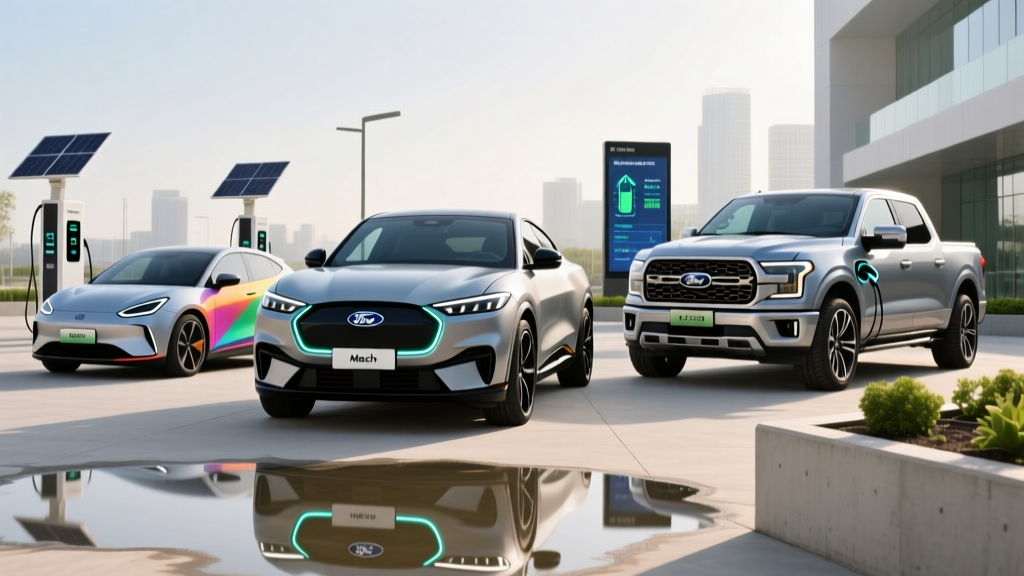
Ford currently sells two consumer EVs in the U.S. for 2026: the Mustang Mach-E crossover (EPA range up to 320 miles, starting at $39,995) and the F-150 Lightning pickup (EPA range up to 320 miles, starting at $54,995). Both use the NACS charge port natively, granting access to over 15,000 Tesla Superchargers. The commercial E-Transit van rounds out the lineup. Federal tax credit eligibility under IRS §30D varies by trim and buyer income — the Mach-E qualifies for up to $3,750–$7,500 depending on battery sourcing, while the Lightning's eligibility is more limited. Expect real-world highway range 10–15% below EPA stickers, with additional 20–30% loss in freezing temperatures.
Ford's 2026 EV Lineup: What's Actually for Sale
Ford's electric strategy has narrowed significantly since the early 2020s. The company canceled the planned next-generation electric SUV that was to ride on a dedicated platform, pivoting toward hybrids and smaller, more affordable EVs slated for 2027 and beyond. For 2026, buyers choosing Ford and electric cars have two proven options with real production history and known reliability data.
| Spec | 2026 Mustang Mach-E (Extended Range RWD) | 2026 F-150 Lightning (Extended Range) |
|---|---|---|
| Base MSRP | $39,995 (Select) | $54,995 (XLT 312A) |
| EPA Range | 320 miles | 320 miles |
| Battery (usable) | 91 kWh, NMC | 131 kWh, NMC |
| Motor / HP | RWD 290 hp / AWD 365 hp | 580 hp (dual motor) |
| 0–60 mph | ~6.1s (RWD) / ~4.8s (AWD) | ~3.8s |
| Peak DC Fast Charge | 150 kW | 150 kW |
| 10–80% DC Charge Time | ~45 minutes | ~41 minutes |
| Level 2 Charge Rate | 10.5 kW (~32 mi/hr) | 19.2 kW (~30 mi/hr) |
| MPGe (combined) | 101 MPGe | 70 MPGe |
| Charge Port | NACS (native) | NACS (native) |
| Battery Warranty | 8 yr / 100,000 mi | 8 yr / 100,000 mi |
| Cargo Volume | 29.7 cu ft (rear) + 4.7 cu ft frunk | 52.8 cu ft bed + 14.1 cu ft Mega Power Frunk |
Real-World Range Expectations
EPA Sticker: 320 miles (both Mach-E ER and Lightning ER)
Real-World Highway (70–75 mph, moderate weather): ~260–280 miles (Mach-E), ~240–260 miles (Lightning)
Cold Weather (below 32°F, highway): ~200–230 miles (Mach-E), ~180–210 miles (Lightning)
Both vehicles use NMC chemistry, which experiences more cold-weather range loss than LFP batteries. Preconditioning the battery while plugged in recovers roughly 5–8% of winter range.
Charging Infrastructure: The NACS Advantage
Ford made a pivotal decision in 2023 to adopt the North American Charging Standard (NACS) for all its EVs. For 2026 models, this means native Tesla-style charge ports — no adapter required. Owners get access to the Tesla Supercharger network, which according to Ford's charging page includes over 15,000 high-speed stalls nationwide. This single decision dramatically improved the ownership proposition for anyone considering Ford and electric cars, especially road-trippers.
| Level | Power | Miles Added/Hour (Mach-E) | Miles Added/Hour (Lightning) | Typical Use |
|---|---|---|---|---|
| Level 1 (120V) | ~1.4 kW | ~3–4 mi/hr | ~2–3 mi/hr | Emergency / overnight top-up |
| Level 2 (240V, 48A) | 10.5–11.5 kW | ~32 mi/hr | ~20 mi/hr | Home daily charging |
| Level 2 (240V, 80A) | 19.2 kW | N/A (10.5 kW max onboard) | ~30 mi/hr | Lightning home / depot |
| DC Fast (150 kW peak) | 150 kW | ~100 mi in 20 min (10–80% ~45 min) | ~115 mi in 20 min (10–80% ~41 min) | Road trips, Superchargers |
Charging curve reality: Both Ford EVs peak at 150 kW but do not sustain that rate. The Mach-E typically holds 130–150 kW from roughly 10% to 35% State of Charge (SoC), then tapers to ~80 kW by 60%, and ~45 kW above 80%. The Lightning's larger 131 kWh battery absorbs energy longer at higher rates, but the physics of NMC chemistry still mean the last 20% is painfully slow. Plan road-trip stops around 10–80% charges — going from 80% to 100% at a DC fast charger can take as long as the 10–80% session.
Cost of Ownership: Ford EVs vs. Gas Equivalents
The purchase price of Ford's EVs remains higher than comparable gas models, but operating costs tell a different story. Here's a data-driven comparison using the Mach-E and the gas Ford Escape, plus the Lightning versus the gas F-150.
| Cost Factor (5-Year / 75,000 mi) | Mach-E Select ($39,995) | Gas Escape ($30,000) | Lightning XLT ($54,995) | Gas F-150 XLT ($44,000) |
|---|---|---|---|---|
| Purchase Price | $39,995 | $30,000 | $54,995 | $44,000 |
| Est. Federal Tax Credit (§30D) | −$3,750 to −$7,500 | $0 | −$0 to −$3,750 | $0 |
| Fuel / Electricity (home L2 avg) | $3,900 (at $0.14/kWh) | $7,500 (at 28 MPG, $3.50/gal) | $6,400 | $11,250 (at 20 MPG, $3.50/gal) |
| Maintenance | $1,200 | $3,000 | $1,500 | $3,500 |
| Insurance (avg) | $9,500 | $7,000 | $11,000 | $8,500 |
| 5-Year Total (excl. depreciation) | ~$50,845–$54,595 | ~$47,500 | ~$73,895–$77,645 | ~$67,250 |
Key takeaways from the numbers:
- Mach-E vs Escape: The EV costs roughly $3,300–$7,100 more over 5 years when you exclude depreciation and the tax credit. With the full $7,500 credit, the Mach-E actually comes out slightly ahead. However, EV insurance premiums run 15–25% higher on average — a real cost many buyers overlook.
- Lightning vs Gas F-150: The Lightning's higher MSRP and insurance cost keep total ownership above the gas F-150 in most scenarios. The fuel savings are substantial (~$4,850 over 5 years), but not enough to close the $11,000 purchase gap without a tax credit.
- Depreciation wildcard: EV resale values have been volatile. The Mach-E has seen steeper depreciation than the gas Escape, while the Lightning has held value better than most EVs due to truck demand. Check current trade-in values on KBB or Edmunds before committing.
For precise fuel economy data on both electric and gas models, cross-reference fueleconomy.gov, the official EPA source.
Federal Tax Credit Eligibility: What Ford Buyers Need to Know
The IRS §30D Clean Vehicle Credit is not a guaranteed $7,500 off every Ford EV. The rules for 2026 are complex and depend on battery component sourcing, critical mineral content, buyer income, and vehicle MSRP caps. Here's the current framework:
- MSRP Cap: Vans, SUVs, and pickups (Mach-E and Lightning both qualify as SUV/truck) — $80,000 MSRP cap. Sedans — $55,000 cap.
- Buyer Income Cap: Modified AGI must not exceed $300,000 (joint), $225,000 (head of household), or $150,000 (single).
- Battery Sourcing: Up to $3,750 for meeting critical-minerals requirements + up to $3,750 for battery-component requirements. Ford sources battery cells from SK On (South Korea) and has been working to increase North American mineral sourcing. Check IRS.gov §30D guidance for the latest eligible VIN list.
- Point-of-Sale Transfer: Buyers can transfer the credit to the dealer at purchase, reducing the sale price immediately — no need to wait for tax filing. The dealer must be IRS-registered.
- Ford-Specific Reality: As of early 2026, the Mach-E typically qualifies for $3,750 (critical minerals portion) on most trims. Full $7,500 eligibility depends on specific build-month battery sourcing. The Lightning's eligibility is more limited — verify the exact VIN with your dealer before assuming a credit.
Common Misconceptions About Ford EVs
| Myth | Fact |
|---|---|
| "The Mach-E is just a rebadged Tesla." | The Mach-E uses Ford's own GE1 platform and SK On battery cells. It has a distinct driving character, Ford's Sync 4A infotainment, and BlueCruise ADAS — not Tesla hardware. |
| "Ford EVs can't road-trip because of charging." | With native NACS ports, both models access Tesla Superchargers — the most reliable DC fast-charging network in the U.S. A 300-mile trip requires one 30-minute stop. |
| "The battery will need replacement in 5 years." | Ford warrants the battery for 8 years/100,000 miles against degradation below 70% capacity. Industry data shows NMC packs typically retain 85–90% capacity at 100,000 miles under normal use. |
| "I can't charge at home — I live in an apartment." | This is a real limitation. Level 1 (120V) charging adds only ~3 miles/hour — enough for a 30-mile daily commute but not for heavier use. If you lack home L2 access, a PHEV or hybrid may be a better Ford choice. |
| "The Lightning can tow as much as a gas F-150." | The Lightning's max tow rating is 10,000 lbs, but towing at that capacity cuts range by 40–50%. A 320-mile range drops to ~160–190 miles while towing 7,000+ lbs. Gas F-150s maintain range far better under load. |
Who Should Buy a Ford EV (and Who Shouldn't)
Decision Framework: Is a Ford EV Right for You?
Choose the Mustang Mach-E if:
- You have home Level 2 charging (or can install a 240V/48A circuit for $500–$1,500)
- Your daily commute is under 80 miles round-trip
- You want crossover practicality with engaging driving dynamics
- You road-trip 2–4 times per year and want Supercharger access
- You qualify for at least the $3,750 federal credit
Choose the F-150 Lightning if:
- You need a full-size truck for work or family but want lower fueling costs
- You can charge at home (the 131 kWh pack needs 8–10 hours on a 19.2 kW L2 charger from empty)
- You value the Mega Power Frunk (14.1 cu ft, 400 lbs payload, with Pro Power Onboard for job-site electricity)
- You tow occasionally but not daily — heavy towing obliterates EV range
Look elsewhere (Ford hybrid or competitor) if:
- You lack home charging access and your area has sparse public DC infrastructure
- You live in a cold climate (below 20°F regularly) and need maximum range — consider the Mach-E with a heat pump option or look at competitors with LFP batteries
- You tow heavy loads daily — the gas or PowerBoost hybrid F-150 is more practical
- You need a third row — the Mach-E is a 5-seater only; Ford's Explorer EV is not yet available in the U.S.
First-Time Ford EV Buyer Checklist
If you're new to EVs and considering Ford, work through this list before signing:
- Audit your daily miles: Check your odometer logs. If you average under 50 miles/day, even Level 1 (120V) charging can keep a Mach-E topped up. Over 80 miles/day demands Level 2.
- Get an electrician quote: A Level 2 home charger installation (240V, 48A circuit) typically costs $800–$2,000 including the Ford Mobile Power Cord or a third-party unit like the ChargePoint Home Flex. If your panel is maxed out at 100A, a panel upgrade to 200A adds $1,500–$3,500.
- Test the actual charge port location: The Mach-E's port is on the driver-side front fender. The Lightning's is on the driver-side front fender as well. Verify your garage or driveway layout accommodates the cable reach.
- Download the FordPass app: This is your charging command center — it handles preconditioning, charge scheduling, remote start/stop, and Supercharger payment. Test it during your trial period.
- Verify the tax credit on the VIN: Before finalizing purchase, ask the dealer for the specific VIN and cross-reference it on the IRS eligible vehicle list. Credit amounts vary by build date and battery batch.
- Get an insurance quote before buying: EV insurance runs 15–25% higher than equivalent gas models. Get a binding quote from your carrier — the monthly premium difference ($30–$60/month) affects the real TCO.
Frequently Asked Questions
Does Ford make any other electric cars besides the Mach-E and Lightning?
For consumers in the U.S., no — the Mach-E and Lightning are Ford's only two retail EVs for 2026. The E-Transit is a commercial delivery van. Ford has announced a next-generation mid-size electric pickup (smaller than the Lightning) expected around 2027, and a $30,000-class electric vehicle using a new universal platform, but neither is available for purchase yet.
How does the Mach-E compare to a Tesla Model Y?
The 2026 Mach-E Extended Range (320 mi EPA, $39,995) competes directly with the Model Y Long Range (~310 mi EPA, ~$44,990). The Mach-E offers a lower starting price and many reviewers prefer its ride quality and interior materials. The Model Y has a more extensive native Supercharger footprint, faster DC charging (up to 250 kW, 10–80% in ~25 min vs the Mach-E's ~45 min), and a slightly larger cargo area. With NACS access, the Mach-E closes the charging-network gap significantly.
Can the F-150 Lightning power my house during an outage?
Yes, with the available Ford Intelligent Backup Power system (requires the 80A Charge Station Pro and a home transfer switch, installed by a licensed electrician). The Lightning's 131 kWh battery can supply up to 9.6 kW of continuous power, which Ford estimates can run an average home for up to 3 days during an outage. The system costs roughly $3,000–$5,000 including equipment and electrical work.
Is BlueCruise self-driving?
No. NHTSA and SAE International classify BlueCruise as a Level 2 driver-assistance system. It offers hands-free driving on pre-mapped divided highways (over 130,000 miles of compatible roads), but the driver must remain attentive. An in-cabin camera monitors eye gaze, and the system will issue warnings and slow the vehicle if the driver looks away for too long. This is fundamentally different from Level 4 robotaxi services like Waymo, which operate without any human driver.
What happens if my Ford EV battery degrades?
Ford's battery warranty guarantees at least 70% capacity retention for 8 years or 100,000 miles, whichever comes first. Real-world data from high-mileage Mach-E and Lightning owners suggests NMC packs lose roughly 1–2% capacity per year under normal charging habits (avoiding daily 100% charges and frequent DC fast charging). A full battery replacement outside warranty would cost $15,000–$25,000 depending on the pack — but this scenario is rare within the first 150,000 miles.
Should I wait for Ford's next-gen EVs?
If you need a vehicle now, the Mach-E and Lightning are proven, well-reviewed products with known reliability records. Ford's upcoming $30,000 EV and mid-size electric pickup are still 12–24 months from production, and final specs, pricing, and tax-credit eligibility are unconfirmed. Waiting means gambling on availability, pricing shifts, and potential credit changes. If your current vehicle is functional and you're not in a rush, monitoring Ford's 2027 announcements is reasonable — but don't pause a needed purchase for an unconfirmed model.