Quick Answer: Which Ford EV Should You Buy?
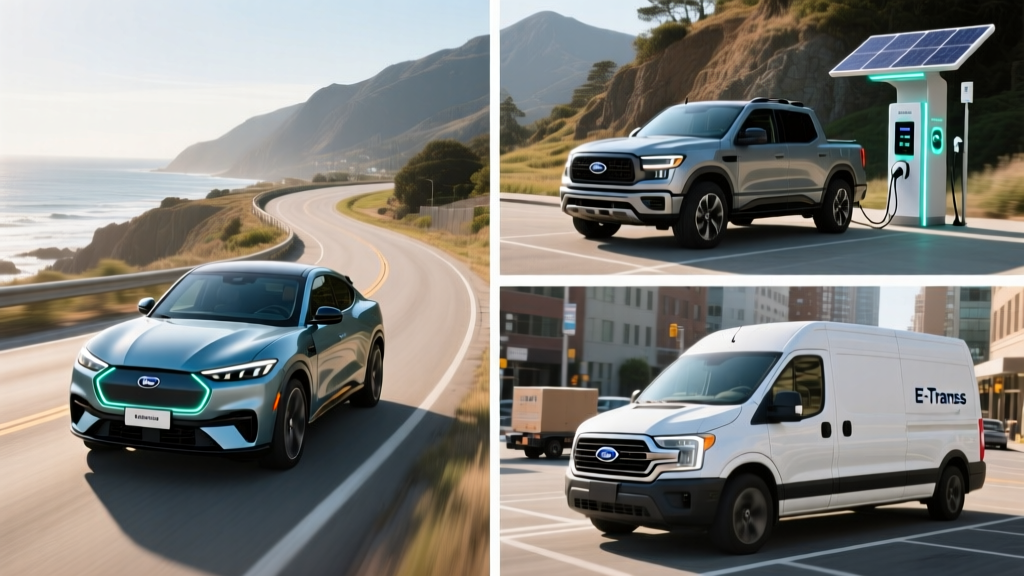
If you're browsing Ford electric cars for sale in 2026, Ford's lineup boils down to three core models: the Mustang Mach-E (compact SUV, EPA 250–320 mi, from ~$39,995), the F-150 Lightning (full-size pickup, EPA 240–320 mi, from ~$54,995), and the E-Transit (commercial van, EPA 126 mi, from ~$47,995). The Mach-E is the volume seller and best all-around pick for most buyers. The Lightning suits truck buyers who need payload, towing, and off-grid power. The E-Transit targets last-mile fleet operators. Federal §30D tax-credit eligibility varies by trim, battery sourcing, and buyer income — always verify on IRS.gov before purchasing.
The 2026 Ford EV Lineup at a Glance
Ford's electric strategy in 2026 centers on these three production models. Each serves a distinct use case, and their specs diverge significantly. Here's the head-to-head comparison buyers need:
| Spec | Mustang Mach-E (ER RWD) | F-150 Lightning (ER) | E-Transit (150" WB) |
|---|---|---|---|
| EPA Range | ~320 mi | ~320 mi | ~126 mi |
| Battery (usable) | 91 kWh (NMC) | 131 kWh (NMC) | 68 kWh (NMC) |
| Peak DC Fast Charge | 150 kW | 150 kW | 115 kW |
| 10–80% DC Charge | ~38 min | ~41 min | ~45 min |
| Level 2 Rate | 10.5 kW (48A) | 11.3 kW (48A) / 19.2 kW (80A option) | 11.3 kW |
| 0–60 mph | ~3.8 sec (ER AWD) | N/A (commercial) | |
| Horsepower | 266 hp (RWD) / 480 hp (GT) | 580 hp | 266 hp |
| Base MSRP | ~$39,995 | ~$54,995 | ~$47,995 |
| Battery Warranty | 8 yr / 100,000 mi | 8 yr / 100,000 mi | 8 yr / 100,000 mi |
Real-World Range Reality Check
EPA estimates assume mixed driving at moderate temperatures. In real-world highway testing (70+ mph sustained), expect the Mach-E ER to deliver roughly 270–290 miles, and the Lightning ER around 250–270 miles. In cold weather (below 30°F), both vehicles can lose 20–30% of rated range due to cabin heating demand and reduced battery chemistry efficiency — a factor every buyer in northern states should budget for.
Mustang Mach-E: The Daily-Driver EV
The Mach-E remains Ford's most accessible electric vehicle and the one most shoppers cross-shop against the Tesla Model Y, Hyundai Ioniq 5, and Kia EV6. For 2026, Ford continues to offer Select, Premium, California Route 1, and GT trims.
Range and Efficiency
The Extended Range rear-wheel-drive model achieves the lineup's best EPA range at approximately 320 miles, with a combined efficiency of roughly 101 MPGe (fueleconomy.gov). The GT Performance model trades range for speed — expect around 260 miles EPA and a 0–60 time of 3.5 seconds with 480 hp and 634 lb-ft of torque.
Charging Practicality
The Mach-E's 150 kW peak DC fast-charging rate means a 10–80% session takes approximately 38 minutes on a capable station. However, the charging curve tapers significantly above 80% — a full 80–100% top-off can add another 25+ minutes. At home on a Level 2 (240V) circuit, the 10.5 kW onboard charger replenishes roughly 30–35 miles per hour, meaning a full overnight charge is easily achievable.
The Mach-E uses the NACS (Tesla-style) connector as of the 2025 model year, granting access to Tesla Supercharger stations via Ford's integrated navigation. This is a significant practical advantage over CCS-only vehicles, as the Supercharger network remains the most reliable DC fast-charging infrastructure in the U.S.
Who It's For
The Mach-E fits commuters, small families, and crossover upgraders who want an engaging drive with strong range. Cargo space is 29.7 cu ft behind the rear seats (59.7 cu ft folded) — competitive with the segment but slightly behind the Model Y. The front trunk (frunk) adds useful sealed storage.
F-150 Lightning: Electric Truck, Real Capability
The F-150 Lightning is not a compliance vehicle — it's a full-size truck that happens to be electric. With a maximum payload of around 2,235 lb and up to 10,000 lb towing capacity (Max Trailer Tow Package on Lariat/Platinum), it handles genuine truck work.
Pro Power Onboard: The Killer Feature
The Lightning's Pro Power Onboard system turns the truck into a mobile generator. The standard 2.4 kW system provides two 120V outlets in the bed, while the optional 9.6 kW system adds 240V capability — enough to run power tools at a job site, appliances during a blackout, or even a small welder. For contractors and rural homeowners, this feature alone can justify the purchase.
Range Under Load
Here's where truck buyers need honesty: the Lightning's 320-mile EPA range (Extended Range battery) drops substantially when towing. Ford's own testing and independent reviews show range can decrease by 40–55% when towing near max capacity. If you regularly tow a 7,000+ lb trailer on the highway, plan for effective range of 150–180 miles between charges. The Standard Range battery (98 kWh usable, ~240 mi EPA) is better suited to light-duty and urban truck use.
Charging the Lightning
At 150 kW DC peak, the 131 kWh Extended Range battery takes roughly 41 minutes for a 10–80% charge. The dual onboard chargers on higher trims allow 19.2 kW Level 2 charging (80A circuit required), which can fully replenish the large battery overnight — a significant advantage over the standard 11.3 kW charger, which would need 12+ hours for a full charge.
E-Transit: The Fleet Workhorse
The E-Transit targets commercial fleet operators running predictable daily routes under 120 miles. With 126 miles of EPA range, it is not a consumer vehicle — it's a purpose-built last-mile delivery van. Ford offers it in multiple roof heights, body lengths, and upfit configurations (cargo van, cutaway, chassis cab).
At 68 kWh, the battery is modest, but fleet economics work differently: lower upfront battery cost means lower vehicle cost, and most delivery routes fall well within the range envelope. Level 2 charging at 11.3 kW replenishes the pack in roughly 6–7 hours — ideal for overnight depot charging. DC fast charging at 115 kW brings a 15–80% session to about 45 minutes.
Cost Comparison: Ford EVs vs. Gas Equivalents
The purchase decision ultimately comes down to total cost of ownership. Let's compare the Mach-E and F-150 Lightning against their closest gas counterparts over a 5-year/75,000-mile ownership period.
| Cost Factor (5 yr / 75k mi) | Mach-E ER RWD | Ford Edge AWD (Gas) | F-150 Lightning ER | F-150 XLT 4x4 (Gas) |
|---|---|---|---|---|
| Base MSRP | $42,495 | $39,940 | $59,995 | $52,500 |
| Est. Federal Tax Credit (§30D) | Up to $3,750* | $0 | Up to $7,500* | $0 |
| Fuel / Electricity | ~$3,200 | ~$8,400 | ~$4,100 | ~$11,200 |
| Maintenance | ~$1,800 | ~$3,600 | ~$2,000 | ~$4,200 |
| Insurance (avg.) | ~$9,500 | ~$7,800 | ~$11,000 | ~$9,200 |
| Est. Depreciation | ~$18,000 | ~$15,000 | ~$24,000 | ~$18,000 |
| Total 5-Yr Cost | ~$75,000 | ~$74,740 | ~$101,095 | ~$95,100 |
*Federal §30D credit eligibility depends on battery critical-mineral sourcing, buyer AGI limits ($150k single / $300k joint), and MSRP caps ($55k SUVs / $80k trucks). Verify current eligibility at IRS.gov before purchase. Credits may be transferred to the dealer as a point-of-sale discount.
Key Takeaways from the Numbers
- Fuel savings are real but modest for low-mileage drivers. At 15,000 miles/year with $0.13/kWh home electricity, the Mach-E saves roughly $1,040/year vs. the Edge. Over 5 years, that's ~$5,200 — not enough to offset a higher purchase price without the tax credit.
- Maintenance savings compound. No oil changes, fewer brake replacements (thanks to regenerative braking), and simpler drivetrains mean EVs cost roughly 40–50% less to maintain annually.
- Insurance is higher for EVs. Expect premiums 15–25% above comparable gas models due to higher repair costs and battery replacement risk. Get quotes before committing.
- Depreciation remains the wildcard. EV resale values have been volatile. Ford's EVs have seen steeper depreciation than Tesla or Toyota hybrids in recent years — a factor that can erase fuel savings.
Federal Tax Credit & Incentive Reality
The §30D Clean Vehicle Credit is not a guaranteed $7,500 for every Ford EV buyer. Here's what actually determines your eligibility:
§30D Eligibility Checklist (2026)
- Battery sourcing: A percentage of critical minerals and battery components must be sourced from the U.S. or FTA partners. Sourcing rules tighten annually — a trim that qualified in 2025 may not qualify in 2026.
- MSRP caps: Vans/SUVs must be under $80,000 MSRP; sedans under $55,000. The Mach-E qualifies; higher Lightning trims may exceed the cap.
- Buyer income limits: AGI must not exceed $150,000 (single), $225,000 (head of household), or $300,000 (joint).
- Point-of-sale transfer: Eligible buyers can transfer the credit to the dealer, reducing the purchase price at signing rather than waiting for a tax refund.
- Final assembly: Vehicle must be assembled in North America (all three Ford EVs qualify).
Because battery-sourcing rules change and Ford adjusts supply chains, always confirm the specific VIN's eligibility through the dealer and cross-reference with the IRS. State and utility incentives (often $500–$3,000 for home charger installation) stack on top — check your state's energy office and local utility.
Common Misconceptions About Ford EVs
| Myth | Fact |
|---|---|
| "The Lightning can't tow anything." | It tows up to 10,000 lb — but range drops 40–55% under heavy tow loads. Plan charging stops accordingly. |
| "Ford EVs can't use Tesla Superchargers." | Since 2025, Ford EVs ship with the NACS connector and have native Supercharger access. CCS adapters are available for older models. |
| "The battery will need replacing in 5 years." | Ford warranties the battery for 8 years/100,000 miles against dropping below 70% capacity. NMC degradation data shows most packs retain 85–90% capacity at 100k miles under normal use. |
| "You need a special electrical panel." | Most homes with a 200A panel can support a 48A Level 2 charger on a 60A circuit. Older homes with 100A panels may need an upgrade ($1,500–$3,000). Always have a licensed electrician assess your panel. |
| "EVs are worse in winter." | Range does drop 20–30% in sub-30°F weather. However, EVs start instantly in cold (no cranking), and preconditioning while plugged in mitigates range loss. A heat pump (available on Mach-E Premium/GT) improves cold efficiency. |
Home Charging: What You Actually Need
Home charging access is the single biggest factor in EV satisfaction. If you can charge at home, an EV is dramatically more convenient than gas. If you can't, ownership becomes significantly harder.
Level 2 Installation Costs
| Item | Typical Cost Range |
|---|---|
| Level 2 Charger (48A, hardwired) | $400–$700 |
| Electrician labor (60A circuit, 240V) | $600–$1,500 |
| Permit & inspection | $50–$200 |
| Panel upgrade (if needed, 100A→200A) | $1,500–$3,000 |
| Total (no panel upgrade) | $1,050–$2,400 |
| Total (with panel upgrade) | $2,550–$5,400 |
For the F-150 Lightning with the optional 80A onboard charger, you'll need a 100A circuit — which requires a 200A+ panel and heavier-gauge wiring. This is a premium installation that can push costs toward the upper range.
Decision Framework: Which Ford EV Is Right for You?
Choose the Mustang Mach-E If:
- You commute 20–80 miles daily and want an engaging crossover
- You need 250+ miles of real-world highway range for road trips
- You want the lowest entry price in Ford's EV lineup
- You don't regularly carry more than 4 passengers or tow
Choose the F-150 Lightning If:
- You need a truck for work (payload, towing, job-site power)
- You want Pro Power Onboard as a backup generator or mobile power source
- You can charge at home and your daily driving is under 200 miles
- You rarely tow heavy loads on long highway trips (or can plan charging stops)
Choose the E-Transit If:
- You operate a commercial fleet with daily routes under 120 miles
- You have depot charging infrastructure or can install it
- Lower operating cost per mile matters more than range
Consider a Hybrid Instead If:
- You lack reliable home or workplace charging
- You regularly drive 300+ miles in rural areas with sparse charging
- You frequently tow heavy loads on long trips (the F-150 PowerBoost hybrid offers 700+ mi range with no range penalty under load)
- Your budget is under $35,000 (the Maverick Hybrid starts ~$28,000 and delivers 42 MPG city)
Frequently Asked Questions
Are Ford EVs reliable?
Ford's EVs have had mixed reliability records in their first model years. Early Mach-E models experienced a high-voltage battery recall (2022, certain 2021–2022 units), and early Lightnings had some build-quality issues typical of first-year production. By the 2025–2026 model years, most early issues have been addressed. Check NHTSA.gov for any open recalls on a specific VIN, and consult IIHS and J.D. Power ratings for the specific model year.
How long does the battery last on a Ford EV?
Ford warranties its EV batteries for 8 years or 100,000 miles, guaranteeing they will retain at least 70% of original capacity. Real-world data from high-mileage Mach-E and Lightning owners suggests NMC packs retain approximately 85–92% capacity at 100,000 miles under normal charging habits (avoiding consistent 100% charges and frequent DC fast charging in extreme heat). Out-of-warranty battery replacement currently ranges from $12,000–$18,000 depending on the model and pack size — a cost to factor into long-term ownership.
Can I charge a Ford EV at any public charger?
Yes. 2025+ Ford EVs with the NACS connector can charge at Tesla Superchargers, Electrify America, EVgo, ChargePoint, and any other network. For DC fast charging, Tesla Superchargers offer the most reliable experience. For older Ford EVs with CCS connectors, a Ford-approved NACS adapter enables Supercharger access.
What's the cheapest way to own a Ford EV?
Maximize savings by: (1) purchasing a trim that qualifies for the full §30D credit and applying it at point of sale, (2) installing a home Level 2 charger during off-peak utility hours, (3) selecting a model with lower insurance premiums (the Mach-E Select/Premium is generally cheaper to insure than the GT or Lightning), and (4) taking advantage of state/utility rebates for charger installation and EV purchase.
Should I buy or lease a Ford EV?
Leasing can be smart if you're uncertain about long-term battery health, EV depreciation, or want to upgrade as charging tech evolves. Ford sometimes passes the §30D credit through as a lease incentive even on models where purchase credit eligibility is uncertain (via the commercial clean vehicle credit loophole — consult a tax professional). Buying makes more sense if you plan to keep the vehicle 5+ years, drive high annual miles (avoiding lease penalties), and want to build equity.