The Quick Answer: Ford's EV Lineup in 2026
If you're narrowing your Ford electric car focus in 2026, the two models that matter are the Mustang Mach-E (starting around $39,995, EPA range up to 320 miles) and the F-150 Lightning (starting around $54,995, EPA range up to 320 miles). Both are eligible for partial or full federal tax credits depending on trim, battery sourcing, and your income. For most buyers, the Mach-E Select with the Standard Range battery offers the best value entry point at roughly $32,495 after the $7,500 point-of-sale credit — but real-world highway range drops to approximately 200–220 miles in cold weather, and home Level 2 charging installation adds $800–$2,000 to your first-year costs.
Ford's Current Electric Vehicle Lineup
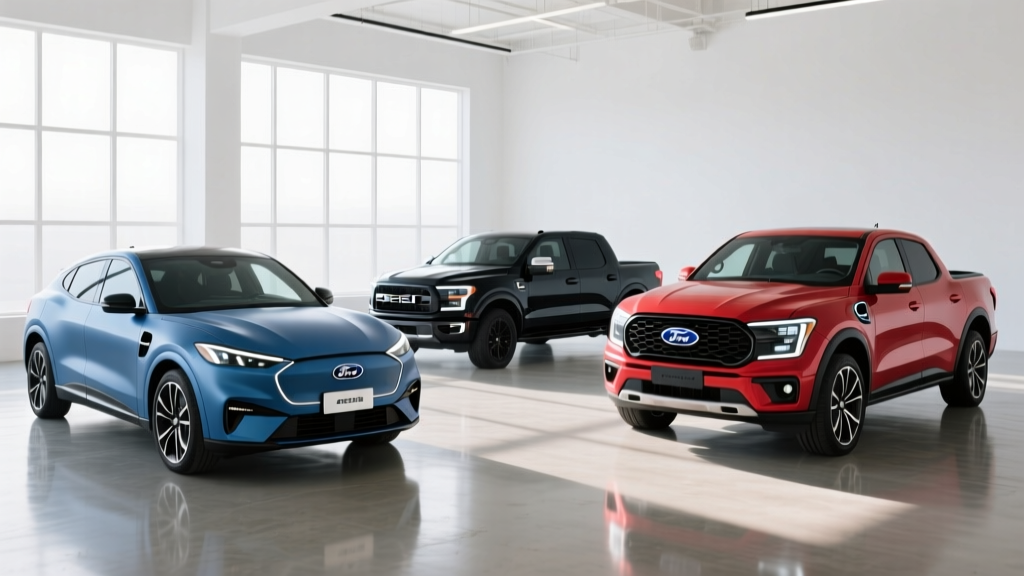
Ford's EV strategy in 2026 centers on two high-volume models. The company discontinued the low-volume Focus Electric years ago, so today's Ford electric car focus means choosing between a crossover and a truck — each with distinct battery options, range profiles, and buyer use cases.
| Spec | Mustang Mach-E Select (SR RWD) | Mustang Mach-E Premium (ER AWD) | F-150 Lightning XLT (SR) | F-150 Lightning Lariat (ER) |
|---|---|---|---|---|
| Base MSRP | $39,995 | $49,995 | $54,995 | $64,995 |
| Battery (usable kWh) | 70 kWh (LFP) | 91 kWh (NMC) | 98 kWh (NMC) | 131 kWh (NMC) |
| EPA Range | 250 mi | 320 mi | 240 mi | 320 mi |
| MPGe (combined) | 101 MPGe | 93 MPGe | 78 MPGe | 73 MPGe |
| Peak DC Fast Charge | 150 kW | 150 kW | 150 kW | 150 kW |
| 10–80% DCFC Time | ~33 min | ~41 min | ~41 min | ~49 min |
| Level 2 Charge Rate | 10.5 kW | 10.5 kW | 11.5 kW (19.2 kW opt.) | 19.2 kW |
| 0–60 mph | 6.3 sec | 5.1 sec | 5.7 sec | 3.8 sec |
| Horsepower | 266 hp | 346 hp | 563 hp | 563 hp |
| Battery Warranty | 8 yr / 100,000 mi | 8 yr / 100,000 mi | 8 yr / 100,000 mi | 8 yr / 100,000 mi |
Sources: fueleconomy.gov, Ford Motor Company. EPA estimates; real-world results vary.
Real-World Range Reality Check
The EPA sticker says 320 miles on the Extended Range Mach-E — but expect roughly 250–270 miles on sustained highway driving at 70+ mph, and 200–220 miles in sub-30°F winter conditions. LFP batteries (Standard Range Mach-E) lose slightly less range in cold weather than NMC packs but start with less total capacity. Always plan road trips around 80% of the EPA number to account for charging curve taper above 80% SoC.
Ford EV vs. Gas and Hybrid: The Numbers
A common question when sharpening your Ford electric car focus: how does a Mach-E or Lightning actually compare to the gas equivalents you're cross-shopping? Here's a concrete breakdown using the Mach-E Premium ER AWD versus the Ford Edge (gas midsize crossover) and the Ford Maverick Hybrid (as a fuel-economy benchmark).
| Vehicle | Energy Source | Efficiency | Cost per Mile | Annual Cost |
|---|---|---|---|---|
| Mach-E Premium ER AWD | Electricity ($0.16/kWh avg.) | 34 kWh/100 mi | $0.054 | $816 |
| Mach-E (DCFC-heavy, $0.48/kWh) | Public DC Fast Charging | 34 kWh/100 mi | $0.163 | $2,448 |
| Ford Edge AWD (gas) | Gasoline ($3.40/gal) | 24 MPG combined | $0.142 | $2,125 |
| Ford Maverick Hybrid | Gasoline ($3.40/gal) | 42 MPG combined | $0.081 | $1,214 |
Gas and electricity prices based on national averages; your costs depend on local utility rates and fuel prices. Home charging assumes Level 2 at residential electricity rates. fueleconomy.gov efficiency data.
The takeaway: home charging is where EV economics work. If you charge primarily at home, the Mach-E saves roughly $1,300/year versus the gas Edge. If you rely entirely on public DC fast chargers, the Mach-E actually costs more per mile than the gas Edge. This is the single biggest variable in your ownership equation.
Total Cost of Ownership: 5-Year Breakdown
Purchase price is only the beginning. Here's what five years actually looks like for a Mach-E Select SR RWD with the $7,500 federal point-of-sale credit applied, compared to a similarly equipped gas crossover.
| Cost Category | Mach-E Select SR RWD | Comparable Gas Crossover |
|---|---|---|
| MSRP | $39,995 | $38,500 |
| Federal Tax Credit (§30D) | −$7,500 | $0 |
| Effective Purchase Price | $32,495 | $38,500 |
| Home Level 2 Charger Install | $1,200 (avg.) | $0 |
| Fuel/Energy (5 yr, 75k mi) | $4,080 (home charging) | $10,625 (gas) |
| Maintenance (5 yr) | $1,800 | $3,500 |
| Insurance (5 yr avg.) | $9,500 | $7,200 |
| Estimated Depreciation | $14,000 | $12,500 |
| 5-Year Total | $63,075 | $72,325 |
Insurance estimates based on national EV averages — EV premiums run 15–25% higher than comparable gas vehicles. Depreciation figures reflect current EV resale trends. Tax credit eligibility requires meeting IRS §30D requirements including income caps and battery sourcing rules.
The Mach-E wins on operating costs but loses ground on insurance and depreciation. Your net savings over five years are approximately $9,250 — meaningful, but not the "free driving" narrative some EV marketing suggests.
Tax Credit Eligibility: What You Actually Qualify For
The federal §30D clean vehicle credit can reduce your effective price by up to $7,500, transferred to the dealer at point of sale. But eligibility is not automatic. Here's the checklist:
- MSRP cap: Vans/SUVs/trucks ≤ $80,000; sedans ≤ $55,000 (Mach-E qualifies as SUV; Lightning qualifies as truck)
- Income cap: AGI ≤ $150,000 (single) / $225,000 (head of household) / $300,000 (joint)
- Battery sourcing: Critical minerals and battery components must meet escalating domestic/free-trade-ally percentages — verify current-year compliance on the manufacturer's window sticker or fueleconomy.gov
- Final assembly: Must occur in North America (both Mach-E and Lightning qualify)
- Point-of-sale transfer: You can apply the credit as a down payment reduction at the dealer rather than waiting for a tax refund
Caveat: Sourcing requirements tighten annually. A trim that qualifies in January may not in December. Always verify on the IRS qualified vehicles list before signing paperwork. Consult a tax professional for your specific situation.
Charging at Home vs. Public: What First-Time Buyers Must Know
Most Ford EV owners do 80%+ of their charging at home. Here's what that requires and what it costs:
| Level | Power (kW) | Miles Added per Hour | Typical Use |
|---|---|---|---|
| Level 1 (120V outlet) | 1.2–1.4 kW | 3–5 mi/hr | Overnight top-up, low daily mileage |
| Level 2 (240V, 48A circuit) | 10.5–11.5 kW | 28–35 mi/hr | Primary home charging, full overnight refill |
| DC Fast Charging | Up to 150 kW | ~180 mi in 30 min (peak) | Road trips; tapers significantly above 80% SoC |
Home Level 2 Installation Cost Breakdown
| Component | Low Estimate | High Estimate |
|---|---|---|
| Level 2 charger hardware (Ford Mobile Power Cord or 3rd-party) | $300 | $700 |
| Electrician labor (240V/50A circuit run) | $500 | $1,500 |
| Electrical panel upgrade (if needed, 200A service) | $0 | $2,500 |
| Permit and inspection | $50 | $300 |
| Total | $850 | $5,000 |
Most homes with 200A service and a nearby garage panel fall in the $800–$1,500 range. Older homes or those needing a panel upgrade push toward $3,000–$5,000. Always get a quote from a licensed electrician before committing to a vehicle purchase.
If you cannot install home charging (apartment, condo, street parking), your economics shift dramatically. Public DCFC at $0.40–$0.55/kWh erases most fuel savings versus gas. In this scenario, a PHEV like the Ford Escape PHEV (37 miles electric-only, 42 MPG gas) may be a more practical electrified choice.
Common Misconceptions About Ford EVs
| Myth | Fact |
|---|---|
| "The battery will need replacing in 5 years" | Ford warranties the battery for 8 years/100,000 miles with a minimum 70% capacity retention threshold. Industry data shows modern NMC and LFP packs typically retain 85–90% capacity at 100,000 miles. |
| "EVs cost more to insure" | True — typically 15–25% higher premiums due to repair costs and parts pricing. Budget an extra $300–$500/year versus a gas equivalent. |
| "The F-150 Lightning can't tow" | The Lightning can tow up to 7,700 lbs (ER) — but towing at capacity cuts range by roughly 40–50%. Plan for 150–170 miles of range when towing heavy on the highway. |
| "Ford's BlueCruise is self-driving" | BlueCruise is a SAE Level 2 driver-assistance system. You must keep your eyes on the road. The driver monitoring camera will alert you if attention lapses. It is not autonomous — it's hands-free lane-keeping on pre-mapped divided highways. |
| "I'll never be able to take a road trip" | Ford EVs use the NACS connector (Tesla Supercharger compatible), giving access to 25,000+ Supercharger stalls nationwide. Plan 15–20 minute stops every 200 miles and road trips are practical — just slower than gas. |
SAE Automation Level: Ford BlueCruise
BlueCruise is SAE Level 2 — the vehicle controls steering and speed on approved highways, but you are the driver. You must remain alert, keep your eyes on the road, and be prepared to take over instantly. This is fundamentally different from Level 4 robotaxi services (Waymo, Zoox) that operate without any human driver. Never treat BlueCruise as a substitute for attentive driving.
Decision Framework: Which Ford EV (If Any) Is Right for You?
If / Then EV Decision Guide
- If you drive <40 miles/day and have home charging access → The Mach-E Select SR is the value winner. LFP battery handles daily cycling well, 250 EPA miles covers your week, and $32,495 after tax credit is compelling.
- If you road-trip monthly and need 300+ miles of range → Mach-E Premium ER delivers 320 EPA miles and NACS Supercharger access. Budget ~$49,995 before credit; expect ~270 real highway miles.
- If you need a truck for work or towing → F-150 Lightning is the only electric full-size pickup in Ford's lineup. Know that towing slashes range hard — the ER model is essential if you tow more than occasionally.
- If you live in an apartment or lack home charging → Reconsider a full BEV. The Ford Escape PHEV (37 mi electric-only, 42 MPG combined) gives you electric commuting without range anxiety or public-charging dependency.
- If your budget is under $30,000 → No new Ford EV fits. Look at the used EV market (pre-owned Mach-E models from 2022–2024 are entering the $22,000–$28,000 range) or consider the used EV tax credit (§25E, up to $4,000).
- If you regularly drive in extreme cold (below 10°F) → Budget 30–40% range loss in winter. The ER models with NMC batteries and heat pumps handle cold better — preconditioning while plugged in is essential to preserve range.
Frequently Asked Questions
Is the Ford Mustang Mach-E actually a Mustang?
No — the Mach-E is a battery-electric crossover SUV that shares no mechanical components with the gas Mustang coupe. Ford uses the Mustang branding for marketing and design cues. If you want a traditional Mustang, that remains a gas-powered sports car. The Mach-E competes with the Tesla Model Y, Hyundai Ioniq 5, and Chevrolet Equinox EV.
What connector does Ford use for charging?
Starting with the 2025 model year, Ford adopted the NACS (North American Charging Standard) connector on new vehicles, replacing CCS1. This gives Ford EVs native access to Tesla Supercharger stations without an adapter. If you're buying a 2022–2024 used Ford EV, it will have CCS1 and require a Ford-provided NACS adapter for Supercharger access.
How long does it take to charge a Mach-E from empty?
On a Level 2 home charger at 10.5 kW, a full 0–100% charge on the 70 kWh Standard Range battery takes roughly 7 hours — easily done overnight. On a 150 kW DC fast charger, 10–80% takes approximately 33 minutes, but charging slows dramatically above 80% (the charge curve taper). Plan road-trip stops for 10–80%, not full charges.
Will Ford release more EVs beyond the Mach-E and Lightning?
Ford has announced plans for a next-generation midsize electric pickup and additional EVs on its flexible EV platform, but as of early 2026, only the Mach-E and Lightning are available for purchase. Ford has also scaled back some EV production targets in response to market demand shifts. Any future models should be considered announced/preliminary until official MSRP and EPA figures are published.
How does the F-150 Lightning compare to the gas F-150 on cost?
The Lightning's starting MSRP ($54,995) is significantly higher than a base gas F-150 XL (~$38,000). However, the Lightning eliminates oil changes, transmission fluid, and exhaust maintenance, and fueling costs drop from ~$2,800/year (gas) to ~$1,000/year (home charging). Over five years and 75,000 miles, the Lightning can break even or save money if you qualify for the full tax credit and charge at home — but the higher purchase price and insurance premiums mean the savings gap is narrower than marketing implies.
What happens if the battery degrades past the warranty threshold?
Ford's battery warranty guarantees at least 70% of original capacity for 8 years or 100,000 miles. If your battery falls below that threshold within the warranty period, Ford will repair or replace it at no cost. Out-of-warranty battery replacement for a Mach-E currently ranges from $12,000–$18,000 depending on the pack — a significant expense, though industry data suggests most modern packs outlast their warranty periods with 85%+ capacity retention at 100,000 miles.