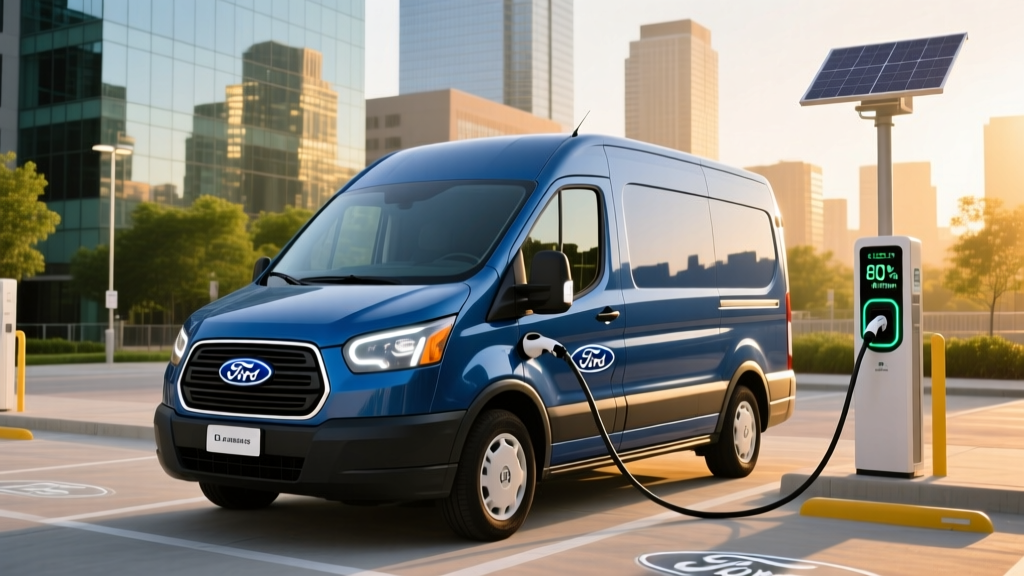
If you're evaluating the Ford E-Transit (often searched as the "Ford Transit City EV") for last-mile delivery or urban fleet duty, here's the direct answer: the 2026 E-Transit delivers an EPA-estimated 126 miles of range from its 68 kWh usable lithium-ion battery, supports DC fast charging up to 115 kW (10–80% in approximately 45 minutes), and starts at an MSRP around $46,895 before any incentives. It's purpose-built for predictable urban routes under 100 miles per day, not long-haul or cold-climate work without route planning. For fleet operators with depot charging, the per-mile energy cost can undercut gasoline by 50–65%.
Quick Verdict: Who Is the Ford E-Transit For?
The E-Transit is ideal for urban and suburban commercial fleets running fixed routes under 100 miles daily with access to overnight Level 2 depot charging. It is not suited for intercity routes exceeding 120 miles, extreme cold-climate operations without preconditioning infrastructure, or businesses without reliable charging access at a home base. If your daily route averages 60–90 miles with depot return, the E-Transit's economics are compelling. If you regularly exceed 130 miles or operate in sub-20°F winters, consider route segmentation or a diesel Transit as backup.
Range, Battery & Efficiency: The Numbers That Matter
The 2026 Ford E-Transit carries a 68 kWh usable battery pack (gross capacity approximately 72 kWh) using NMC (nickel manganese cobalt) cell chemistry. Ford rates the low-roof cargo van variant at 126 miles EPA, while the high-roof and cutaway configurations drop slightly due to aerodynamic drag and weight, landing around 118–121 miles EPA.
Real-World Range Expectations
EPA Sticker: 126 miles (low-roof cargo van)
Real-World Highway (70 mph, moderate climate): ~100–110 miles
Urban Stop-and-Go (30 mph avg, 65°F): ~120–130 miles (regen braking helps)
Cold Weather (20°F, highway): ~80–95 miles (25–35% loss typical for NMC packs without heat pump preconditioning)
Fully Loaded (3,500+ lbs payload, urban): ~105–115 miles
The E-Transit's range benefits enormously from urban regenerative braking. Highway driving at sustained speeds is where you'll see the steepest drop from EPA figures.
Efficiency is rated at approximately 2.0–2.2 kWh/mile depending on configuration, which translates to roughly 45–50 MPGe combined. That's not a typo — commercial vans are heavy, and the E-Transit prioritizes payload capacity over efficiency. For context, a gasoline Ford Transit 250 cargo van averages 15–17 MPG combined in similar urban duty, according to fueleconomy.gov.
Charging Speed & Infrastructure Requirements
Charging is where commercial EV adoption lives or dies. The E-Transit supports three charging tiers:
| Charging Level | Power (kW) | Connector | Time (10–80%) | Miles Added/Hour |
|---|---|---|---|---|
| Level 1 (120V) | 1.4 kW | J1772 | Not practical (48+ hrs) | ~3–4 mi/hr |
| Level 2 (240V, 48A) | 11.5 kW | J1772 | ~8 hours (full) | ~23 mi/hr |
| DC Fast Charge | 115 kW peak | CCS1 | ~45 min (10–80%) | ~130 mi/hr (peak) |
The 115 kW peak DC fast-charge rate is moderate by 2026 passenger-car standards (where 250–350 kW is common), but it's typical for commercial vans prioritizing battery longevity over peak speed. The charge curve tapers significantly above 80% SoC, so plan DC sessions around the 10–80% sweet spot.
Depot charging reality: Most fleet operators will rely on Level 2 overnight charging at 11.5 kW, which fully replenishes the 68 kWh pack in roughly 7–8 hours — perfectly aligned with an overnight depot schedule. Installation of a commercial-grade Level 2 station (like a ChargePoint CT4000 or similar) typically costs $3,000–$7,000 per port including electrical work, permits, and equipment, though this varies widely based on existing panel capacity and conduit runs. Always get a site survey from a licensed electrician before committing.
E-Transit vs. Gasoline Transit: 5-Year Cost Breakdown
The purchase premium for the E-Transit is significant, but operational savings can close the gap quickly for high-mileage urban fleets. Here's a side-by-side comparison based on 25,000 miles/year of urban delivery driving:
| Cost Category | Ford E-Transit (EV) | Ford Transit 250 (Gas) |
|---|---|---|
| Base MSRP (2026) | $46,895 | $42,500 |
| Federal Tax Credit (§30D)* | Up to $7,500 (if eligible) | $0 |
| Effective Purchase Price | ~$39,395 | $42,500 |
| Fuel/Energy Cost (5 yr, 125k mi) | ~$8,500 (at $0.13/kWh avg) | ~$22,100 (at $3.50/gal, 16 MPG) |
| Maintenance (5 yr) | ~$2,800 | ~$6,200 |
| Insurance (5 yr est.) | ~$14,500 | ~$12,000 |
| 5-Year Total Cost | ~$65,195 | ~$82,800 |
| Cost Per Mile | ~$0.52 | ~$0.66 |
*Federal §30D tax credit eligibility depends on MSRP caps (vans capped at $80,000), buyer income limits, and battery component/critical mineral sourcing requirements per current IRS rules. Commercial fleets may alternatively qualify under the §45W Commercial Clean Vehicle Credit — consult a tax professional. Point-of-sale transfer is available for eligible buyers.
The $17,600 five-year savings is driven primarily by fuel cost reduction ($13,600) and lower maintenance ($3,400 — no oil changes, fewer brake replacements due to regen braking, no transmission fluid). Insurance runs 15–20% higher on the E-Transit due to repair costs and parts pricing for EV-specific components.
Performance, Payload & Practical Specs
| Specification | 2026 Ford E-Transit (Low-Roof Cargo Van) |
|---|---|
| Battery (usable) | 68 kWh, NMC chemistry |
| EPA Range | 126 miles |
| Motor Output | 266 hp (198 kW), 317 lb-ft torque |
| 0–60 mph | ~8.5 seconds (unloaded) |
| Max Payload | 3,880 lbs (cargo van) |
| Cargo Volume | 246.7 cu ft (low-roof, 130" WB) |
| Max DC Charge Rate | 115 kW (CCS1) |
| Level 2 Charge Rate | 11.5 kW (J1772) |
| 10–80% DC Fast Charge | ~45 minutes |
| Battery Warranty | 8 years / 100,000 miles |
| Bumper-to-Bumper | 3 years / 36,000 miles |
| Base MSRP | $46,895 |
The 266 hp electric motor delivers instant torque, which matters for stop-and-go urban delivery — the E-Transit pulls away from lights with authority even when loaded. Top speed is electronically limited to 75 mph, which is intentional: Ford tuned this vehicle for urban efficiency, not highway cruising. The 3,880-lb max payload is competitive with the gas Transit 250, though the E-Transit's curb weight is roughly 600 lbs heavier due to the battery pack, which slightly reduces available payload in some configurations.
Federal Tax Credits & Incentives: What Fleets Actually Qualify For
§30D Clean Vehicle Credit Checklist (2026 Rules)
- MSRP Cap: Vans and trucks must be under $80,000 — the E-Transit qualifies at $46,895 base
- Income Limits: AGI must not exceed $150,000 (single), $225,000 (head of household), or $300,000 (joint) — applies to individual buyers, not commercial entities
- Battery Sourcing: Critical minerals and battery components must meet phased-in domestic/free-trade sourcing thresholds per IRS guidelines
- Point-of-Sale Transfer: Eligible buyers can transfer the credit to the dealer at purchase, reducing the upfront price directly
- Commercial Alternative: Businesses that don't qualify for §30D may be eligible for the §45W Commercial Clean Vehicle Credit (up to $7,500 for vehicles under 14,000 lbs GVWR)
Sourcing requirements tighten annually. Verify current-year eligibility on IRS.gov before purchase. State and utility incentives (e.g., California HVIP, New York Truck Voucher) can stack on top — check your local programs.
Common Misconceptions About the E-Transit
| Myth | Fact |
|---|---|
| "126 miles of range isn't enough for any real business." | The average last-mile delivery route covers 60–90 miles/day (US Census Bureau / BTS data). The E-Transit covers 80%+ of urban commercial routes without mid-day charging. |
| "EV batteries need replacing every few years." | Ford warranties the E-Transit battery for 8 years/100,000 miles with a capacity retention threshold of 70%. Real-world fleet data from early adopters shows 5–8% degradation at 80,000 miles with proper charging habits. |
| "You need a special utility rate to make it worthwhile." | Even at the US average commercial rate of $0.13/kWh, the E-Transit costs ~$0.07/mile in energy vs. ~$0.18/mile for a gas Transit at $3.50/gal. Time-of-use rates improve savings further but aren't required. |
| "Cold weather makes it unusable." | Cold reduces range 25–35% (down to ~80–95 miles at 20°F). Fleets in cold climates mitigate this with depot preconditioning, route segmentation, and cabin preheating while plugged in. |
| "The E-Transit can't handle heavy payloads." | Max payload is 3,880 lbs — competitive with the gas Transit 250. The electric motor's instant torque actually improves loaded acceleration vs. the gas V6. |
Ownership Realities: What First-Time Commercial EV Buyers Should Know
Depot charging is non-negotiable. Public DC fast charging is not a viable daily strategy for commercial fleets — it's too slow for turnaround, too expensive at $0.35–$0.50/kWh, and reliability on networks like Electrify America remains inconsistent for CCS1 connectors. Plan your operation around overnight Level 2 charging at your depot. If you can't install Level 2 charging at your base, the E-Transit is not the right vehicle for you yet.
Maintenance shifts, not disappears. You'll eliminate oil changes, spark plugs, transmission service, and most brake jobs (regen braking saves pads). But you'll add tire rotation (EVs are heavier and eat tires faster), cabin air filter replacement, coolant system checks for the battery thermal management loop, and software updates. Budget ~$500–$700/year in maintenance vs. ~$1,200–$1,500 for a gas Transit.
Driver training matters. One-pedal driving mode, regen braking intensity, and preconditioning habits all affect real-world range by 10–15%. Fleets that train drivers on efficient EV operation see measurably better energy consumption. Ford's Pro telematics system can track energy efficiency per driver, which helps identify coaching opportunities.
Insurance is higher — plan for it. Commercial EV insurance premiums run 15–25% above equivalent gas vehicles due to higher repair costs, specialized parts, and adjuster training requirements. Get quotes before purchasing; the savings gap narrows if your insurance premium difference exceeds $500/year per vehicle.
Decision Framework: Should You Buy the Ford E-Transit?
Choose the Ford E-Transit If:
- Your daily routes are under 100 miles with predictable patterns
- You have (or can install) Level 2 depot charging at your base of operations
- You drive primarily urban/suburban with frequent stops (regen braking maximizes range)
- Your fleet operates in moderate climates or you can precondition at the depot
- You want to reduce per-mile operating cost and can absorb the higher upfront price
- You qualify for §30D or §45W tax credits plus state/utility incentives
Stick With the Gasoline Transit (or Wait) If:
- Your routes regularly exceed 120 miles/day without mid-day charging access
- You operate in extreme cold (sub-10°F) without depot preconditioning infrastructure
- You cannot install depot charging and must rely on public infrastructure
- Your business requires towing (the E-Transit is not rated for trailer towing)
- You need cutaway/chassis cab configurations with upfit requirements that exceed current E-Transit GVWR limits
Frequently Asked Questions
Can the Ford E-Transit charge at Tesla Superchargers?
Not natively. The 2026 E-Transit uses the CCS1 connector for DC fast charging. Tesla's NACS connector is now open to other manufacturers, and Ford has announced adapter programs for passenger vehicles, but as of the 2026 model year, commercial E-Transit operators should plan around CCS1-compatible networks (Electrify America, EVgo, ChargePoint DC) for public fast charging. Depot Level 2 charging uses the standard J1772 connector, which is universal.
How long will the E-Transit battery last before replacement?
Ford warranties the high-voltage battery for 8 years or 100,000 miles, guaranteeing at least 70% capacity retention. Based on fleet data from early E-Transit adopters and comparable NMC packs in other commercial EVs, expect 85–92% state of health at 100,000 miles with proper charging habits (avoiding sustained 100% SoC, using depot Level 2 rather than daily DC fast charging). Full battery replacement, if ever needed out of warranty, is estimated at $12,000–$18,000 based on current commercial EV battery pricing.
Does the E-Transit qualify for the $7,500 federal tax credit?
It can, but eligibility is not universal. The E-Transit's MSRP is well under the $80,000 van cap. However, the buyer must meet income limits (for individual purchasers under §30D), and the vehicle's battery must satisfy critical mineral and component sourcing thresholds that tighten each year. Commercial fleet buyers may qualify under the separate §45W Commercial Clean Vehicle Credit instead. Always verify on IRS.gov and consult a tax professional before relying on credit eligibility in your purchase calculation.
What's the real cost per mile to operate the E-Transit vs. a gas Transit?
At the US average commercial electricity rate of $0.13/kWh and the E-Transit's efficiency of ~2.1 kWh/mile, energy costs approximately $0.07 per mile. A gasoline Transit 250 at 16 MPG combined and $3.50/gallon costs roughly $0.22 per mile in fuel alone. Add maintenance savings (~$0.03/mile advantage for EV), and the E-Transit saves approximately $0.15–$0.18 per mile in direct operating costs. Over 25,000 miles/year, that's $3,750–$4,500 in annual savings per vehicle.
Is the E-Transit good for highway driving?
It's capable but not optimized for it. The E-Transit is electronically limited to 75 mph and range drops significantly at sustained highway speeds — expect 100–110 real-world miles at 70 mph in moderate temperatures, falling to 80–90 miles in cold weather. The aerodynamic profile of a cargo van creates substantial drag at speed, and the 68 kWh battery doesn't have the reserve capacity of larger passenger EVs. If your routes are 80%+ highway, the range limitation becomes a genuine operational constraint.