Quick Answer: Is the Ford Electric Transit Right for Your Fleet?
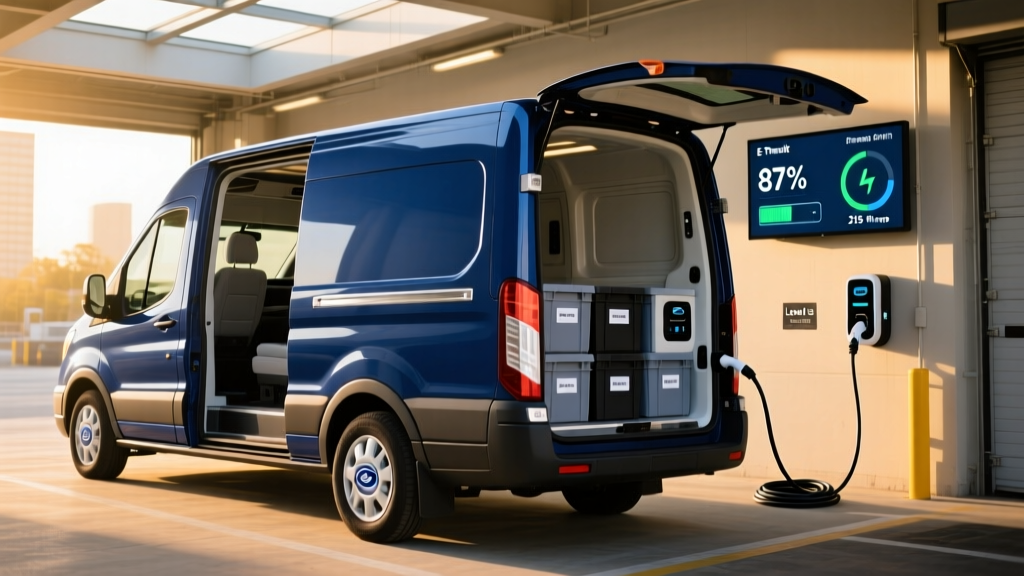
The Ford E-Transit is a purpose-built electric commercial van with an EPA-estimated 126 miles of range (low-roof cargo van), a 68 kWh usable LFP battery, and DC fast charging up to 115 kW (10–80% in approximately 45 minutes). Starting around $55,000 MSRP before incentives, it targets last-mile delivery, tradespeople, and urban commercial routes under 100 miles per day. Compared to a gas Ford Transit, the E-Transit saves an estimated $2,500–$4,000 annually in fuel and maintenance per vehicle but demands reliable depot or home Level 2 charging. It qualifies for the up-to-$7,500 federal §30D commercial clean vehicle credit (subject to sourcing and entity rules) and additional state fleet incentives.
E-Transit Specs: Range, Battery, and Charging at a Glance
The E-Transit is not built for cross-country hauls. It is engineered for predictable, return-to-base routes. Here is exactly what the powertrain delivers for the 2025–2026 model years:
| Specification | E-Transit (Low Roof, 130" WB Cargo) |
|---|---|
| EPA Range | 126 miles |
| Real-World Range (loaded, mixed driving) | 95–115 miles |
| Battery Chemistry | LFP (Lithium Iron Phosphate) |
| Usable Battery Capacity | 68 kWh |
| Motor Output | 266 hp / 317 lb-ft torque |
| 0–60 mph | ~8.5 seconds (unloaded) |
| Max DC Fast Charge Rate | 115 kW |
| 10–80% DC Charge Time | ~45 minutes |
| Level 2 AC Charge Rate | 10.5 kW (onboard charger) |
| Level 2 Full Charge Time | ~8 hours (0–100%) |
| Max Payload | Up to 3,880 lbs (cutaway) |
| Cargo Volume (low roof, 148" WB) | 487.3 cu ft |
| Pro Power Onboard | 2.4 kW (optional 7.2 kW) |
| Starting MSRP (Cargo Van) | ~$55,000 |
| Battery Warranty | 8 years / 100,000 miles |
Real-World Range Reality: The EPA's 126-mile figure applies to the low-roof cargo variant under ideal conditions. Expect 10–15% range loss when carrying near-max payload, and 20–30% loss in freezing temperatures (below 32°F) due to cabin heating demands and reduced battery efficiency. For a van loaded with 2,000 lbs of cargo on a 25°F morning, plan for roughly 80–95 usable miles. Route planning must account for this headroom.
E-Transit vs. Gas Transit: Total Cost of Ownership Breakdown
The purchase price of the E-Transit is significantly higher than its internal-combustion sibling. A gas Ford Transit-250 cargo van starts around $48,000, putting the E-Transit at a roughly $7,000–$10,000 upfront premium before incentives. But commercial van economics are about operating cost, not sticker price.
| Cost Factor (Annual, per Vehicle) | E-Transit (Electric) | Gas Transit-250 |
|---|---|---|
| Energy/Fuel (25,000 mi/yr) | $1,875 (at $0.15/kWh, 2.0 kWh/mi) | $4,583 (at $3.50/gal, 13 MPG combined) |
| Fuel/Energy Savings | ~$2,700/year in favor of E-Transit | |
| Oil Changes | $0 | $400–$600 |
| Brake Wear (regen extends life) | ~$100 | $350–$500 |
| Transmission/Engine Maintenance | $0 | $300–$500 |
| Total Annual Maintenance | ~$200 | ~$1,200 |
| Estimated Annual Insurance | $2,400–$3,200 | $1,800–$2,400 |
| Net Annual Operating Savings (E-Transit) | ~$2,900–$3,700 | |
Over a 5-year, 125,000-mile ownership cycle, the E-Transit can save a fleet operator $14,500–$18,500 in operating costs per van. Factor in the federal commercial clean vehicle credit (up to $7,500 under IRS §45W) and potential state incentives, and the E-Transit reaches cost parity with the gas Transit within approximately 2–3 years for high-mileage urban routes.
One critical note: commercial fleets purchasing the E-Transit are generally subject to the §45W Commercial Clean Vehicle Credit, not the consumer §30D credit. This credit is up to $7,500 for vehicles under 14,000 lbs GVWR and requires the vehicle to be placed in service for business use. Eligibility hinges on battery component and critical-mineral sourcing requirements that have tightened significantly through 2025–2026. Consult a tax professional and verify current IRS guidance before finalizing a fleet purchase order.
Charging the E-Transit: Depot, Home, and Public Infrastructure
The E-Transit uses a CCS1 connector for DC fast charging and a standard J1772 connector for Level 2 AC charging. Ford has announced NACS (Tesla Supercharger) compatibility for future model years via adapter, but current E-Transit models rely on the CCS/J1772 ecosystem. Here is what charging looks like in practice:
| Charging Level | Power (kW) | Miles Added per Hour | Use Case |
|---|---|---|---|
| Level 1 (120V household) | ~1.4 kW | ~3–4 mi/hr | Emergency/trickle only; not viable for daily fleet ops |
| Level 2 (240V, 48A) | 10.5 kW (vehicle max) | ~25–28 mi/hr | Overnight depot/home charging — primary method |
| DC Fast Charge | Up to 115 kW peak | ~120+ mi/hr (at peak) | Midday top-up; 10–80% in ~45 min |
Level 2 is the backbone of E-Transit ownership. An overnight charge on a 10.5 kW Level 2 circuit fully replenishes the 68 kWh battery in roughly 8 hours — perfectly aligned with a van that returns to base each evening. For fleet depots, installing multiple 40-amp or 48-amp Level 2 wall connectors (such as the ChargePoint CPF32 or Ford Connected Charge Station) is standard practice. Budget $1,500–$3,500 per stall for equipment and electrician labor, with potential panel-upgrade costs of $2,000–$5,000 for multi-stall commercial installations.
DC fast charging is supplementary, not primary. The E-Transit's 115 kW peak rate is modest compared to passenger EVs (many now hit 200–350 kW), but it is adequate for a midday boost. On a route where the van dips to 20% SoC by early afternoon, a 30-minute DC session at an Electrify America or EVgo station can add 50–60 miles — enough to finish the day. However, rely on this daily and you will accelerate battery wear and increase energy costs (DCFC electricity often costs $0.35–$0.55/kWh vs. $0.10–$0.18/kWh for depot power).
The LFP battery chemistry is a major ownership advantage. LFP cells tolerate frequent charging to 100% without the degradation concerns that affect NMC batteries. Ford recommends regular full charges for LFP packs to maintain accurate state-of-charge calibration — the opposite of NMC best practices. This simplifies fleet management: plug in, charge to full, and go.
Real-World Ownership: Who the E-Transit Actually Works For
The E-Transit is not a universal replacement for every gas Transit on the road. Its viability depends on specific operational patterns:
Where the E-Transit Excels
- Last-mile delivery: Amazon DSP routes, parcel delivery, and food distribution averaging 60–90 miles/day with return-to-base charging.
- Urban trades: Electricians, plumbers, and HVAC techs covering a metro area with predictable daily mileage under 80 miles.
- Campus and municipal fleets: University maintenance, city works departments, and airport ground operations with on-site charging.
- Pro Power Onboard users: The optional 7.2 kW onboard generator replacement powers job-site tools directly from the van's battery, eliminating a separate gas generator.
Where the E-Transit Falls Short
- Long-distance or intercity routes: 126 miles of range with 45-minute charge stops makes multi-city runs impractical.
- Cold-climate operations without preconditioning: Northern fleets in Minnesota, Maine, or Montana will see 20–30% range loss in winter. Without depot preconditioning, a 126-mile van becomes an 88-mile van.
- Operations without depot/home charging access: Street-parked vans relying solely on public DCFC will face high costs, downtime, and logistical friction.
- Heavy-payload, full-day routes: Near-max payload (3,800+ lbs) combined with highway speeds and HVAC use can push real-world range below 90 miles.
Federal Tax Credits and Fleet Incentives: What You Can Actually Claim
Tax-credit eligibility for the E-Transit is one of the most misunderstood aspects of the purchase. Here is the current framework:
| Requirement | Detail |
|---|---|
| Credit Type (Commercial Fleets) | §45W Commercial Clean Vehicle Credit (up to $7,500 for <14,000 lbs GVWR) |
| Credit Type (Individual Purchase) | §30D New Clean Vehicle Credit (up to $7,500, subject to MSRP/income/sourcing caps) |
| MSRP Cap (§30D, if applicable) | $80,000 for vans — E-Transit qualifies |
| Buyer Income Cap (§30D) | $150K single / $300K joint (modified AGI) |
| Battery Sourcing Requirements | Critical minerals + battery components must meet phased thresholds per IRS guidance |
| Point-of-Sale Transfer | Available for §30D (consumer); §45W claimed at tax filing |
| State/Local Incentives | Varies widely — check AFDC incentive database for your jurisdiction |
For most fleet buyers, the §45W commercial credit is the relevant path. This credit equals the lesser of 15% of the vehicle's basis (30% if the buyer does not claim bonus depreciation) or $7,500 for vehicles under 14,000 lbs GVWR. Tax-exempt organizations (municipalities, nonprofits) can receive this as a direct payment from the IRS — a significant advantage for government fleets. Always verify current-year eligibility with the IRS Commercial Clean Vehicle Credit page and a qualified tax professional before committing to a purchase order.
Common Misconceptions About the Ford E-Transit
| Myth | Fact |
|---|---|
| "The E-Transit has the same range as a Tesla — over 300 miles." | EPA range is 126 miles for the low-roof cargo van. It is a short-range commercial tool, not a long-distance vehicle. |
| "Electric vans are more expensive to own overall." | Higher upfront cost is offset within 2–3 years for high-utilization urban routes via fuel and maintenance savings, plus tax credits. |
| "The battery will need replacing in 5 years." | Ford warranties the battery for 8 years/100,000 miles. LFP chemistry offers excellent cycle life, typically retaining 70%+ capacity well beyond warranty. |
| "You can't charge an E-Transit in the cold." | You can, but charging is slower and range drops 20–30%. Preconditioning while plugged in mitigates this significantly. |
| "All E-Transit buyers get a $7,500 tax credit automatically." | Credit eligibility depends on entity type, battery sourcing compliance, and tax liability. §45W for fleets; §30D for individual buyers with income/MSRP caps. |
Decision Framework: Should You Buy the Ford E-Transit?
Choose the Ford E-Transit if:
- Your daily routes are under 100 miles (ideally 60–90 miles) with predictable return-to-base patterns.
- You have depot or home Level 2 charging access (or can install it).
- Your operation is urban or suburban, minimizing highway-speed range drain.
- You value Pro Power Onboard for job-site tool power without a separate generator.
- You qualify for the §45W or §30D credit and applicable state incentives.
- You plan to keep the van 4+ years to capture full TCO savings.
Stick with the gas Ford Transit (or consider a PHEV alternative) if:
- Your daily routes regularly exceed 130 miles or include intercity highway segments.
- You lack reliable overnight charging infrastructure and cannot install it.
- You operate in extreme cold climates (consistently below 10°F) without preconditioning capability.
- Your payload needs push real-world range below your daily minimum.
- You turn over vehicles every 2–3 years, preventing TCO payback.
Frequently Asked Questions
What is the real-world range of the Ford E-Transit with a full load?
With a 2,000-lb payload in moderate temperatures (50–80°F), expect approximately 100–110 miles. Near-max payload (3,500+ lbs) combined with stop-and-go urban driving drops this to 90–100 miles. In freezing weather with a full load, plan conservatively for 75–90 miles.
How much does it cost to install Level 2 charging for an E-Transit fleet?
A single Level 2 station (48A hardwired) costs $1,500–$3,500 installed, including equipment ($500–$900), electrician labor ($800–$2,000), and permits ($100–$300). For a 5-van fleet depot, budget $10,000–$20,000 total, with potential panel-upgrade costs of $2,000–$5,000 if your existing service cannot support simultaneous charging. Commercial utility EV rate programs and state incentive programs can offset 30–50% of installation costs in many jurisdictions.
Does the E-Transit support Tesla Supercharger (NACS) charging?
As of the 2025–2026 model year, the E-Transit ships with a CCS1 port. Ford has committed to NACS adoption across its lineup, and a CCS-to-NACS adapter or future native NACS port is expected for subsequent model years. Check with your Ford Pro dealer for the latest adapter availability and Supercharger network access status for commercial vehicles.
How does the E-Transit's Pro Power Onboard work?
Pro Power Onboard converts the E-Transit's traction battery into a mobile power source. The standard 2.4 kW system provides 120V outlets suitable for power tools, laptops, and lighting. The optional 7.2 kW system adds 240V capability, enough to run compressors, welders, or multiple heavy-draw tools simultaneously — effectively replacing a portable gas generator. Running tools at 2 kW draw for 4 hours consumes roughly 8 kWh, reducing range by approximately 12–15 miles.
What is the E-Transit's battery replacement cost?
Out-of-warranty LFP battery replacement is estimated at $12,000–$18,000 (parts and labor) based on current Ford Pro service data. However, LFP batteries are engineered for extended cycle life — typically 3,000+ full charge cycles before reaching 80% capacity. For a van charged daily over 8 years, that equates to roughly 200,000+ miles before significant degradation. Most fleet operators will retire or reassign the van before battery replacement becomes necessary.
Is the E-Transit eligible for the $7,500 federal EV tax credit?
It can be, but the path depends on the buyer. Commercial fleet buyers generally use the §45W Commercial Clean Vehicle Credit (up to $7,500). Individual buyers using the van for personal/business use may qualify under §30D, subject to income caps ($150K single/$300K joint), the $80,000 van MSRP cap, and battery-sourcing requirements. Tax-exempt organizations can receive §45W as a direct payment. Verify current-year rules at irs.gov and consult a tax professional.
Sources: EPA fuel economy data via fueleconomy.gov, Ford Pro E-Transit specifications, IRS Commercial Clean Vehicle Credit guidance at irs.gov, Alternative Fuels Data Center incentive database.