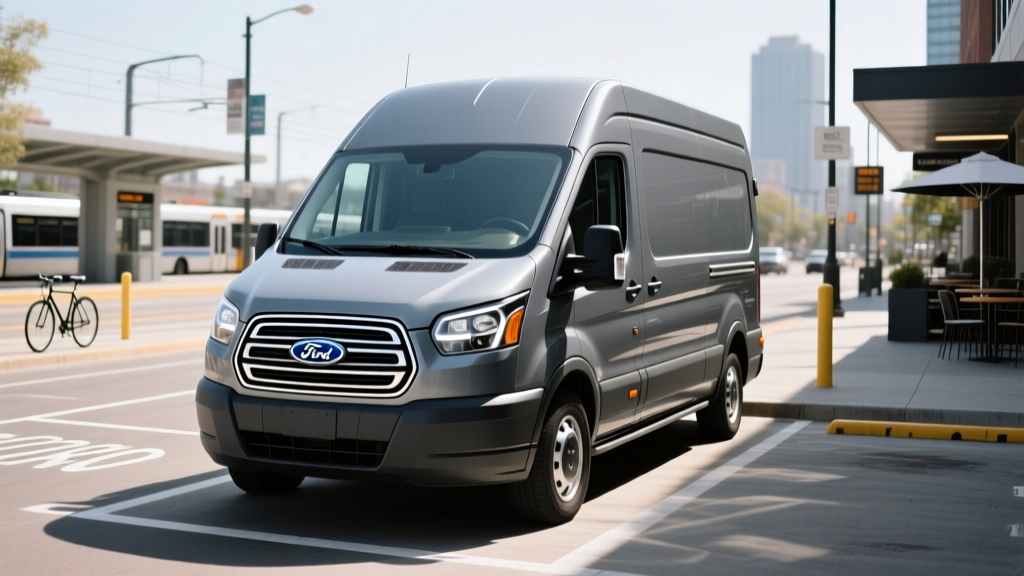
Commercial van buyers evaluating the Ford E-Transit EV van need to know one thing above all else: this vehicle is purpose-built for predictable, urban and suburban last-mile routes — not long-haul interstate runs. With an EPA-estimated 126 miles of range (108 miles for the high-roof extended-wheelbase variant), the E-Transit excels when daily routes stay under 80 miles and the vehicle returns to a depot for overnight Level 2 charging. If that describes your operation, the fuel and maintenance savings over a gas-powered Transit can be substantial. If your routes regularly exceed 100 miles or require highway-speed driving in cold climates, you'll need to plan carefully or consider a different solution.
Quick Answer: Is the Ford E-Transit Right for You?
Yes, if: Your daily routes are under 80 miles, you have depot-based Level 2 charging, and you operate in urban/suburban environments where regenerative braking maximizes efficiency.
No, if: Your routes regularly exceed 100 miles, you lack reliable overnight charging access, or you operate primarily in extreme cold climates without route-length adjustments.
2026 Ford E-Transit: Core Specifications at a Glance
The 2026 Ford E-Transit carries over the proven powertrain from prior model years with incremental software and thermal-management refinements. Here are the numbers that matter for fleet planning:
| Specification | E-Transit (Low/Mid Roof, Regular WB) | E-Transit (High Roof, Extended WB) |
|---|---|---|
| EPA-Estimated Range | 126 miles | 108 miles |
| Battery Capacity (usable) | 68 kWh (NMC lithium-ion) | 68 kWh (NMC lithium-ion) |
| Motor Output | 266 hp / 317 lb-ft torque | 266 hp / 317 lb-ft torque |
| Max DC Fast Charge Rate | 115 kW peak | 115 kW peak |
| 10–80% DC Fast Charge | ~45 minutes | ~45 minutes |
| Level 2 Charge Rate (240V) | 10.5 kW (~13 hrs 0–100%) | 10.5 kW (~13 hrs 0–100%) |
| Max Payload Capacity | Up to 3,330 lbs | Up to 3,330 lbs |
| Cargo Volume (max) | 246.7 cu ft | 487.3 cu ft |
| Starting MSRP (cutaway excluded) | ~$51,000 | ~$56,000 |
| Battery/Powertrain Warranty | 8 years / 100,000 miles | 8 years / 100,000 miles |
Sources: Ford Commercial Vehicles, fueleconomy.gov
Real-World Range vs. EPA Sticker
The 126-mile EPA figure assumes a mixed driving cycle. In real-world fleet operations, expect:
- Urban stop-and-go (with regen): 115–130 miles — regenerative braking recovers energy in traffic
- Suburban mixed driving: 100–120 miles
- Sustained highway (65–70 mph): 85–100 miles — aerodynamic drag and lack of regen opportunities reduce efficiency
- Cold weather (below 30°F): 75–95 miles — battery chemistry and cabin heating draw reduce usable capacity by 20–35%
For fleet managers, plan routes using the worst-case scenario for your climate and route type, not the EPA sticker.
E-Transit vs. Gas Ford Transit: Total Cost of Ownership
The purchase price of the E-Transit is significantly higher than a gas-powered Transit — but the operational cost gap closes quickly in the right use case. Here's a 5-year / 75,000-mile comparison based on typical urban delivery patterns (15,000 miles/year):
| Cost Category | Ford E-Transit (EV) | Ford Transit 250 (Gas, 3.5L V6) |
|---|---|---|
| Base MSRP | ~$51,000 | ~$47,000 |
| Federal Commercial Clean Vehicle Credit (§45W) | Up to $7,500 (weight-dependent) | $0 |
| Effective Purchase Price | ~$43,500 | ~$47,000 |
| Fuel/Energy (75,000 mi total) | ~$3,750 (at $0.15/kWh, 2.0 kWh/mi) | ~$9,900 (at $3.60/gal, 13 MPG combined) |
| Maintenance (75,000 mi) | ~$1,200 (no oil changes, reduced brake wear via regen) | ~$4,500 (oil changes, transmission service, brake pads) |
| Estimated Insurance (5 yrs) | ~$12,500 | ~$10,500 |
| 5-Year Total Cost | ~$60,950 | ~$71,900 |
| Cost Per Mile | $0.81 | $0.96 |
The E-Transit saves approximately $10,950 over 5 years in this scenario — primarily from fuel and maintenance reductions. The savings widen further if your electricity rate is below $0.15/kWh or if your routes involve more stop-and-go driving (where the gas Transit's MPG drops but the E-Transit's regen recovers energy).
Critical caveat: The commercial clean vehicle credit under IRS §45W has specific requirements including vehicle weight classifications, battery sourcing, and business-use criteria. Unlike the consumer §30D credit, §45W is structured for fleet and commercial purchasers. Consult IRS guidance on §45W and a tax professional to confirm your eligibility.
Charging Infrastructure: What Fleet Buyers Actually Need
The E-Transit's viability hinges entirely on your charging setup. Here's what each charging level delivers:
| Charging Level | Power (kW) | Miles Added Per Hour | Full Charge Time (0–100%) | Best Use Case |
|---|---|---|---|---|
| Level 1 (120V, standard outlet) | ~1.4 kW | ~2–3 miles | ~48+ hours | Emergency only; not viable for fleet ops |
| Level 2 (240V, 48A) | 10.5 kW | ~18–22 miles | ~11–13 hours | Overnight depot charging — the primary use case |
| DC Fast Charging | 115 kW peak | N/A (session-based) | 10–80% in ~45 min | Mid-day top-ups on longer routes |
Depot Charging Installation Costs
Most E-Transit fleet operators install multiple Level 2 stations at a depot. Here's a realistic cost breakdown per charging stall:
| Item | Cost Range (Per Stall) |
|---|---|
| Level 2 EVSE hardware (commercial-grade, e.g., ChargePoint CT4000 or similar dual-port) | $2,500 – $6,500 |
| Electrical panel upgrade (if needed, 200A to 400A service) | $3,000 – $12,000 |
| Wiring, conduit, and labor (licensed commercial electrician) | $2,000 – $8,000 |
| Permits and utility coordination | $500 – $3,000 |
| Total per stall | $8,000 – $29,500 |
The wide range reflects whether your existing electrical service can handle additional load. A fleet of five E-Transits might need 3–5 Level 2 ports (depending on shift patterns), putting infrastructure investment between $24,000 and $147,500. Many utilities offer commercial EV charging rebates or make-ready programs that can offset 30–50% of infrastructure costs — check with your local utility before budgeting.
Key insight: The E-Transit uses a CCS1 connector for DC fast charging and a J1772 connector for Level 2. Ford has not adopted NACS (Tesla's connector) for the E-Transit as of the 2026 model year, so public DC fast charging requires CCS-compatible networks like Electrify America, EVgo, or ChargePoint.
Real-World Ownership: What First-Time EV Fleet Buyers Miss
Transitioning a fleet from gas to electric involves operational adjustments that don't appear on a spec sheet:
Route Planning Discipline
Unlike a gas Transit, which can refuel in 5 minutes at any station, the E-Transit requires advance route planning. Fleet managers need to:
- Map daily routes against worst-case range (not EPA estimates)
- Identify DC fast chargers along routes as emergency backup
- Build in a 15–20% range buffer for unexpected detours, A/C or heat use, and heavy payloads
Payload and Range Trade-Off
The E-Transit's 3,330-lb max payload is competitive with the gas Transit, but every pound of cargo reduces efficiency. A fully loaded E-Transit on a hilly route in cold weather could see range drop to 70–80 miles. Fleet operators running near max payload should plan routes conservatively.
Cold-Weather Operations
The E-Transit's NMC battery loses efficiency in cold temperatures, and cabin heating draws directly from the traction battery. Ford includes a preconditioning feature — scheduling the van to warm its battery and cabin while still plugged in at the depot preserves range for the route. Fleets in northern climates should make preconditioning standard operating procedure; it can recover 10–15 miles of range that would otherwise be lost to cold-soak.
The Charging Curve Reality
The E-Transit's 115 kW peak DC fast charge rate is only sustained at low states of charge (roughly 10–40%). Above 60% SoC, the charge rate tapers significantly — often to 40–50 kW — to protect battery health. This means a 10–80% session takes ~45 minutes, but an 80–100% top-off could take nearly as long. Train drivers to charge to 80% during mid-day stops and finish charging overnight on Level 2.
Common E-Transit Misconceptions — Addressed with Data
| Myth | Fact |
|---|---|
| "The E-Transit can't handle a full day's work." | The average commercial van in the US drives 74 miles per day (BTS data). The E-Transit's 126-mile EPA range covers this with margin — for routes that fit its profile. |
| "EV maintenance is basically zero." | Reduced, not zero. You'll still need tire rotations, cabin air filter replacements, brake fluid checks, and windshield washer fluid. Budget ~$200–300/year vs. ~$900/year for gas. |
| "The battery will need replacing in 5 years." | Ford warrants the battery for 8 years/100,000 miles with a capacity retention threshold (typically 70% of original capacity). NMC batteries in commercial use with proper charge management typically retain 80–85% capacity at 100,000 miles. |
| "Any electrician can install a commercial charger." | Commercial EVSE installation requires a licensed electrician familiar with EV charging loads, load-management systems, and local permitting. Using an unqualified installer risks code violations and voided equipment warranties. |
| "The federal tax credit is automatic." | Both §30D (consumer) and §45W (commercial) credits have specific eligibility requirements around vehicle classification, battery sourcing, and buyer income/entity type. Not every purchase qualifies. Always verify with a tax professional. |
Decision Framework: Should Your Fleet Go E-Transit?
Choose the Ford E-Transit EV Van If:
- Your average daily route is under 80 miles — this leaves adequate buffer for weather, payload, and detours
- You have (or can install) depot Level 2 charging — overnight charging is the economic backbone of E-Transit ownership
- Your routes are urban or suburban with frequent stops — regenerative braking extends range and reduces brake wear in stop-and-go traffic
- You plan to own the vehicles 5+ years — the TCO advantage grows over time as fuel and maintenance savings compound
- You qualify for the §45W commercial credit — the up-to-$7,500 credit meaningfully narrows the purchase-price gap
Stick With the Gas Transit (or Consider Alternatives) If:
- Daily routes regularly exceed 100 miles — range limitations become operationally constraining
- You lack depot or home-base charging access — relying on public DC fast charging destroys the cost advantage and adds downtime
- You operate in extreme cold (sustained below 15°F) with long routes — range loss of 30%+ may make the E-Transit impractical without mid-day charging
- You need towing capability — the E-Transit is not rated for towing; the gas Transit can tow up to 6,900 lbs
- Your fleet turns over vehicles every 2–3 years — the E-Transit's higher upfront cost won't be recouped in fuel savings in a short ownership window
Frequently Asked Questions
What is the real-world range of the Ford E-Transit EV van?
The EPA rates the standard E-Transit at 126 miles and the high-roof extended-wheelbase version at 108 miles. In real-world fleet use, expect 100–120 miles in moderate weather with mixed urban/suburban driving. Highway-heavy routes and cold weather will reduce this to 75–100 miles. Always plan routes using worst-case estimates for your climate.
How long does it take to charge the E-Transit?
On a Level 2 (240V, 10.5 kW) charger, a full 0–100% charge takes approximately 11–13 hours — ideal for overnight depot charging. On a DC fast charger at 115 kW peak, a 10–80% session takes roughly 45 minutes, though the charge rate tapers significantly above 60% SoC.
Does the Ford E-Transit qualify for a federal tax credit?
The E-Transit may qualify for the §45W Commercial Clean Vehicle Credit (up to $7,500 for vehicles under 14,000 lbs GVWR). This credit is structured for business and fleet purchasers rather than individual consumers. Eligibility depends on vehicle classification, battery component sourcing, and your business entity type. Consult IRS §45W guidance and a qualified tax professional before relying on the credit in your budget.
How does the E-Transit compare to a gas Transit on cost per mile?
Based on 2026 energy and fuel prices, the E-Transit operates at roughly $0.25–0.30 per mile (electricity only), compared to $0.55–0.65 per mile for a gas Transit at 13 MPG combined and $3.60/gallon. When maintenance savings are included, the E-Transit's total operating cost per mile is approximately 15–20% lower — assuming depot-based Level 2 charging at commercial electricity rates.
What happens if the E-Transit battery degrades?
Ford warrants the high-voltage battery for 8 years or 100,000 miles against defects and excessive capacity loss (typically defined as falling below 70% of original capacity). Real-world NMC battery data from commercial fleets suggests 80–85% capacity retention at 100,000 miles with proper charge management (avoiding frequent 100% charges and deep discharges). A full battery replacement outside warranty would cost approximately $15,000–$20,000 based on current pricing — though this cost is expected to decline over the vehicle's lifespan.
Can I charge the E-Transit at home if I'm an owner-operator?
Yes, if you have access to a 240V outlet (like a dryer circuit) or can install a Level 2 home charger. A single-owner-operator running daily routes under 80 miles can fully recharge overnight on Level 2. However, if you live in an apartment or lack dedicated parking with electrical access, the E-Transit becomes far less practical — public charging alone is not a sustainable daily strategy for commercial use.
Is the E-Transit suitable for cold climates?
It can work in cold climates with operational adjustments. Expect 20–35% range loss in sustained below-freezing temperatures due to battery chemistry limitations and cabin heating demands. Preconditioning the battery and cabin while plugged in at the depot is essential — it can recover 10–15 miles of range. Fleets in Minnesota, Wisconsin, or similar climates should plan routes with a 30% range buffer in winter and consider whether mid-day DC fast charging is available as backup.
For the latest EPA efficiency data, see fueleconomy.gov. For federal commercial EV credit rules, consult IRS.gov §45W. Safety ratings and crash-test data can be reviewed at NHTSA.gov.