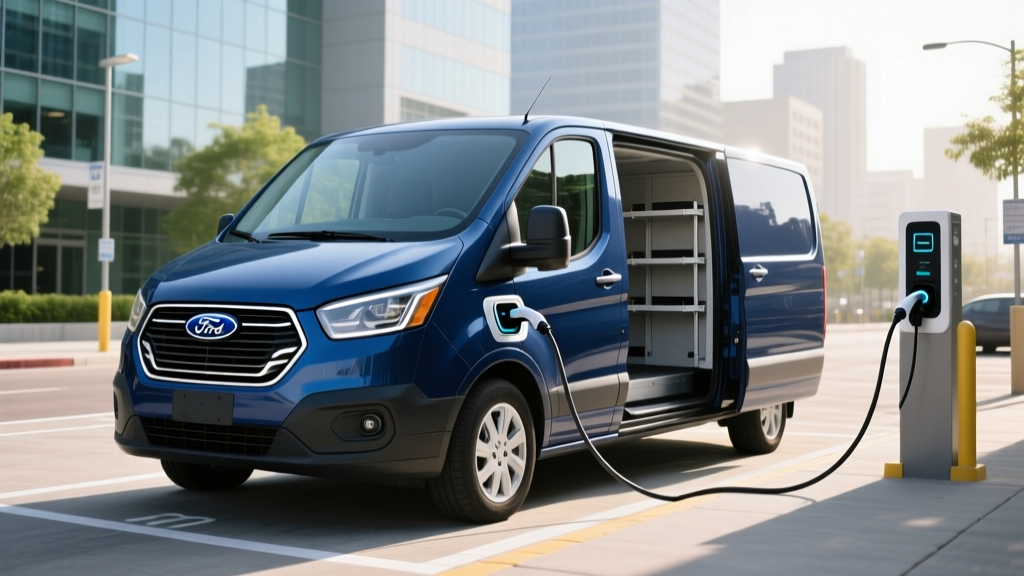
Commercial fleets and small-business owners eyeing electrification keep returning to one question: does the Ford E-Transit electric van actually work as a daily workhorse, or is it a compliance vehicle with a charging cord? After examining the 2026 model year's specs, real-world fleet data, and total-cost-of-ownership math, the answer is nuanced. The E-Transit excels at predictable, short-route urban delivery and service work — but its limited range and modest DC charging speed mean route planning isn't optional.
This review covers the 2026 Ford E-Transit cargo van (low, medium, and high roof configurations), including the cutaway and chassis-cab variants where data is available. We'll break down what the EPA sticker says versus what fleets actually see, how fast it charges on depot Level 2 versus public DC fast chargers, and whether the §30D commercial credit or the §45W commercial clean vehicle credit makes the math work.
2026 Ford E-Transit: Core Specifications at a Glance
| Specification | Value |
|---|---|
| EPA Estimated Range | 126 miles (low-roof cargo van) |
| Usable Battery Capacity | 68 kWh (LFP — lithium iron phosphate) |
| Max DC Fast Charge Rate | 115 kW peak |
| 10–80% DC Fast Charge Time | ~45 minutes (at peak-capable charger) |
| Level 2 AC Charge Rate | 10.5 kW (onboard charger) |
| Level 2 Miles Added per Hour | ~24–28 miles/hr at 10.5 kW |
| Motor Output | 266 hp (198 kW) / 317 lb-ft torque |
| Drivetrain | Rear-wheel drive (single motor) |
| 0–60 mph (estimated) | ~8.5 seconds (unladen) |
| EPA Combined MPGe | ~1.9–2.1 kWh/mile (~105 MPGe combined, varies by roof/wheelbase) |
| Max Payload | Up to 3,880 lbs (cargo van, varies by config) |
| Max Cargo Volume | 487.3 cu ft (high-roof, extended wheelbase) |
| Base MSRP (2026 Cargo Van) | ~$46,895 (before incentives, excl. destination) |
| Battery/Powertrain Warranty | 8 years / 100,000 miles |
Note: Range, payload, and cargo volume vary significantly by roof height (low, medium, high), wheelbase (130" or 148"), and body style (cargo van, cutaway, chassis cab). The 126-mile EPA figure applies to the most efficient low-roof cargo configuration. High-roof and extended-wheelbase variants can dip to ~108–116 miles EPA. Always check the specific configuration on fueleconomy.gov before purchasing.
Real-World Range: What Fleets Actually See
Real-World Expectation: 90–115 miles in mixed urban/highway driving; 75–95 miles in cold weather (below 32°F) with cabin heating; up to 120+ miles in mild-weather, low-speed urban stop-and-go with regen braking.
The E-Transit's range story is entirely about use case. For a bakery delivery route covering 40 miles of urban stops with frequent regenerative braking opportunities, 126 miles EPA is more than sufficient — fleets routinely report using 60–70% of battery on such routes. But for a plumber driving 50 miles each way to a suburban job site at highway speeds, the math gets tight fast.
Cold weather is the E-Transit's biggest range adversary. LFP chemistry already has slightly lower energy density than NMC, and LFP cells experience more pronounced internal resistance increases in freezing temperatures. Fleet telematics data from northern-climate operators shows 25–35% range reduction in sustained sub-32°F operation, primarily from cabin heating load and battery thermal losses. The E-Transit does not include a heat pump (it uses resistive PTC heating), which draws significantly more energy than a heat-pump system in cold conditions.
Highway driving also hurts. At 70 mph, the E-Transit's tall, flat-fronted profile generates substantial aerodynamic drag, and real-world efficiency drops to roughly 2.4–2.8 kWh/mile — cutting effective range to 80–95 miles even in moderate temperatures. This van was engineered for urban and suburban routes under 55 mph, not interstate corridors.
Charging Speed: Depot Level 2 vs. Public DC Fast Charging
For most commercial E-Transit owners, charging happens at the depot overnight — and that's where the math works best. Here's the full charging picture:
| Charging Level | Power (kW) | Time (0–100% or 10–80%) | Miles Added per Hour |
|---|---|---|---|
| Level 1 (120V / 12A) | ~1.4 kW | ~55+ hours (0–100%) | ~3 mi/hr |
| Level 2 (240V / 48A) | 10.5 kW (onboard max) | ~7–8 hours (0–100%) | ~24–28 mi/hr |
| DC Fast Charge (CCS) | 115 kW peak | ~45 min (10–80%) | ~150+ mi/hr (at peak) |
The 10.5 kW onboard AC charger is the workhorse here. A fleet depot with multiple Level 2 wall connectors (such as the Ford Pro AC charger or ChargePoint commercial units) can fully replenish an E-Transit overnight in about 7–8 hours — perfectly aligned with a standard shift pattern. For a single-van small business, a dedicated 48-amp Level 2 circuit at the shop or home garage handles daily needs.
DC fast charging tops out at 115 kW, which is modest by 2026 passenger-EV standards but adequate for a commercial van that shouldn't need mid-day top-ups on most routes. The charge curve is relatively flat for LFP chemistry — you'll see sustained rates near 90–110 kW through the 20–60% state of charge window, then a gradual taper above 70%. A 10–80% session takes roughly 45 minutes at a 150 kW+ capable CCS station. The E-Transit uses the CCS1 connector; it does not natively support NACS (Tesla Supercharger) without an adapter, and Ford has not announced a NACS port for the current-generation E-Transit.
One practical note: the E-Transit supports Pro Power Onboard (available as an option), which provides up to 2.4 kW of AC power output from the vehicle's battery through bed-mounted or interior outlets. This lets crews run power tools, job-site lighting, or laptops directly from the van — a genuine differentiator versus gas Transit models that require a separate generator.
Performance, Payload, and Cargo Configurations
The E-Transit's single rear-mounted electric motor produces 266 horsepower and 317 lb-ft of torque. That torque is available instantly from zero RPM, which makes the van feel surprisingly responsive in urban stop-and-go traffic — far more so than the gas Transit's 3.5L V6 at low speeds. The 0–60 mph time of roughly 8.5 seconds (unladen) is irrelevant for a commercial vehicle; what matters is 0–30 mph merge capability, where the E-Transit is genuinely quick.
Payload capacity varies by configuration:
- Cargo Van (low roof, 130" WB): up to 3,880 lbs payload
- Cargo Van (high roof, 148" WB): up to 3,330 lbs payload
- Cutaway (138" WB): up to 4,287 lbs payload
- Chassis Cab: varies by upfitter configuration
The battery pack is mounted under the floor, which preserves the gas Transit's cargo dimensions almost entirely. Ford designed the E-Transit on a dedicated EV platform that maintains the same cargo bay dimensions, bulkhead mounting points, and upfitter interfaces as the internal-combustion Transit. That means existing shelving systems, ladder racks, and upfit packages carry over directly — a critical consideration for fleet buyers who standardize on upfit configurations.
Cargo volume ranges from 246.7 cu ft (low roof, regular wheelbase) to 487.3 cu ft (high roof, extended wheelbase). Interior load length, width between wheel wells, and rear door opening dimensions match the gas Transit exactly, so fleet managers can spec bodies and shelving without re-engineering.
Pricing, Trim Levels, and Tax Credit Eligibility
The 2026 Ford E-Transit is available in a single primary trim level (no XL/XLT differentiation like the F-150 Lightning), with options packages for technology, comfort, and upfitter needs.
| Configuration | Base MSRP (approx.) | After Commercial Credit (§45W) |
|---|---|---|
| Cargo Van, Low Roof, 130" WB | $46,895 | ~$39,395 |
| Cargo Van, Medium Roof, 148" WB | $49,395 | ~$41,895 |
| Cargo Van, High Roof, 148" WB (Ext.) | $52,895 | ~$45,395 |
| Cutaway, 138" WB | $44,895 | ~$37,395 |
| Chassis Cab, 138" WB | $45,395 | ~$37,895 |
Tax credit clarification: The E-Transit, as a commercial vehicle, is primarily eligible for the §45W Commercial Clean Vehicle Credit rather than the §30D consumer credit. Under §45W, businesses can claim up to $7,500 for vehicles under 14,000 lbs GVWR, provided the vehicle meets battery component and critical mineral sourcing requirements as defined by the IRS. The §30D consumer credit (which has MSRP caps of $80,000 for vans and income limits of $150,000/$300,000 depending on filing status) technically applies if purchased for personal use, but the E-Transit's buyer profile is overwhelmingly commercial.
Key caveats per current IRS guidance:
- Battery components must meet North American manufacturing/assembly thresholds that phase up annually
- Critical minerals must be sourced from the U.S. or FTA partners
- The vehicle must be assembled in North America (the E-Transit is built at the Kansas City Assembly Plant in Missouri)
- For §45W, the vehicle must be placed in service for business use and cannot have been previously claimed under §30D by another buyer
- Point-of-sale transfer is available for §30D; §45W is claimed on the business tax return
Consult a tax professional before relying on credit eligibility — sourcing rules tighten each model year, and Ford's battery supply chain compliance status should be verified for the specific build date.
Tech, Driver Assists, and Fleet Management Integration
The E-Transit comes standard with Ford's SYNC 4 infotainment system on a 12-inch touchscreen, including wireless Apple CarPlay and Android Auto, cloud-connected navigation with EV-specific route planning (factoring in charge station locations and battery state), and Ford Power-Up over-the-air software updates.
Standard driver-assistance features (Ford Co-Pilot360) include:
- Pre-Collision Assist with Automatic Emergency Braking
- Lane-Keeping System
- Auto High-Beam Headlamps
- Rear View Camera
- Blind Spot Information System (BLIS) with trailer coverage (optional)
This is SAE Level 1–2 driver assistance — it provides warnings and limited steering/braking intervention but requires the driver to remain fully engaged at all times. It is not autonomous or self-driving.
The standout feature for commercial buyers is Ford Pro integration. The E-Transit connects to the Ford Pro telematics platform, which provides fleet managers with real-time vehicle location, battery state of charge, charging status, driver behavior scoring, geofencing alerts, and predictive maintenance notifications. Ford Pro also offers managed charging software that optimizes depot charging schedules to minimize electricity costs (charging during off-peak utility rate windows) and ensure vehicles are fully charged by departure time.
For owner-operators without a fleet management system, the FordPass app provides remote charge monitoring, preconditioning scheduling, and charge station location via PlugShare integration.
Ownership Costs: E-Transit vs. Gas Transit TCO
The E-Transit's business case rests on total cost of ownership (TCO), not sticker price. Here's a simplified 5-year / 75,000-mile comparison for a cargo van on an urban delivery route (15,000 miles/year):
| Cost Category | E-Transit (EV) | Gas Transit 250 (3.5L V6) |
|---|---|---|
| Purchase Price (after credit) | ~$39,395 | ~$44,500 |
| Fuel / Electricity (75k mi) | ~$4,200 (at $0.13/kWh) | ~$11,250 (at $3.50/gal, 16 MPG) |
| Maintenance (5 years) | ~$1,800 | ~$4,500 |
| Estimated Insurance (5 yr) | ~$7,500 | ~$6,500 |
| Estimated 5-Year Total | ~$52,895 | ~$66,750 |
The E-Transit saves an estimated $13,000–$14,000 over 5 years in this scenario, driven primarily by fuel and maintenance savings (no oil changes, no transmission fluid, fewer brake replacements due to regenerative braking). The gap widens further in states with commercial EV incentives or where fleets can access time-of-use electricity rates below $0.10/kWh.
The battery warranty covers 8 years or 100,000 miles against defects and excessive capacity loss (Ford defines this as dropping below 70% state of health within the warranty period). LFP chemistry generally offers excellent cycle life — often exceeding 3,000 charge cycles before reaching 80% capacity — which means the battery should outlast the vehicle's useful commercial life in most fleet duty cycles.
Pros and Cons
Pros
- Low operating cost — electricity and maintenance savings are substantial vs. gas Transit
- Instant torque makes urban driving responsive and effortless
- Same cargo dimensions and upfit compatibility as gas Transit
- Pro Power Onboard eliminates need for job-site generators
- Ford Pro telematics and managed charging are fleet-ready
- LFP battery offers long cycle life and no cobalt/nickel sourcing concerns
- Quiet operation reduces driver fatigue and is ideal for early-morning residential deliveries
Cons
- 126-mile EPA range limits use to short, predictable routes
- 115 kW peak DC charging is slow vs. modern passenger EVs (250+ kW)
- No heat pump — cold-weather range loss is significant (25–35%)
- No AWD option — RWD only, limiting traction in snow/ice for some regions
- Payload slightly reduced vs. gas Transit due to battery weight
- CCS1 connector only; no native NACS/Supercharger access
- High upfront cost before tax credits (though TCO is favorable)
Who Should Buy the Ford E-Transit Electric Van?
- Your daily routes are under 100 miles with predictable stops
- You have depot or home charging access for overnight Level 2 replenishment
- You operate primarily in urban/suburban environments under 55 mph
- You want to reduce operating costs and qualify for commercial EV credits
- You value job-site power (Pro Power Onboard) and quiet operation for residential areas
- You're a fleet manager who can leverage Ford Pro telematics for route and charge optimization
- Your routes regularly exceed 120 miles or include extended highway driving
- You operate in extreme cold climates without heated garage storage
- You need AWD capability for unplowed roads or job sites
- You need mid-day fast charging to complete double shifts (45-min 10–80% may not fit your schedule)
- You require towing capacity (the E-Transit is not rated for towing)
The E-Transit competes most directly with the Mercedes-Benz eSprinter (which offers slightly more range but at a higher price) and the Rivian EDV (built for Amazon, not yet available to general fleets). For most commercial van buyers running short urban routes, the E-Transit remains the most accessible, affordable, and fleet-integrated electric cargo van on the U.S. market as of the 2026 model year.
Frequently Asked Questions
What is the real-world range of the Ford E-Transit?
The EPA rates the low-roof E-Transit cargo van at 126 miles. In real-world urban delivery use with regenerative braking, expect 100–120 miles in mild weather. Highway driving at 65–70 mph reduces this to 80–95 miles, and sustained cold-weather operation (below 32°F) can drop range to 75–95 miles due to resistive cabin heating and LFP battery characteristics.
How fast does the E-Transit charge at home and on DC fast chargers?
On a 48-amp Level 2 home or depot charger, the E-Transit charges at 10.5 kW and goes from 0–100% in about 7–8 hours — ideal for overnight fleet charging. On a DC fast charger (CCS1), it peaks at 115 kW and reaches 10–80% in approximately 45 minutes. Level 1 (120V) charging is impractical for daily use at ~55 hours for a full charge.
Does the Ford E-Transit qualify for the federal EV tax credit?
Yes, but primarily under the §45W Commercial Clean Vehicle Credit for business use, which provides up to $7,500. Personal-use buyers could potentially claim the §30D credit, subject to income caps ($150,000 single / $300,000 joint), battery sourcing requirements, and North American assembly rules. The E-Transit is assembled in Kansas City, MO. Always verify current-year eligibility with a tax professional and consult the IRS clean vehicle credit page.
Is the E-Transit worth buying versus a gas Transit?
If your routes are under 100 miles daily and you have overnight charging, the E-Transit's 5-year TCO is roughly $13,000–$14,000 lower than a gas Transit 250, driven by fuel and maintenance savings. If your routes are longer, unpredictable, or highway-heavy, the gas Transit remains the more practical choice until battery range and charging infrastructure improve.
Can the E-Transit tow a trailer?
No. The E-Transit is not rated for towing. If your work requires trailer towing, the gas Transit or F-150 Lightning (which tows up to 10,000 lbs) would be appropriate alternatives.
What happens if the E-Transit battery degrades?
Ford warrants the battery for 8 years / 100,000 miles against capacity loss below 70% state of health. LFP chemistry typically retains strong capacity over 3,000+ cycles, which in a 15,000-mile-per-year duty cycle translates to well over a decade of service before meaningful degradation. Full battery replacement cost (out of warranty) is estimated at $15,000–$22,000 based on current LFP pack pricing, though this figure is expected to decline as battery costs continue to fall.