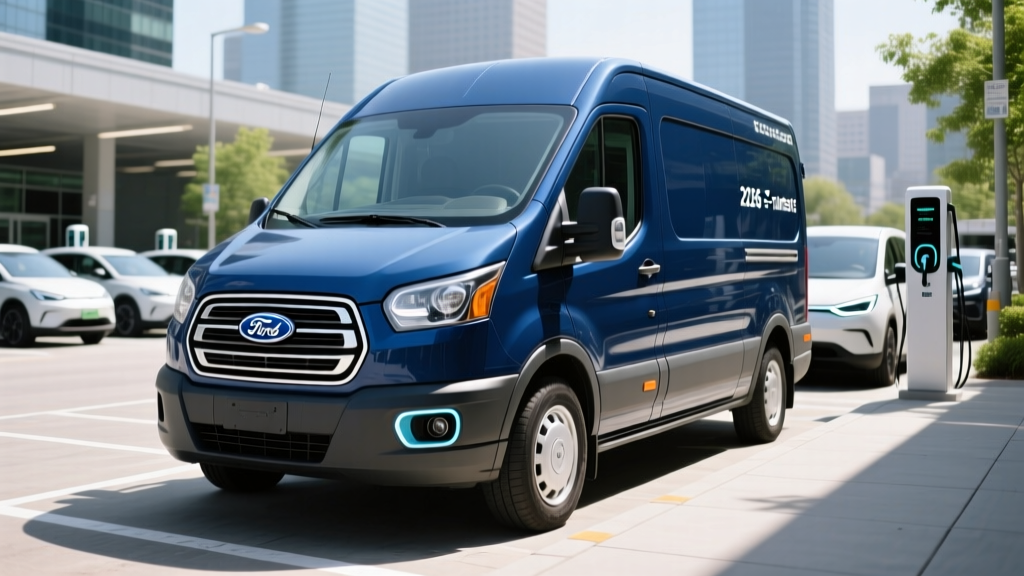
The Ford E-Transit isn't trying to win road-trip bragging rights. It's a purpose-built commercial workhorse designed to replace the gas Transit in last-mile delivery routes, urban service fleets, and shuttle duty — where daily loops rarely exceed 100 miles and overnight depot charging is the norm. For the 2026 model year, Ford has kept the formula largely intact: a 68 kWh usable battery pack, a rear-wheel-drive motor making 266 horsepower, and a starting price that undercuts most electric van competitors. But with rivals like the Mercedes-Benz eSprinter and BrightDrop Zevo 600 pushing longer range, the E-Transit's value proposition rests on its lower entry cost, Ford Pro's telematics ecosystem, and the reality that most commercial van routes don't need 250 miles of range.
This review covers the 2026 E-Transit in its most popular configuration — the low-roof, 148-inch wheelbase cargo van — with notes on cutaway, chassis cab, and passenger variants where specs diverge.
Specs at a Glance: 2026 Ford E-Transit Cargo Van
| Attribute | Specification |
|---|---|
| EPA Estimated Range | 126 miles (low-roof cargo van) |
| Battery (Usable Capacity) | 68 kWh, NMC lithium-ion |
| Motor / Drivetrain | 266 hp / 317 lb-ft, RWD |
| 0-60 mph (est.) | ~9.5 seconds (unloaded) |
| Max DC Fast Charge Rate | 115 kW (peak) |
| 10-80% DC Charge Time | ~45 minutes |
| Level 2 AC Charge Rate | 10.5 kW (onboard charger) |
| Level 2 Time (0-100%) | ~8 hours |
| EPA Efficiency | 2.0 kWh/mile (~2.0–2.4 kWh/mi loaded) |
| MPGe (Combined) | ~59 MPGe (cargo, low roof) |
| Max Payload | 3,880 lbs (cargo van) |
| Cargo Volume | 246.7 cu ft (low roof, 148" WB) |
| Base MSRP | $47,995 (T-150 low roof cargo) |
| Battery Warranty | 8 years / 100,000 miles |
Range Reality: 126 Miles EPA, but Plan for 90 in Winter
EPA Sticker: 126 miles (low-roof T-150 cargo van, 148" WB)
Real-World Expectation: ~100–115 mi city delivery routes (stop-and-go regen helps); ~90–105 mi mixed highway at 65 mph; ~80–95 mi in freezing weather with cabin heat and cargo load.
Bottom Line: The E-Transit is a sub-100-mile daily-route vehicle in adverse conditions. If your fleet averages more than 110 miles/day year-round, this van will require opportunity charging or route reassignment.
The 68 kWh usable battery is smaller than the eSprinter's 113 kWh pack, and that math shows up directly in the range column. The E-Transit's 126-mile EPA figure applies to the low-roof cargo van; high-roof and extended-wheelbase variants drop to roughly 108–118 miles due to increased weight and aerodynamic drag. Fueleconomy.gov lists the combined efficiency at approximately 2.0 kWh per mile, though real-world fleet telemetry from Ford Pro users often shows 2.2–2.5 kWh/mi when carrying 1,500+ lbs of cargo in mixed driving.
Cold weather is the E-Transit's biggest operational constraint. Lithium-ion chemistry loses efficiency below 40°F, and cabin heating in a large metal cargo box draws significant power. Fleet operators in northern climates report 25–35% range reduction in sub-freezing conditions, bringing usable range to roughly 80–95 miles. The E-Transit lacks a heat pump (resistive heating is standard), which worsens winter efficiency compared to EVs equipped with heat-pump HVAC systems. Ford does offer a programmable preconditioning feature that warms the battery and cabin while plugged in — using it is essential for maximizing winter range.
Charging Speeds: Adequate for Depot, Slow on the Road
Charging is where the E-Transit's commercial-depot use case becomes very clear. It's optimized for overnight Level 2 charging at a fleet yard, not for highway fast-charging pit stops.
| Level | Power | Time | Miles Added/Hour |
|---|---|---|---|
| Level 1 (120V, 12A) | ~1.4 kW | ~50+ hours (0-100%) | ~2 mi/hr |
| Level 2 (240V, 48A) | 10.5 kW (onboard max) | ~8 hours (0-100%) | ~15 mi/hr |
| DC Fast Charge (CCS) | 115 kW peak | ~45 min (10-80%) | ~100+ mi/hr (peak) |
The 10.5 kW onboard AC charger is competitive for the segment. A full charge from empty on a 48-amp Level 2 station takes roughly 8 hours — perfect for overnight depot cycles. Fleet operators installing multiple Level 2 chargers (e.g., ChargePoint or EVBox commercial units) should budget for 240V/60A circuits per stall; a commercial electrician will typically charge $2,000–$5,000 per charger installation depending on trenching and panel capacity.
On DC fast charging, the E-Transit peaks at 115 kW — respectable but not fast by passenger-EV standards. The charge curve is relatively flat between 10–60% state of charge, then tapers noticeably above 70%. Expect a 10-80% session to take around 45 minutes at a 150 kW+ station. That's too slow for mid-route top-ups on tight delivery schedules but acceptable for opportunity charging during a driver's lunch break at a public Electrify America or EVgo station.
The E-Transit uses the CCS1 connector standard. Ford has not announced a NACS (Tesla-style) transition for the E-Transit as of early 2026, so CCS compatibility with the broader Supercharger network requires an adapter — and Ford's free adapter program that applied to passenger EVs like the F-150 Lightning and Mustang Mach-E does not currently extend to commercial vehicles.
Performance and Drivetrain: Workhorse, Not a Hot Rod
A single rear-mounted electric motor produces 266 horsepower and 317 lb-ft of torque, routed exclusively to the rear wheels. Unloaded, the E-Transit hits 60 mph in roughly 9.5 seconds — perfectly adequate for merging onto highways but noticeably slower than passenger EVs. With a full payload approaching the 3,880-lb maximum, acceleration stretches to the 11–12 second range.
The instant torque delivery is the real story in urban driving. From a stoplight or loading dock, the E-Transit pulls away with the responsiveness that makes electric vans feel more capable than their diesel counterparts in stop-and-go traffic. Regenerative braking is aggressive enough for near one-pedal driving in city conditions, which reduces brake wear — a meaningful maintenance savings for high-mileage fleets.
Rear-wheel drive is the only configuration. There's no AWD option, which matters for fleets operating in snow-belt regions. Winter tires are strongly recommended, and some northern fleets add rear ballast for traction when running light loads.
Cargo, Configurations, and Upfitting
The E-Transit mirrors the gas Transit's body styles, which is a deliberate strategy: existing upfitters, shelving systems, and rack installations carry over without modification. Available configurations include:
- Cargo Van: Low, medium, and high roof; 130" and 148" wheelbases. Cargo volume ranges from 246.7 cu ft (low roof, 148") to 487.3 cu ft (high roof, 148" extended).
- Cutaway: For box-truck and specialty upfits. 138" and 156" wheelbases.
- Chassis Cab: For flatbed, utility body, and service-body applications.
- Passenger Wagon: 7-seat configuration, primarily for shuttle and airport duty.
The cargo floor is flat and unobstructed by the battery pack (mounted under the floor), and the load floor height matches the gas Transit — a critical detail for fleets with existing loading docks. Interior cargo width between the wheel wells is 54.8 inches, and the side door opening accommodates standard pallets.
Pro Power Onboard is available, providing up to 2.4 kW of exportable 120V/240V AC power from the traction battery through bed-mounted outlets. This turns the E-Transit into a mobile generator for job sites — running power tools, lighting, or small equipment without a separate gas generator.
Pricing, Trims, and Federal Tax Credit Eligibility
| Configuration | Base MSRP |
|---|---|
| T-150 Low Roof / 130" WB | $47,995 |
| T-150 Low Roof / 148" WB | $49,995 |
| T-250 Medium Roof / 148" WB | $52,495 |
| T-350 High Roof / 148" WB | $55,995 |
| T-350 HD High Roof / 148" EL WB | $58,495 |
All E-Transit trims fall under the $80,000 MSRP cap for commercial vans under the IRS §30D federal tax credit. However, eligibility is not automatic. The IRS rules require that the buyer (or the fleet entity) meet adjusted gross income thresholds and that the vehicle's battery components and critical minerals satisfy North American sourcing requirements that tighten each year through 2030.
For commercial fleets purchasing vehicles under a business entity, the Commercial Clean Vehicle Credit (§45W) may apply instead of §30D. This credit offers up to $7,500 for vehicles under 14,000 lbs GVWR and does not have the same income caps or MSRP limits — but it has its own sourcing and domestic-assembly requirements. Fleet buyers should consult a tax professional to determine which credit pathway applies, as the interaction between §30D, §45W, and depreciation schedules (bonus depreciation under §168) can significantly alter total acquisition cost.
- ✅ MSRP under $80,000 cap for vans (all trims qualify)
- ⚠️ Battery sourcing and critical-mineral requirements must be verified at point of sale
- ⚠️ Buyer income caps apply under §30D ($150K single / $300K joint); §45W for commercial entities has different rules
- ⚠️ Point-of-sale transfer available for §30D if buyer qualifies
- ⚠️ Final assembly in North America (Kansas City Assembly Plant) — requirement met
Tech, Driver Assists, and Fleet Connectivity
The E-Transit comes standard with Ford's SYNC 4 infotainment system on a 12-inch touchscreen, including wireless Apple CarPlay and Android Auto. The standout tech isn't the radio — it's Ford Pro Intelligence, a connected telematics platform that provides real-time vehicle health, state-of-charge monitoring, geofencing, driver behavior scoring, and route optimization suggestions based on battery levels.
For fleet managers, Ford Pro's software layer is the E-Transit's strongest differentiator. It integrates with common fleet management platforms and provides predictive maintenance alerts, charging-session logging, and energy-cost tracking. Ford also offers Ford Pro Charging, a turnkey service that handles depot charger selection, electrical contractor coordination, and software management — reducing the complexity of electrifying a fleet from a multi-vendor headache to a single-vendor engagement.
Standard driver-assist features include:
- Pre-Collision Assist with Automatic Emergency Braking
- Lane-Keeping System
- Blind Spot Information System (BLIS) with trailer coverage on cutaway models
- Rear View Camera with dynamic hitch assist
- Available Adaptive Cruise Control with Stop & Go (requires option package)
These are SAE Level 1–2 assists — the driver must remain fully engaged at all times. There is no hands-free driving system like BlueCruise available on the E-Transit as of 2026.
Ownership Costs: Where the E-Transit Earns Its Keep
The E-Transit's purchase price is higher than a gas Transit 250 (~$45,000 base), but the total cost of ownership equation shifts quickly in the E-Transit's favor for high-utilization urban routes. Key ownership factors:
- Fuel vs. Electricity: At $3.50/gallon and 14 mpg (gas Transit), fuel costs ~$0.25/mile. At $0.13/kWh (national commercial average) and 2.2 kWh/mi, electricity costs ~$0.29/mile. However, many fleets negotiate commercial EV rates as low as $0.07–0.10/kWh, dropping cost to $0.15–0.22/mile.
- Maintenance: No oil changes, no transmission fluid, no exhaust system. Regenerative braking extends brake pad life significantly. Ford estimates ~40% lower scheduled maintenance costs vs. gas Transit.
- Battery Warranty: 8 years / 100,000 miles, with Ford warranting that the battery will retain at least 70% of original capacity during that period. Replacement cost (out of warranty) is estimated at $15,000–$20,000 for the pack.
- Insurance: Commercial EV insurance premiums run 10–20% higher than gas equivalents, driven by higher repair costs and parts pricing. Get fleet quotes before committing.
Pros and Cons
- Lowest entry price in the full-size electric van segment
- Cargo dimensions and upfitting match gas Transit exactly
- Ford Pro telematics and fleet management integration
- Pro Power Onboard for job-site electricity
- Strong dealer and commercial service network
- Low maintenance costs vs. diesel/gas vans
- 126-mile EPA range limits use to short urban routes
- No AWD option — problematic in snow regions
- No heat pump — winter range suffers significantly
- DC fast charging at 115 kW is slow for road-trip flexibility
- CCS-only connector; no native NACS or Supercharger access
- Smaller battery than eSprinter and BrightDrop competitors
Who Should Buy the Ford E-Transit?
- Your fleet runs predictable urban/suburban routes under 100 miles/day
- You have depot charging infrastructure (or can install it)
- You want the lowest upfront cost in a full-size electric cargo van
- You already use gas Transit upfits and want a drop-in electric replacement
- Ford Pro's connected fleet ecosystem fits your operations
- Your routes regularly exceed 130 miles/day or include highway segments
- You operate in severe cold climates without opportunity charging
- You need AWD for unplowed routes or job sites
- You want access to the Tesla Supercharger network without adapters
Competitor Comparison: E-Transit vs. eSprinter vs. BrightDrop
The E-Transit competes primarily with the Mercedes-Benz eSprinter (up to 200 miles range with the 113 kWh battery, but starting around $74,000) and the BrightDrop Zevo 600 (up to 250 miles range, starting ~$70,000+). The E-Transit undercuts both on price by $20,000–$25,000, but gives up 50–100+ miles of range in return. For fleets where range is the limiting factor, the eSprinter or BrightDrop may justify the premium. For fleets where daily mileage is well under 100 miles and acquisition cost drives ROI calculations, the E-Transit is the segment's value leader.
Frequently Asked Questions
What is the real-world range of the Ford E-Transit?
The EPA rates the low-roof E-Transit cargo van at 126 miles. In real-world urban delivery use with moderate cargo loads, expect 100–115 miles. Highway driving at sustained 65 mph drops this to roughly 90–105 miles, and freezing temperatures can reduce range to 80–95 miles. Preconditioning while plugged in helps mitigate cold-weather losses.
How fast does the E-Transit charge at home and on the road?
On a 240V Level 2 charger (48A), the 10.5 kW onboard charger replenishes the battery in about 8 hours — ideal for overnight depot charging. On a DC fast charger, the E-Transit peaks at 115 kW, reaching 10-80% in approximately 45 minutes. Level 1 (120V) charging is impractical for daily use at over 50 hours for a full charge.
Does the Ford E-Transit qualify for the $7,500 federal tax credit?
The E-Transit's MSRP falls under the $80,000 van cap, and it's assembled in North America. However, full §30D credit eligibility depends on the buyer's income, the battery's critical-mineral and component sourcing compliance for the purchase year, and whether the buyer is an individual or a commercial entity (which may qualify under §45W instead). Consult the IRS Clean Vehicle Credit page and a tax professional before assuming the full credit.
Is the E-Transit worth buying vs. the Mercedes eSprinter or BrightDrop Zevo?
If your routes stay under 100 miles daily and you prioritize lowest acquisition cost, the E-Transit is the clear value pick — saving $20,000+ over competitors. If you need 150+ miles of range, operate in extreme cold, or require AWD, the eSprinter or BrightDrop offer more capable (but more expensive) alternatives. The E-Transit wins on price, Ford Pro ecosystem integration, and upfitting compatibility with existing Transit fleets.
What is the E-Transit's battery warranty?
Ford covers the high-voltage battery for 8 years or 100,000 miles, whichever comes first. The warranty guarantees the battery will retain at least 70% of its original usable capacity during that period. The electric powertrain components (motor, inverter) are covered under the same 8-year/100,000-mile term.
Can I use the E-Transit for towing?
The E-Transit is rated for up to 7,500 lbs of towing capacity (when properly equipped). However, towing significantly increases energy consumption — expect range to drop by 30–50% when pulling a loaded trailer. Towing with the E-Transit is best suited for short, local hauls rather than highway-distance towing.
Does the E-Transit have Pro Power Onboard?
Yes, Pro Power Onboard is available and provides up to 2.4 kW of exportable AC power through 120V and 240V outlets. This is a standout feature for tradespeople and service fleets who need to run power tools, compressors, or lighting at job sites without carrying a separate generator.