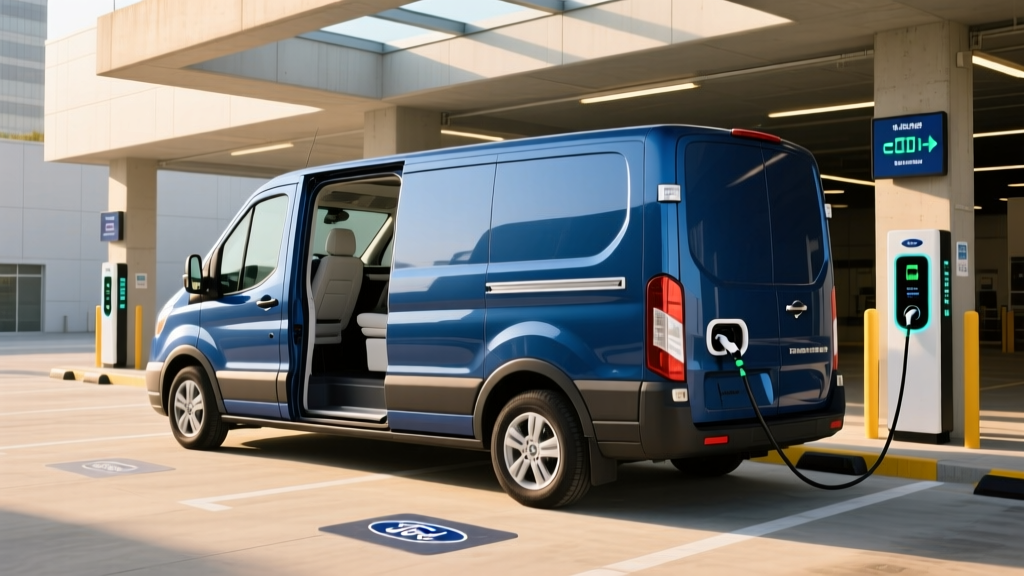
Ford's E-Transit has become a bellwether for commercial vehicle electrification in North America. Now in its 2026 model year with an updated battery pack and revised charging architecture, the electric full-size van targets last-mile delivery fleets, tradespeople, and shuttle operators who can charge at a depot overnight and stay within a predictable daily route radius. We spent time with the 2026 E-Transit to evaluate whether the real-world range, charging logistics, and total cost of ownership justify the switch from the gas Transit.
Quick Verdict: Who the E-Transit Actually Fits
The 2026 E-Transit is not a road-trip vehicle. It is a purpose-built commercial tool that excels when daily routes stay under 100 miles and depot charging is available. Fleet operators running predictable urban and suburban delivery loops will find the math compelling: lower per-mile energy cost, reduced maintenance, and quiet operation that matters in residential delivery zones. Owner-operators or businesses with long inter-city routes, no dedicated charging infrastructure, or heavy towing needs should look at the gas Transit or a diesel Sprinter instead.
Range, Battery, and Real-World Efficiency
The 2026 E-Transit carries a 68 kWh usable lithium iron phosphate (LFP) battery pack. Ford moved to LFP chemistry for this model year, trading some energy density for longer cycle life, lower degradation, and reduced reliance on cobalt and nickel — a smart trade-off for a commercial vehicle that will see daily deep cycling.
Real-World Expectation: Plan for 95–110 miles in mixed city/highway driving. In cold weather (below 35°F), expect 75–90 miles due to cabin heating demands and battery chemistry resistance. Highway-heavy routes at 70+ mph will pull range toward the low end. Stop-and-go urban delivery with regenerative braking actually maximizes efficiency.
The EPA rates the E-Transit cargo van at 2.0 kWh/mile (approximately 50 kWh/100 mi), which translates to an MPGe of roughly 1.7 MPGe equivalent when compared on the fueleconomy.gov scale — though for commercial operators, cost-per-mile is the more useful metric. At a national commercial electricity average of $0.14/kWh, that works out to roughly $0.28 per mile in energy cost, versus $0.55–$0.65 per mile for the gas Transit at $3.50/gallon and 14 MPG combined.
Charging Speed and Depot Infrastructure
Charging is the make-or-break factor for commercial vehicle electrification, and the E-Transit's profile is depot-first, public-second.
| Level | Power | Time / Rate | Best Use Case |
|---|---|---|---|
| Level 1 (120V) | ~1.4 kW | ~3 mi/hr; 48+ hrs for full charge | Emergency top-off only |
| Level 2 (240V, 48A) | 11.5 kW | ~8 hours 0–100% (~14 mi/hr) | Overnight depot charging (primary) |
| DC Fast Charge | 120 kW peak | 10–80% in ~45 minutes | Midday opportunity charging |
The 120 kW DC fast-charging peak is modest compared to passenger EVs like the Hyundai Ioniq 5 or Ford F-150 Lightning, but it's adequate for commercial duty cycles. The charge curve is relatively flat on LFP chemistry — you'll sustain 80–100 kW through most of the 10–80% window, with tapering above 85%. The CCS1 connector is standard; NACS is not offered on the E-Transit, so Tesla Supercharger access requires a Ford-approved adapter (sold separately).
For depot charging, fleet operators should budget for a commercial electrician to install dedicated 60A circuits per vehicle. A single ChargePoint CPF32 or Blink HQ 100 commercial pedestal runs $3,500–$6,000 installed per port, with potential panel upgrades adding $2,000–$8,000 for multi-van sites. According to fueleconomy.gov, overnight Level 2 charging at commercial rates keeps per-mile costs predictable and eliminates fuel-card logistics.
Performance, Drivetrain, and Payload
The E-Transit uses a single rear-mounted electric motor producing 266 horsepower and 317 lb-ft of torque. Rear-wheel drive is standard — all-wheel drive is not offered, which limits appeal in snow-belt markets.
| Specification | 2026 E-Transit (Low Roof, 130" WB) |
|---|---|
| 0–60 mph | ~8.5 seconds (unloaded) |
| Horsepower | 266 hp |
| Torque | 317 lb-ft |
| Drivetrain | RWD (single motor) |
| Max Payload | 3,300 lbs |
| Max Towing | Not rated for towing |
| Cargo Volume (low roof, 130" WB) | 246.7 cu ft |
| Battery Usable Capacity | 68 kWh (LFP) |
| EPA Range | 126 miles |
| Efficiency | ~2.0 kWh/mi (50 kWh/100 mi) |
The 3,300-pound max payload is roughly 1,000 pounds less than an equivalently configured gas Transit 250 — a direct consequence of battery weight. For parcel delivery, this rarely matters. For heavy-materials trades (plumbing, HVAC, stone/countertop transport), it's a real constraint. The E-Transit is not rated for towing, which eliminates it for businesses that need to pull equipment trailers.
Pricing, Trim Levels, and Federal Tax Credits
The 2026 E-Transit is offered in three body lengths (130", 148", 148" extended) and three roof heights (low, medium, high), with cutaway and chassis cab variants available. Pricing starts at $52,995 MSRP for the low-roof/short-wheelbase cargo van and climbs to approximately $62,000 for the high-roof/extended-wheelbase model before destination.
| Configuration | Base MSRP | Est. After §30D Credit* |
|---|---|---|
| T-150 Cargo, Low Roof, 130" WB | $52,995 | $45,495 |
| T-250 Cargo, Med Roof, 148" WB | $55,495 | $47,995 |
| T-350 Cargo, High Roof, 148" Ext WB | $61,995 | $54,495 |
| Cutaway / Chassis Cab | $50,995–$54,495 | Varies by GVWR |
*Federal tax credit estimates assume eligibility. Under IRS §30D rules, the commercial EV credit for fleets operates under §45W (Commercial Clean Vehicle Credit) rather than §30D, which is for individual purchasers. Fleet buyers should consult a tax professional regarding §45W eligibility, which caps at $7,500 for vehicles under 14,000 lbs GVWR. Individual owner-operators purchasing through a sole proprietorship may qualify for §30D if personal income caps apply ($150K single / $300K joint) and the vehicle meets battery sourcing requirements. MSRP caps of $80,000 for vans apply, and all E-Transit trims fall under this threshold.
Technology, Driver Assists, and Fleet Management
The E-Transit runs Ford's SYNC 4 infotainment system on a 12-inch touchscreen with standard wireless Apple CarPlay and Android Auto. The standout for fleet operators is the integrated Ford Pro Telematics modem, which provides real-time vehicle location, state-of-charge monitoring, geofencing, and driver behavior scoring — all accessible through the Ford Pro dashboard. This eliminates the need for aftermarket telematics hardware that gas-fleet operators often pay $20–$30/month per vehicle to install.
Standard driver-assist features include:
- Pre-Collision Assist with Automatic Emergency Braking
- Lane-Keeping System
- Blind Spot Information System (BLIS) with trailer coverage
- Rear View Camera with dynamic hitch assist
- Available 360-degree camera (highly recommended for the extended wheelbase)
Notably absent: Ford's BlueCruise hands-free highway driving system is not available on the E-Transit. This is SAE Level 1–2 driver assistance, not autonomous driving — the driver must remain fully engaged at all times.
Warranty and Total Cost of Ownership
Ford backs the E-Transit with an 8-year / 100,000-mile battery and electric component warranty, with a capacity retention threshold of 70% — meaning Ford will repair or replace the pack if it degrades below 70% of original capacity within the warranty period. The bumper-to-bumper warranty is 3 years / 36,000 miles, and the powertrain warranty is 5 years / 60,000 miles.
For fleet operators, the total cost of ownership picture is compelling over a 5-year, 75,000-mile horizon:
- Energy savings: ~$0.28/mile (electric) vs ~$0.60/mile (gas) = $24,000 fuel savings
- Maintenance savings: No oil changes, no transmission fluid, fewer brake replacements (regen braking) = estimated $4,000–$6,000 savings
- Higher upfront cost: ~$10,000–$15,000 more than gas Transit before credits
- Depot charging investment: $3,500–$8,000 per vehicle for Level 2 infrastructure
Net 5-year TCO typically favors the E-Transit by $8,000–$18,000 for fleets that can charge at depot and stay within the range envelope, according to Ford Pro's fleet calculators. The breakeven point typically arrives around year 3–4 depending on local electricity and fuel costs.
Pros
- Lowest per-mile energy cost in class
- Integrated Ford Pro telematics (no aftermarket hardware)
- LFP battery chemistry: long cycle life, low degradation
- Quiet operation ideal for residential delivery
- Proven Transit platform — body shops know the sheet metal
- Overnight Level 2 charging covers most daily routes
Cons
- 126-mile EPA range limits route flexibility
- ~1,000 lb payload penalty vs gas Transit
- No towing capability
- No AWD option for snow markets
- 45-minute DC fast charge (10–80%) is slow for midday top-offs
- Depot charging infrastructure is a real capital expense
- BlueCruise not available
Competitor Comparison: E-Transit vs Rivian EDV vs BrightDrop Zevo
The E-Transit competes primarily with the Rivian EDV (built exclusively for Amazon, not available to general fleets) and the BrightDrop Zevo 600 (GM's commercial van, with limited production). Among vehicles actually purchasable by general commercial buyers in 2026, the E-Transit has the broadest dealer network, the most body configurations, and the deepest integration with existing Ford Pro service infrastructure. The NHTSA has not crash-tested the E-Transit, which is common for commercial vans in this class.
Frequently Asked Questions
What is the real-world range of the 2026 Ford E-Transit?
The EPA rates the E-Transit at 126 miles for the low-roof short-wheelbase model. In real-world mixed driving, plan for 95–110 miles. In cold weather below 35°F, expect 75–90 miles. Urban stop-and-go delivery routes with regenerative braking tend to yield the best efficiency.
How fast does the E-Transit charge at home and on DC fast chargers?
On a 48-amp Level 2 charger (11.5 kW), the E-Transit charges from empty to full in about 8 hours — ideal for overnight depot charging. On a DC fast charger, it peaks at 120 kW and reaches 10–80% in approximately 45 minutes. The LFP battery maintains a relatively flat charge curve through the bulk of the session.
Does the E-Transit qualify for the federal EV tax credit?
It depends on how you buy it. Individual owner-operators purchasing personally may qualify for up to $7,500 under IRS §30D, subject to income caps ($150K single / $300K joint), MSRP limits (under $80K for vans — all trims qualify), and battery critical-mineral sourcing rules. Fleet buyers purchasing through a business entity typically use the §45W Commercial Clean Vehicle Credit instead, which has different rules and also caps at $7,500 for vehicles under 14,000 lbs GVWR. Consult a tax professional and review current rules at irs.gov.
Is the E-Transit worth buying vs a gas Transit?
If your daily routes stay under 100 miles, you can install depot charging, and you don't need towing or maximum payload, the E-Transit typically saves $8,000–$18,000 over 5 years in fuel and maintenance. If you run long routes, need AWD, tow trailers, or lack charging infrastructure, the gas Transit remains the practical choice.
What are the biggest drawbacks of the E-Transit?
The 126-mile EPA range (less in winter) is the primary limitation. Payload is ~1,000 lbs less than gas equivalents, towing is not supported, and there's no AWD option. The 45-minute DC fast charge time means midday charging requires planning. Depot charging infrastructure is a real upfront cost.
What battery chemistry does the E-Transit use, and how long will it last?
The 2026 E-Transit uses a 68 kWh LFP (lithium iron phosphate) battery. LFP chemistry offers longer cycle life (typically 3,000+ cycles to 80% capacity) and lower degradation than NMC. Ford warranties the battery for 8 years / 100,000 miles with a 70% capacity retention threshold. For a commercial vehicle driven 15,000–20,000 miles annually, the pack should outlast the typical fleet ownership cycle.