Quick Verdict: The Urban Delivery Workhorse
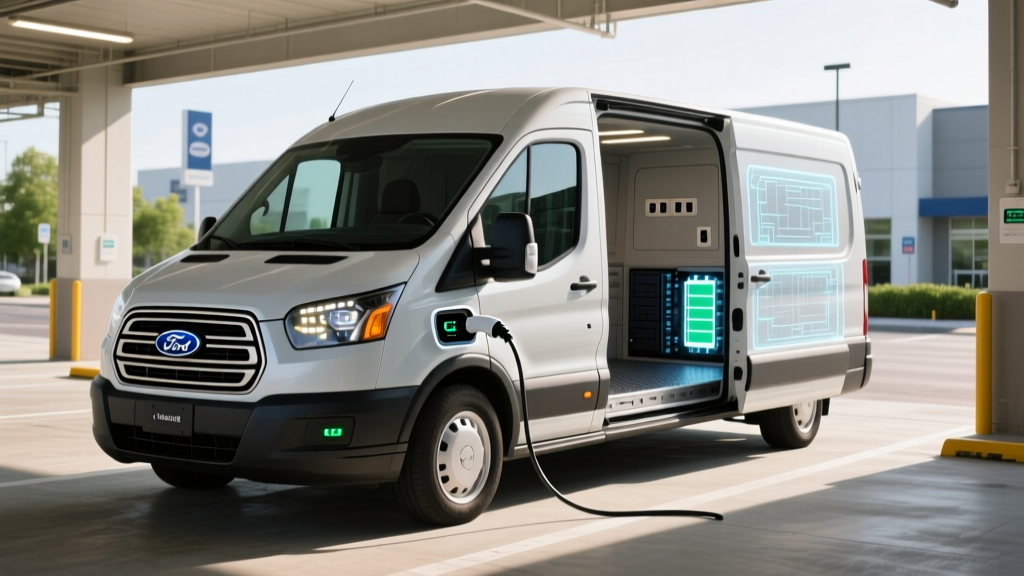
The 2026 Ford E-Transit cargo van is not built for road trips. It's engineered for a very specific job: last-mile delivery, urban service routes, and fleet duty where vehicles return to a depot every night. With an EPA-estimated 126 miles of range in its low-roof, short-wheelbase cutaway configuration, the E-Transit won't win range wars. But for fleets running predictable routes under 100 miles per day, it eliminates fuel costs, reduces maintenance, and qualifies for up to $7,500 in federal commercial EV tax credits under IRS §45W.
The E-Transit competes directly with the Mercedes-Benz eSprinter and the BrightDrop Zevo 600, but Ford's dealer network, Pro Power Onboard, and fleet management integration give it an edge for small-to-mid-size commercial operators. Here's the full data-driven breakdown.
Range, Battery & Real-World Efficiency
The 2026 E-Transit uses a 68 kWh usable lithium-ion battery pack (NMC chemistry — nickel manganese cobalt). Ford does not offer an LFP option for the E-Transit, which makes sense given the payload and power demands of a commercial van.
EPA Estimated Range: 126 miles (low-roof, short-wheelbase cargo van)
Real-World City/Delivery Route: 105–120 miles (stop-and-go with regen braking helps)
Real-World Highway (65+ mph, unloaded): 85–100 miles
Cold Weather (below 32°F, cabin heat on): 75–95 miles (30–40% range loss is typical for electric vans without heat pumps)
Loaded to Max Payload (3,800 lbs): Subtract ~10–15% from above estimates
The E-Transit does not come equipped with a heat pump — it uses a resistive PTC heater for cabin warmth. In northern-climate winters, this significantly impacts range. Fleet operators in cold regions should plan routes around 70–80 miles of usable range in December through February.
| Specification | Value |
|---|---|
| Battery Capacity (Usable) | 68 kWh |
| Battery Chemistry | NMC (Nickel Manganese Cobalt) |
| EPA Range (Low-Roof SWB) | 126 miles |
| EPA Range (High-Roof LWB) | 108 miles |
| Combined MPGe | ~1.9–2.0 kWh/mile (per fueleconomy.gov) |
| Energy Consumption | ~50–53 kWh/100 mi |
Charging: DC Fast, Level 2 & Depot Setup
Charging speed is where commercial EVs live or die. A fleet van needs to top up quickly during driver lunch breaks or between shifts. The E-Transit handles this adequately — not class-leading, but functional.
| Level | Power (kW) | Speed / Time | Connector |
|---|---|---|---|
| Level 1 (120V) | ~1.4 kW | ~3 mi/hr (overnight top-up only) | J1772 |
| Level 2 (240V, 48A) | 11.5 kW | ~24 mi/hr; full charge in ~7 hrs | J1772 / CCS1 |
| Level 2 (240V, 80A — Ford Pro) | 19.2 kW | ~40 mi/hr; full charge in ~4 hrs | CCS1 |
| DC Fast Charge (Peak) | 115 kW (peak) | 15–80% in ~45 min | CCS1 |
Charging curve reality: The E-Transit peaks at approximately 115 kW on a DC fast charger, but like most commercial EVs, it tapers significantly above 60% state of charge. Expect an average sustained rate of ~70–80 kW during a 15–80% session. Ford's quoted 45-minute 15–80% time assumes optimal battery preconditioning and a charger capable of sustaining at least 150 kW.
Depot charging recommendation: For fleet operators, the Ford Pro 80A Level 2 wall unit at 19.2 kW is the sweet spot. A full charge in roughly 4 hours means a van finishing its route at 6 PM is fully topped up by 10 PM — no need for expensive DC fast-charging infrastructure at the depot. Budget approximately $3,000–$6,000 per stall for 80A Level 2 installation, including panel upgrades and conduit runs (get quotes from a licensed electrician for your specific facility).
Performance, Powertrain & Payload
The E-Transit is rear-wheel drive with a single permanent-magnet synchronous motor on the rear axle. It produces 266 horsepower (198 kW) and 317 lb-ft of torque. That torque is available instantly from zero RPM, which makes the E-Transit surprisingly quick off the line at stoplights — even when loaded.
| Metric | Value |
|---|---|
| Horsepower | 266 hp (198 kW) |
| Torque | 317 lb-ft |
| Drivetrain | Rear-Wheel Drive (single motor) |
| 0–60 mph (est.) | ~8.0 seconds (unloaded) |
| Top Speed (Governor) | 75 mph |
| Max Payload (Cargo Van, Low-Roof) | 3,880 lbs |
| Max Payload (Cutaway) | 4,290 lbs |
| GVWR | 9,500 lbs |
| Towing | Not rated for towing |
The 75-mph speed governor is a deliberate fleet-management choice: it limits liability and preserves range. Highway driving at 75 mph would drain the 68 kWh battery alarmingly fast anyway. This van is happiest at 35–55 mph on urban and suburban routes.
Cargo Volume, Configurations & Dimensions
The E-Transit mirrors the gas Transit's body configurations, which means upfitters already have mounting points and rack systems that bolt right in. Ford offers three roof heights, three body lengths, and cargo van, cutaway, and chassis cab variants.
| Configuration | Cargo Volume | Wheelbase | Max Payload |
|---|---|---|---|
| Low-Roof, Regular Length (130" WB) | 246.7 cu ft | 130 in | 3,880 lbs |
| Medium-Roof, Regular Length (130" WB) | 277.7 cu ft | 130 in | 3,720 lbs |
| High-Roof, Extended Length (148" WB) | 487.3 cu ft | 148 in | 3,340 lbs |
| Cutaway (138" WB) | Cab only (upfit required) | 138 in | 4,290 lbs |
Interior cargo height on the high-roof model is 81.5 inches — tall enough for most workers to stand upright. The load floor is flat and unobstructed by a transmission tunnel, since the motor sits on the rear axle. Ford retained the same interior bulkhead mounting points as the gas Transit, so commercial shelving systems from Adrian Steel, Sortimo, and others carry over directly.
Pricing, Tax Credits & Fleet Incentives
Commercial EV pricing requires looking beyond the sticker. The E-Transit qualifies for the Commercial Clean Vehicle Credit (IRS §45W), which offers up to $7,500 for vehicles under 14,000 lbs GVWR. Because the E-Transit sits at 9,500 lbs GVWR, it falls under the $7,500 cap. Critically, §45W is a commercial credit — it does not have the same buyer income caps or MSRP caps that apply to the consumer §30D credit. This means a fleet buyer can claim the credit regardless of company revenue, and there's no per-manufacturer cap.
| Trim / Configuration | Base MSRP | After §45W Credit | Notes |
|---|---|---|---|
| T150 Cargo Van, Low-Roof, 130" WB | ~$52,000 | ~$44,500 | Best range (126 mi EPA) |
| T250 Cargo Van, Medium-Roof, 130" WB | ~$54,500 | ~$47,000 | Mid-volume workhorse |
| T350 Cargo Van, High-Roof, 148" WB | ~$58,500 | ~$51,000 | Max cargo (487 cu ft) |
| T350 Cutaway, 138" WB | ~$49,000 | ~$41,500 | For custom upfits |
Important §45W caveats: The vehicle must be placed in service for business use, and the credit cannot exceed the incremental cost of the EV over a comparable gas vehicle (for the E-Transit vs. gas Transit, the incremental cost typically exceeds $7,500, so the full credit is usually claimable). Always consult a tax professional for your specific situation. Many states also offer additional commercial EV rebates — check your state energy office or AFDC state incentive database.
Consumer buyers: If you're purchasing an E-Transit as an individual (not through a business entity), you may qualify for the §30D consumer credit instead, which has income caps ($150K single / $300K joint) and requires North American assembly plus battery-sourcing compliance. The E-Transit is assembled in Kansas City, Missouri, which satisfies the assembly requirement. Verify current-year battery sourcing compliance on the IRS clean vehicle credit page before purchasing.
Tech, Driver Assistance & Pro Power Onboard
The 2026 E-Transit comes equipped with Ford's SYNC 4 infotainment system on a 12-inch touchscreen. For a commercial van, the tech package is surprisingly robust:
- Ford Pro Telematics: Real-time vehicle location, state of charge, battery health, and route optimization through the Ford Pro platform. Fleet managers can set geofences, monitor driver behavior, and schedule charging remotely.
- Pro Power Onboard: Available 2.0 kW or 7.2 kW onboard power export. The 7.2 kW version turns the E-Transit into a mobile generator — plug in power tools, lighting rigs, or even job-site heaters directly from the van's battery via bed-mounted and cab outlets.
- Ford Co-Pilot360: Standard Pre-Collision Assist with Automatic Emergency Braking, Lane-Keeping System, and Rear View Camera. Available Blind Spot Information System (BLIS) with trailer coverage.
- Intelligent Adaptive Cruise Control: Available on higher trims — useful for highway segments between delivery zones.
Notable drawbacks:
- No available all-wheel drive — RWD only, which limits traction on unplowed routes in snow-belt states.
- No heat pump — resistive cabin heating significantly reduces winter range.
- Top speed limited to 75 mph — fine for urban routes, frustrating on interstates.
- DC fast charging peaks at 115 kW — slower than passenger EVs like the Hyundai Ioniq 5 or Tesla Model Y.
- The 126-mile EPA range (best case) is tight for any route that exceeds a tight urban loop.
Pros
- Zero tailpipe emissions in urban delivery zones
- Instant torque makes loaded driving effortless
- Pro Power Onboard eliminates separate generators
- Ford Pro telematics and fleet management integration
- Same cargo dimensions and upfit compatibility as gas Transit
- Up to $7,500 federal commercial tax credit (§45W)
- Significantly lower maintenance (no oil, filters, exhaust, transmission fluid)
- Quiet operation — ideal for early-morning residential deliveries
Cons
- 126-mile max EPA range — tight for longer routes
- No heat pump — severe winter range penalty
- RWD only — no AWD option for snow/ice
- 75-mph governed top speed
- 115 kW peak DC charging is modest for 2026
- ~$52K+ starting MSRP before incentives
- Heavy battery reduces payload vs. gas Transit (~800 lb penalty)
- Not suited for towing
Warranty & Long-Term Ownership
Ford backs the E-Transit's high-voltage battery and electric powertrain with an 8-year / 100,000-mile warranty, whichever comes first. The battery warranty guarantees that the pack will retain at least 70% of its original capacity during the warranty period. If degradation exceeds 30%, Ford will repair or replace the battery at no cost.
The base vehicle limited warranty covers 3 years / 36,000 miles, and the powertrain warranty (including the electric motor and reduction gear) runs 5 years / 60,000 miles.
Battery replacement cost: If the battery needs replacement out of warranty, expect a cost in the range of $15,000–$22,000 for the 68 kWh pack including labor. However, NMC batteries in commercial fleet use with regular Level 2 charging (avoiding constant DC fast-charging and 100% SoC storage) typically retain 80–85% capacity at 150,000 miles based on industry fleet data.
Total cost of ownership advantage: Ford estimates the E-Transit saves fleet operators approximately $0.12–$0.18 per mile in fuel and maintenance compared to a gas Transit, depending on local electricity rates and gas prices. Over a 5-year, 100,000-mile ownership cycle, that translates to $12,000–$18,000 in operational savings — often enough to offset the higher purchase price even before tax credits.
Who Should Buy the Ford E-Transit?
- Choose the E-Transit if: Your routes are under 100 miles/day, vehicles return to a depot nightly, you operate in urban/suburban areas, you want to eliminate fuel and reduce maintenance costs, and your business qualifies for the §45W commercial credit.
- Choose the gas Transit if: Your routes regularly exceed 150 miles/day, you operate in extreme cold climates without depot charging, you need AWD for rural or unplowed roads, or you need towing capability.
- Consider the Mercedes-Benz eSprinter if: You need more range (the eSprinter offers ~200 miles EPA with its larger battery option) and are willing to pay a significant premium.
- Consider the BrightDrop Zevo 600 if: You're a large enterprise fleet (FedEx, Walmart) with dedicated charging infrastructure and can negotiate volume pricing.
The E-Transit is best suited for bakeries, florists, plumbing/HVAC companies, last-mile delivery contractors (Amazon DSP, FedEx Ground routes), and municipal fleets with predictable daily loops. It's a purpose-built tool, not a general-purpose vehicle — and within its lane, it executes well.
Frequently Asked Questions
What is the real-world range of the Ford E-Transit cargo van?
The EPA rates the low-roof, short-wheelbase E-Transit at 126 miles. In real-world urban delivery driving with frequent stops (where regenerative braking recovers energy), expect 105–120 miles. Highway driving at 65+ mph drops that to roughly 85–100 miles. In freezing temperatures with cabin heat running, plan for 75–95 miles. Loading the van to its maximum payload further reduces range by approximately 10–15%.
How fast does the E-Transit charge at home and on DC fast chargers?
On a standard 48A Level 2 home/depot charger (11.5 kW), the E-Transit gains about 24 miles of range per hour, reaching a full charge in roughly 7 hours. With Ford's optional 80A Pro charger (19.2 kW), a full charge takes about 4 hours. On a DC fast charger, the E-Transit peaks at 115 kW and charges from 15% to 80% in approximately 45 minutes under optimal conditions.
Does the Ford E-Transit qualify for the federal EV tax credit?
Yes, but the specific credit depends on the buyer. Commercial fleet buyers can claim up to $7,500 under IRS §45W (Commercial Clean Vehicle Credit), which has no income caps or MSRP caps but requires the vehicle be used for business. Individual consumer buyers may qualify under §30D, which has income limits ($150K single / $300K joint) and battery-sourcing requirements. The E-Transit is assembled in Kansas City, MO, satisfying the North American assembly requirement. Always verify current-year eligibility with a tax professional and consult IRS.gov.
Is the E-Transit worth buying vs. the gas Ford Transit?
It depends on your route profile. If your daily routes stay under 100 miles and you have depot charging, the E-Transit's lower fuel and maintenance costs typically pay back the price premium within 3–5 years, especially after the $7,500 tax credit. If you need range flexibility, towing, or AWD, the gas Transit remains the better tool. For most urban delivery fleets, the math favors the E-Transit.
Can the Ford E-Transit power tools on a job site?
Yes. With the available Pro Power Onboard system (2.0 kW standard, 7.2 kW optional), the E-Transit can power job-site tools, lighting, and equipment directly from the traction battery through outlets in the cab and cargo area. The 7.2 kW version can run miter saws, compressors, and multiple power tools simultaneously — eliminating the need for a separate portable generator.
What is the E-Transit's payload capacity vs. the gas Transit?
The E-Transit's battery pack adds approximately 800 lbs compared to the gas Transit, reducing maximum payload accordingly. The low-roof E-Transit cargo van offers 3,880 lbs of payload capacity, compared to roughly 4,500+ lbs for an equivalently configured gas Transit. For most delivery applications (parcels, food, parts), this is more than sufficient, but heavy-material haulers should verify their typical load weights.