Quick Answer: Is There a Ford Bronco Electric?
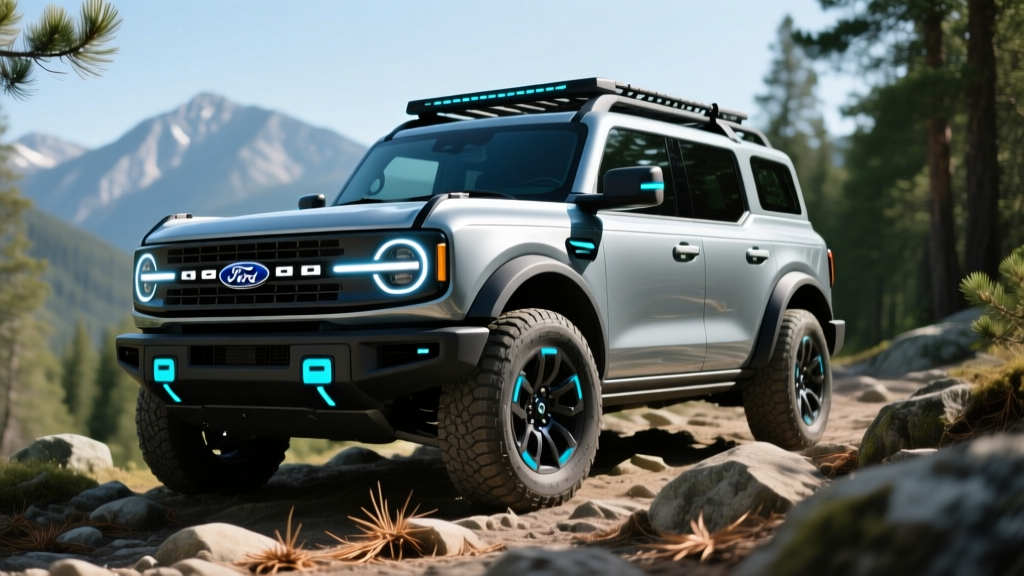
As of early 2026, Ford has not yet released a production Ford Bronco electric model. The automaker has confirmed that an electrified Bronco is in development — most likely a battery-electric variant riding on a dedicated EV platform — but official EPA range figures, pricing, and a firm on-sale date remain unannounced. What we do know comes from Ford's EV roadmap statements, supplier reports, and the architecture underpinning current Ford EVs. If you're researching a Bronco EV today, treat every spec below as preliminary and subject to change. For a buyable electric off-roader right now, the closest competitors are the Rivian R1S and the Jeep Wrangler 4xe (PHEV).
What We Know About the Ford Bronco EV So Far
Ford CEO Jim Farley has publicly stated that the Bronco nameplate will go electric, and industry reporting points to a mid-2027 or 2028 model-year debut. The electric Bronco is expected to ride on Ford's next-generation flexible EV architecture — a body-on-frame-compatible platform that also underpins the next-generation F-150 Lightning and the electric Explorer. Key preliminary details circulating from supplier and patent filings include:
- Platform: Dedicated EV skateboard with structural battery pack, likely supporting dual-motor AWD as standard
- Battery chemistry: Ford has been diversifying between NMC (nickel manganese cobalt) for energy density and LFP (lithium iron phosphate) for cost reduction — the Bronco EV could offer both depending on trim
- Estimated battery capacity: 100–130 kWh usable (based on F-150 Lightning Extended Range precedent and off-road energy demands)
- Target EPA range: 280–340 miles (estimate; off-road-oriented tires and boxy aero will limit efficiency)
- Charging architecture: Expected 800V system, enabling peak DC fast-charge rates potentially above 250 kW
- NACS connector: Ford has committed to the Tesla NACS standard for all new EVs, so the Bronco EV will almost certainly ship with a native NACS port
None of these figures are confirmed by Ford. We'll update this guide the moment official specifications drop.
How a Bronco EV Would Compare to the Gas Bronco
The current sixth-generation gas Ford Bronco remains one of the most capable and popular off-road SUVs on the market. Here's how the gas model stacks up against what we project for the electric variant:
| Spec | 2026 Gas Bronco (Badlands 2.7L EcoBoost) | Ford Bronco Electric (Projected) |
|---|---|---|
| Powertrain | 2.7L turbo V6, 10-speed auto | Dual-motor AWD (est.) |
| Horsepower | 330 hp | 450–550 hp (est.) |
| Torque | 415 lb-ft | 550–700 lb-ft (est.) |
| 0–60 mph | ~6.5 sec | ~4.0–5.0 sec (est.) |
| EPA Range / Fuel Economy | ~17 MPG combined (~340 mi on 20-gal tank) | 280–340 mi EPA (est.) |
| Energy/Fuel Cost per Mile | ~$0.21/mi (at $3.50/gal) | ~$0.05–0.07/mi (home L2 at $0.14/kWh) |
| Towing Capacity | 3,500 lbs | 4,500–6,000 lbs (est.) |
| Base MSRP | ~$47,000 (Badlands) | $55,000–$65,000 (est.) |
| Federal Tax Credit (§30D) | None | Up to $7,500 (if eligible — see below) |
| Off-Road Capability | Proven (locking diffs, sway-bar disconnect) | Expected (torque vectoring, adjustable air suspension rumored) |
Key takeaway: The electric Bronco should deliver substantially more torque and quicker acceleration — a major advantage for rock crawling where instant electric torque is ideal. However, the gas Bronco currently wins on refueling speed in remote areas where DC fast chargers are scarce. If you regularly overland deep into BLM land or national forests with no charging infrastructure, this is a real limitation to consider.
Projected Charging and Battery Details
Charging speed will be make-or-break for the Bronco EV's road-trip viability. Based on Ford's current EV trajectory and the 800V architectures now proliferating across the industry, here's a reasonable projection:
| Charging Level | Power (kW) | Miles Added per Hour | Notes |
|---|---|---|---|
| Level 1 (120V household) | ~1.4 kW | ~3–4 mi/hr | Emergency/trickle only; full charge in 3+ days |
| Level 2 (240V home) | ~11.5 kW | ~28–35 mi/hr | Full charge overnight (~9–11 hrs for 120 kWh pack) |
| DC Fast Charge (peak) | 250+ kW (est.) | ~700+ mi/hr (peak) | 10–80% in ~20–25 min (est.); tapers above 80% |
Charging-curve reality check: No EV sustains its peak charge rate across the full session. Expect the Bronco EV to hold peak kW up to roughly 40–50% SoC, then taper progressively. A 10–80% session at a 350 kW-capable station should take roughly 20–25 minutes if the battery is preconditioned — but cold batteries or high SoC arrivals will add minutes. Always precondition before DC fast charging; Ford's navigation-routed preconditioning (as seen in the Mustang Mach-E and F-150 Lightning) should carry over.
Real-World Ownership Considerations
Before committing to any EV — especially an off-road-oriented one — weigh these practical factors:
Home Charging Access
Level 2 home charging is the backbone of convenient EV ownership. If you have a garage or driveway with access to a 240V circuit (NEMA 14-50 or hardwired), you'll wake up to a full battery every morning. Expect to pay $500–$2,000 for a quality Level 2 charger (e.g., ChargePoint Home Flex, Ford Connected Charge Station) and $800–$2,500 for electrician installation, depending on panel capacity and run length. If your home has a 100-amp panel, a $1,500–$3,000 panel upgrade to 200 amps may be necessary. Renters and condo dwellers without dedicated parking face a harder path — rely on public DC fast charging, which costs 2–4× more per kWh than home electricity.
Cold-Weather Range Loss
Boxy, heavy SUVs with aggressive all-terrain tires are not aerodynamically efficient, and cold temperatures compound the problem. Expect 20–35% range reduction in sub-freezing conditions — a projected 320-mile EPA Bronco EV could deliver as little as 210–250 real-world highway miles at 70 mph in 20°F weather. A heat pump (likely standard on a premium Ford EV) will help mitigate cabin-heating energy draw, but physics is physics. If you live in northern climates and regularly drive long highway routes in winter, plan your trips around charging stops accordingly.
Off-Road Energy Consumption
Low-range crawling, sand driving, and heavy accessory loads (winch, light bars, rooftop tent) will consume battery energy far faster than highway cruising. Off-road energy consumption can spike to 600–900 Wh/mile compared to ~350–450 Wh/mile on pavement. This means a 120 kWh pack might yield only 130–200 miles of aggressive trail use. For weekend overlanding, you'll need a strategy: portable solar, a generator for emergencies, or route planning around trailheads with charging access.
Federal Tax Credit Eligibility (§30D)
Under current IRS §30D rules, a new Bronco EV could qualify for up to $7,500 in federal tax credits, but eligibility is not guaranteed and depends on several factors:
- MSRP cap: SUVs must have a base MSRP at or below $80,000 — the Bronco EV should clear this, but fully loaded trims could push close
- Buyer income cap: Adjusted gross income must not exceed $150,000 (single), $225,000 (head of household), or $300,000 (joint filers)
- Battery sourcing: At least 50% of critical minerals must be sourced from the US or a free-trade-agreement partner (increasing annually), and battery components must meet domestic-content thresholds
- Point-of-sale transfer: Since 2024, buyers can transfer the credit to the dealer for an upfront price reduction rather than waiting for tax filing
- Final assembly: Vehicle must undergo final assembly in North America
Critical caveat: Battery-sourcing and critical-mineral requirements tighten each year. A Bronco EV launching in 2027 or 2028 will face stricter thresholds than today's EVs. Ford has been actively onshoring battery production (via SK On joint ventures in Kentucky and Tennessee), which improves the odds of compliance — but always verify eligibility on fueleconomy.gov at the time of purchase, as the IRS updates the qualifying-vehicle list regularly. Consult a tax professional for your specific situation.
Cost Breakdown: EV vs. Gas Bronco Over 5 Years
Here's a projected 5-year/75,000-mile cost comparison assuming the gas Badlands and an electric Bronco at roughly equivalent trim levels:
| Category | Gas Bronco Badlands (~$47K) | Bronco EV (Projected ~$60K, after $7,500 credit = ~$52.5K) |
|---|---|---|
| Purchase Price (after credit) | $47,000 | $52,500 |
| Fuel / Electricity | $15,750 (17 MPG, $3.50/gal) | $3,750 (350 Wh/mi, $0.14/kWh home avg.) |
| Maintenance | $3,500 (oil, filters, plugs, brakes) | $1,200 (cabin filter, wipers, brake fluid; regen saves pads) |
| Insurance (est. avg.) | $7,500 | $8,500 (EVs typically cost 10–15% more to insure) |
| Estimated Depreciation | $18,800 (40% over 5 yrs) | $23,600 (45% over 5 yrs — EV depreciation remains higher) |
| Total 5-Year Cost | $92,550 | $89,550 |
Bottom line: Even with a higher purchase price, the Bronco EV's dramatically lower fuel and maintenance costs could yield roughly $3,000 in savings over five years — and potentially more if gas prices rise. However, higher EV insurance premiums and steeper depreciation partially offset the gains. Your actual savings depend heavily on local electricity rates, driving volume, and whether you can charge at home.
Common Misconceptions About the Bronco EV
| Myth | Fact |
|---|---|
| "The Bronco EV is available to buy now." | As of 2026, it is not yet in production. Ford has confirmed development, but no on-sale date has been announced. Expect 2027–2028. |
| "Electric motors can't handle serious off-roading." | Electric motors deliver instant, controllable torque at zero RPM — ideal for rock crawling. Rivian's R1S and GMC Hummer EV have already proven EV off-road capability. The challenge is energy supply in remote areas, not traction. |
| "I'll get the full $7,500 tax credit no matter what." | Credit eligibility depends on your income, the vehicle's MSRP, battery-sourcing compliance, and final assembly location. Verify on IRS.gov at purchase time. |
| "The battery will need replacing in a few years." | Ford's EV battery warranty covers at least 8 years/100,000 miles with a capacity-retention threshold (typically 70%). Modern NMC and LFP packs are designed for 15–20 years of service with gradual degradation — not sudden failure. |
| "Towing with an EV Bronco won't work." | EVs can tow, but expect a 40–60% range reduction when towing at highway speeds. A 320-mile range Bronco EV might deliver only 130–190 miles while towing a 3,500-lb trailer. Plan charging stops accordingly. |
Decision Framework: Should You Wait or Buy Now?
Wait for the Ford Bronco Electric if:
- You want a solid-electric off-roader from a legacy brand with a widespread dealer network for service
- You have reliable home Level 2 charging and most of your driving is within 200 miles round-trip
- You're not in a rush — the Bronco EV is likely 1–2 years from production
- You value instant torque for technical trail riding and want to eliminate trail-side fuel cans
Buy a gas Bronco now if:
- You regularly overland in remote areas with zero charging infrastructure
- You need a vehicle immediately and can't wait for an unannounced model
- Your daily commute is short but your weekend adventures are long and off-grid
- You want proven reliability data and an established aftermarket for modifications
Consider a Rivian R1S or Jeep Wrangler 4xe instead if:
- You want an electric or electrified off-roader you can actually buy today
- The R1S offers ~350 miles of EPA range, 800+ hp (quad-motor), and proven off-road chops starting around $75,000
- The Wrangler 4xe (PHEV) gives you ~22 miles of electric-only range for daily commuting plus a gas engine for trail range — a practical bridge solution
What First-Time EV Buyers Should Know
If the Bronco EV would be your first electric vehicle, prepare now so you're ready when it launches:
- Assess your electrical panel: Have a licensed electrician evaluate whether your home's panel can support a 40–60 amp Level 2 circuit. Upgrading from 100A to 200A adds cost but is often necessary.
- Understand kW vs. kWh: kWh measures battery capacity (the "tank size"); kW measures charging power (the "pump speed"). A 120 kWh battery charged at 11.5 kW takes roughly 10.5 hours from empty.
- Map your local charging: Use apps like PlugShare or A Better Routeplanner to see DC fast chargers along your common routes. If you live in a charging desert, an EV may not be practical yet.
- Factor in insurance: Get EV insurance quotes before buying. EVs typically cost 10–15% more to insure due to higher repair costs and battery-replacement risk.
- Learn about preconditioning: Warming the battery before DC fast charging dramatically improves charge speed. Ford's EVs support navigation-based preconditioning — use it.
Has Ford officially confirmed the Bronco EV release date?
No. Ford has confirmed an electrified Bronco is in development, but no official release date, pricing, or detailed specifications have been published as of early 2026. Industry estimates point to a 2027–2028 model-year launch.
Will the electric Bronco be as capable off-road as the gas version?
Electric powertrains offer advantages for technical off-roading — instant torque, precise throttle modulation, and no stall risk in water crossings. The challenge is energy logistics: recharging in remote areas is far slower than refueling with gas. Ford is expected to equip the Bronco EV with serious off-road hardware (locking differentials, terrain modes, underbody protection), but real-world trail range will be the limiting factor.
Will the Bronco EV qualify for the $7,500 federal tax credit?
It's possible but not guaranteed. Eligibility depends on your income, the vehicle's MSRP (must be ≤$80,000 for SUVs), battery-sourcing compliance, and North American final assembly. Ford's domestic battery production investments improve the odds, but always verify on the IRS clean vehicle credit page at the time of purchase.
Can I reserve a Ford Bronco EV now?
Not yet. Ford has not opened reservations or a waitlist for the electric Bronco. Monitor Ford's official newsroom and dealer communications for reservation announcements, which typically open 6–12 months before production begins.
What are the best electric off-roaders I can buy today?
The Rivian R1S (EPA range up to ~410 miles with Max Pack, starting ~$75,000) is the most capable all-electric SUV for off-road use currently on sale. The GMC Hummer EV SUV offers extreme performance and Watts-to-Freedom mode but starts above $98,000 with limited range. For a plug-in hybrid option, the Jeep Wrangler 4xe provides 22 miles of electric-only range plus gas-engine trail range, starting around $50,000.