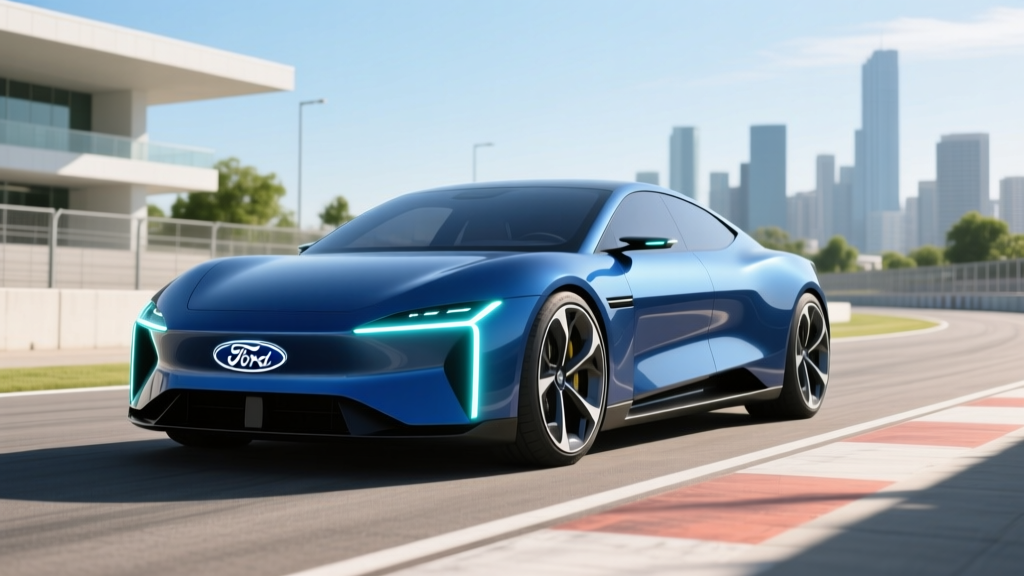
Ford's EV strategy has pivoted hard over the last two years, and the headline move is clear: Ford is developing an affordable electric vehicle to rival Tesla at the entry-level price point where the Model 3 and the upcoming next-generation Tesla platform compete. This isn't a compliance car or a warmed-over ICE chassis — it's a ground-up, next-generation battery-electric built on Ford's newly engineered universal EV platform, targeting a base price near $30,000 when production begins in 2027.
As of early 2026, the vehicle remains in pre-production and has not been officially named, fully specced, or priced by Ford. What we do know comes from executive briefings, supply-chain reports, and platform disclosures. Below is a comprehensive preview of what buyers can expect — along with honest caveats about what remains unconfirmed.
Platform and Powertrain: What Ford Has Confirmed
Ford CEO Jim Farley has described the next-generation EV architecture as the company's most significant product investment since the Model T. The platform is designed to underpin multiple body styles — starting with a compact crossover and potentially expanding into a sedan or small pickup variant. Key engineering targets include:
- Drivetrain: Rear-wheel drive (RWD) standard, with all-wheel drive (AWD) available on higher trims
- Battery chemistry: Lithium iron phosphate (LFP) for base trims, with a higher-density NMC option for extended-range variants
- Manufacturing: Production at Ford's Louisville, Kentucky assembly plant, retooled for the new platform
- Target segment: Compact crossover/SUV — directly competing with the Tesla Model Y, Hyundai Ioniq 5, and Chevrolet Equinox EV
Estimated Range, Battery, and Efficiency
The most critical question for any affordable EV is range. Ford has targeted a competitive EPA range that undercuts neither usability nor cost. Based on the platform's disclosed battery options and efficiency targets, here is what we expect:
| Spec | Base (LFP) | Extended Range (NMC) |
|---|---|---|
| Battery Capacity (usable) | ~58 kWh | ~75 kWh |
| Chemistry | LFP (lithium iron phosphate) | NMC (nickel manganese cobalt) |
| EPA Est. Range | ~230–250 miles | ~300–320 miles |
| Efficiency (est.) | ~26 kWh/100 mi (~130 MPGe) | ~25 kWh/100 mi (~135 MPGe) |
| Drivetrain | RWD / AWD optional | RWD / AWD optional |
| 0–60 mph (est.) | ~7.0 sec (RWD) | ~5.5 sec (AWD) |
LFP vs. NMC: What the Chemistry Choice Means for You
The LFP base battery is a deliberate strategy choice. LFP cells cost less to produce, contain no cobalt or nickel (simplifying supply chains), and tolerate daily 100% charging without the accelerated degradation that NMC cells experience at high state-of-charge. The trade-off: LFP is heavier and less energy-dense, which is why the base model carries ~58 kWh and targets ~240 miles rather than 300+.
The NMC extended-range option trades higher cost for better energy density and lighter weight, making it the better choice for buyers who regularly take road trips exceeding 250 miles or who live in regions with sparse charging infrastructure.
Charging Speed and Infrastructure
Charging speed is where affordable EVs often disappoint. Ford has signaled that this platform will support competitive DC fast-charging rates, and the adoption of the NACS (North American Charging Standard) connector — now the Tesla Supercharger plug — is confirmed across Ford's EV lineup.
| Charging Level | Base LFP (~58 kWh) | Extended NMC (~75 kWh) |
|---|---|---|
| Level 1 (120V / 12A) | ~1.4 kW — ~4 mi/hr | ~1.4 kW — ~4 mi/hr |
| Level 2 (240V / 48A) | ~11.5 kW — ~33 mi/hr | ~11.5 kW — ~33 mi/hr |
| DC Fast Charge (peak) | ~150 kW | ~180 kW |
| 10–80% DC Fast Charge | ~25 minutes (est.) | ~28 minutes (est.) |
Charging curve reality check: Peak kW rates are not sustained across the entire session. Expect the base LFP model to hold ~150 kW from roughly 10–50% SoC before tapering to ~80 kW through 80%, and further above that. This is standard behavior for all lithium-ion batteries and is managed by the vehicle's thermal management system. Preconditioning the battery (available via the FordPass app or navigation-routed charging) is essential for achieving peak rates at DC fast chargers.
Ford's NACS adoption means direct access to Tesla's Supercharger network — over 20,000 stalls in North America as of 2026 — without an adapter. This is a significant practical advantage over CCS-only vehicles in areas where Electrify America or EVgo coverage is thin.
Performance and Driving Dynamics
The RWD base model is expected to produce approximately 210–230 horsepower, adequate for confident highway merging and city driving. The AWD dual-motor variant should push output to roughly 300–330 horsepower, with the 0–60 mph time dropping to the mid-5-second range.
Ford has emphasized a low center of gravity (battery pack mounted under the floor) and a short front overhang enabled by the dedicated EV platform. Expect a turning circle competitive with the Hyundai Ioniq 5 (~39.4 feet) and regenerative braking calibrated for one-pedal driving in its strongest setting.
Towing capacity has not been disclosed, but the compact crossover segment typically ranges from 1,500 to 2,500 pounds for EVs in this class — enough for a small utility trailer but not a boat or camper.
Interior Space, Cargo, and Technology
Ford has confirmed the vehicle will seat five and is targeting class-leading interior volume for the compact EV crossover segment. Estimated dimensions based on platform wheelbase disclosures:
- Rear legroom: ~38–40 inches (competitive with Ioniq 5's 39.4 in)
- Cargo volume (behind rear seats): ~28–32 cubic feet
- Cargo volume (rear seats folded): ~60–65 cubic feet
- Front trunk (frunk): Expected, ~2–3 cubic feet for charging cables and essentials
Tech and Driver Assistance
Ford's latest SYNC infotainment system is expected, likely on a 12- to 15-inch center touchscreen with wireless Apple CarPlay and Android Auto. Over-the-air (OTA) software updates are confirmed as a core platform feature.
On the driver-assistance front, Ford Co-Pilot360 will be standard, including:
- Adaptive cruise control with stop-and-go
- Lane centering assist
- Automatic emergency braking with pedestrian detection
- Blind-spot monitoring with rear cross-traffic alert
BlueCruise (Ford's hands-free highway driving system, SAE Level 2) is expected to be available on higher trims, operating on pre-mapped divided highways. Note: BlueCruise requires driver attention monitoring and is not autonomous driving — the driver must remain engaged at all times.
Pricing, Trims, and Federal Tax Credit Eligibility
Ford has targeted a starting MSRP near $30,000 for the base trim, with a fully loaded AWD extended-range model expected to land in the $40,000–$45,000 range. This pricing directly undercuts the Tesla Model Y and competes with the Chevrolet Equinox EV and Hyundai Ioniq 5.
| Trim (Est.) | Est. Base MSRP | Max §30D Credit | Effective Price (if eligible) |
|---|---|---|---|
| Base RWD (LFP) | ~$30,000 | Up to $7,500 | ~$22,500 |
| Mid RWD (LFP, more features) | ~$34,000 | Up to $7,500 | ~$26,500 |
| Extended Range RWD (NMC) | ~$38,000 | Up to $7,500 | ~$30,500 |
| Extended Range AWD (NMC) | ~$43,000 | Up to $7,500 | ~$35,500 |
Federal Tax Credit: Eligibility Is Not Guaranteed
The IRS §30D Clean Vehicle Credit offers up to $7,500, but eligibility depends on multiple requirements that change frequently:
- MSRP cap: SUVs/crossovers must be under $80,000 — all trims of this vehicle should qualify
- Buyer income cap: AGI must not exceed $150,000 (single), $225,000 (head of household), or $300,000 (joint) — based on the tax year of delivery or the prior year, whichever is lower
- Battery sourcing: A portion of battery minerals must be sourced from the U.S. or free-trade-agreement partners, and battery components must be manufactured/assembled in North America (thresholds increase annually)
- FEOC restriction: Vehicles with battery components from a "foreign entity of concern" (e.g., certain Chinese suppliers) may be disqualified entirely
- Point-of-sale transfer: Eligible buyers can transfer the credit to the dealer at purchase, reducing the out-of-pocket cost immediately rather than waiting for tax filing
Critical caveat for the LFP base model: LFP cells are predominantly manufactured in China. If Ford sources LFP cells from a FEOC-linked supplier, the base trim could lose partial or full credit eligibility. Ford has stated it is building domestic battery capacity (including a CATL-licensed LFP plant in Michigan), but the FEOC rules are complex and subject to interpretation. Buyers should verify credit eligibility with a tax professional and check the latest IRS guidance at the time of purchase.
Warranty and Ownership Costs
Ford's current EV warranty structure is expected to carry over:
- Battery & electric powertrain: 8 years / 100,000 miles (minimum capacity retention threshold typically 70%)
- Bumper-to-bumper: 3 years / 36,000 miles
- Safety restraint system: 5 years / 60,000 miles
LFP chemistry offers a longevity advantage: LFP cells generally degrade more slowly than NMC and can tolerate routine 100% charging. This means the base model may show better long-term state-of-health (SoH) retention for daily commuters who charge to full regularly.
Estimated annual fuel cost (electricity) for 15,000 miles of driving: roughly $550–$700 at the U.S. average residential electricity rate of ~$0.17/kWh — compared to approximately $1,800–$2,100 for a comparable gasoline crossover at $3.50/gallon and 28 MPG combined.
Competitive Landscape: How It Stacks Up
The affordable EV crossover segment is increasingly crowded. Here's how Ford's upcoming entry is positioned against key rivals available or announced as of 2026:
| Vehicle | EPA Range | Base MSRP | DC Fast Peak | Connector |
|---|---|---|---|---|
| Ford Next-Gen EV (est.) | ~240–320 mi | ~$30,000 | ~150–180 kW | NACS |
| Tesla Model Y (2026) | ~310 mi | ~$44,990 | ~250 kW | NACS |
| Chevrolet Equinox EV (2026) | ~319 mi | ~$33,000 | ~150 kW | CCS (NACS via adapter) |
| Hyundai Ioniq 5 (2026) | ~303 mi | ~$42,000 | ~235 kW | NACS (2025+ models) |
| Tesla Model 3 (2026) | ~341 mi | ~$38,990 | ~250 kW | NACS |
Ford's primary advantage is price. If the $30,000 base MSRP holds, it undercuts every competitor here by a significant margin. The Chevrolet Equinox EV is the closest rival on price, but its CCS connector (requiring an adapter for Supercharger access) and slower DC charging are potential drawbacks. The Tesla Model Y remains the benchmark for charging speed and Supercharger network integration but costs roughly $15,000 more at the base trim.
Pros, Cons, and Who Should Wait for This EV
✓ Expected Pros
- Aggressive ~$30,000 base price
- Native NACS — direct Supercharger access
- LFP option for daily-charge longevity
- Dedicated EV platform (not a conversion)
- Competitive interior space for the segment
- Ford dealer network for service accessibility
✗ Potential Cons
- Not available until 2027 — long wait
- DC fast-charge speed below Tesla/Hyundai
- LFP battery sourcing may complicate tax credit
- Final specs, pricing, and trims unconfirmed
- AWD performance variant may push past $43K
- Unknown long-term software/OTA reliability
Should You Wait or Buy Now?
Wait for the Ford if: You want the lowest possible price for a new EV, you don't need a vehicle immediately, you primarily drive under 200 miles per day, and you value Supercharger access without an adapter.
Buy now instead if: You need a vehicle within 6 months, you regularly drive 300+ miles between charges (the Tesla Model Y or Ioniq 5 offer more range and faster charging today), or you need confirmed tax-credit eligibility before committing.
Frequently Asked Questions
What is the real-world range of Ford's upcoming affordable EV?
Based on preliminary estimates, the base LFP model (~240 mi EPA) should deliver approximately 200–215 miles in real-world highway driving and 170–190 miles in cold weather. The extended-range NMC model (~310 mi EPA) should yield 265–280 highway miles and 230–250 cold-weather miles. These figures will be confirmed after EPA testing closer to launch.
How fast does it charge at home and on the road?
At home on a Level 2 (240V/48A) charger, expect approximately 33 miles of range added per hour — a full overnight charge from 20% to 100% in about 6–8 hours. On DC fast chargers, the base model should peak around 150 kW (10–80% in ~25 minutes) and the extended-range model around 180 kW (10–80% in ~28 minutes). These are estimates; Ford has not published official charging curves.
How much will this EV cost after federal tax credits?
If the base model starts near $30,000 and qualifies for the full $7,500 §30D credit, the effective price could be as low as ~$22,500. However, credit eligibility depends on your income, the vehicle's battery sourcing compliance, and current IRS rules at time of purchase. The LFP battery's China-linked supply chain may pose a risk to full credit qualification. Always verify with a tax professional.
Does it qualify for the federal EV tax credit?
It is expected to qualify, but this is not guaranteed. The vehicle should meet the MSRP cap (under $80,000 for SUVs/crossovers). The buyer must also meet income caps ($150K single / $300K joint). The biggest uncertainty is battery-sourcing compliance — particularly for the LFP variant, given current FEOC restrictions. Ford's Michigan LFP plant may help, but final determination rests with IRS guidance at time of sale.
Is it worth waiting for vs. buying a Tesla Model Y or Chevy Equinox EV?
If price is your top priority and you can wait until 2027, Ford's offering could be the best value in the segment at ~$30K with Supercharger access. If you need a car now, the Chevy Equinox EV (~$33K, 319 mi range) is the closest current alternative on price, and the Tesla Model Y (~$45K) remains the benchmark for charging speed and network reliability. The right choice depends on your timeline, budget, and daily driving needs.
When will Ford's affordable EV be available to order?
Ford has targeted production start in 2027 at its Louisville, Kentucky plant. Reservation or pre-order timing has not been announced. We expect Ford to reveal final specs, pricing, and open orders in late 2026 or early 2027.