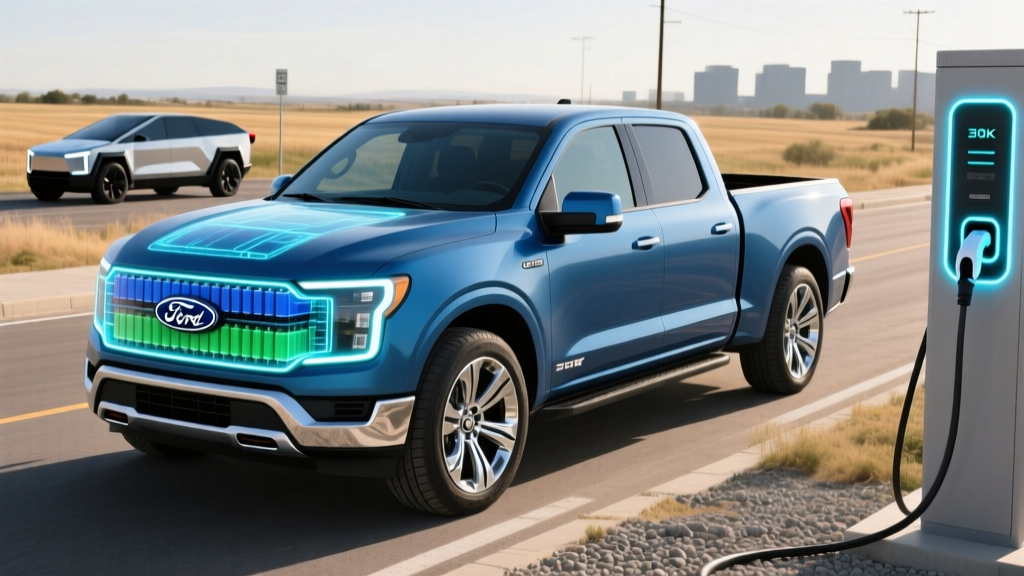
Buyers searching for a Ford 30K EV truck are chasing one of the most anticipated vehicles in the electric pickup segment: an affordable, compact-to-midsize battery-electric truck from the Blue Oval. As of early 2026, Ford has not officially released a $30,000 electric truck, but the company has confirmed a next-generation, smaller EV pickup built on a new flexible architecture — internally referred to as a "universal EV platform" — with pricing targeted to undercut the current F-150 Lightning significantly. The truck most likely to fill this role is the next-generation Ford Ranger EV or a new compact pickup positioned below it, expected to start in the low-to-mid $30,000 range before incentives.
Quick Answer: Can You Buy a Ford 30K EV Truck Today?
No — not yet. Ford has not released a $30,000 electric truck as of early 2026. The closest current option is the Ford F-150 Lightning, starting around $55,000 before incentives. However, Ford has confirmed a smaller, more affordable EV pickup is in development on a new universal platform, with production targeted for the late-2026 to 2027 timeframe. In the meantime, buyers seeking an EV truck near $30K should consider the Chevrolet Colorado ZR2 Bison concepts, used F-150 Lightning deals, or PHEV truck alternatives.
What Ford Has Confirmed About Its Affordable EV Truck
Ford CEO Jim Farley has publicly discussed the company's intent to build a smaller, more affordable electric pickup that leverages lessons learned from the F-150 Lightning and the Maverick's runaway success in the compact truck segment. Key known details include:
- Platform: A new "universal" EV architecture designed for lower-cost production, distinct from the F-150 Lightning's body-on-frame platform.
- Target pricing: Ford has signaled an entry point in the $25,000–$35,000 range, though final MSRP by trim has not been published.
- Production timeline: Announced for Ford's Louisville Assembly Plant, with production expected to begin in late 2026 or 2027. These specs remain preliminary and subject to change.
- Size class: Expected to slot between the Maverick (compact) and Ranger (midsize), likely a unibody design similar to the Maverick but fully electric.
- Estimated range: No official EPA figures yet, but industry analysts project 230–300 miles based on a 60–80 kWh battery pack and the efficiency targets of the new platform.
Ford's official newsroom has confirmed the investment but has not published final specifications. Until the vehicle enters production, all range, battery, and performance figures should be treated as estimates.
The Current EV Truck Landscape: What You Can Actually Buy
If you need an electric truck today, here is how the 2026 market stacks up. Note that none of these currently hit the $30,000 target at base MSRP, but federal and state incentives can narrow the gap substantially.
| Model | Base MSRP (2026) | EPA Range | Battery (kWh) | Max DC Charge (kW) | 10–80% Time | 0–60 mph |
|---|---|---|---|---|---|---|
| Ford F-150 Lightning (Std Range) | ~$55,000 | 240 mi | 98 kWh (usable) | 150 kW | ~41 min | ~5.8 sec |
| Ford F-150 Lightning (Ext Range) | ~$69,000 | 320 mi | 131 kWh (usable) | 150 kW | ~41 min | ~4.5 sec |
| Chevrolet Silverado EV 4WT | ~$55,000 | 260 mi | 100 kWh | 200 kW | ~30 min | ~6.5 sec |
| Rivian R1T (Standard) | ~$70,000 | 270 mi | 95 kWh (NMC) | 200 kW | ~28 min | ~4.9 sec |
| Tesla Cybertruck (AWD) | ~$80,000 | 340 mi | 123 kWh | 250 kW | ~20 min | ~4.1 sec |
The gap between "available" and "$30K" is significant. This is precisely why the Ford affordable EV truck announcement has generated so much attention — it would be the first mainstream electric pickup to break the $35,000 barrier.
EV Truck vs. Gas Truck: Real Cost Comparison
Even at $55,000, an electric truck can deliver meaningful savings over a gas equivalent like the Ford Ranger or Maverick EcoBoost when you look at total cost of ownership over five years. Here is a data-driven comparison assuming 15,000 miles/year, $3.50/gallon gas, and $0.14/kWh electricity (national average):
| Cost Category (5-Year) | Ford F-150 Lightning (Std) | Ford Ranger Gas (XLT) | Difference |
|---|---|---|---|
| Purchase Price (MSRP) | $55,000 | $38,000 | EV +$17,000 |
| Federal Tax Credit (§30D) | −$7,500* | $0 | EV saves $7,500 |
| Fuel/Energy Cost | $5,250 | $13,125 | EV saves $7,875 |
| Maintenance | $1,800 | $3,500 | EV saves $1,700 |
| Insurance (avg) | $9,500 | $7,000 | EV costs $2,500 more |
| Total 5-Year Cost | $64,050 | $61,625 | EV +$2,425 |
*§30D credit eligibility depends on MSRP caps (trucks: $80,000), buyer income limits ($150K single / $300K joint), and battery mineral/component sourcing requirements. Verify current rules at IRS.gov before purchasing. Point-of-sale transfer is available for 2026 model-year vehicles.
The Lightning nearly breaks even over five years despite the higher sticker, primarily through fuel and maintenance savings. A $30,000 Ford EV truck would tip the economics decisively in the EV's favor from day one.
Real-World Ownership: What First-Time EV Truck Buyers Must Know
Owning an electric truck involves considerations that don't apply to gas pickups. Here is what the data — and experience — tells us:
Home Charging Is Non-Negotiable for Most Owners
Over 80% of EV charging happens at home. A Level 2 home charger (240V, 32–48 amps / 7.7–11.5 kW) adds roughly 20–30 miles of range per hour and can fully replenish a truck battery overnight. Installation costs typically range from $800–$2,500 depending on panel capacity and wiring distance. If your home electrical panel is at or near capacity (common in older homes with 100-amp service), a panel upgrade to 200 amps can add $1,500–$3,000. Budget for this upfront.
Range Reality: EPA Sticker vs. What You Actually Get
EPA range estimates are measured under mixed driving conditions. In real-world truck usage, expect the following adjustments:
- Highway driving at 70+ mph: Subtract 10–15% from EPA range due to aerodynamic drag (trucks are inherently less aero than sedans).
- Cold weather (below 32°F): Subtract 20–30% due to battery chemistry limitations and cabin heating demands. A truck rated at 240 miles EPA may deliver 170–190 miles in freezing conditions.
- Towing or heavy payload: Subtract 30–50%. Towing a 5,000-lb trailer can cut range nearly in half. This is the single biggest range killer for truck owners.
- Preconditioning: Warming the battery before DC fast charging (most trucks do this automatically when a charger is navigated to) can improve charge speed by 20–40% in cold weather.
DC Fast Charging: The Curve Matters More Than Peak kW
A truck that advertises 150 kW peak DC fast charging does not sustain 150 kW for the entire session. Most EVs charge at peak rate only between 10–40% State of Charge (SoC), then taper progressively. The F-150 Lightning, for example, sustains roughly 100–120 kW through 60%, then drops to 40–60 kW above 80%. This is why the 10–80% time is a more useful metric than peak kW alone.
Ford §30D Tax Credit Eligibility: What Applies to Future EV Trucks
When the affordable Ford EV truck launches, buyers will want to know whether it qualifies for the federal clean vehicle credit. Here is the 2026 eligibility framework under IRS §30D:
- MSRP cap: Trucks, vans, and SUVs must have an MSRP at or below $80,000. A $30,000 truck easily clears this bar.
- Buyer income limits: Modified adjusted gross income must not exceed $150,000 (single), $225,000 (head of household), or $300,000 (joint filers).
- Battery sourcing: A percentage of critical minerals and battery components must be sourced from the U.S. or free-trade-agreement countries. These thresholds increase annually — check IRS guidance for current-year percentages.
- Final assembly: Must occur in North America. Ford's Louisville, KY production plan satisfies this.
- Point-of-sale transfer: Eligible buyers can transfer the credit to the dealer at purchase, reducing the out-of-pocket price immediately rather than waiting for a tax refund.
A $30,000 Ford EV truck with full §30D eligibility could effectively cost $22,500 after the $7,500 credit — a price point that would make it one of the most affordable electric vehicles on the market, let alone a truck.
Alternatives to Consider While You Wait
If you need a truck now and the Ford affordable EV truck timeline doesn't align with your purchase window, here are practical alternatives with real numbers:
Decision Framework: Which Truck Fits Your Situation?
Choose the Ford F-150 Lightning (used/CPO) if: You need a full-size truck today, can install Level 2 at home, and want to capture the §30D used-EV credit (up to $4,000 on vehicles under $25,000 from a dealer).
Choose the Ford Maverick Hybrid if: You want a compact truck under $30K now, prioritize fuel economy (42 MPG city EPA) over all-electric driving, and don't have reliable home charging access. It's not a BEV, but it's the most efficient gas-electric truck available.
Choose the Chevrolet Silverado EV if: You need a full-size electric work truck with available 4WT (4-wheel steer) and can stretch your budget to $55K+. The Ultium platform offers strong DC fast-charge performance (200 kW peak).
Wait for the Ford affordable EV truck if: You don't need a truck immediately, your budget is firm at $30,000–$35,000, and you want a compact/midsize electric pickup optimized for daily commuting rather than heavy towing.
Common Misconceptions About a Ford 30K EV Truck
| Myth | Fact |
|---|---|
| "A $30K EV truck can't tow anything." | Even compact EV trucks can tow 2,000–5,000 lbs. The constraint isn't capability — it's range reduction while towing (30–50% loss). For occasional light towing, a smaller EV truck is viable. |
| "The battery will need replacing in 5 years." | Ford provides an 8-year/100,000-mile battery warranty on current EVs (retaining at least 70% capacity). Industry data shows average degradation of 5–8% over 100,000 miles for NMC packs with active thermal management. A Ford EV battery is engineered to outlast the typical ownership cycle. |
| "There are no public chargers for trucks." | While pull-through charging stalls are still limited, networks like Electrify America and Tesla Superchargers (now open to NACS-equipped non-Teslas) are adding truck-friendly sites. Ford's BlueOval Charge Network includes over 90,000 access points. |
| "A cheap EV truck will have terrible range." | A 60–70 kWh LFP battery pack in a compact unibody truck could realistically deliver 230–270 miles EPA — sufficient for 90%+ of daily driving. LFP chemistry sacrifices some energy density but gains cycle life and lower cost. |
Frequently Asked Questions
When will the Ford 30K EV truck be available to buy?
Ford has confirmed production at its Louisville Assembly Plant, with a target start in late 2026 or 2027. No firm on-sale date has been published. Reservations may open 6–12 months before production begins. Monitor Ford's official newsroom for announcements.
Will the Ford affordable EV truck qualify for the $7,500 tax credit?
It is highly likely but not guaranteed. The truck's expected MSRP (well under $80K), North American assembly, and Ford's battery sourcing strategy all position it for eligibility. However, critical mineral and battery component thresholds under §30D tighten annually. Confirm eligibility with your tax professional and the IRS at the time of purchase.
What battery chemistry will the Ford 30K EV truck use?
Ford has not confirmed chemistry for this specific model. However, the company has indicated it will use LFP (lithium iron phosphate) batteries in lower-cost EV models to reduce reliance on nickel and cobalt. LFP offers excellent cycle life (3,000+ full cycles to 80% capacity) and lower cost, at the trade-off of slightly lower energy density — acceptable in a compact truck with modest range targets.
Can I charge an EV truck on a standard 120V outlet?
Yes, but slowly. Level 1 charging (120V, 12 amps) delivers roughly 1.4 kW, adding about 3–5 miles of range per hour to a truck. Fully recharging a 70 kWh battery from empty would take 50+ hours. Level 1 is viable only for overnight top-ups if your daily driving is under 30 miles. A Level 2 installation is strongly recommended for truck owners.
Is a PHEV truck a better option than waiting for the Ford EV truck?
It depends on your driving pattern. If you drive under 30 miles daily and have home charging, a PHEV truck (like the upcoming Ford Ranger PHEV in international markets) can run mostly on electricity with a gas backup for longer trips. However, PHEVs carry both a battery and an engine — more moving parts, more maintenance, and typically only 25–40 miles of electric-only range. If your commute is short and predictable, a BEV is simpler and cheaper to operate. If you regularly tow heavy loads or drive in areas with sparse charging infrastructure, a PHEV or hybrid (like the Maverick Hybrid at 42 MPG city) remains the pragmatic choice today.