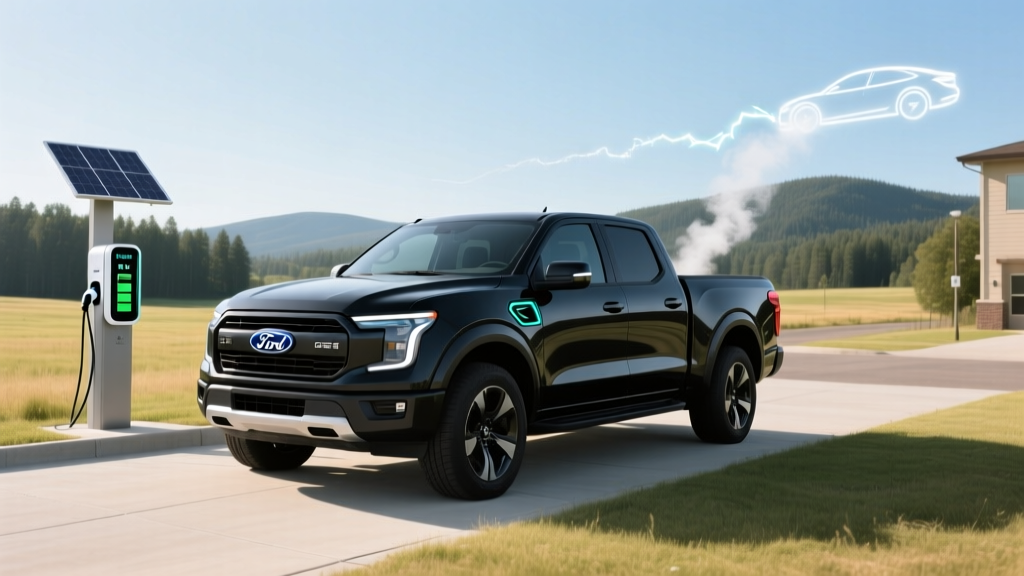
Ford has signaled it is building a next-generation electric pickup aimed squarely at the mainstream truck buyer — a vehicle widely referred to as the Ford $30,000 EV truck. As of early 2026, Ford has not officially named the model or released final specifications, but the company's public statements, supply-chain moves, and next-generation EV platform investments point to a smaller, more affordable electric pickup positioned below the F-150 Lightning.
Quick Answer: Is There a $30,000 Ford EV Truck?
Ford has not confirmed a $30,000 MSRP electric truck for the 2026 model year. The company has announced a next-generation EV truck program and a new flexible EV platform, but official pricing, range, and battery specs remain unconfirmed. What we can piece together from Ford's investor disclosures, industry reporting, and the current F-150 Lightning lineup suggests a target base price in the $30,000–$40,000 range before incentives, with a likely EPA range of 230–300 miles on a battery in the 70–90 kWh range. If the vehicle qualifies for the federal §30D tax credit, the effective price could drop significantly — but eligibility depends on battery sourcing, buyer income, and MSRP caps that are subject to current IRS rules.
This article breaks down everything we know, what's confirmed versus speculative, and how a budget Ford EV truck would compare to the existing F-150 Lightning, gas-powered midsize trucks, and hybrids in real ownership cost. If you're researching whether to wait for this truck or buy now, the data below will help you decide.
What Ford Has Actually Said About a Cheaper EV Truck
Ford CEO Jim Farley has publicly discussed the company's ambition to produce a more affordable electric truck built on a new, flexible architecture. During Ford's 2024 and 2025 investor updates, the company outlined a "universal EV platform" designed to underpin multiple vehicle types — including a pickup — with dramatically reduced battery costs through a combination of LFP (lithium iron phosphate) chemistry and simplified manufacturing.
Key facts confirmed by Ford:
- Next-gen EV truck program exists — Ford has allocated capital for a new electric pickup on a dedicated platform.
- LFP battery adoption — Ford has committed to using LFP cells for standard-range models, following Tesla's lead in trading peak energy density for lower cost and longer cycle life.
- Target: mainstream truck buyers — Ford has stated the goal is to reach buyers currently purchasing midsize gas trucks like the Ranger and Maverick, not just premium EV early adopters.
- Production timeline — Industry analysts project a reveal in late 2026 or 2027, with deliveries likely in the 2027–2028 model-year window. This truck is not currently available for purchase.
What Ford has not confirmed: an exact $30,000 price point, a model name, battery capacity in kWh, EPA range figures, towing capacity, or a specific on-sale date. Any article claiming definitive specs is speculating.
Projected Specs: What a $30K Ford EV Truck Could Look Like
Based on Ford's platform disclosures, the current F-150 Lightning architecture, competitive pressure from the Chevrolet Silverado EV and Tesla Cybertruck, and the trajectory of LFP battery costs, here is a reasonable projection of where this truck lands. All figures below are estimated, not confirmed by Ford.
| Specification | Projected Value | Notes |
|---|---|---|
| Base MSRP | $30,000–$38,000 | Before incentives; final trim pricing TBD |
| Battery Chemistry | LFP (standard range) | Lower cost, longer cycle life, heavier than NMC |
| Battery Capacity | ~70–85 kWh usable | Smaller than Lightning's 98–131 kWh packs |
| EPA Range (est.) | 230–300 miles | Depends on drivetrain, aero, weight |
| Peak DC Fast Charge | ~150–200 kW | LFP cells typically accept slightly lower peak rates |
| 10–80% Charge Time | ~25–35 minutes | At a compatible DC fast charger |
| Level 2 Charging | ~11.5 kW onboard charger | ~7–9 hours for full charge on 240V |
| Drivetrain | RWD standard, AWD optional | RWD improves efficiency and lowers base price |
| Horsepower | ~250–350 hp | Single-motor RWD or dual-motor AWD |
| 0–60 mph | ~5.5–7.0 seconds | Varies by motor config |
| Towing Capacity | ~5,000–7,500 lbs | Midsize truck territory, not heavy-duty |
| Payload | ~1,500–1,800 lbs | Comparable to Ford Maverick/Ranger |
| Bed Length | ~4.5–5.5 ft | Compact/midsize footprint likely |
| ADAS | Ford Co-Pilot360 (Level 2) | Driver supervision required at all times |
| Battery Warranty | 8 yr / 100,000 mi (expected) | Standard federal minimum for EV batteries |
Real-World Range Reality Check
If this truck achieves a 270-mile EPA rating, expect ~210–240 miles in real-world highway driving at 70–80 mph, and ~170–200 miles in cold weather (below 30°F) due to battery resistance and cabin heating demands. LFP batteries are particularly sensitive to cold-weather charging speeds — preconditioning will be essential for DC fast charging in winter. These are typical BEV reductions, not unique to Ford.
How It Compares: EV Truck vs. Gas Truck vs. Hybrid
The biggest question for truck buyers isn't just whether an EV is "better" — it's whether the total cost of ownership and daily usability work for your specific situation. Here's how a projected $35,000 Ford EV truck stacks up against the gas-powered Ford Maverick (the closest current Ford truck by size and price) and the F-150 Lightning.
| Metric | Ford Budget EV Truck (est.) | Ford Maverick Gas (2026) | F-150 Lightning (2026) |
|---|---|---|---|
| Base MSRP | $30,000–$38,000 | ~$28,000–$30,000 | ~$52,000–$58,000 |
| Fuel/Energy Cost per Mile | ~$0.04–$0.06 (home charging) | ~$0.12–$0.15 (gas at $3.20/gal) | ~$0.04–$0.06 |
| Annual Fuel Savings vs. Gas | ~$1,200–$1,800 | Baseline | ~$1,200–$1,800 |
| EPA Range / Tank Range | 230–300 mi | ~400–500 mi (16.5 gal tank) | 240–320 mi |
| Refuel/Recharge Time | 25–35 min (10–80% DC) | ~5 min (gas station) | ~20–40 min (10–80% DC) |
| Home Charging (Level 2) | ~7–9 hours (overnight) | N/A | ~8–13 hours |
| Maintenance (5-yr est.) | ~$1,500–$2,000 | ~$3,500–$4,500 | ~$1,500–$2,000 |
| Federal Tax Credit (§30D) | Potentially up to $7,500 | $0 | Up to $7,500 (varies by trim) |
| Towing Capacity | ~5,000–7,500 lbs | ~2,000–4,000 lbs | ~7,700–10,000 lbs |
| Insurance (annual est.) | ~$1,800–$2,400 | ~$1,400–$1,800 | ~$2,000–$2,800 |
A few things stand out in this comparison. First, the gas Maverick wins on upfront price, range, and refueling speed — and it doesn't require home charging infrastructure. Second, the F-150 Lightning offers far more towing and payload but at a significantly higher price. A budget Ford EV truck would occupy a middle ground: lower running costs than gas, more utility than a Maverick, but at a price point that requires careful ownership math.
The Real Cost: 5-Year Ownership Breakdown
Purchase price is only the start. Here's a realistic 5-year / 75,000-mile total cost of ownership (TCO) comparison, assuming 15,000 miles driven annually, home Level 2 charging at $0.14/kWh (national average), and gas at $3.20/gallon.
| Cost Category | Ford EV Truck ($35K est.) | Ford Maverick Gas | F-150 Lightning |
|---|---|---|---|
| Purchase Price (base) | $35,000 | $29,000 | $55,000 |
| Federal Tax Credit (§30D) | –$3,750 to –$7,500* | $0 | –$3,750 to –$7,500* |
| Home Charger Install | $1,200–$2,500 | $0 | $1,200–$2,500 |
| Fuel/Energy (5 yr) | $3,500–$5,000 | $10,500–$13,000 | $4,000–$5,500 |
| Maintenance (5 yr) | $1,500–$2,000 | $3,500–$4,500 | $1,500–$2,000 |
| Insurance (5 yr) | $10,000–$12,000 | $7,500–$9,000 | $11,000–$14,000 |
| Estimated Depreciation | $12,000–$16,000 | $10,000–$13,000 | $18,000–$24,000 |
| 5-Year TCO (approx.) | $50,000–$60,000 | $60,000–$68,000 | $72,000–$90,000 |
*Federal §30D tax credit eligibility depends on battery component sourcing, critical mineral content, buyer income caps ($150K single / $300K joint for new vehicles), and MSRP caps ($80,000 for trucks). Credit amount can range from $0 to $7,500 depending on these factors. Check current rules at IRS.gov and consult a tax professional. Point-of-sale transfer is available at participating dealers.
The EV truck's advantage comes from dramatically lower energy and maintenance costs — no oil changes, no transmission fluid, fewer brake replacements thanks to regenerative braking. But insurance premiums for EVs tend to run 15–25% higher than gas equivalents, and depreciation on EVs has been volatile. If you can charge at home and drive under 300 miles per day, the math works. If you rely on public DC fast charging exclusively at $0.35–$0.50/kWh, your fuel cost nearly doubles.
Charging at Home: What First-Time EV Truck Buyers Need
The single biggest factor in EV truck satisfaction is home charging access. A Level 2 home charger (240V, typically 32–48 amps / 7.7–11.5 kW) will fully replenish a ~80 kWh battery overnight in 7–9 hours. For most truck owners who drive 30–60 miles per day, that means starting every morning with a full "tank."
Here's what installation actually costs:
| Item | Cost Range | Notes |
|---|---|---|
| Level 2 Charger (hardware) | $400–$800 | ChargePoint Home Flex, Emporia, Wallbox, Ford Connected Charge Station |
| Electrician labor | $500–$1,500 | Depends on run length, conduit, panel proximity |
| Permit | $50–$200 | Varies by municipality |
| Electrical panel upgrade | $1,500–$3,500 | Only if your panel lacks capacity (200A service recommended) |
| Total (no panel upgrade) | $950–$2,500 | Most common scenario |
| Total (with panel upgrade) | $2,450–$6,000 | Older homes with 100A service |
If you rent, live in an apartment, or lack garage/driveway access, home Level 2 charging may not be feasible. In that case, you'd rely on public Level 2 chargers (slower, often $0.20–$0.30/kWh) or DC fast chargers ($0.35–$0.50/kWh). This significantly erodes the cost advantage and adds time to your routine. Be honest about your situation before committing to an EV truck.
For public fast charging, the projected 150–200 kW peak rate means you'd add roughly 150–200 miles of range in a 25–30 minute session at a compatible station. Remember that peak kW is not sustained — charging speed tapers significantly above 80% state of charge (SoC) to protect the battery. Plan road-trip stops around 10–80% charges for the fastest overall times.
Common Misconceptions About a Budget Ford EV Truck
| Myth | Fact |
|---|---|
| "The $30,000 Ford EV truck is available now." | It is not. Ford has announced the program but has not released final specs, pricing, or an on-sale date. Expect 2027–2028 availability at earliest. |
| "A $30K EV truck will have terrible range." | With LFP battery costs dropping and Ford's efficiency gains, 230–300 EPA miles is achievable at this price point — adequate for most daily truck use. |
| "EV trucks can't tow." | The F-150 Lightning tows up to 10,000 lbs. A smaller budget EV truck would tow less (~5,000–7,500 lbs), but that matches or beats many midsize gas trucks. Towing does reduce range by 30–50%, however — plan accordingly. |
| "I'll get the full $7,500 tax credit." | §30D credit eligibility depends on battery sourcing, critical mineral content, your income, and the vehicle's MSRP. The credit can range from $0 to $7,500. Always verify at IRS.gov. |
| "EV batteries need replacing every few years." | Modern EV batteries are warrantied for 8 years / 100,000 miles minimum (federally mandated). LFP chemistry specifically offers 3,000+ charge cycles with minimal degradation — potentially 500,000+ miles before reaching 80% capacity. |
| "Charging takes too long for a work truck." | If you charge at home overnight, you start every day full. For road trips, 25–35 minute fast-charge stops are comparable to a meal break. For high-mileage workdays over 250 miles, a gas or hybrid truck may still be the better tool. |
Decision Framework: Should You Wait, Buy an F-150 Lightning, or Go Gas?
Choose Based on Your Situation
Wait for the Ford budget EV truck if:
- You need a truck primarily for commuting, light hauling, and weekend projects under 200 miles round-trip
- You have home Level 2 charging access (garage or driveway with 240V capability)
- Your budget is $30,000–$40,000 and you want the lowest possible running costs
- You can wait until late 2027 or 2028 to purchase
- You don't need to tow more than 5,000–7,000 lbs regularly
Buy the F-150 Lightning now if:
- You need a full-size truck with 7,700–10,000 lbs towing capacity today
- You need 320 miles of EPA range (Extended Range battery) and a large bed
- Your budget allows $52,000+ before incentives
- You want a proven platform with established charging compatibility (NACS adapter for Tesla Superchargers)
Buy a gas or hybrid truck (Maverick, Ranger) now if:
- You lack reliable home charging access
- You regularly drive over 300 miles in a day or tow long distances
- You live in a region with limited DC fast-charging infrastructure
- You need a truck immediately and can't wait 1–2 years
- Your budget is under $30,000 and you want proven long-term reliability data
Federal Tax Credit: What It Could Mean for This Truck
If the Ford budget EV truck qualifies for the federal §30D clean vehicle credit, the savings are substantial — but far from guaranteed at the full $7,500. Here's the eligibility checklist as of 2026:
- MSRP cap: Trucks must have an MSRP at or below $80,000 (likely met easily at ~$30K–$40K)
- Buyer income cap: Adjusted gross income ≤ $150,000 (single) / $225,000 (head of household) / $300,000 (joint)
- Battery sourcing: Required percentages of battery components must be manufactured or assembled in North America, and critical minerals must be sourced from the U.S. or FTA partners — these thresholds increase annually
- Point-of-sale transfer: You can transfer the credit to the dealer at purchase, reducing your out-of-pocket cost immediately rather than waiting for tax filing
- Final assembly: Vehicle must undergo final assembly in North America
Ford's investment in domestic battery plants (including the BlueOval SK facilities in Kentucky and Tennessee) positions them well for sourcing compliance, but the specific LFP cells for a budget model may face different sourcing rules. Verify eligibility at the time of purchase — rules change, and the DOE/Fueleconomy.gov tax credit lookup tool is the most reliable source for vehicle-by-vehicle qualification.
Frequently Asked Questions
When will the $30,000 Ford EV truck be available?
Ford has not announced an exact on-sale date. Based on the company's EV platform timeline and industry analysis, a reveal could come in late 2026 or 2027, with customer deliveries likely in the 2027–2028 model-year window. This is a projected timeline and subject to change.
Will it be called the Ford Maverick EV?
Ford has not confirmed a name. "Maverick EV" is widely speculated given the Maverick's compact truck positioning, but Ford could use a new nameplate entirely. We'll update this article when Ford makes an official announcement.
Can it handle cold weather?
All EVs lose range in cold weather — typically 20–35% below 30°F due to battery chemistry resistance and cabin heating demands. LFP batteries are somewhat more affected by cold than NMC chemistry. Preconditioning the battery (warming it before driving and charging) is essential for maintaining range and DC fast-charging speed in winter. If you live in a harsh-winter climate, plan for ~65–75% of EPA-rated range in the coldest months.
Will it use NACS or CCS for charging?
Ford has committed to adopting the NACS (North American Charging Standard) connector across its EV lineup, giving access to Tesla's Supercharger network in addition to Electrify America, EVgo, and other networks. It's highly likely the budget EV truck will ship with a native NACS port, but this is not yet confirmed for this specific model.
Is an EV truck practical for a job site?
For light-duty job-site use — carrying tools, materials, and crew within a ~150-mile daily radius — an EV truck works well. The instant torque is useful for hauling, and the "frunk" (front trunk) adds secure storage. For heavy towing, long-distance runs, or remote job sites without charging access, a gas or diesel truck remains the more practical choice in 2026.
How does insurance compare to a gas truck?
EV insurance typically runs 15–25% higher than comparable gas vehicles due to higher repair costs, specialized parts, and battery replacement risk. For a $35,000 EV truck, expect annual premiums of roughly $1,800–$2,400 depending on your state, driving record, and insurer. Shop quotes from EV-friendly insurers before purchasing.
What happens if the battery degrades?
Federal law requires EV battery warranties of at least 8 years / 100,000 miles. Ford currently warrants its EV batteries to retain at least 70% of original capacity during that period. LFP chemistry degrades more slowly than NMC, with laboratory data suggesting 3,000+ full charge cycles before reaching 80% capacity — equivalent to hundreds of thousands of miles. Out-of-warranty replacement costs for a ~80 kWh LFP pack are projected at $8,000–$14,000 by the late 2020s as cell prices continue to fall, though this is speculative.
Sources: Ford Motor Company investor disclosures and press releases; fueleconomy.gov (EPA); IRS.gov §30D Clean Vehicle Credits. All projected specifications are estimates based on available public information and are not confirmed by Ford. Verify all pricing, range, and tax credit details at the time of purchase.