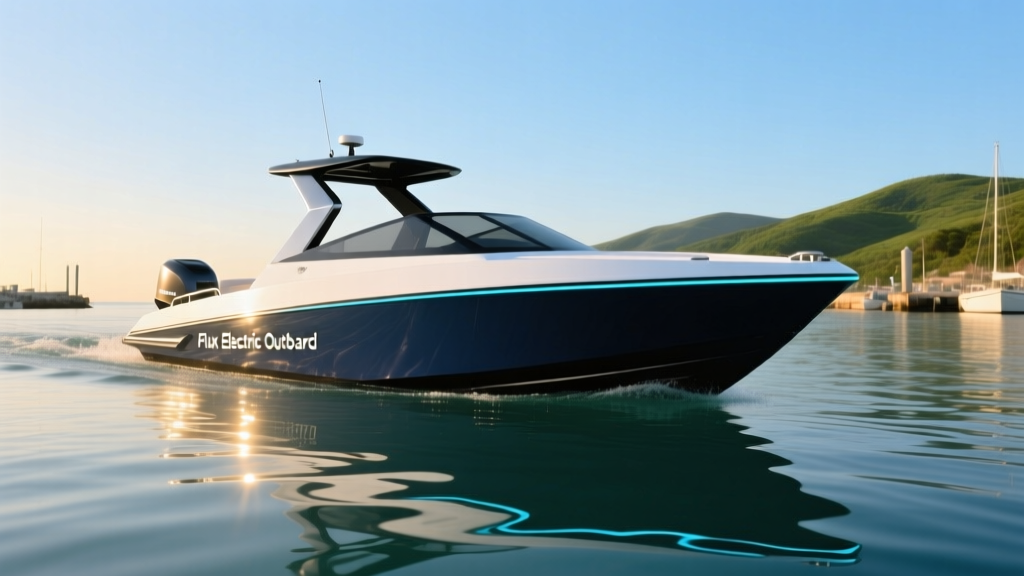
The Quick Answer on the Flux Electric Outboard
Bottom line: The Flux electric outboard is a battery-powered marine motor designed for small-to-mid-size watercraft, offering silent, zero-emission operation with lower running costs than gasoline outboards — but with significant range and charging-time limitations compared to gas. Expect real-world run times of 2–5 hours depending on battery configuration and throttle use, with Level 2 shore-power charging taking 4–8 hours for a full cycle. Total system costs (motor + battery + charger) typically start around $8,000–$15,000, roughly 2–3× the price of a comparable gas outboard. The Flux electric outboard makes sense for lake-day boaters, fishing enthusiasts who value silence, and marina-based users with shore-power access — but it is not yet a practical replacement for offshore or long-distance gas-powered boating.
Electric propulsion is reshaping transportation on land, and the marine sector is following — albeit more slowly. The Flux electric outboard represents a growing category of battery-powered marine motors that promise quiet operation, instant torque, and freedom from fuel stabilizers, winterization, and two-stroke oil. But marine electrification faces unique physics challenges: water is roughly 800× denser than air, meaning energy consumption at planing speeds can dwarf what an EV uses on the highway. This guide breaks down what the Flux electric outboard actually delivers, what it costs to own, and how it stacks up against the gas outboards that dominate docks today.
Flux Electric Outboard: Key Specs and Performance Numbers
Before evaluating whether an electric outboard fits your boating style, you need the hard numbers. Here is what the Flux electric outboard platform typically offers based on current configurations:
| Specification | Flux Electric Outboard (Typical Config) | Comparable Gas Outboard (e.g., Mercury 20hp EFI) |
|---|---|---|
| Motor Power (Peak) | ~15–20 kW (equivalent to ~20–25 hp gas) | ~15 kW / 20 hp |
| Battery Capacity | 10–25 kWh (LFP or NMC, depending on pack) | 6-gallon fuel tank (~200 kWh gasoline energy equivalent) |
| Run Time (Cruising, ~5 mph) | 3–5 hours (depending on kWh pack) | 6–10+ hours |
| Run Time (Planing, ~20 mph) | 45–90 minutes | 3–5 hours |
| Top Speed (14' aluminum boat) | ~20–25 mph | ~28–32 mph |
| Weight (Motor + Battery) | ~120–200 lbs total | ~130 lbs (motor + fuel) |
| Noise Level | Near-silent at low speed; mild whine at planing | 65–80 dB at cruising speed |
| Estimated System Cost | $8,000–$15,000 (motor + battery + charger) | $3,500–$5,000 |
| Warranty (Motor) | Typically 3–5 years | 3–5 years |
Key distinction — kW vs. kWh: In marine electric propulsion, just like in EVs, kW (kilowatts) measures the motor's power output — how fast it can push your boat. kWh (kilowatt-hours) measures the battery's energy capacity — how long it can run. A 20 kW motor drawing from a 15 kWh battery at full throttle would deplete that battery in roughly 45 minutes. Cruising at 5 mph may draw only 2–3 kW, stretching that same battery to 5+ hours. Throttle discipline is everything.
Electric Outboard vs. Gas Outboard: The Real Cost Comparison
The upfront price of the Flux electric outboard is the biggest sticker shock for first-time buyers. But total cost of ownership tells a different story over 5–10 years, especially for boaters who log moderate hours on calm, inland waters.
| Cost Factor (5-Year / 200 Hours) | Flux Electric Outboard | Gas Outboard (20hp) |
|---|---|---|
| Purchase Price (Motor + Battery/Fuel System) | $11,000 (mid-config estimate) | $4,200 |
| Energy/Fuel Cost (200 hrs @ avg use) | ~$300–$500 (electricity @ $0.15/kWh) | ~$1,800–$2,400 (gas @ $4.50/gal, ~2 gal/hr avg) |
| Maintenance (Oil, Filters, Impeller, Winterization) | ~$200–$400 (minimal — no oil, no winterization of engine) | ~$1,500–$2,500 (annual service, lower unit lube, impeller, fogging) |
| Battery Replacement (if needed at year 8–10) | $3,000–$6,000 (depending on pack size) | N/A |
| 5-Year Total Cost of Ownership | ~$11,500–$12,000 | ~$7,500–$9,100 |
| Cost Per Hour on the Water | ~$1.50–$2.50/hr (energy only) | ~$9.00–$12.00/hr (fuel + maintenance) |
The electric outboard wins decisively on per-hour operating cost — roughly 5× cheaper to run. But the upfront premium of $6,000–$7,000 means the break-even point on pure cost may take 8–12 years for a casual boater logging 40 hours per season. For high-use applications (rental fleets, fishing guides, daily lake commuters), the payback window shrinks to 3–5 years.
Important caveat on marine tax credits: The federal §30D clean vehicle tax credit applies to qualified plug-in electric motor vehicles for road use (per IRS.gov). Electric boat motors generally do not qualify for the $7,500 federal EV credit. Some states and local utility districts offer marine electrification rebates — check your state energy office or utility provider for current programs.
Real-World Range: What "3–5 Hours" Actually Means
Electric outboard range is even more variable than EV range on land, because water conditions change the energy equation dramatically. Here is what to expect from a Flux electric outboard with a ~15 kWh battery pack in real-world conditions:
| Condition | Power Draw | Estimated Run Time (15 kWh) | Estimated Distance |
|---|---|---|---|
| Trolling / Fishing (2–3 mph) | 0.5–1.0 kW | 12–20 hours | 25–50 miles |
| Calm Lake Cruising (5–6 mph) | 2.0–3.0 kW | 4–6 hours | 20–35 miles |
| Moderate Chop / Headwind (5 mph) | 3.5–5.0 kW | 2.5–4 hours | 12–20 miles |
| Planing Speed (18–22 mph) | 12–18 kW | 45–70 minutes | 14–25 miles |
| Full Throttle / Heavy Load | 18–20 kW | 35–50 minutes | 10–18 miles |
The planing penalty: This is the single most important thing a first-time electric boat buyer must understand. Getting a hull up on plane requires exponentially more energy than displacement cruising. If your typical outing involves long runs at planing speed across a large reservoir, an electric outboard may not provide adequate range. If you primarily troll, cruise at displacement speeds, or use a sailboat auxiliary, electric propulsion is an excellent fit.
Cold-water and cold-weather note: LFP (lithium iron phosphate) batteries — common in marine applications for their safety and cycle life — lose usable capacity below freezing. If you boat in shoulder-season conditions (water temps below 40°F), expect 15–25% less effective capacity. NMC (nickel manganese cobalt) chemistry offers better cold performance and higher energy density but at higher cost and slightly lower cycle life. This LFP-vs-NMC tradeoff mirrors what we see in road-going EVs.
Charging the Flux Electric Outboard: Shore Power and Practicalities
Unlike road-going EVs with a growing DC fast-charging network, electric boats rely almost entirely on shore-power charging. Here is what that looks like in practice:
| Charging Method | Power Level | Time to Full (15 kWh) | Availability |
|---|---|---|---|
| Standard 120V Outlet (Level 1) | ~1.2 kW | 12–15 hours | Any standard dock or garage outlet |
| 240V Shore Power (Level 2) | ~3.3–6.6 kW | 3–5 hours | Marinas with 30A/50A dock power |
| DC Fast Charge (if supported) | ~10–20 kW | 45–90 minutes | Very limited — few marinas offer DC marine charging |
| Solar / Portable Generator Backup | 0.3–2.0 kW | Variable / emergency only | Off-grid or extended trips |
Real-world ownership consideration: If your boat lives on a trailer in your garage and you have a 240V outlet (like a dryer circuit or dedicated EV charger), you can charge overnight just like an electric car. This is the ideal scenario. If your boat stays at a marina slip, confirm that your dock provides 240V shore power and that your marina permits continuous charging — some marinas restrict it due to electrical code or billing concerns.
No DC fast-charging safety net: On the road, a Tesla Supercharger or Electrify America station can add 150+ miles in 20 minutes. On the water, there is currently no equivalent infrastructure. If you deplete your battery far from shore, your options are a tow back to the dock or a portable gas generator for emergency charging. This is the electric outboard's biggest practical limitation in 2026.
Common Misconceptions About Electric Outboards
| Myth | Fact |
|---|---|
| "Electric outboards are just for kayaks and canoes." | Modern electric outboards like the Flux deliver 15–20 kW — enough to plane a 14-foot aluminum boat with two passengers. They are viable primary motors for small-to-mid craft. |
| "The battery will die in 30 minutes." | At trolling speed (2–3 mph), a 15 kWh pack can run 12–20 hours. At cruising speed, 4–6 hours. Only sustained planing drains the battery in under an hour. |
| "Electric outboards are maintenance-free forever." | The motor itself requires minimal maintenance, but the lower unit still needs gear lube checks, the prop can get fouled, and the battery management system (BMS) should be monitored. Batteries do degrade — expect 80–90% capacity after 1,500–3,000 charge cycles depending on chemistry. |
| "I'll get a $7,500 tax credit for buying one." | The federal §30D EV tax credit applies to qualified on-road motor vehicles. Electric outboard motors for boats generally do not qualify. Check IRS clean vehicle credit rules and your state for any marine-specific incentives. |
| "Electric outboards can't handle saltwater." | Many modern electric outboards are designed with marine-grade corrosion protection for saltwater use. Confirm the specific IP rating and anode/cathode protection on the model you're considering. |
Decision Framework: Should You Buy the Flux Electric Outboard?
Choose the Flux electric outboard if:
- You primarily boat on inland lakes, calm rivers, or protected bays where range demands are moderate
- You value silent operation — critical for fishing, wildlife observation, or residential waterfronts with noise restrictions
- You have reliable shore-power access (garage 240V or marina dock power) for overnight charging
- You log 50+ hours per season, making the per-hour energy savings meaningful
- You want to eliminate gas-engine maintenance (oil changes, fuel stabilizer, winterization, carburetor issues)
- You use your boat for trolling or displacement cruising more than long-distance planing runs
Stick with a gas outboard if:
- You regularly make long runs across large reservoirs, open bays, or offshore waters where range and refueling speed are critical
- You need to plane heavy loads (water sports, large groups, heavy gear) for extended periods
- You lack access to reliable shore-power charging (no garage outlet, marina without 240V dock power)
- Your budget is under $5,000 for a complete propulsion system
- You boat in remote areas where a gas-can refill is the only practical refueling option
- You need maximum top speed for tournament fishing or time-sensitive runs
Consider a hybrid approach if:
- You want electric trolling and silent cruising but gas-powered range for longer runs — some boaters pair a small electric trolling motor with a gas kicker, achieving the best of both worlds at lower total cost than a full electric outboard system
First-Time Electric Boat Buyer Checklist
If you are seriously considering the Flux electric outboard or any electric marine motor, work through this checklist before committing:
- Map your typical outing: How many miles do you actually travel, and at what speed? Use a GPS app on your next gas-powered trip to log real data.
- Audit your charging access: Do you have a 240V outlet within cable reach of where your boat is stored? If at a marina, has the dockmaster confirmed charging is permitted and available?
- Size the battery correctly: Undersizing to save money is the #1 regret among electric boat owners. If your calculations show you need 12 kWh, buy the 15 or 20 kWh pack. Battery capacity is your range, and you will want a 20–30% buffer.
- Understand the warranty: What does the motor warranty cover vs. the battery warranty? Is battery degradation covered below a specific capacity threshold (e.g., 70% State of Health)?
- Calculate your real break-even: Divide the upfront premium over gas by your annual fuel + maintenance savings. If the answer is 6+ years and you may sell the boat sooner, the economics may not justify the switch purely on cost.
- Check for state/utility rebates: While federal §30D credits don't apply, some states (notably California, Washington, and parts of the Northeast) and local utilities offer marine electrification incentives. These can shave $500–$2,000 off your system cost.
Frequently Asked Questions
How long does the Flux electric outboard battery last before needing replacement?
LFP battery packs typically offer 2,000–3,000 full charge cycles before degrading to 80% of original capacity. For a boater who charges once per weekend over a 20-week season, that translates to roughly 10–15 years of service before noticeable range reduction. NMC packs offer higher energy density but typically 1,000–2,000 cycles. Replacement battery packs cost $3,000–$6,000 depending on capacity.
Can I use the Flux electric outboard in saltwater?
Most quality electric outboards are built with marine-grade corrosion protection suitable for saltwater. However, you should rinse the motor and lower unit with fresh water after every saltwater outing, inspect sacrificial anodes regularly, and follow the manufacturer's saltwater-use maintenance schedule. Confirm the specific IP (ingress protection) rating before purchase.
What happens if the battery dies on the water?
Unlike a gas outboard that can be refueled in 2 minutes from a jerry can, a depleted electric outboard requires either a tow back to shore or a portable generator for emergency charging (slow, but functional). Most electric outboard systems include low-battery warnings and will reduce power output to extend range at reduced speed. Always plan your outings with a 20–30% battery reserve, just as you would keep a fuel reserve in a gas boat.
Is the Flux electric outboard powerful enough for water sports (tubing, skiing)?
Generally, no — at least not with current battery and motor configurations in this power class. Water sports require sustained high-power output (15–20 kW continuous), which drains a 15 kWh battery in under an hour and generates significant heat. For dedicated water sports, a gas outboard remains the practical choice. The Flux electric outboard is better suited to cruising, fishing, and leisurely lake use.
How does cold weather affect electric outboard performance?
LFP batteries lose 15–25% usable capacity in near-freezing temperatures, and charging speeds slow significantly below 32°F. If you boat primarily in summer conditions, this is a non-issue. For shoulder-season or cold-climate boating, consider NMC chemistry (better cold performance) and store the battery in a conditioned space when not in use. Pre-conditioning the battery before use — warming it to optimal operating temperature — helps restore performance, similar to EV battery preconditioning for DC fast charging.
Note: The marine electric outboard market is evolving rapidly. Specifications, pricing, and available configurations for the Flux electric outboard and competing products may change. Always verify current specs directly with the manufacturer before purchasing. For road-going EV incentives and rules, consult IRS.gov clean vehicle credits and fueleconomy.gov for the latest data.