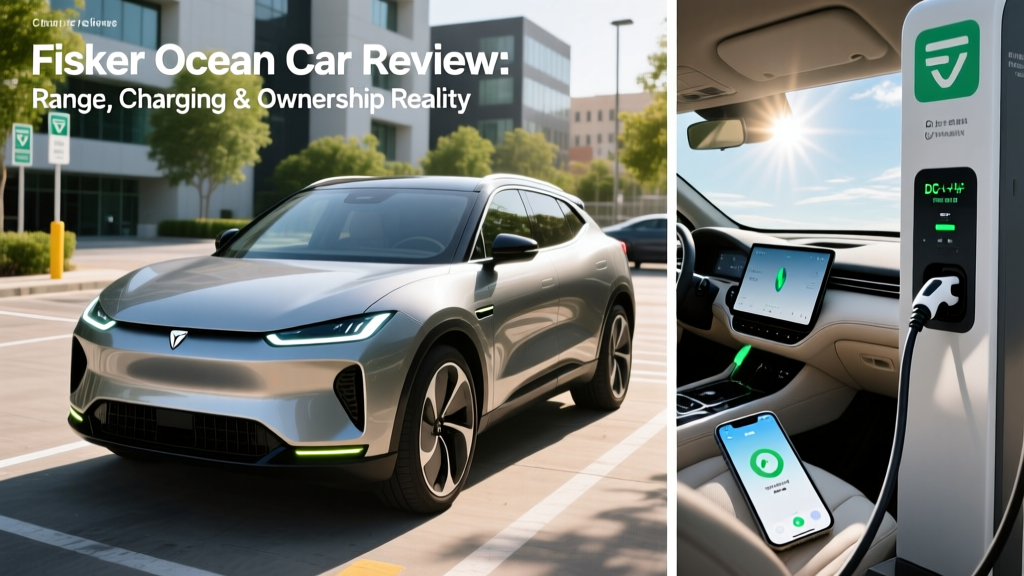
The Fisker Ocean arrived with bold promises: 360 miles of EPA range, a solar roof, and a starting price that undercut most midsize electric SUVs. But the story of this EV is as much about the company behind it as the vehicle itself. Fisker Inc. filed for bankruptcy in late 2024 after building roughly 11,000 units, leaving current owners and prospective used-buyers with a unique set of considerations. This review examines the Fisker Ocean car on its engineering merits while being transparent about what ownership looks like in 2026.
Quick Verdict: An Impressive EV With Complicated Ownership
The Fisker Ocean delivers legitimate long-range capability, distinctive design, and a spacious interior that competes with the Tesla Model Y and Hyundai Ioniq 5 on paper. Its 113 kWh battery pack is one of the largest in its class, and the EPA-estimated 360 miles on the Extreme trim is genuinely competitive. However, purchasing a Fisker Ocean in 2026 means buying into an orphaned platform — no manufacturer warranty support, uncertain parts availability, and limited service infrastructure. For informed buyers who understand the risks and can secure independent EV service, the Ocean can represent significant used-market value. For those who need dealer support and guaranteed parts access, it's a pass.
| Spec | Ocean Sport (FWD) | Ocean Ultra / Extreme (AWD) |
|---|---|---|
| EPA Range | 250 mi | 360 mi (Extreme) / 340 mi (Ultra) |
| Battery Capacity | ~113 kWh usable (NMC) | ~113 kWh usable (NMC) |
| Horsepower | 275 hp | 540 hp (dual motor) |
| 0–60 mph | 7.2 sec | 3.9 sec |
| Peak DC Fast Charge | ~170 kW | ~170 kW |
| 10–80% DC Charge Time | ~34 min | ~34 min |
| Level 2 Home Charge Rate | 10.5 kW | 10.5 kW |
| MPGe (combined) | ~97 MPGe | ~92 MPGe |
| Drivetrain | FWD single motor | AWD dual motor |
| Original Base MSRP | $37,499 | $52,999 (Ultra) / $68,999 (Extreme) |
Range and Efficiency: EPA Numbers vs. Real-World Reality
The Fisker Ocean Extreme's EPA-estimated 360 miles was among the highest of any production electric SUV when it launched. The Ultra trim achieved 340 miles, while the base Sport (with a smaller motor and the same battery) was rated at 250 miles — a surprisingly low figure for a 113 kWh pack, reflecting its heavier efficiency draw in certain test cycles.
Real-World Range Expectations
EPA sticker: 360 mi (Extreme) / 340 mi (Ultra) / 250 mi (Sport)
Real-world highway (70 mph, moderate temps): Expect roughly 280–310 mi on the Extreme, 260–290 mi on the Ultra. The Ocean's tall, boxy SUV profile creates significant aerodynamic drag at highway speeds — efficiency drops noticeably above 65 mph.
Cold-weather impact (below 32°F): Plan for a 20–30% range reduction, bringing the Extreme to approximately 250–285 mi in winter highway driving. The Ocean lacks a heat pump in early production models, which increases cabin heating energy draw.
City/mixed driving: Range closely tracks or slightly exceeds EPA estimates in stop-and-go conditions thanks to regenerative braking.
Efficiency on the Extreme trim was rated at approximately 92 MPGe combined (about 36 kWh/100 mi). That's competitive with the Ford Mustang Mach-E Extended Range but trails the more aerodynamic Tesla Model Y Long Range (~122 MPGe). The Ocean's 5,200+ lb curb weight and upright design work against it on the efficiency front, even with its massive battery.
Charging Speed: DC Fast Charging and Home Level 2
Charging performance was one of the Ocean's weaker points relative to competitors. The vehicle peaked at approximately 170 kW on DC fast chargers — adequate but well behind the Hyundai Ioniq 5's 240 kW or the Tesla Model Y's 250 kW capability. The large 113 kWh battery means more energy to push even at moderate charge rates.
| Charging Level | Power / Rate | Speed | Notes |
|---|---|---|---|
| Level 1 (120V) | ~1.4 kW | ~3–4 mi/hr | Emergency/trickle only |
| Level 2 (240V, 48A) | 10.5 kW | ~25–28 mi/hr | Full charge in ~11 hours |
| DC Fast Charge | Peak ~170 kW | 10–80% in ~34 min | Curve tapers significantly above 80% |
| DC Fast (80–100%) | ~40–60 kW avg | Adds ~20–25 min | Typical NMC taper behavior |
On a 150 kW Electrify America or EVgo station, the Ocean charges near its peak rate through approximately 50% state of charge, then begins a gradual taper. Owners who regularly DC fast-charge should expect realistic 10–80% sessions of 34–38 minutes depending on battery temperature and station output. The Ocean supports preconditioning — warming the battery before arrival at a charger — which is critical for achieving peak rates in cool weather. Always enable navigation-based preconditioning if using the built-in route planner.
For home charging, the 10.5 kW onboard charger is standard. On a 48-amp Level 2 circuit (the most common residential installation), you'll recover roughly 25–28 miles of range per hour. An overnight charge from 20% to 80% takes about 6–7 hours, which suits daily commuting patterns well. Installation of a Level 2 home charger typically costs $800–$2,000 including equipment and electrician labor, depending on panel capacity and conduit run distance.
Performance and Driving Dynamics
The dual-motor Ultra and Extreme trims deliver 540 horsepower and a 3.9-second 0–60 mph time — genuinely quick for a family SUV. Acceleration is immediate and linear, as expected from electric motors, and the all-wheel-drive system provides confident traction in wet and light snow conditions.
The single-motor Sport trim (275 hp, 7.2 sec 0–60) is adequate for commuting and merging but won't excite. Its front-wheel-drive layout is unusual for a modern EV and can struggle with traction under hard acceleration, especially given the vehicle's weight.
Ride quality drew mixed reviews during the Ocean's production run. The suspension tuning leaned firm, which helped control body motion given the heavy battery pack, but some drivers found it overly stiff over broken pavement. The steering is precise but numb — typical of electric SUVs — and the 4,770–5,270 lb curb weight is noticeable in tight corners. This is a competent highway cruiser and family hauler, not a sports SUV.
Interior, Cargo, and Technology
The Ocean's interior is one of its strongest selling points. The cabin features a vegan-leather interior, a 17.1-inch rotating center touchscreen ("Revolve" screen), and a distinctive "California Mode" that opens all side windows and the rear liftgate glass simultaneously for an open-air experience. The available "SolarSky" panoramic roof on the Extreme trim incorporates photovoltaic cells that Fisker claimed could add up to 1,500 miles of range per year under ideal conditions — roughly 4 miles per day. In practice, solar contribution is marginal but conceptually interesting.
Cargo space is competitive:
- Behind rear seats: ~28.0 cu ft
- Rear seats folded: ~58.0 cu ft
- Front trunk (frunk): Not available — the Ocean uses that space for HVAC components
- Rear legroom: ~38.5 inches
- Front legroom: ~41.5 inches
Compared to the Tesla Model Y (30.2 cu ft behind rear seats, 76.2 cu ft folded), the Ocean sacrifices some cargo volume but offers a more traditional SUV seating position and more rear-seat headroom.
The infotainment system ran on Fisker's proprietary software, which received mixed reviews for responsiveness and app availability. Over-the-air updates were supported during Fisker's operational period, but future software updates are uncertain following the company's bankruptcy. Apple CarPlay and Android Auto were not standard at launch — a notable omission for a 2024-era vehicle — though some later OTA updates addressed connectivity features. Driver-assistance features included adaptive cruise control, lane-keeping assist, and automatic emergency braking, classified as SAE Level 2 (driver must remain engaged at all times).
Pricing, Tax Credits, and Used-Market Value
The Fisker Ocean launched with aggressive pricing across three main trims:
| Trim | Original MSRP | Key Features |
|---|---|---|
| Sport | $37,499 | FWD, 250 mi range, base interior |
| Ultra | $52,999 | AWD, 340 mi, upgraded audio |
| Extreme | $68,999 | AWD, 360 mi, SolarSky roof, full tech package |
Federal tax credit eligibility (IRS §30D): The Fisker Ocean was assembled in Austria by Magna Steyr, not in North America. Under current IRS §30D rules, vehicles must undergo final assembly in North America to qualify for the new clean vehicle credit. The Ocean did not meet this requirement, meaning original purchasers were not eligible for the up-to-$7,500 federal tax credit. This was a significant competitive disadvantage against the Tesla Model Y, Ford Mustang Mach-E, and other domestically assembled EVs.
Used EV credit (IRC 25E): If purchasing a pre-owned Fisker Ocean in 2026, you may qualify for the used clean vehicle credit — up to $4,000 or 30% of the sale price (whichever is less), subject to income caps ($75,000 single / $150,000 joint filers) and a sale price cap of $25,000. Given the Ocean's depressed resale values following Fisker's bankruptcy, some trims may fall under this threshold, making the used credit a real possibility. Always verify eligibility with a tax professional.
2026 used-market values: Fisker Ocean resale prices have dropped significantly since the company's collapse. Expect to find Ultra trims in the $22,000–$32,000 range and Extreme trims in the $28,000–$40,000 range depending on mileage and condition, well below original MSRP. Sport trims can appear below $20,000.
Warranty, Reliability, and Parts Availability
This is where the Fisker Ocean carries the most risk in 2026. During production, Fisker offered:
- Basic vehicle warranty: 6 years / 60,000 miles
- Battery and powertrain warranty: 10 years / 100,000 miles (with a capacity retention threshold of 70%)
Following Fisker Inc.'s bankruptcy, these manufacturer warranties are effectively unbacked. There is no active dealer network to honor claims, and Fisker's service infrastructure has dissolved. Some third-party warranty companies may offer extended coverage, but read terms carefully — many exclude orphaned EV brands.
Parts availability is the primary concern for 2026 buyers. Body panels, interior trim pieces, and proprietary electronics (like the Revolve screen) are already becoming scarce. Mechanical components shared with Magna Steyr's platform may be more accessible, but Fisker-specific parts rely on dwindling inventory. Joining active Fisker owner communities and forums is strongly recommended for anyone considering a purchase, as these groups track parts sources and independent repair shops familiar with the vehicle.
The NMC battery pack was manufactured by CATL, one of the world's largest battery suppliers, which provides some confidence in cell-level longevity. NMC chemistry typically retains 80–85% capacity after 150,000–200,000 miles under normal use. However, the thermal management system's long-term reliability is unknown given the limited fleet size and short production run.
Pros, Cons, and Who Should Buy the Fisker Ocean
Pros
- EPA-estimated 360 mi range on Extreme trim is class-leading
- Spacious interior with comfortable rear seating and good headroom
- Distinctive design with SolarSky roof and California Mode
- Strong dual-motor performance (3.9 sec 0–60)
- Significantly discounted used-market pricing in 2026
- Large 113 kWh battery provides comfortable daily range buffer
Cons
- No active manufacturer warranty support post-bankruptcy
- Parts availability is limited and worsening
- DC fast-charge speed (170 kW peak) lags competitors
- No frunk; cargo space trails Model Y
- Software/OTA update future is uncertain
- Did not qualify for new-vehicle federal tax credit
- Limited service network; independent EV shop required
Who the Fisker Ocean suits best: Budget-conscious EV enthusiasts who want long range and distinctive styling, have access to a qualified independent EV mechanic, and are comfortable accepting orphaned-brand risk. It can work as a commuter and family hauler for those with home Level 2 charging who rarely need dealer-level service.
Who should look elsewhere: Buyers who need guaranteed warranty coverage, worry about parts availability, want the latest ADAS technology, or plan to own the vehicle for 8–10+ years. The Tesla Model Y, Hyundai Ioniq 5, or Ford Mustang Mach-E remain safer bets for risk-averse buyers.
Frequently Asked Questions
What is the real-world range of the Fisker Ocean?
The EPA rates the Extreme at 360 miles and the Ultra at 340 miles. In real-world highway driving at 70 mph, expect approximately 280–310 miles (Extreme) and 260–290 miles (Ultra). Cold weather below freezing can reduce range by 20–30%. City driving with regenerative braking often matches or slightly exceeds EPA estimates.
How fast does the Fisker Ocean charge?
On DC fast chargers, the Ocean peaks at approximately 170 kW, achieving a 10–80% charge in about 34 minutes under optimal conditions. At home on a Level 2 (240V, 48A) charger, it charges at 10.5 kW, adding roughly 25–28 miles of range per hour. A full overnight charge is practical for daily use.
Does the Fisker Ocean qualify for the federal EV tax credit?
The Ocean did not qualify for the new-vehicle §30D credit because it was assembled in Austria, not North America. However, as a used purchase in 2026, it may qualify for the IRC 25E used clean vehicle credit (up to $4,000) if the sale price is $25,000 or less and the buyer meets income caps ($75,000 single / $150,000 joint). Consult a tax professional and check current IRS guidance before purchasing.
Is the Fisker Ocean worth buying vs. a Tesla Model Y or Hyundai Ioniq 5?
On specs alone — range, interior space, performance — the Ocean competes well. The 360-mile Extreme trim beats most rivals on EPA range. But the bankruptcy risk, lack of warranty support, and parts uncertainty are significant disadvantages. A used Model Y or Ioniq 5 from an active manufacturer offers warranty coverage, dealer service, and proven software ecosystems. The Ocean makes sense only if you accept orphaned-brand risk in exchange for a lower purchase price and distinctive design.
Can I still get the Fisker Ocean serviced?
Fisker's official service network no longer exists. You'll need an independent EV-qualified mechanic or shop familiar with high-voltage systems. Some Magna Steyr-shared components may be serviceable through European import specialists. Parts sourcing increasingly depends on owner communities and salvage inventory. Research service options in your area before purchasing.
How long will the Fisker Ocean's battery last?
The 113 kWh NMC battery pack from CATL is built with proven cell chemistry. NMC packs typically retain 80–85% capacity after 150,000–200,000 miles. The original warranty specified 70% retention at 10 years/100,000 miles, but that warranty is now unbacked. Proper charging habits (avoiding frequent 100% charges, using preconditioning for DC fast charging) will help maximize longevity.