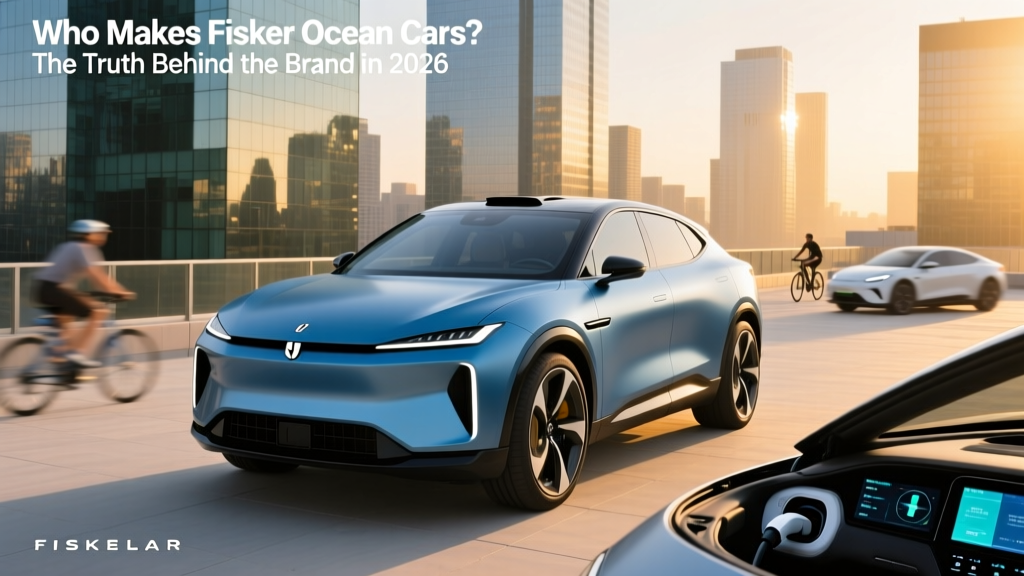
The Short Answer: Fisker Inc. Designed It, Magna-Steyr Built It
If you've been searching for who makes Fisker Ocean cars, the answer involves two companies with very different fates. The Fisker Ocean was designed and engineered by Fisker Inc., the EV startup founded by automotive designer Henrik Fisker (who also penned the BMW Z8 and Aston Martin DB9). However, Fisker Inc. did not manufacture the vehicle itself — production was contracted to Magna-Steyr, the Austrian contract manufacturer that also builds the Mercedes G-Class, BMW 5 Series, and Jaguar I-PACE at its Graz, Austria facility.
This matters enormously for anyone considering a Fisker Ocean today, because Fisker Inc. filed for Chapter 11 bankruptcy in June 2024 and ceased operations. Production of the Ocean ended after roughly 11,200 units were built between late 2022 and early 2024. As of 2026, no new Fisker Oceans are being manufactured, and the company's assets were liquidated.
That said, used Fisker Oceans are available on the secondary market, often at steep discounts from their original MSRP. If you're evaluating one, here's everything you need to know about the vehicle's specs, real-world usability, and ownership risks.
Fisker Ocean Core Specifications
| Attribute | Extreme / One (AWD) | Ultra (AWD) | Sport / Pure (FWD) |
|---|---|---|---|
| EPA Range | 360 miles | 340 miles | 250 miles |
| Battery Capacity (Usable) | ~113 kWh (NMC) | ~113 kWh (NMC) | ~75 kWh (LFP) |
| Horsepower | 564 hp | 540 hp | 275 hp |
| 0-60 mph | 3.7 seconds | 3.9 seconds | 6.9 seconds |
| Drivetrain | Dual-motor AWD | Dual-motor AWD | Single-motor FWD |
| Max DC Fast Charge | ~250 kW (peak) | ~250 kW (peak) | ~150 kW (peak) |
| 10-80% DCFC Time | ~33 minutes | ~33 minutes | ~38 minutes |
| Level 2 Home Charging | 10.9 kW (~37 mi/hr) | 10.9 kW (~37 mi/hr) | 10.9 kW (~37 mi/hr) |
| MPGe (Combined) | 84 MPGe | 87 MPGe | 106 MPGe |
| Cargo Volume | 32.5 cu ft (rear up) / 67.0 cu ft (rear folded) | 32.5 / 67.0 cu ft | 32.5 / 67.0 cu ft |
| Original Base MSRP | $68,999 | $52,999 | $38,999 |
Sources: fueleconomy.gov, Fisker Inc. original specifications (2023-2024).
Real-World Range vs. the EPA Sticker
Real-World Expectation: ~280-310 miles highway; ~220-260 miles in cold weather (below 32°F)
The Fisker Ocean Extreme's 360-mile EPA rating was one of the highest of any production SUV when it launched. That figure comes from the 113 kWh usable NMC (nickel manganese cobalt) battery pack supplied by CATL. On paper, it rivals the Tesla Model X Long Range and surpasses most competitors.
Real-world testing by owners and independent reviewers tells a more nuanced story. At sustained highway speeds of 70-75 mph, the Ocean Extreme typically delivers between 280 and 310 miles — a 14-22% reduction from the EPA sticker. This is consistent with how most EVs perform under highway loads, where aerodynamic drag (the Ocean is a boxy SUV) and the absence of regenerative braking opportunities reduce efficiency.
In cold weather, expect a further reduction. NMC chemistry loses roughly 20-30% of capacity at temperatures below freezing. The Ocean does include a heat pump for cabin heating, which mitigates some of this loss, but battery preconditioning and cabin heating still draw significant energy. Owners in northern climates report 220-260 miles of usable range in winter conditions.
The Sport and Pure trims, equipped with a smaller 75 kWh LFP (lithium iron phosphate) battery, carry a 250-mile EPA rating. LFP chemistry offers excellent cycle life and thermal stability but lower energy density. Real-world highway range for these trims lands around 195-215 miles, and cold-weather performance drops to roughly 160-185 miles.
Charging Speed: DC Fast and Home Level 2
Charging is where the Ocean's story gets complicated — both in terms of hardware capability and the practical reality of owning a vehicle from a defunct manufacturer.
| Charging Level | Power (kW) | Speed / Notes |
|---|---|---|
| Level 1 (120V household) | ~1.4 kW | ~4-5 miles per hour |
| Level 2 (240V home, 48A) | 10.9 kW | ~37 miles per hour; full charge in ~11 hours (113 kWh) |
| DC Fast Charge (Extreme/Ultra) | Peak ~250 kW | 10-80% in ~33 min; tapers significantly above 80% |
| DC Fast Charge (Sport/Pure) | Peak ~150 kW | 10-80% in ~38 min |
The Ocean Extreme and Ultra accept a peak DC fast-charge rate of approximately 250 kW. On a 350 kW Electrify America or Tesla Supercharger (via adapter) station, you can expect the charge curve to sustain above 200 kW through roughly 40-50% State of Charge, then taper progressively. The 10-80% time of about 33 minutes is competitive with vehicles like the Hyundai Ioniq 5 and Kia EV6, though those vehicles' 800V architectures sustain peak rates longer.
Home Level 2 charging at 10.9 kW (48 amps on a 60-amp circuit) adds about 37 miles of range per hour. A full overnight charge of the 113 kWh pack takes roughly 11 hours, which fits comfortably within a typical overnight window. You'll need a properly installed Level 2 home charger on a dedicated 240V/60A circuit — budget $800-$2,000 for equipment and electrician work depending on your panel capacity.
Critical ownership note: The Fisker Ocean originally shipped with a CCS1 charge port. Following Fisker's bankruptcy, software updates that were promised (including improved preconditioning for DC fast charging) were never delivered. Some owners have successfully used CCS-to-NACS adapters at Tesla Superchargers, but compatibility is not guaranteed and the Fisker mobile app infrastructure that managed charging sessions is no longer operational.
Performance, Handling, and Efficiency
The Ocean Extreme's dual-motor all-wheel-drive powertrain produces 564 horsepower and achieves a 3.7-second 0-60 mph time. That puts it in the territory of a Porsche Cayenne E-Hybrid or BMW iX M60. The Ultra trim dials this back slightly to 540 hp and 3.9 seconds, still firmly in performance-SUV territory.
The single-motor Sport and Pure trims are decidedly more relaxed at 275 hp and 6.9 seconds to 60 mph. They're adequate for daily commuting and highway merging but won't win any stoplight drags.
Efficiency varies significantly by trim. The Sport/Pure, with its lighter weight, smaller battery, and front-wheel-drive layout, achieves an impressive 106 MPGe combined (approximately 32 kWh/100 mi). The heavier, more powerful Extreme trim drops to 84 MPGe (40 kWh/100 mi). For context, the Tesla Model Y Long Range AWD achieves 117 MPGe combined — the Ocean's efficiency is hampered by its 5,600+ lb curb weight and upright SUV aerodynamics.
Interior Space, Tech, and the California Mode
The Ocean is a midsize SUV with generous interior dimensions. Rear-seat legroom measures 38.2 inches, and the flat floor (no transmission tunnel) makes the middle seat usable for adults. Cargo volume is 32.5 cubic feet behind the second row and 67.0 cubic feet with the rear seats folded — competitive with the Hyundai Ioniq 5 (37.9/73.7 cu ft, though the Ioniq is classified as a crossover).
The interior's standout feature was the California Mode, which simultaneously lowers all windows (including the rear hatch glass, which retracts into the tailgate) and opens the solar roof panel. The result is a near-convertible open-air experience unique in the EV market. The fixed solar roof (called the SolarSky) was marketed as adding up to 1,500 miles of range per year under ideal conditions — in practice, owners report it contributes roughly 2-5 miles per day of supplemental charge, useful for offsetting vampire drain but not a meaningful range extender.
The 17.1-inch rotating center touchscreen (called the Revolve screen) was impressive in concept but drew criticism for a sluggish interface and a lack of physical buttons for climate and volume controls. The infotainment system was developed in-house by Fisker, and with the company's dissolution, no further over-the-air updates will be delivered. Features like the Fisker Intelligent Pilot ADAS suite (a Level 2 driver-assist system using radar and cameras) remain functional but will not receive improvements or bug fixes.
Pricing, Depreciation, and the Tax Credit Question
The Fisker Ocean launched with an MSRP range of $38,999 (Sport, later rebranded from the "Pure" concept) to $68,999 (Extreme). The Ocean One launch edition, limited to 5,000 units, was priced at $68,999 and included the full feature set of the Extreme trim.
| Trim | Original MSRP | Estimated 2026 Used Price | Depreciation |
|---|---|---|---|
| Sport / Pure (FWD) | $38,999 | $18,000-$24,000 | ~40-55% |
| Ultra (AWD) | $52,999 | $25,000-$33,000 | ~38-53% |
| Extreme / One (AWD) | $68,999 | $32,000-$42,000 | ~39-54% |
The Ocean has experienced severe depreciation since Fisker's bankruptcy — a direct consequence of warranty uncertainty, software stagnation, and parts-supply concerns. For bargain-hunters willing to accept those risks, a used Ocean Extreme with 360 miles of EPA range for under $40,000 is an exceptional value proposition on paper.
Federal Tax Credit Eligibility
When new, the Fisker Ocean Extreme and Ultra did not qualify for the full $7,500 IRS §30D federal tax credit. The primary disqualifying factor was the MSRP cap: under current rules, SUVs must have an MSRP at or below $80,000 (which the Ocean met), but the battery-sourcing and critical-minerals requirements eliminated most vehicles using CATL-supplied cells. The Sport/Pure trim at $38,999 met the MSRP threshold but also failed the battery-component sourcing requirements.
For used Fisker Oceans purchased in 2026, the IRS §25E used clean vehicle credit may apply. This credit offers up to $4,000 (or 30% of the sale price, whichever is less) and has its own eligibility requirements:
- Vehicle must be at least 2 model years old (2023-2024 Oceans qualify in 2026)
- Sale price must be $25,000 or less (limits eligibility to Sport/Pure trims or high-mileage Ultra examples)
- Buyer income caps: $75,000 single / $112,500 head of household / $150,000 joint
- Must purchase from a licensed dealer (private-party sales excluded)
- Can only be claimed once per buyer every 3 years
Consult a tax professional before relying on this credit, as IRS rules are subject to change and individual eligibility varies.
The Warranty Problem: What Bankruptcy Means
When Fisker Inc. sold the Ocean, it backed the vehicle with a 6-year/60,000-mile bumper-to-bumper warranty and an 8-year/100,000-mile battery and powertrain warranty — competitive with Hyundai's industry-leading coverage at the time.
With Fisker's bankruptcy and liquidation, those warranties are effectively void. There is no successor entity honoring warranty claims. Some third-party warranty companies have offered extended coverage for Fisker Oceans, but coverage terms vary widely, premiums are high, and claim payouts depend on parts availability that is increasingly uncertain.
The 113 kWh NMC battery pack, manufactured by CATL, is a proven cell chemistry used in millions of EVs globally. Under normal conditions, NMC batteries retain 80-90% of their original capacity after 150,000 miles. However, if a battery module fails or the thermal management system requires service, sourcing replacement parts through unofficial channels will be challenging and expensive. Independent EV shops report that Fisker-specific body panels, interior trim, and electronic modules are already difficult to find.
Should You Buy a Fisker Ocean in 2026?
- You want 360 miles of EPA range for under $40,000 (Extreme trim, used market)
- You value the unique open-air California Mode and solar roof
- You have access to reliable home charging and don't rely on public DC fast charging
- You're comfortable with no warranty coverage and limited software support
- You have a trusted independent EV mechanic in your area
- You need active warranty coverage and manufacturer support
- You depend on a functioning mobile app for charging management
- You want ongoing over-the-air software updates
- You plan to keep the vehicle 8-10 years and worry about parts availability
- You want access to Tesla Superchargers without adapter uncertainty
The Fisker Ocean is a compelling vehicle engineered by talented people and built by a world-class contract manufacturer. Its range, performance, and open-air features are genuinely distinctive. But buying one in 2026 means accepting orphan-vehicle risk — no warranty, no software updates, dwindling parts supply, and uncertain resale value. It's best suited for EV-savvy buyers who view it as a depreciated luxury asset rather than a long-term daily driver.
Frequently Asked Questions
Who actually manufactured the Fisker Ocean?
The Fisker Ocean was manufactured by Magna-Steyr at their plant in Graz, Austria. Magna-Steyr is one of the world's largest automotive contract manufacturers and also builds vehicles for Mercedes-Benz, BMW, Jaguar, and Toyota. Fisker Inc. handled design, engineering, and brand management but did not operate its own factory.
Is Fisker still in business in 2026?
No. Fisker Inc. filed for Chapter 11 bankruptcy protection in June 2024 and subsequently liquidated its assets. The company ceased all operations, including vehicle production, software development, and customer support. No new Fisker vehicles are being produced.
What is the real-world range of the Fisker Ocean Extreme?
The EPA rates the Fisker Ocean Extreme at 360 miles. In real-world highway driving at 70-75 mph, expect approximately 280-310 miles. In cold weather (below 32°F), range drops to roughly 220-260 miles. These figures are consistent with other large-battery EVs and reflect the physics of aerodynamic drag and battery chemistry at low temperatures.
Can I still get a Fisker Ocean serviced?
Some independent EV repair shops and former Fisker-authorized service partners continue to service the Ocean, but there is no manufacturer-backed service network. Parts availability — especially for Fisker-specific components like body panels, the Revolve screen, and interior trim — is limited and expected to become more constrained over time. Magna-Steyr does not provide direct-to-consumer parts support.
Does the Fisker Ocean qualify for any tax credits in 2026?
New Fisker Oceans are no longer available for purchase. On the used market, the §25E used clean vehicle credit may provide up to $4,000 for eligible buyers purchasing a qualifying used Ocean for $25,000 or less from a licensed dealer. Income caps and other restrictions apply — see the IRS clean vehicle credit page for current rules.
How does the Fisker Ocean compare to the Tesla Model Y or Hyundai Ioniq 5?
The Ocean Extreme offers more EPA range (360 mi vs. 310 mi for Model Y LR, 303 mi for Ioniq 5 LR AWD) and a unique open-air experience. However, the Model Y has vastly superior charging infrastructure access (Tesla Supercharger network), active software support, and a functioning warranty for new buyers. The Ioniq 5 offers faster sustained DC charging via its 800V architecture and full manufacturer backing. For most buyers in 2026, the Model Y or Ioniq 5 represents a lower-risk choice despite the Ocean's range advantage.