The original Fisker Karma was one of the most polarizing vehicles of the early 2010s — a striking plug-in hybrid luxury sedan that promised eco-conscious opulence but delivered a troubled ownership experience. Henrik Fisker's original company, Fisker Automotive, folded in 2013 after battery supplier A123 Systems went bankrupt and Hurricane Sandy destroyed hundreds of unsold Karmas at the Port of Newark. The brand was later acquired by China's Wanxiang Group and relaunched as Karma Automotive, which produced the updated Karma Revero (and later the Revero GT) through roughly 2020 before production ceased again.
If you're searching for a Fisker Karma interior review in 2026, you're likely evaluating one of these vehicles on the used market — or perhaps confusing it with Henrik Fisker's second venture, Fisker Inc. (which produced the Fisker Ocean SUV before filing for bankruptcy in June 2024). This review covers the Karma sedan lineage — the original 2012 Fisker Karma and the Karma Revero/GT successors — with a focus on interior quality, powertrain specs, range, and whether any of these cars make sense to buy today.
Fisker Karma Interior: Design, Materials & Cabin Space
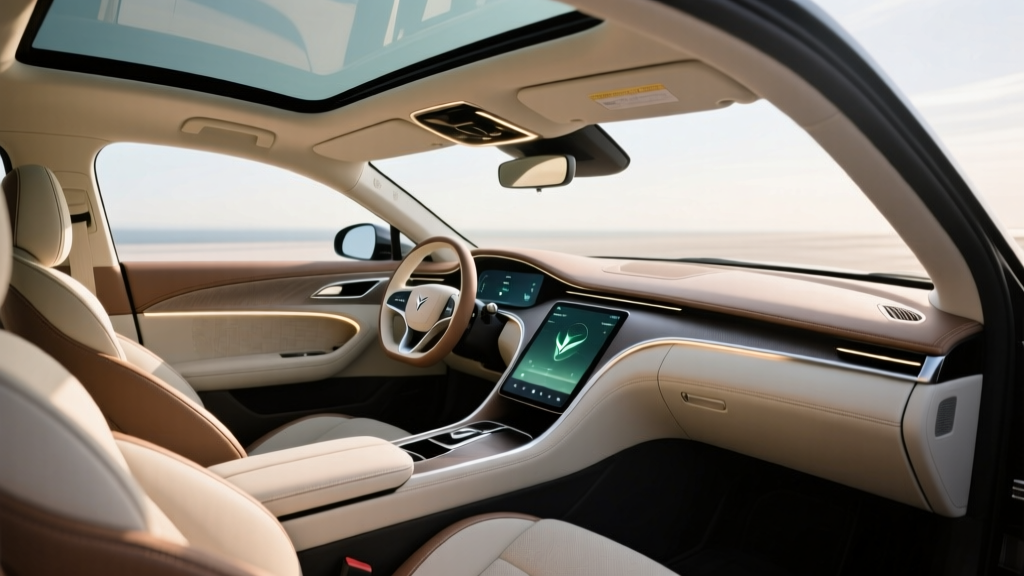
The Fisker Karma's interior was always its strongest selling point — and simultaneously the source of its most pointed criticism. Henrik Fisker, an automotive designer by trade (BMW Z8, Aston Martin DB9), styled the Karma with a "California luxury" ethos that emphasized sustainable materials and dramatic proportions.
Materials & Build Quality
The original 2012 Karma offered two interior themes: the EcoChic package (animal-free, using recycled glass, reclaimed wood from California wildfire damage, and bamboo) and the EcoSport package (traditional leather sourced from Bridge of Weir in Scotland). The EcoChic variant was genuinely innovative for 2012 — no mainstream luxury automaker offered a comparable sustainable-luxury cabin at that time. However, reviewers consistently noted that panel gaps, switchgear quality, and infotainment responsiveness fell short of BMW 7 Series or Mercedes S-Class standards at the Karma's $96,000+ starting price.
The Karma Revero (2017-2020), produced under Wanxiang ownership in Moreno Valley, California, retained the basic interior architecture but updated the infotainment system and improved some material quality. The Revero GT (2020 model year) added a revised center stack, updated digital instrument cluster, and a new BMW-sourced turbocharged 3-cylinder range extender replacing the original GM-sourced 2.0L Ecotec.
Passenger & Cargo Dimensions
The Karma's dramatic roofline and large battery tunnel running through the center of the car created significant packaging compromises:
| Dimension | Fisker Karma (2012) | Karma Revero GT (2020) |
|---|---|---|
| Front Headroom | 37.4 in | 37.4 in |
| Front Legroom | 42.4 in | 42.4 in |
| Rear Headroom | 35.4 in | 35.4 in |
| Rear Legroom | 29.6 in | 29.6 in |
| Trunk Volume | 6.9 cu ft | 6.9 cu ft |
| Seating Capacity | 4 passengers | 4 passengers |
The rear seat is the Karma's most notorious flaw. With only 29.6 inches of legroom, it's tighter than a Mazda Miata's passenger space. The central battery tunnel eliminates any possibility of a fifth seat. The 6.9 cu ft trunk is smaller than a Toyota Corolla's — barely accommodating two carry-on bags. This is strictly a two-person grand tourer with occasional emergency rear seating for children or very short adults.
Powertrain, Battery & Electric-Only Range
As an extended-range electric vehicle (EREV), the Karma/Revero uses its gasoline engine solely as a generator — the wheels are always driven by electric motors. Here's how the powertrain evolved across generations:
| Spec | Fisker Karma (2012) | Karma Revero (2017-2019) | Karma Revero GT (2020) |
|---|---|---|---|
| Battery Capacity (usable) | 16.0 kWh (NMC) | 20.1 kWh (NMC) | 28.0 kWh (NMC) |
| EPA Electric Range | 32 miles | 50 miles | 61 miles |
| Total Range (elec + gas) | ~230 miles | ~300 miles | ~360 miles |
| Range Extender Engine | GM 2.0L turbo I4 | GM 2.0L turbo I4 | BMW 1.5L turbo I3 |
| Combined Output | 403 hp | 403 hp | 536 hp |
| Drive Motors | 2x rear (Q-Drive) | 2x rear (Q-Drive) | 2x rear (twin-motor) |
| 0-60 mph | 5.9 sec | 5.8 sec | 4.5 sec |
| Drivetrain | RWD | RWD | RWD |
Efficiency Ratings
The Karma Revero GT (2020) achieved an EPA-rated 70 MPGe in electric mode and approximately 22 mpg combined when running on gasoline. For context, a 2020 BMW 530e PHEV achieved 64 MPGe with a shorter electric range but significantly better gas-only fuel economy (29 mpg). The Karma's heavy curb weight (~5,400 lbs) and wide tires penalize efficiency in both modes.
Charging Speed: Home & Public
Charging is where the Karma lineage reveals its age. None of these vehicles support DC fast charging — a significant limitation even by 2020 standards and a dealbreaker for anyone without reliable home or workplace Level 2 charging access.
| Charging Level | Fisker Karma (2012) | Revero GT (2020) |
|---|---|---|
| Level 1 (120V, 12A) | ~1.4 kW / ~4 mi/hr | ~1.4 kW / ~5 mi/hr |
| Level 2 (240V, 32A) | ~3.3 kW / ~10 mi/hr | ~6.6 kW / ~22 mi/hr |
| Full Charge Time (Level 2) | ~5 hours | ~4.5 hours |
| DC Fast Charge | ❌ Not supported | ❌ Not supported |
| Connector | J1772 | J1772 |
The Revero GT's 6.6 kW onboard charger is adequate for overnight home replenishment — a full 0-100% charge takes roughly 4.5 hours on a 240V/32A Level 2 home station. But without DC fast charging, road trips require strategic planning: you'll rely on the gasoline range extender for highway driving, which defeats the purpose of electric propulsion for long-distance travel.
For home Level 2 installation, expect to spend $800-$2,000 on a quality 32A-40A wall-mounted charger (ChargePoint Home Flex, Emporia Vue, or Wallbox Pulsar Plus), plus $500-$2,500 for electrician labor depending on panel proximity and whether your home's electrical panel needs upgrading to support a dedicated 50A circuit.
Tech, Driver Assistance & Infotainment
The Karma's technology suite reflects its design era. The original 2012 model featured a 10.2-inch touchscreen — large for its time — but the interface was sluggish and prone to freezing. The Karma Revero GT improved matters with a faster processor, Apple CarPlay, and a revised UI, but it never matched the responsiveness or feature depth of contemporary BMW iDrive or Mercedes MBUX systems.
Notable Tech Features (Revero GT)
- 10.2-inch capacitive touchscreen with Apple CarPlay
- Digital instrument cluster with drive-mode displays (Stealth, Sport, Sustain)
- Solar-panel roof (originally standard on the Karma; supplemental cabin power only, not propulsion)
- Premium audio system (10 speakers)
- Heated front seats, dual-zone climate control
- Keyless entry and push-button start
Driver Assistance (ADAS)
The Karma lineage offers minimal driver assistance by modern standards:
- Rearview camera
- Front and rear parking sensors
- Basic stability and traction control
Notably absent: adaptive cruise control, lane-keeping assist, automatic emergency braking, blind-spot monitoring, or any form of semi-autonomous driving. For a vehicle that originally cost over $100,000, this is a glaring omission. Buyers accustomed to Tesla Autopilot, GM Super Cruise, or even Toyota Safety Sense will find the Karma's ADAS suite rudimentary.
Pricing, Tax Credits & Ownership Costs
The Karma lineage has a complicated financial picture. Because these vehicles are no longer in production, you'll be shopping the used market exclusively.
Original MSRP & Current Used Market
| Model | Original Base MSRP | 2026 Used Range |
|---|---|---|
| Fisker Karma (2012) | $96,850 | $18,000 – $35,000 |
| Karma Revero (2017-2019) | $130,000 | $40,000 – $65,000 |
| Karma Revero GT (2020) | $135,000 | $55,000 – $80,000 |
Federal Tax Credit Eligibility
Under current IRS §30D rules, the federal clean vehicle credit applies only to new vehicles purchased from a licensed dealer. Since Karma Automotive is no longer producing vehicles and no new inventory exists, the $7,500 federal EV tax credit does not apply to any Karma purchase in 2026.
However, the Used Clean Vehicle Credit (also under §25E) offers up to $4,000 (30% of sale price, capped at $4,000) for qualifying used plug-in vehicles purchased from a dealer for $25,000 or less. In practice:
- 2012 Fisker Karma: May qualify for the $4,000 used credit if purchased from a dealer at $25,000 or less. Income caps apply ($75,000 single / $150,000 married filing jointly). The vehicle must be at least two model years old, which any Karma satisfies.
- Karma Revero / Revero GT: Used prices exceed the $25,000 cap, so these do not qualify for the used-EV credit.
Always verify eligibility with a tax professional and confirm the vehicle's battery capacity meets the minimum 7 kWh requirement (all Karma variants exceed this). Consult the IRS Used Clean Vehicle Credit page for current rules.
Warranty & Longevity Concerns
The original Fisker Karma carried an 8-year/100,000-mile battery warranty and a 4-year/50,000-mile bumper-to-bumper warranty. However, with Fisker Automotive defunct since 2013 and Karma Automotive having ceased production around 2020, warranty claims are essentially unenforceable. Parts availability — particularly for the original A123 battery packs, proprietary Q-Drive powertrain components, and custom body panels — is extremely limited.
The Karma Revero and Revero GT (built under Wanxiang) carried similar warranty terms, but Karma Automotive's service network was always thin. As of 2026, finding a qualified technician to service a Karma's high-voltage system or source replacement parts is a significant ownership challenge. Independent EV specialists in major metro areas may be your only option.
Pros & Cons: The Fisker Karma Verdict
✅ Pros
- Stunning, head-turning exterior design — still one of the most beautiful sedans ever built
- EcoChic interior uses genuinely innovative sustainable materials
- 61-mile EV range (Revero GT) covers most daily commutes electric-only
- Solar roof is a unique conversation piece and provides supplemental power
- RWD twin-motor layout delivers smooth, instant torque
- Depreciation from $135K MSRP makes Revero GT a relative value on the used market
❌ Cons
- No DC fast charging — a dealbreaker for road trips
- Rear seat nearly unusable (29.6" legroom); trunk tiny (6.9 cu ft)
- No modern driver-assist features (no AEB, no ACC, no lane-keeping)
- Defunct manufacturer — warranty claims unenforceable, parts scarce
- Heavy (5,400 lbs) with mediocre gas-mode efficiency (~22 mpg)
- Known reliability issues with original Karma (battery fires, coolant leaks, A123 battery failures)
- Infotainment dated even on the Revero GT
Who Should Buy a Fisker Karma (or Karma Revero)?
The Fisker Karma and its Karma Revero successors are collector-grade vehicles, not practical daily drivers. Here's who they suit:
- Design collectors who value automotive styling as art and want a conversation piece in their garage
- Short-distance commuters with reliable home Level 2 charging who rarely drive more than 50 miles per day and never need rear-seat space
- EV-curious enthusiasts who want the EREV experience (electric daily driving + gas backup) in a unique package
Who should avoid the Karma:
- Families needing rear-seat space or cargo room
- Anyone without dedicated home charging (no DC fast charging means no practical public-charging reliance)
- Buyers who prioritize safety tech, warranty coverage, or dealer service support
- Cost-conscious shoppers worried about maintenance and parts availability
How Does the Karma Compare to Alternatives?
If you're drawn to the Karma's blend of luxury, electrification, and striking design, consider these alternatives on the used or new market:
| Vehicle | Type | EV Range | DC Fast Charge | ADAS |
|---|---|---|---|---|
| Karma Revero GT (2020) | EREV | 61 mi | ❌ No | None |
| BMW 530e (2020) | PHEV | 21 mi | ❌ No | Full suite |
| Porsche Taycan (used) | BEV | 200-227 mi | ✅ 270 kW | Full suite |
| Tesla Model S (used) | BEV | 320-405 mi | ✅ 250 kW | Autopilot (L2) |
| Mercedes EQS (used) | BEV | 305-350 mi | ✅ 200 kW | Full suite |
For the same budget as a used Karma Revero GT ($55K-$80K), a used Porsche Taycan or Tesla Model S delivers vastly superior range, DC fast charging, modern ADAS, active dealer support, and far better practicality. The Karma's only advantage is exclusivity and design drama.
Frequently Asked Questions
What is the real-world range of the Fisker Karma?
The original 2012 Fisker Karma achieves about 32 miles EPA-rated on electric power alone, with real-world results typically 25-30 miles depending on temperature and driving style. The Karma Revero GT (2020) is rated at 61 miles EPA electric, with real-world results of 45-55 miles in moderate conditions and 35-45 miles in cold weather. Total range with the gas range extender reaches approximately 360 miles in the Revero GT.
How fast does the Karma charge at home?
The Karma Revero GT charges at up to 6.6 kW on a Level 2 (240V) home charger, replenishing a depleted battery in about 4.5 hours. The original 2012 Karma charges at 3.3 kW, requiring about 5 hours. Neither vehicle supports DC fast charging.
Does the Fisker Karma qualify for the federal EV tax credit?
No. The IRS §30D new vehicle credit requires purchase of a new vehicle from a licensed dealer. Karma Automotive is not producing vehicles, so the $7,500 credit is unavailable. The used-EV credit (§25E, up to $4,000) may apply to a 2012 Fisker Karma purchased from a dealer for $25,000 or less, subject to income caps ($75K single / $150K joint).
Is the Fisker Karma reliable?
The original 2012 Fisker Karma has a poor reliability reputation. A123 battery pack failures were common and led to a major recall. Coolant leaks into the battery enclosure caused several fires. The Karma Revero (2017+) improved reliability somewhat under Wanxiang ownership, but limited production volumes mean there's insufficient data for robust reliability assessments. Parts scarcity is a major concern for all variants.
Is the Fisker Karma a fully electric car?
No. The Fisker Karma and Karma Revero are extended-range electric vehicles (EREVs). They drive exclusively on electric motors but carry a gasoline-powered generator (range extender) that recharges the battery when it depletes. You must plug in to get the benefit of electric-only driving; otherwise, you're driving a heavy, inefficient gasoline generator-powered car at roughly 22 mpg.
What happened to Fisker and Karma Automotive?
Fisker Automotive (founded by Henrik Fisker) went bankrupt in 2013. China's Wanxiang Group bought the assets and formed Karma Automotive, which produced the Revero from 2017 through approximately 2020. Henrik Fisker separately founded Fisker Inc., which produced the all-electric Fisker Ocean SUV before filing for bankruptcy in June 2024. As of 2026, neither company is producing vehicles.
Should I buy a Fisker Karma in 2026?
Only if you're a collector or enthusiast who values design exclusivity over practicality, warranty coverage, and modern safety technology. For daily transportation, a used Porsche Taycan, Tesla Model S, or BMW i5 offers dramatically better range, charging, safety tech, and serviceability at comparable or lower used-market prices. The Karma is an automotive art piece — buy it with your eyes open about the ownership challenges.