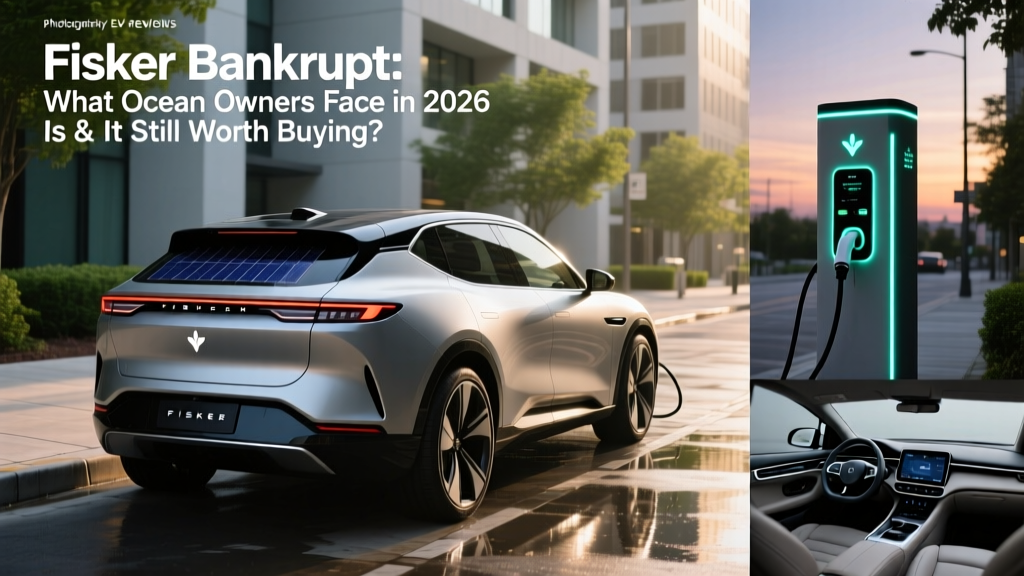
Fisker Inc. filed for Chapter 11 bankruptcy in June 2024 and completed liquidation by late 2024, leaving roughly 10,000–12,000 Fisker Ocean SUVs on U.S. roads with no manufacturer backing. For current owners and bargain-hunting used-EV shoppers in 2026, the Fisker Ocean presents a unique proposition: striking design and legitimate long-range capability at fire-sale prices, but with serious questions about software support, parts availability, and long-term serviceability.
This profile breaks down the Fisker Ocean's real-world specs, ownership realities post-bankruptcy, and whether the risk-reward math works compared to supported competitors like the Hyundai Ioniq 5, Tesla Model Y, and Ford Mustang Mach-E.
Fisker Ocean Specs at a Glance
| Specification | Ocean Sport (FWD) | Ocean Ultra / Extreme (AWD) |
|---|---|---|
| EPA Range | 250 mi (Sport, 2023 est.) / 283 mi (Ultra) | 360 mi (Extreme, 113 kWh pack) |
| Battery Capacity | ~80 kWh usable (LFP, CATL) | ~113 kWh usable (NMC, CATL) |
| Drivetrain | Single-motor FWD | Dual-motor AWD |
| Horsepower | 275 hp | 550 hp (Hyper mode) |
| 0–60 mph | ~6.9 sec | 3.7 sec |
| Max DC Fast Charge | ~150 kW (peak) | ~250 kW (peak) |
| 10–80% DC Time | ~35 min | ~30 min |
| Level 2 Home Charge | 10.5 kW (~25 mi/hr) | 10.5 kW (~30 mi/hr) |
| EPA Efficiency | ~96 MPGe | ~88 MPGe (Extreme) |
| Cargo Volume | 32.4 cu ft (rear up) / 65.2 cu ft (rear folded) + 3.5 cu ft frunk (limited trims) | |
| Original MSRP (2023–2024) | $37,499 (Sport lease) | $61,499 (Ultra) / $68,999 (Extreme) |
| Battery/Powertrain Warranty | Originally 10 yr / 100,000 mi (now effectively void — see below) | |
Sources: fueleconomy.gov (EPA estimates), Fisker Inc. press materials (2023). Real-world figures may vary. Post-bankruptcy, official warranty support is no longer available from the manufacturer.
Real-World Range: What the EPA Number Doesn't Tell You
Real-World Expectation: 280–310 miles on mixed highway driving (70–75 mph); 240–270 miles in cold weather (below 32°F); 320–340 miles in city/low-speed commuting.
Why the gap: The Ocean Extreme's boxy SUV shape creates significant aerodynamic drag at highway speeds. Combined with the heavy 113 kWh battery pack (~5,600 lb curb weight), efficiency drops sharply above 65 mph. Cold weather further reduces range by 15–25% due to battery heating demands and the absence of a standard heat pump on early builds.
The Ocean Sport with its smaller LFP battery delivers an EPA-estimated 250 miles, but expect closer to 200–220 miles in real-world highway use and as low as 170–185 miles in freezing temperatures. LFP chemistry actually handles cold slightly better than NMC in terms of long-term degradation, but range loss in winter is still substantial for both pack sizes.
For context, a Tesla Model Y Long Range (EPA 310 mi) typically delivers 270–290 real-world highway miles thanks to superior aerodynamics and a more mature thermal management system. The Ocean's range advantage on paper narrows considerably in practice.
Charging Speed: DC Fast and Home Level 2
Charging infrastructure compatibility is one of the Fisker Ocean's more complicated post-bankruptcy issues. The Ocean was built with a CCS1 connector and does not natively support Tesla's NACS plug. As the industry has shifted toward NACS in 2025–2026, Ocean owners need a CCS-to-NACS adapter (approximately $150–200) to access Tesla Superchargers — assuming the adapter is certified and available, which remains inconsistent for Fisker vehicles.
| Charging Level | Power | Ocean Sport (LFP) | Ocean Extreme (NMC) |
|---|---|---|---|
| Level 1 (120V household) | 1.2 kW | ~3 mi/hr | ~3 mi/hr |
| Level 2 (240V home) | 10.5 kW | ~25 mi/hr (full in ~8 hr) | ~30 mi/hr (full in ~11 hr) |
| DC Fast Charge (peak) | 150–250 kW | 10–80% in ~35 min | 10–80% in ~30 min |
| DC Sustained (avg 10–80%) | ~90–120 kW | Actual avg ~90 kW | Actual avg ~120 kW |
Charging curve reality: The Ocean Extreme peaks near 250 kW only between roughly 15–35% state of charge, then tapers progressively. From 80–100%, charging slows to under 40 kW, making the final 20% a lengthy affair. On road trips, plan stops around 10–80% to minimize time at the charger. Networks like Electrify America and EVgo support CCS natively, but reliability varies by station — a concern magnified when you can't fall back on a manufacturer's proprietary network.
Home Level 2 charging at 10.5 kW is competitive with rivals, but requires a 48-amp dedicated circuit (60-amp breaker). Budget $800–2,500 for a quality Level 2 home charger installation depending on your electrical panel's capacity and proximity to the parking spot. A licensed electrician should assess whether a panel upgrade (to 200A service) is needed — common in older homes.
Post-Bankruptcy Ownership: The Risks You Must Accept
Buying or owning a Fisker Ocean in 2026 means accepting risks that don't exist with supported EVs:
- Warranty is effectively void. The original 10-year/100,000-mile battery and powertrain warranty has no entity behind it to honor claims. Some third-party warranty companies may offer aftermarket EV coverage, but read exclusions carefully — most won't cover a bankrupt manufacturer's proprietary components.
- Software updates have stopped. The Ocean launched with known software bugs (infotainment freezes, phantom braking alerts, charging handshake failures). Fisker's OTA update pipeline ceased with the bankruptcy. What you see in 2026 is what you get, permanently.
- Parts scarcity is real and worsening. Body panels, the distinctive solar roof, headlight assemblies, and proprietary suspension components are increasingly difficult to source. Third-party salvage networks have emerged, but wait times of 4–12 weeks for collision parts are common. Routine consumables (brake pads, cabin filters, tires) are generally available since Fisker used standard supplier parts.
- Insurance costs are elevated. Insurers price the Ocean higher than comparable EVs due to parts uncertainty and repair complexity. Expect premiums 15–30% above a Model Y or Ioniq 5 in most states. Shop quotes before purchasing.
- Resale value has cratered. Depreciation was steep even before bankruptcy. Ocean Extreme models that stickered above $68,000 are trading for $22,000–32,000 on the used market in 2026 depending on mileage and condition. This is either a disaster for original owners or an opportunity for buyers — depending on your risk tolerance.
Pricing, Tax Credits, and the Used-EV Loophole
| Scenario | Price Range (2026) | Tax Credit Eligibility |
|---|---|---|
| New (old stock, if found) | $25,000–35,000 (dealer liquidation) | Not eligible — Fisker VINs may not meet §30D battery sourcing requirements; verify on IRS.gov |
| Used Ocean Sport | $14,000–19,000 | Up to $4,000 used-EV credit (§25E) if buyer income ≤$75K single / $150K joint and sale price ≤$25,000 |
| Used Ocean Ultra | $18,000–25,000 | Up to $4,000 used-EV credit (§25E) — same income/price caps apply |
| Used Ocean Extreme | $22,000–32,000 | Often exceeds $25,000 sale-price cap — credit may not apply |
Critical tax credit note: The federal §30D new-vehicle credit (up to $7,500) requires meeting North American battery assembly and critical-mineral sourcing thresholds. Fisker Oceans used CATL (Chinese-manufactured) battery cells, which likely disqualifies new-stock purchases under current IRS §30D rules. Always verify a specific VIN on the IRS's official eligible-vehicle list before relying on the credit.
The §25E used-EV credit is more accessible: 30% of the sale price up to $4,000, available on vehicles priced at $25,000 or less, purchased from a licensed dealer, subject to buyer income caps ($75,000 single / $112,500 head of household / $150,000 joint). This credit can be applied at point of sale. This makes a used Ocean Sport or Ultra one of the most range-per-dollar EVs available in 2026 — if you accept the risk profile.
How the Ocean Compares to Supported Rivals
For buyers weighing a used Fisker Ocean against a new or certified-pre-owned competitor:
Fisker Ocean (Used, 2023–2024)
Pros:- 360 mi EPA range (Extreme) — top-tier for the price
- Striking design, solar roof (Extreme/One trim)
- Spacious cabin: 32.4 cu ft cargo, generous rear legroom
- Fire-sale pricing: $14K–32K used
- Used-EV tax credit eligible on many examples
Competitors (Hyundai Ioniq 5 / Tesla Model Y)
Pros:- Full manufacturer warranty and OTA updates
- Established service networks and parts supply
- NACS compatibility (Model Y native; Ioniq 5 via adapter or 2025+ models)
- Lower insurance premiums
- Better real-world charging reliability
The Ioniq 5 (EPA 303 mi, ~$42,000 new) charges faster on real-world DC (10–80% in ~18 min at 250 kW sustained) and has full dealer support. The Model Y Long Range (EPA 310 mi, ~$45,000) offers Supercharger access and strong resale. Neither matches the Ocean's used-market value per mile of range, but both eliminate the bankruptcy risk entirely.
Who Should (and Shouldn't) Buy a Fisker Ocean in 2026
This EV suits you if: You're a risk-tolerant buyer who wants maximum range and cargo space on a tight budget, can self-manage maintenance through independent EV shops, have reliable home Level 2 charging, and don't depend on the vehicle as your sole daily driver (a backup plan for software or parts failures is essential).
Look elsewhere if: You need a worry-free daily commuter with dealer support, you live in a region with limited independent EV repair options, you plan to keep the vehicle 8–10 years, or you frequently road-trip through areas with sparse CCS charging infrastructure.
Frequently Asked Questions
What is the real-world range of the Fisker Ocean?
The Ocean Extreme delivers approximately 280–310 miles in real-world highway driving, down from its 360-mile EPA estimate. The Sport trim manages 200–220 highway miles against its 250-mile EPA rating. Cold weather (below freezing) reduces these figures by an additional 15–25%.
How fast does the Fisker Ocean charge?
The Ocean Extreme peaks at 250 kW on DC fast chargers, achieving 10–80% in roughly 30 minutes, though sustained average power is closer to 120 kW due to charge-curve taper. The Sport peaks around 150 kW with a 10–80% time of approximately 35 minutes. Home Level 2 charging at 10.5 kW adds about 25–30 miles per hour.
Does the Fisker Ocean qualify for the federal EV tax credit?
New old-stock Oceans likely do not qualify for the §30D new-vehicle credit due to CATL battery sourcing from China. However, used Oceans priced at or below $25,000 may qualify for the §25E used-EV credit (up to $4,000), subject to buyer income limits. Always verify VIN eligibility at IRS.gov and consult a tax professional.
Can I still get the Fisker Ocean serviced?
Independent EV repair shops and mobile technicians handle routine maintenance (brakes, tires, cabin filters). However, proprietary components — battery modules, power electronics, the infotainment system, and body panels — are increasingly difficult to source. Third-party salvage networks exist but with multi-week lead times for specialized parts.
Is buying a Fisker Ocean worth the risk in 2026?
It depends on your risk tolerance. At $14,000–25,000 after potential tax credits, the Ocean offers exceptional range and space for the money. But you're accepting zero warranty coverage, frozen software, parts scarcity, and higher insurance costs. For risk-averse buyers, a supported EV like the Hyundai Ioniq 5 or Chevrolet Equinox EV is the safer choice despite higher upfront cost.
Will the Fisker Ocean get NACS / Tesla Supercharger access?
Not natively. The Ocean uses a CCS1 port. CCS-to-NACS adapters exist from third-party manufacturers ($150–200), but compatibility with Tesla Superchargers is not guaranteed for Fisker VINs, as Tesla's network requires vehicle whitelisting. Check adapter certification and Tesla's current compatibility list before relying on Supercharger access.
This article reflects information available as of early 2026. Tax credit rules, parts availability, and third-party support ecosystems evolve. Verify current IRS eligibility and consult local EV specialists before purchasing.