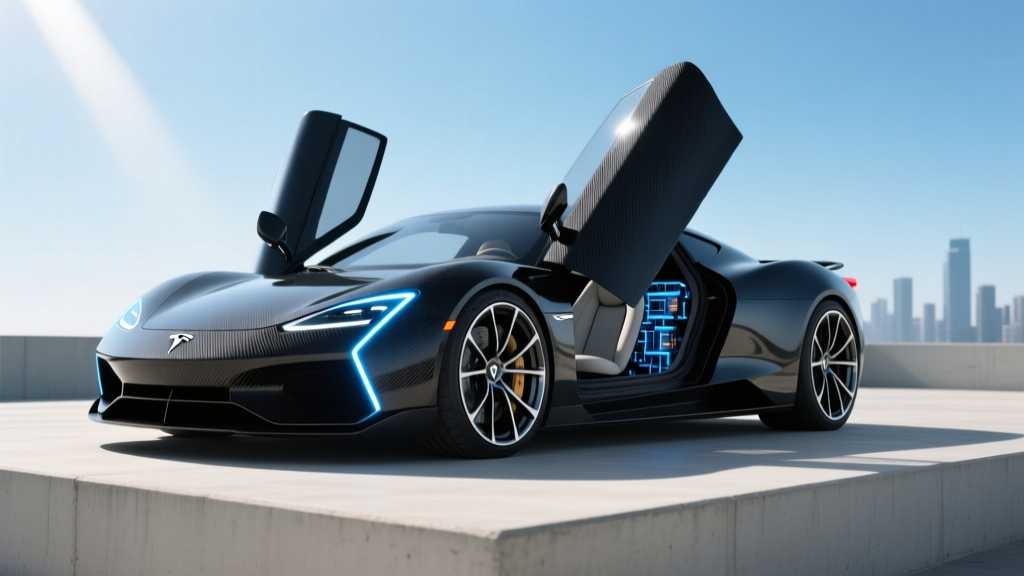
Before the Model S redefined luxury sedans and the Model 3 brought electric vehicles to the masses, there was the car that started it all. The first ever Tesla — the original Roadster, produced from 2008 to 2012 — was a proof-of-concept that lithium-ion batteries could deliver serious performance in a production car. Built on the Lotus Elise chassis and powered by a then-revolutionary battery pack, the Roadster remains a landmark in automotive history. For collectors, EV historians, and curious buyers eyeing the used market, here is a comprehensive technical profile of the vehicle that launched a revolution.
Quick Verdict: The Car That Proved EVs Could Perform
The original Tesla Roadster was never a mass-market vehicle. With roughly 2,450 units produced over four model years, it was a low-volume halo car designed to fund Tesla's long-term vision. Today, it exists almost entirely in the collector and enthusiast market. Its specs — 244 miles of EPA-rated range, a 3.7-second 0-60 mph time, and a 53 kWh battery — were groundbreaking in 2008 but are now eclipsed by virtually every new EV on sale. Still, the Roadster's engineering significance and rarity keep it relevant. If you're considering one on the used market, understanding its real-world capabilities, battery health realities, and ownership costs is essential.
Range, Battery & Real-World Efficiency
| Specification | Value |
|---|---|
| EPA Estimated Range | 244 miles |
| Battery Capacity | 53 kWh (usable) |
| Battery Chemistry | Lithium-cobalt (LiCoO₂) — 6,831 cells |
| Energy Consumption | ~280 Wh/mile (combined) |
| MPGe (EPA Combined) | 120 MPGe |
| Battery Warranty (Original) | 5 years / 100,000 miles |
The Roadster's battery pack was an engineering marvel for its time: 6,831 laptop-style 18650 lithium-cobalt cells arranged in 11 modules. Tesla's thermal management system — liquid-cooled and heated — was a first for production EVs and became the template for every subsequent Tesla battery. However, lithium-cobalt chemistry is more susceptible to thermal runaway and degradation than the NMC (nickel-manganese-cobalt) and LFP (lithium iron phosphate) chemistries used in modern EVs.
For context on how far battery technology has come, the current Tesla Model S uses a ~100 kWh pack with modern NMC chemistry to deliver over 400 miles of range.
Charging Speed: DC Fast Charge and Home Level 2
| Charging Level | Power / Rate | Time (0–100%) | Notes |
|---|---|---|---|
| Level 1 (120V) | ~1.4 kW | ~36–40 hours | Emergency/trickle only |
| Level 2 (240V, 48A) | ~11.5 kW | ~4.5 hours | High Power Wall Connector |
| Level 2 (240V, 30A) | ~7 kW | ~7–8 hours | Standard Roadster connector |
| DC Fast Charge | Not natively supported | N/A | Aftermarket adapters exist (limited) |
The original Roadster predates the CCS and CHAdeMO DC fast-charging standards. Tesla's proprietary Supercharger network launched in 2012, the same year Roadster production ended, so the Roadster has no native DC fast-charging capability. This is the single biggest practical limitation for anyone considering one today.
Home Level 2 charging was the primary refueling method. Tesla's High Power Wall Connector (HPWC) delivered up to 11.5 kW via a proprietary Roadster-specific connector, adding roughly 40–45 miles of range per hour. The more common Universal Mobile Connector (UMC) with a 240V/30A outlet provided about 7 kW, or roughly 25 miles per hour of charging.
Some aftermarket companies have developed CHAdeMO adapters for the Roadster, enabling DC charging at roughly 40–50 kW, but these are expensive ($3,000–$5,000), rare, and not officially supported by Tesla. For any prospective buyer, plan on overnight Level 2 charging as your only practical refueling option.
Performance: 0-60, Powertrain & Driving Dynamics
| Metric | Sport 2.5 (Final Production) |
|---|---|
| 0–60 mph | 3.7 seconds |
| Horsepower | 288 hp (electric motor) |
| Torque | 295 lb-ft |
| Top Speed | 125 mph (electronically limited) |
| Drivetrain | Rear-wheel drive (single motor) |
| Transmission | Single-speed fixed gear (early: 2-speed, later revised) |
| Curb Weight | ~2,880 lbs |
The Roadster's acceleration was its headline feature. In 2008, a 3.7-second 0-60 mph time from a zero-emission vehicle was almost incomprehensible to the automotive establishment. The rear-mounted AC induction motor delivered instant torque, and the lightweight Lotus-derived chassis (with significant Tesla modifications to accommodate the battery) gave the car sharp, go-kart-like handling.
The early two-speed transmission was problematic — Tesla revised it to a single-speed unit for most production cars, simplifying the drivetrain but limiting top-end efficiency. The Sport 2.5 variant, introduced for the final production run, added a more powerful motor, upgraded suspension, and interior refinements.
By modern standards, the Roadster's performance is still respectable but no longer exceptional. The current Tesla Model 3 Performance hits 0-60 in 2.9 seconds with dual-motor AWD, and even the base Model 3 RWD manages a 5.8-second run.
Interior, Cargo & Daily Practicality
Let's be direct: the Roadster was never designed for practicality. It's a two-seat roadster with minimal storage and a cabin borrowed heavily from the Lotus Elise, meaning it's tight, low to the ground, and spartan by modern standards.
- Seating: 2 passengers only
- Cargo Space: ~3.5 cubic feet (rear trunk shelf, behind seats — no traditional trunk)
- Infotainment: 7-inch touchscreen (basic by 2026 standards — no Apple CarPlay, no Android Auto, limited navigation)
- Driver Assistance: None. No Autopilot, no adaptive cruise, no lane-keeping. This is a raw, analog driving experience.
- Climate: Basic HVAC; no heat pump, resistive heating only (further reduces cold-weather range)
The touchscreen controlled most vehicle settings, including charge scheduling and battery status — a novel concept in 2008 that became standard across the industry. However, the system lacks over-the-air updates (the Roadster's firmware is essentially frozen), and the 3G connectivity that once enabled remote monitoring has been sunset, meaning remote features no longer function on most cars.
Pricing, Tax Credits & Used Market Reality
| Item | Value |
|---|---|
| Original MSRP (2008) | $109,000 |
| Original MSRP (Sport 2.5, 2011–12) | $128,500 |
| Current Used Market Range (2026) | $120,000 – $250,000+ |
| Federal §30D Tax Credit (New EV Purchase) | Not applicable — discontinued model |
| Used EV Tax Credit (§25E, up to $4,000) | Potentially eligible if purchased from a dealer for ≤$25,000 — but Roadster prices far exceed this cap |
The original Roadster is not eligible for the federal §30D new clean vehicle tax credit — it's long out of production. The used EV credit (§25E) caps eligible vehicles at a $25,000 sale price, which no Roadster approaches in the current collector market. In short, there are no federal tax incentives available for purchasing a first-generation Roadster today.
Collector pricing has surged, particularly for low-mileage Sport 2.5 models and cars with documented battery replacements. Auction results in 2024–2025 have shown Roadsters selling between $140,000 and $200,000, with exceptional examples exceeding $250,000. This is a collector's market, not a practical-transportation market.
Pros & Cons: The Honest Assessment
Pros
- Historic significance — the car that launched the EV revolution
- Strong collector value and appreciating asset potential
- Lightweight, analog driving feel absent from modern EVs
- Liquid-cooled battery management (pioneering tech)
- Rarity — only ~2,450 built worldwide
Cons
- No DC fast charging — Level 2 only
- Battery degradation risk on 12–17-year-old packs
- No modern driver assistance (ADAS) or safety tech
- Minimal cargo, no rear seats, impractical for daily use
- Frozen software — no OTA updates, dead 3G connectivity
- Parts and service increasingly difficult to source
- No federal tax credit eligibility
Who Should Consider the Original Roadster?
Buy the first ever Tesla Roadster if: You're an EV collector or automotive historian who values provenance and rarity over practicality. You have garage charging (Level 2), a second vehicle for daily use, and a budget that accommodates potential battery replacement ($20,000–$30,000+ if available).
Look elsewhere if: You need a daily driver, want fast-charging road-trip capability, expect modern safety features, or are looking for tax-credit-assisted affordability. Any current-production Tesla — or competitors like the Porsche Taycan, BMW i4, or Hyundai Ioniq 5 — will deliver vastly superior range, charging, tech, and practicality.
Frequently Asked Questions
What is the real-world range of the first ever Tesla Roadster?
The EPA rated the Roadster at 244 miles, but real-world driving typically yielded 200–220 miles in moderate conditions. Highway driving at 70+ mph dropped that to 160–180 miles, and cold weather could push it as low as 140–160 miles. On a used example today, expect further reduction based on battery health — a degraded pack may deliver 140–180 miles in ideal conditions.
How fast does the original Roadster charge?
At home with Tesla's High Power Wall Connector (Level 2, 240V/48A), the Roadster charges at roughly 11.5 kW, reaching a full charge in about 4.5 hours. With a standard 240V/30A outlet, expect about 7 kW and 7–8 hours. There is no native DC fast-charging capability. Some aftermarket CHAdeMO adapters exist but are costly and unsupported.
Does the original Tesla Roadster qualify for any federal tax credit?
No. The §30D new clean vehicle credit applies only to new vehicles meeting current battery-sourcing, MSRP, and buyer income requirements. The §25E used EV credit caps vehicle price at $25,000 — far below Roadster market values. There are no federal incentives available for this purchase. Always verify current rules at IRS.gov.
Is the original Roadster worth buying vs. modern EVs?
As a daily driver or practical EV, no — modern vehicles offer more range, fast charging, safety tech, and connectivity at a fraction of the cost. As a collector piece or historical artifact, the Roadster holds unique value. Its rarity, significance, and Lotus-derived chassis make it a compelling garage addition for enthusiasts, but it should not be anyone's primary vehicle.
How much does battery replacement cost for the Roadster?
Tesla offered a battery replacement program, and third-party specialists have occasionally serviced Roadster packs. Costs have ranged from $20,000 to over $30,000 depending on availability and condition. Parts scarcity is a growing concern. Before purchasing any used Roadster, insist on a battery health report (State of Health / SoH percentage) and factor replacement cost into your budget.
Can the Roadster use Tesla Superchargers?
No. The Supercharger network launched in 2012, the same year Roadster production ended. The Roadster uses a proprietary connector incompatible with Superchargers, CCS, or CHAdeMO without expensive aftermarket adapters. Charging is limited to Level 1 and Level 2 AC sources.