When enthusiasts search for the first ever Tesla car, they're usually tracing the brand's arc from the original 2008 Roadster to today's flagship sedan: the 2026 Tesla Model S. While the Roadster put Tesla on the map, the Model S (introduced in 2012) is the vehicle that proved a battery-electric sedan could rival — and often outperform — internal-combustion luxury competitors. Now in its 2026 model year with the latest Highland-adjacent interior refresh and NACS-standard Supercharger ecosystem, the Model S remains the benchmark against which every premium EV sedan is measured.
This review covers the 2026 Tesla Model S in full: EPA range, real-world efficiency, DC fast-charging curves, battery chemistry, performance, interior space, pricing, and federal tax credit eligibility under current IRS §30D rules.
Real-World Range vs. EPA Sticker
EPA Estimated Range: 402 miles (Long Range AWD, 19" wheels)
Real-World Expectation: Plan for 310–350 miles in mixed highway driving at 70–80 mph. In cold weather (below 30°F), expect a 15–25% reduction, bringing effective range to roughly 260–310 miles. City driving with regenerative braking recovers energy more efficiently, often achieving 370+ miles on a single charge.
2026 Tesla Model S: Quick Spec Overview
| Specification | Long Range AWD | Plaid (Tri-Motor AWD) |
|---|---|---|
| EPA Range | 402 mi (19" wheels) | 359 mi (19" wheels) |
| Battery Capacity | ~100 kWh usable (NMC) | ~100 kWh usable (NMC) |
| Drivetrain | Dual-Motor AWD | Tri-Motor AWD |
| Horsepower | 670 hp | 1,020 hp |
| 0–60 mph | 3.1 seconds | 1.99 seconds |
| Top Speed | 155 mph | 200 mph |
| Max DC Fast Charge | 250 kW | 250 kW |
| 10–80% DC Charge Time | ~30 minutes | ~30 minutes |
| Level 2 Home Charge Rate | 11.5 kW (~44 mi/hr) | 11.5 kW (~44 mi/hr) |
| MPGe (Combined) | 120 MPGe | 116 MPGe |
| Energy Consumption | 28 kWh/100 mi | 29 kWh/100 mi |
| Cargo Volume | 28 cu ft (rear) + frunk | 28 cu ft (rear) + frunk |
| Base MSRP | $79,990 | $94,990 |
| Battery Warranty | 8 yr / 150,000 mi | 8 yr / 150,000 mi |
Source: Tesla Model S official specs and fueleconomy.gov.
Battery Chemistry and Longevity
The 2026 Model S continues to use NMC (nickel manganese cobalt) lithium-ion cells in a structural pack configuration. Tesla has not migrated the Model S to LFP (lithium iron phosphate) chemistry, which is reserved for the standard-range Model 3 and Model Y due to LFP's lower energy density. The trade-off is clear:
| Attribute | NMC (Model S) | LFP (Model 3 RWD) |
|---|---|---|
| Energy Density | Higher — enables 402-mi range | Lower — ~272-mi range |
| Cycle Life | ~1,500–2,000 full cycles | ~3,000+ full cycles |
| Recommended Daily Charge | 80% for daily; 100% for trips | 100% regularly is fine |
| Cold-Weather Performance | Slightly better in extreme cold | More range loss in freezing temps |
| Cobalt Content | Yes | No — cobalt-free |
Tesla's battery warranty guarantees the pack will retain at least 70% of its original capacity over 8 years or 150,000 miles, whichever comes first. Real-world data from high-mileage Model S owners suggests degradation typically plateaus around 10–15% after 100,000 miles when owners follow best practices (avoiding frequent 100% charges, limiting DC fast charging when Level 2 is available, and using preconditioning).
Charging Speed: DC Fast and Home Level 2
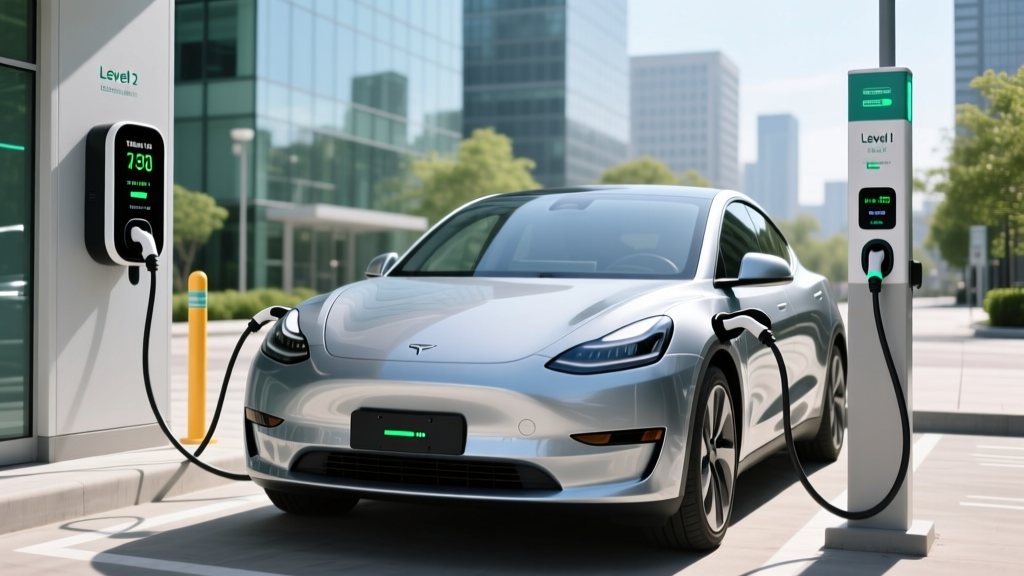
Charging speed remains one of the most scrutinized metrics for EV buyers, and the Model S leverages Tesla's proprietary NACS (North American Charging Standard) connector — now the de facto standard adopted by Ford, GM, Rivian, Hyundai, and most major automakers through 2025–2026.
| Charging Level | Power (kW) | Speed (Miles Added per Hour) | Typical Use Case |
|---|---|---|---|
| Level 1 (120V household) | ~1.4 kW | ~4–5 mi/hr | Emergency / overnight trickle |
| Level 2 (240V home Wall Connector) | 11.5 kW | ~44 mi/hr | Daily home charging |
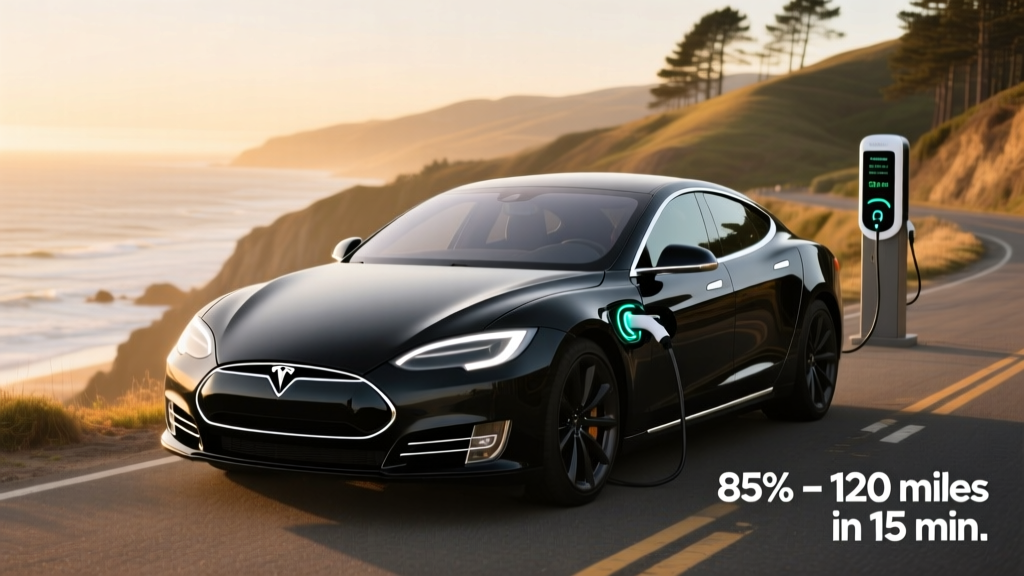
| DC Fast (Tesla Supercharger V3) | Up to 250 kW | ~200 mi in 15 min (peak) | Road trips |
| DC Fast (Supercharger V4) | Up to 250 kW (Model S) | Same as V3 for Model S | Road trips (newer stalls) |
Understanding the charge curve: The Model S peaks at 250 kW only between roughly 10–30% state of charge. Above 50%, the rate tapers to ~150 kW, and above 80% it drops further to ~60–80 kW. This is why Tesla (and fueleconomy.gov) quotes 10–80% times rather than 0–100%. For road-trip planning, budget roughly 30 minutes for a 10–80% session at a V3 or V4 Supercharger, and plan to stop at 80% rather than waiting for a full charge — the time cost of that last 20% is rarely worth it.
For home charging, the Tesla Wall Connector at 48 amps delivers 11.5 kW, replenishing a depleted 100 kWh battery in roughly 9–10 hours. Most owners who plug in nightly never need DC fast charging for daily use.
Performance and Driving Dynamics
The Model S Long Range delivers 670 hp via dual motors (one front, one rear), achieving a 3.1-second 0–60 mph time — quicker than most V8 sports sedans at twice the price. The Plaid variant's tri-motor setup (one front, two rear) produces 1,020 hp and a physics-defying 1.99-second 0–60 mph, making it one of the fastest production cars ever built.
Beyond straight-line speed, the Model S features adaptive air suspension with automatic height adjustment, torque vectoring across all driven wheels, and a low center of gravity from the floor-mounted battery pack that minimizes body roll. The yoke-style steering wheel remains polarizing — some drivers love the unobstructed display view, while others find it impractical for low-speed parking maneuvers. A conventional round wheel is available at no extra cost.
Driver Assistance: Level 2, Not Self-Driving
Tesla's Autopilot (standard) and optional Full Self-Driving (Supervised) are both SAE Level 2 driver-assistance systems. The driver must remain fully attentive, keep hands on the wheel, and be prepared to take over at any moment. These systems do not make the Model S a self-driving vehicle. Only Level 4 robotaxi services like Waymo operate without a human driver in geofenced areas. FSD (Supervised) adds automatic city-street navigation, traffic-light recognition, and parking assist, but it remains a supervised assist feature — not autonomous driving.
Interior, Cargo, and Technology
The 2026 Model S interior features a minimalist design anchored by a 17-inch center touchscreen (tilt-adjustable), a 12.3-inch driver instrument cluster, and a rear-seat 8-inch entertainment display. The cabin uses synthetic leather (Tesla dropped animal leather in 2022), with ventilated front seats, heated rear seats, and a HEPA air filtration system with "Bioweapon Defense Mode."
Passenger and cargo dimensions:
- Front legroom: 42.7 inches
- Rear legroom: 35.4 inches
- Rear cargo (behind second row): 28 cu ft
- Cargo (rear seats folded): ~50 cu ft
- Frunk (front trunk): ~3.1 cu ft
The rear seat comfortably fits two adults on longer trips, though the center position is best for children due to the transmission-tunnel-style hump (housing electronics). Compared to the Mercedes EQS (which offers more rear-seat luxury and a larger 35 cu ft trunk), the Model S trades some rear-seat refinement for superior driving dynamics and a more extensive charging network.
Pricing, Trims, and Federal Tax Credit Eligibility
| Trim | Base MSRP | Federal Tax Credit (§30D) | Effective Price (if eligible) |
|---|---|---|---|
| Long Range AWD | $79,990 | Up to $7,500 (see rules below) | ~$72,490 |
| Plaid (Tri-Motor AWD) | $94,990 | Up to $7,500 (see rules below) | ~$87,490 |
Critical §30D eligibility rules for 2026 (per IRS.gov):
- MSRP Cap: Sedars must have an MSRP at or below $55,000 to qualify. The Model S exceeds this cap at $79,990+ and does NOT qualify for the new-vehicle §30D credit.
- Income Cap: Modified adjusted gross income must not exceed $150,000 (single), $225,000 (head of household), or $300,000 (joint).
- Battery Sourcing: Critical minerals and battery components must meet phased-in domestic-content thresholds.
- Point-of-Sale Transfer: Eligible credits can be transferred to the dealer at purchase for an immediate price reduction.
⚠️ Tax Credit Reality Check
The 2026 Tesla Model S does not qualify for the $7,500 federal new-vehicle tax credit because its MSRP exceeds the $55,000 sedan cap set by the Inflation Reduction Act. Buyers looking for Tesla models that may qualify should look at the Model 3 (starting ~$38,990), which meets the MSRP threshold — though income limits and battery-sourcing rules still apply. Always consult a tax professional and verify current-year rules at IRS.gov before making a purchase decision based on credit eligibility.
Model S vs. Key Competitors: Is It Worth Buying?
The Model S competes in the premium electric sedan segment against the Lucid Air, Mercedes-Benz EQS, BMW i7, and Porsche Taycan. Here's how the critical numbers stack up:
| Metric | 2026 Tesla Model S LR | 2026 Lucid Air Pure | 2026 Mercedes EQS 450+ | 2026 Porsche Taycan 4S |
|---|---|---|---|---|
| EPA Range | 402 mi | 419 mi | 390 mi | 318 mi |
| Base MSRP | $79,990 | $69,900 | $104,400 | $103,800 |
| 0–60 mph | 3.1 sec | 5.2 sec | 5.9 sec | 3.8 sec |
| Max DC Charge | 250 kW | 200+ kW | 200 kW | 320 kW (800V) |
| Charging Network | Supercharger (best-in-class) | Electrify America + NACS adapter | CCS / NACS adapter | CCS / NACS adapter |
Choose the Tesla Model S If:
- You prioritize access to the Tesla Supercharger network — still the most reliable and extensive DC fast-charging infrastructure in North America
- You want the best combination of range, performance, and price in a premium sedan
- You value over-the-air software updates that continuously add features
- You want a proven platform with over a decade of real-world data on battery longevity
Choose a Competitor If:
- Lucid Air: You want maximum range (419 mi) and a more spacious rear seat at a lower starting price
- Mercedes EQS: You prioritize rear-seat luxury, ride comfort, and a more traditional luxury-brand experience
- Porsche Taycan: You value 800V architecture (faster sustained charging at 320 kW) and sports-car handling above all else
Pros and Cons
✅ Pros
- 402-mile EPA range — among the longest of any EV sedan
- Access to Tesla Supercharger network (17,000+ stalls in North America)
- Class-leading acceleration (3.1s Long Range; 1.99s Plaid)
- Proven battery longevity with 8-year/150,000-mile warranty
- Continuous OTA updates keep the vehicle current years after purchase
- Generous cargo space (28 cu ft + frunk) for a sedan
❌ Cons
- Does NOT qualify for $7,500 federal tax credit (MSRP exceeds $55K cap)
- Yoke steering is impractical for some drivers (round wheel available)
- Rear seat comfort and materials trail Mercedes EQS and Lucid Air
- 250 kW max DC charge rate is outpaced by 800V competitors (Taycan at 320 kW)
- Panel gaps and build-quality inconsistency reported by some owners
- No Apple CarPlay or Android Auto — Tesla's proprietary infotainment only
Who the 2026 Model S Suits Best
Ideal buyer: The Model S is best suited for the tech-forward commuter and road-tripper who drives 30+ miles daily, has access to home Level 2 charging, and takes multi-state road trips several times per year. The Supercharger network advantage is most valuable for buyers who regularly drive routes outside major metro areas where Electrify America or third-party chargers are sparse.
Not ideal for: Budget-conscious buyers (the Model 3 or Model Y offer better value and may qualify for tax credits), luxury seekers who prioritize rear-seat comfort above performance (consider the EQS or Lucid Air), or fleet/rideshare drivers who benefit from LFP chemistry's longer cycle life (Model 3 RWD).
Frequently Asked Questions
What was the first ever Tesla car?
The first ever Tesla car was the Tesla Roadster (2008–2012), a two-seat sports car based on the Lotus Elise chassis. It featured a 53 kWh battery pack and an EPA range of 244 miles — groundbreaking for its time. Only about 2,450 were produced. The Model S, launched in 2012, was Tesla's first ground-up vehicle design and is considered the car that established Tesla as a mass-market automaker.
What is the real-world range of the 2026 Tesla Model S?
The EPA rates the Model S Long Range at 402 miles. In real-world highway driving at 70–80 mph, expect 310–350 miles. In cold weather (below 30°F), that drops to roughly 260–310 miles. City driving with regenerative braking can push range closer to the EPA figure, often 370+ miles.
How fast does the Model S charge at home and on the road?
At home on a Level 2 Tesla Wall Connector (11.5 kW / 48A), the Model S adds approximately 44 miles of range per hour, fully charging in 9–10 hours. On a Tesla V3 or V4 Supercharger, it peaks at 250 kW and charges from 10–80% in approximately 30 minutes. Charging slows significantly above 80% due to battery-protection tapering.
Does the 2026 Model S qualify for the federal EV tax credit?
No. Under current IRS §30D rules, new sedans must have an MSRP at or below $55,000 to qualify. The Model S starts at $79,990, well above the cap. Buyers seeking a Tesla that may qualify should consider the Model 3 (starting ~$38,990), subject to income limits and battery-sourcing requirements. Always verify eligibility at IRS.gov and consult a tax professional.
Is the Model S worth buying over the Lucid Air or Mercedes EQS?
The Model S wins on performance-per-dollar, Supercharger network access, and proven battery longevity. The Lucid Air Pure offers more range (419 mi) at a lower starting price ($69,900) but relies on third-party charging networks. The Mercedes EQS offers superior rear-seat luxury and a more traditional ownership experience at a significantly higher price. For most buyers who road-trip regularly and value charging reliability, the Model S remains the strongest all-around choice in this segment.
What is the battery warranty on the 2026 Model S?
Tesla covers the Model S battery and drive unit for 8 years or 150,000 miles, whichever comes first, with a guaranteed minimum capacity retention of 70%. This is among the best battery warranties in the luxury EV segment.