Quick Answer: Is an EV Right for Your First Electric Purchase?
Your first ever electric car makes financial sense if you can charge at home (Level 2, 240V), drive under 250 miles daily, and live in a moderate or warm climate. Expect to pay $28,000–$45,000 before incentives for a mainstream EV with 250–330 miles of EPA range, spend roughly $500–$1,200 on home charger installation, and save $800–$1,500 annually on fuel and maintenance compared to a gas equivalent. The federal §30D tax credit can reduce your net cost by up to $7,500, but eligibility depends on your income, the vehicle's MSRP, and battery-mineral sourcing rules that shift yearly.
The Real Numbers: What Your First EV Actually Costs
The sticker price is only the opening move. A first-time EV buyer in 2026 needs to map five cost layers before signing any paperwork: purchase price, incentives, home charging setup, ongoing energy, and long-term ownership expenses.
Let's ground this in a concrete example. The 2026 Hyundai Ioniq 5 SEL starts at approximately $42,600 (MSRP before destination). With the full $7,500 federal point-of-sale credit — assuming you meet IRS §30D income caps ($150K single / $300K joint) and the vehicle's battery sourcing qualifies — your effective purchase drops to $35,100. Add a Level 2 home charger and installation at $700–$1,200, and your drive-away investment sits around $36,000.
Compare that to a well-equipped 2026 Toyota RAV4 XLE AWD at roughly $34,500. The EV costs more upfront, but the five-year picture tells a different story.
| Cost Category | Ioniq 5 SEL (EV) | RAV4 XLE AWD (Gas) |
|---|---|---|
| Base MSRP | $42,600 | $34,500 |
| Federal Tax Credit (§30D) | −$7,500 | $0 |
| Effective Purchase Price | $35,100 | $34,500 |
| Home Charger Install | $1,000 | $0 |
| Energy/Fuel (5 yrs, 12K mi/yr) | $3,750 | $9,000 |
| Maintenance (5 yrs) | $1,200 | $3,500 |
| Insurance (5 yrs, avg) | $8,500 | $7,200 |
| 5-Year Total Cost | $49,550 | $54,200 |
Energy costs assume $0.14/kWh national average for home charging (per EIA data) and $3.40/gal gasoline. The EV saves roughly $4,650 over five years even with higher insurance premiums — a common reality for first-time EV buyers to budget for. Source: fueleconomy.gov.
Range Reality Check: EPA Sticker vs Your Actual Miles
The EPA range on a window sticker is tested under controlled conditions. Your commute is not controlled. Here's what a first-time EV buyer should actually expect from a 303-mile EPA-rated vehicle like the Ioniq 5:
Real-World Range Expectations (303 mi EPA Baseline)
- City/suburban, 55–75°F: 290–310 mi (regen braking helps)
- Highway, 70–80 mph, 75°F: 250–275 mi (aerodynamic drag dominates)
- Highway, 20–35°F (cold): 200–230 mi (cabin heating + battery resistance)
- Extreme cold, below 10°F: 170–200 mi (worst-case scenario)
This range loss is physics, not a defect. Lithium-ion batteries slow their chemical reactions in cold temperatures, and resistive cabin heating draws 2–5 kW continuously. EVs with heat pumps — standard on the Ioniq 5, Tesla Model Y, and most 2026 models — reduce that heating penalty by 40–60% compared to resistive elements, recovering roughly 20–30 miles of winter range.
If your daily round-trip commute is under 80 miles and you charge at home overnight, even the worst-case cold scenario leaves you with a 100+ mile buffer. Range anxiety diminishes quickly once you understand your actual energy consumption in kWh per mile — typically 0.28–0.35 kWh/mi for a midsize crossover EV.
Charging at Home: Your Most Important Decision
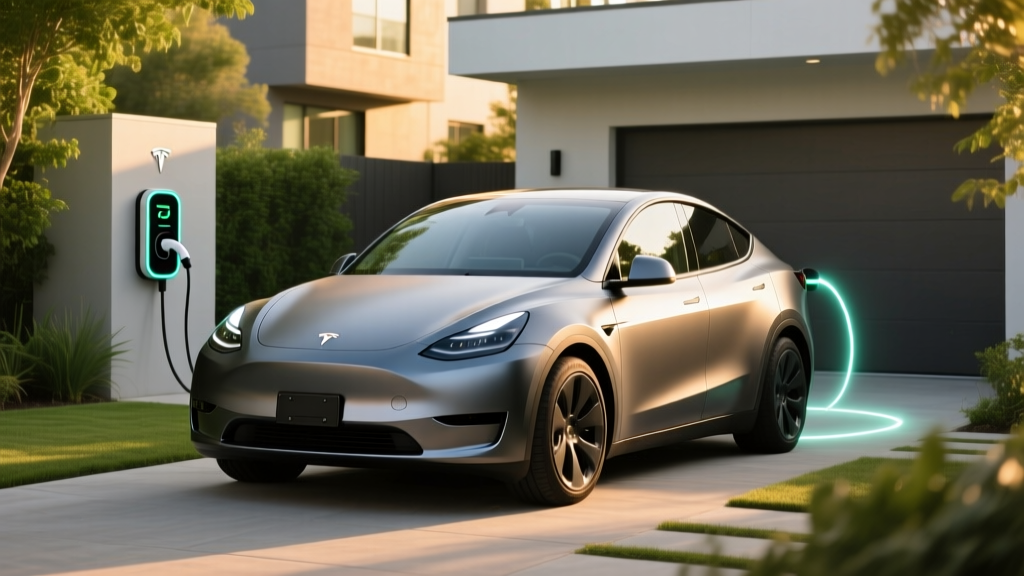
Over 80% of EV charging happens at home, and this single factor determines whether your first ever electric car feels like liberation or a burden. Here's the practical breakdown:
Level 1 (120V Standard Outlet)
Every EV ships with a cord that plugs into a regular household outlet. It delivers roughly 1.2–1.4 kW, adding 3–5 miles of range per hour. A full charge from empty takes 40–60 hours. This works if you drive under 30 miles daily and can plug in for 10+ hours nightly. For most buyers, it's a backup, not a primary strategy.
Level 2 (240V — The Standard for Daily Charging)
A Level 2 home charger delivers 7.2–11.5 kW (32–48 amps), adding 25–44 miles of range per hour. A full overnight charge (8 hours) replenishes 200–350 miles — more than enough for virtually any daily routine. Equipment costs $300–$700; professional installation runs $400–$1,500 depending on your electrical panel's capacity and the distance from panel to garage.
| Level | Voltage | Power (kW) | Miles Added/Hour | Full Charge Time (75 kWh Battery) |
|---|---|---|---|---|
| Level 1 | 120V | 1.2–1.4 kW | 3–5 mi | 50–60 hours |
| Level 2 (32A) | 240V | 7.7 kW | 25–28 mi | 9–10 hours |
| Level 2 (48A) | 240V | 11.5 kW | 38–44 mi | 6.5–7 hours |
Panel Upgrade: The Hidden Cost
If your home has a 100-amp electrical panel (common in homes built before 2000), adding a 48-amp EV charger may require a panel upgrade to 200 amps. This costs $1,500–$3,500 and must be performed by a licensed electrician. Always get a site assessment before purchasing a charger — many electricians offer these for free or a small fee that's credited toward installation.
DC Fast Charging (Public — For Road Trips)
Modern EVs accept 150–350 kW at DC fast chargers along highways. The Ioniq 5 peaks at roughly 240 kW on an 800V architecture, charging 10–80% in approximately 18 minutes under ideal conditions. However, charging curves taper significantly above 80% — that last 20% can take as long as the first 80%. Plan road-trip stops to charge only to 80% and move on; it's faster and preserves battery health.
EV vs Gas vs Hybrid: Which Powertrain Fits Your Life?
Not every driver is best served by a battery-electric vehicle. Your first ever electric car should match your actual lifestyle, not an aspirational one. Here's how the three main electrified options compare in 2026:
| Factor | BEV (e.g., Ioniq 5) | PHEV (e.g., RAV4 Prime) | HEV (e.g., RAV4 Hybrid) |
|---|---|---|---|
| EPA Range / MPGe | 303 mi / 114 MPGe | 42 mi electric + 38 MPG gas | 40 MPG combined |
| Base MSRP | $42,600 | $44,500 | $34,000 |
| Federal Tax Credit | Up to $7,500 | Up to $7,500 | $0 |
| Home Charging Needed? | Essential | Recommended | No |
| Annual Fuel/Energy Cost | ~$600 | ~$900 (mixed) | ~$1,500 |
| Maintenance (Annual) | ~$200 | ~$500 | ~$600 |
| Best For | Home chargers, daily <250 mi | Short commutes + road trips | No charging access, high mileage |
A plug-in hybrid like the RAV4 Prime covers 42 miles on electricity alone — enough for most commutes — then switches to hybrid mode for road trips with zero charging infrastructure needed. If you live in an apartment without charging access or regularly drive 400+ miles in rural areas, a PHEV or HEV may be the smarter first step into electrification.
Common Myths First-Time Buyers Believe
| Myth | Fact |
|---|---|
| "EV batteries need replacing every few years" | Federal law mandates 8-year/100,000-mile battery warranties. Real-world degradation averages 8–12% over 100K miles (Recurrent data). Most batteries outlast the car. |
| "Charging takes too long" | Home Level 2 charging happens while you sleep — zero active time. Road-trip DC fast stops add 15–25 minutes every 2–3 hours, comparable to gas-station rest breaks. |
| "EVs are worse in winter" | Range drops 20–30% in extreme cold, but EVs start instantly (no cold-cranking), pre-heat while plugged in using grid power, and have no engine warm-up penalty. Many cold-climate owners prefer EVs. |
| "The power grid can't handle EVs" | Most EV charging occurs overnight during off-peak hours when grid demand is lowest. A single EV adds roughly the same load as a central air conditioner. |
| "I'll never find a public charger" | The U.S. has over 200,000 public charging ports as of 2026. Apps like PlugShare and your vehicle's built-in navigation route you to available chargers. Tesla's Supercharger network now accepts NACS and CCS adapters. |
Federal Tax Credit: What You Actually Qualify For
The IRS §30D clean vehicle credit can knock up to $7,500 off your tax bill — or, as of 2024 onward, be transferred to the dealer at the point of sale for an instant price reduction. But the rules are layered, and many first-time buyers are surprised by the restrictions. Here's the eligibility checklist for 2026 purchases:
- Income caps: Modified AGI must not exceed $150,000 (single), $225,000 (head of household), or $300,000 (married filing jointly).
- MSRP caps: Vans, SUVs, and pickups must be under $80,000 MSRP; sedans and other body styles under $55,000.
- Battery sourcing: Increasing percentages of critical minerals and battery components must be sourced from the U.S. or free-trade-agreement countries. These thresholds tighten annually — verify current-year requirements at IRS.gov.
- Final assembly: The vehicle must undergo final assembly in North America.
- One credit per VIN, one vehicle per taxpayer per year.
Many popular EVs — including certain Tesla Model Y and Hyundai Ioniq 5 configurations — qualify for the full credit, but eligibility can shift mid-year as manufacturers adjust supply chains. Always verify a specific VIN's eligibility on the dealer lot using the IRS's online tool before committing.
Your Decision Framework: Should You Buy an EV, PHEV, or HEV?
Choose a Battery-Electric Vehicle (BEV) If:
- You have reliable access to Level 2 charging at home or work
- Your daily driving is under 250 miles
- You want the lowest per-mile operating cost (~$0.04–0.06/mi)
- You're eligible for the §30D credit, closing the upfront price gap
- You value instant torque, quiet operation, and minimal maintenance
Choose a Plug-In Hybrid (PHEV) If:
- You have home charging but also take frequent 300+ mile road trips
- Your daily commute is under 40 miles (covered by electric-only range)
- You live in an area with sparse public DC fast-charging infrastructure
- You want EV-like daily driving without any range planning
Choose a Standard Hybrid (HEV) If:
- You have no access to home or workplace charging
- You drive high annual mileage (15,000+ miles/year) in varied conditions
- Upfront cost is a primary constraint and tax credits don't apply to you
- You want better MPG with zero behavior change
Frequently Asked Questions
How long will the battery in my first EV last?
Federal law requires manufacturers to warranty EV batteries for at least 8 years or 100,000 miles (10 years/150,000 miles in CARB states like California). Real-world data from fleet operators shows most modern NMC and LFP batteries retain 85–92% of original capacity at 100,000 miles. Full replacement — rarely needed — costs $8,000–$18,000 depending on the vehicle, but degradation typically plateaus rather than accelerating.
What if I live in an apartment and can't install a charger?
This is the single biggest barrier for first-time EV buyers. Check whether your building has existing EV charging or plans to add it. Many cities now require new construction to include EV-ready wiring. If home charging is impossible, map nearby public Level 2 chargers (workplace, grocery stores, gyms) and DC fast chargers. If reliable daily charging access isn't feasible, a PHEV or HEV is the more practical choice.
Will my EV insurance cost more?
Yes, typically 10–25% more than an equivalent gas vehicle, according to industry averages. Higher repair costs for battery-adjacent damage and specialized parts drive the premium. Shop quotes from EV-friendly insurers (Geico, Progressive, and State Farm all have competitive EV rates in most states) and factor this into your five-year cost calculation.
Do I need to worry about charging on road trips?
Plan routes using your vehicle's built-in navigation or apps like A Better Routeplanner, which account for elevation, temperature, and charger availability. Most 2026 EVs with 250+ mile range and 150+ kW DC fast-charging capability need one 20-minute stop every 2–2.5 hours of highway driving. The expanding NACS/CCS interoperability means Tesla Superchargers now welcome non-Tesla EVs with adapters, significantly expanding the reliable charging network.
Is a used EV a smart first purchase?
A used EV can be an excellent entry point — prices on 2–4 year-old models often sit 30–40% below original MSRP. The federal used-EV credit (§25E) offers up to $4,000 (30% of sale price) on vehicles priced under $25,000 from a dealer, subject to income caps. Prioritize vehicles with battery health reports and remaining warranty coverage.