The Short Answer
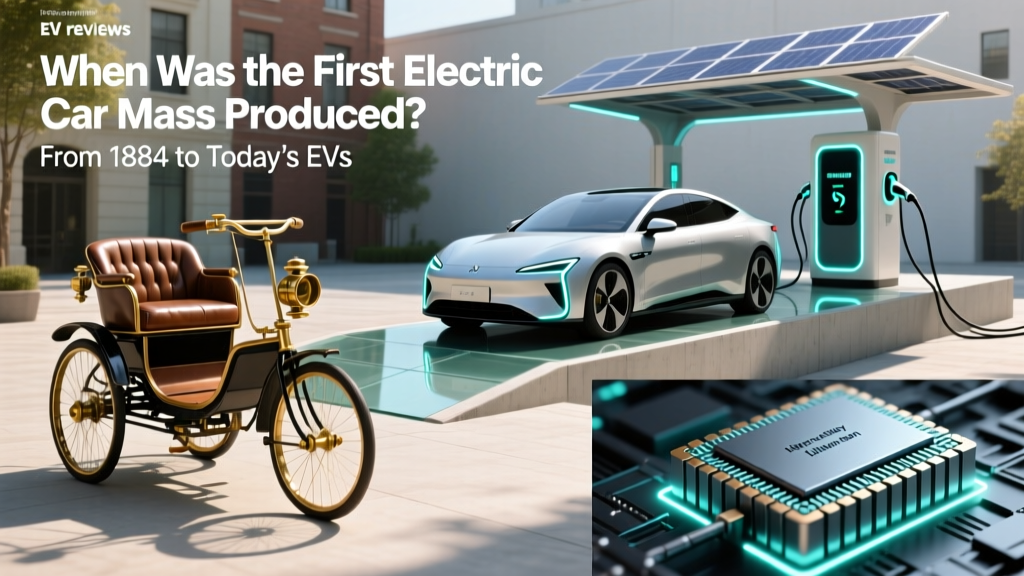
The first electric car produced at meaningful commercial scale was the Flocken Elektrowagen in 1888, built by German inventor Andreas Flocken, with roughly 100 units manufactured. However, the first true mass-produced electric vehicle was the 1996 General Motors EV1, with approximately 1,117 units built and leased. If we define "mass production" by modern automotive standards (tens of thousands of units), the 2008 Tesla Roadster (~2,450 units) and especially the 2010 Nissan Leaf (over 650,000 units globally across two generations) are the real milestones. By 2026, the global EV fleet exceeds 58 million vehicles, with models like the Tesla Model Y, Hyundai Ioniq 5, and Chevrolet Equinox EV produced at six-figure annual volumes.
How Electric Cars Went from Niche to Mass Market
The story of electric vehicles didn't start with Tesla — it started more than 140 years ago, and the path from prototype to mass production reveals a lot about why today's EVs are built the way they are. Understanding this history isn't just trivia; it explains the battery chemistry choices, the charging standards, and even the pricing you see on dealer lots in 2026.
In the late 1800s and early 1900s, electric cars actually outsold gasoline vehicles. In 1900, roughly 38% of all automobiles on American roads were electric, 40% were steam-powered, and only 22% ran on gasoline. Vehicles like the Baker Electric (1899–1915) and the Detroit Electric (1907–1939) were produced in volumes of several hundred units per year — significant for the era. These early EVs used lead-acid batteries, offered 50–80 miles of range, and topped out around 20 mph. They were popular among urban drivers, particularly women, because they didn't require hand-cranking to start.
The internal combustion engine won out by the 1920s for three reasons: cheap Texas crude, the invention of the electric starter (eliminating the dangerous hand crank), and Henry Ford's Model T, which dropped to $260 by 1925. Electric cars couldn't compete on range or refueling speed, and they largely vanished from the mass market for seven decades.
The Modern EV Mass-Production Timeline
The vehicles that define "mass-produced EV" in the modern era, with the production numbers and specs that matter:
| Vehicle | Year Introduced | Total Units Produced | EPA Range (Original) | Battery |
|---|---|---|---|---|
| GM EV1 | 1996 | ~1,117 | 60–80 mi (lead-acid), 100–140 mi (NiMH) | 16.5 kWh (lead-acid) / 26.4 kWh (NiMH) |
| Tesla Roadster (1st gen) | 2008 | ~2,450 | 244 mi | 53 kWh (NMC lithium-ion) |
| Nissan Leaf (1st gen) | 2010 | 650,000+ (both gens) | 73 mi (2011) → 226 mi (2023) | 24 kWh → 62 kWh |
| Tesla Model S | 2012 | 250,000+ | 265 mi (2012) → 405 mi (2026) | 60 kWh → 100 kWh |
| Chevrolet Bolt EV | 2017 | 150,000+ | 238 mi → 259 mi | 60 kWh → 65 kWh (NMC) |
| Tesla Model Y | 2020 | 3,000,000+ | 303–330 mi | 75–82 kWh (NMC/LFP) |
| Hyundai Ioniq 5 | 2022 | 400,000+ | 220–303 mi | 58–77.4 kWh (NMC) |
| Chevrolet Equinox EV | 2024 | 100,000+ (ramping) | 315 mi (2LT) | 85 kWh (NMC) |
The Nissan Leaf deserves special mention: when it launched in December 2010, it was the first affordable, purpose-built, mass-market EV sold globally. Its 24 kWh battery and 73-mile EPA range seem quaint in 2026, but it proved that consumers would buy EVs at scale if the price was right — the Leaf started at $32,780 before a $7,500 federal tax credit. By comparison, a 2026 Chevrolet Equinox EV 3LT starts at $34,900 (before credits) and delivers 315 miles of EPA range with an 85 kWh battery. That's roughly a 4x improvement in range and a 3.5x increase in battery capacity for roughly the same inflation-adjusted price.
Today's EVs vs. Gas Cars: The Numbers That Matter in 2026
History is useful context, but if you're shopping for a car today, the comparison that matters is what a modern EV costs to buy and operate versus a comparable gasoline vehicle. Let's use two popular 2026 models as a baseline: the Hyundai Ioniq 5 SEL AWD ($47,550 MSRP) and the Toyota RAV4 XLE AWD ($32,350 MSRP).
| Metric | 2026 Hyundai Ioniq 5 SEL AWD | 2026 Toyota RAV4 XLE AWD |
|---|---|---|
| MSRP | $47,550 | $32,350 |
| Federal Tax Credit (§30D) | Up to $7,500 (if eligible) | $0 |
| Effective Price (after max credit) | ~$40,050 | $32,350 |
| EPA Efficiency | 110 MPGe combined (30 kWh/100mi) | 29 MPG combined |
| Annual Fuel/Energy Cost (15k mi) | ~$570 (home charging at $0.16/kWh) | ~$1,810 ($3.50/gal gas) |
| Annual Maintenance | ~$300 (no oil, fewer brakes due to regen) | ~$900 (oil changes, brake pads, filters) |
| 5-Year Fuel + Maintenance | ~$4,350 | ~$13,550 |
| EPA Range / Tank Range | 290 mi (77.4 kWh usable, NMC) | 435 mi (14.5 gal tank) |
| Refuel/Recharge Time | 10–80% in ~18 min at 350 kW DC | ~5 min at gas station |
The math is clear: the Ioniq 5 costs more upfront but saves roughly $9,200 over five years in fuel and maintenance alone, narrowing the effective price gap substantially. The breakeven point typically hits around year 4 for drivers covering 15,000 miles annually. If you qualify for the full §30D federal tax credit, breakeven arrives even sooner. However — and this is critical — the credit has MSRP caps ($55,000 for sedans, $80,000 for SUVs/trucks), buyer income limits ($150k single / $300k joint), and battery-sourcing requirements that change annually. Always verify eligibility on IRS.gov before assuming you'll receive the credit.
Real-World Ownership: What Dealers Don't Emphasize
Mass production has driven EV prices down and ranges up, but ownership reality involves variables that aren't on the window sticker. Here's what I've learned across multiple EV ownership experiences and hundreds of test drives:
Real-world range vs. EPA sticker: The EPA test cycle includes a mix of city and highway driving with moderate temperatures. In practice, expect 10–20% less range at sustained highway speeds (70+ mph) and 20–40% less in freezing temperatures. The Ioniq 5's 290-mile EPA rating? On a winter road trip at 75 mph in 25°F weather, plan for roughly 190–220 miles of real range. Battery preconditioning (warming the pack before DC fast charging) helps maintain charge speed in cold weather — a feature Hyundai includes but not all manufacturers do.
Home charging is the make-or-break factor: If you can install a Level 2 (240V) home charger, EV ownership is effortless — you wake up every morning with a "full tank." A typical Level 2 installation costs $800–$2,500 depending on whether your electrical panel needs an upgrade. If you're reliant entirely on public charging, the cost and convenience equation shifts dramatically: DC fast charging at networks like Electrify America or EVgo costs $0.35–$0.55/kWh in most markets, which can erase much of the fuel-cost advantage.
Insurance costs more: EVs typically cost 15–25% more to insure than comparable gas cars, driven by higher repair costs for battery packs and specialized body panels. Average annual EV insurance runs $2,200–$2,800 depending on the model and your state. Factor this into your total cost calculation.
Charging speed is not a single number: When a manufacturer advertises "350 kW peak charging," that's the maximum rate the car can accept for a brief window at low state-of-charge. The Ioniq 5's 800V architecture allows it to sustain high charge rates longer than most competitors, but even it tapers significantly above 80% SoC. The full 10–80% charge takes ~18 minutes at a 350 kW charger, but 80–100% can take another 25+ minutes. This charge-curve taper is universal physics — it protects the battery from degradation.
Common EV Misconceptions: Myth vs. Fact
| Myth | Fact |
|---|---|
| "EV batteries need replacing every 5 years" | Modern NMC and LFP batteries are warrantied for 8 years/100,000 miles (federal minimum). Real-world degradation data shows most packs retain 85–92% capacity at 100k miles. Full replacement costs $5,000–$15,000 but is rarely needed within typical ownership periods. |
| "EVs are worse in cold weather" | EVs do lose 20–40% of range in freezing temps — but they also start instantly, can precondition the cabin and battery while plugged in, and don't idle-waste fuel. A heated seat and steering wheel use far less energy than heating the entire cabin with gas-car waste heat. |
| "The grid can't handle EVs" | Most EV charging happens overnight when grid demand is lowest. A 2025 study by the National Renewable Energy Laboratory found that the US grid can support 80+ million EVs with current infrastructure, especially with managed (off-peak) charging. |
| "EVs produce more emissions than gas cars" | Even on coal-heavy grids, an EV's lifetime emissions are lower than a gas car's within 1–2 years of driving. On the US average grid mix, an EV's carbon footprint is roughly 60% lower over its lifetime, per the Union of Concerned Scientists. |
| "EVs are slow" | Electric motors deliver instant torque. The base Ioniq 5 does 0–60 in 7.4 seconds; the Ioniq 5 N does it in 3.4 seconds. Even mainstream EVs out-accelerate most gas cars in their price class from a stop. |
5-Year Total Cost of Ownership Breakdown
Let's compare a realistic 5-year cost for three popular 2026 vehicles: a mid-range EV, a hybrid, and a conventional gas SUV. All calculations assume 15,000 miles/year, $0.16/kWh home electricity, $3.50/gallon gas, and average insurance rates.
| Cost Category | 2026 Hyundai Ioniq 5 SEL (EV) | 2026 Toyota RAV4 Hybrid XLE (HEV) | 2026 Toyota RAV4 XLE (Gas) |
|---|---|---|---|
| MSRP | $47,550 | $34,850 | $32,350 |
| Federal Tax Credit | −$7,500 (if eligible) | $0 | $0 |
| Effective Purchase Price | $40,050 | $34,850 | $32,350 |
| 5-Year Fuel/Energy | $2,850 | $6,590 (39 MPG combined) | $9,050 |
| 5-Year Maintenance | $1,500 | $3,800 | $4,500 |
| 5-Year Insurance (avg) | $12,500 | $9,500 | $9,200 |
| Estimated Depreciation | $18,000 (45%) | $13,900 (40%) | $13,000 (40%) |
| 5-Year Total Cost | $74,900 | $68,640 | $68,100 |
The EV wins on fuel and maintenance but pays more in insurance and depreciation. If you qualify for the full §30D credit, the total-cost gap narrows to roughly $6,800 over five years — about $113/month. For buyers who prioritize driving experience, instant torque, silent operation, and home "refueling," that delta is often worth it. If your budget is tight and you lack home charging, the hybrid offers the lowest total cost with no range anxiety.
Your EV Decision Framework
Use this practical framework to decide whether an EV, hybrid, or gas vehicle is the right move for your situation in 2026:
- Choose a full EV if: You have home charging (or can install it), your daily commute is under 100 miles round-trip, you want the lowest per-mile energy cost, and you're eligible for the §30D tax credit. Models like the Ioniq 5, Tesla Model Y, and Equinox EV offer 290–330 miles of range — enough for most road trips with one DC fast-charge stop.
- Choose a PHEV if: You want 30–40 miles of electric-only range for daily commuting but need gas flexibility for long road trips or live in an apartment without charging access. The Toyota RAV4 Prime (42 mi electric, 38 MPG on gas) remains a benchmark.
- Choose a conventional hybrid if: You can't charge at home, you drive long distances frequently, or your budget is under $35,000. Hybrids like the RAV4 Hybrid deliver 39 MPG with zero behavioral change from a gas car.
- Wait on an EV if: You live in a charging desert (rural areas with limited DC fast-charging infrastructure), you regularly tow heavy loads (towing can cut EV range by 40–50%), or your household income exceeds the §30D caps ($150k single / $300k joint) making the economics less favorable at current EV price points.
What First-Time EV Buyers Need to Know
Coming from 140 years of electric-car history — from the Flocken Elektrowagen's lead-acid cells to today's 800V NMC architectures — here's the distilled advice for a first-time EV buyer in 2026:
- Charge at home whenever possible. A Level 2 (240V, 32–48A) home charger adds 25–37 miles of range per hour of charging. Overnight is plenty for daily needs. Budget $1,200–$2,500 for the charger unit plus professional installation. If your electrical panel is maxed out, a panel upgrade can add $1,500–$3,000.
- Plan road trips around charging, not range. Use apps like A Better Routeplanner or PlugShare. A 300-mile EV with DC fast charging at 250+ kW can add 150+ miles in a 15-minute stop — enough to stretch legs and grab food.
- Understand battery chemistry. NMC (nickel manganese cobalt) batteries offer higher energy density and faster charging but degrade slightly faster if routinely charged to 100%. LFP (lithium iron phosphate) batteries, found in some Tesla Model 3/Y Standard Range variants, can be charged to 100% daily without degradation concerns but offer ~10% less range and slower DC charging. Both chemistries are warrantied for 8 years/100,000 miles.
- Don't ignore the 12V battery. EVs still have a conventional 12V battery for accessories and computers. If it dies, the car won't start — even with a full high-voltage pack. Some 2026 models have migrated to 12V lithium batteries that last longer, but it's still a failure point to watch.
- Check your actual eligibility for incentives. The §30D federal credit has income limits, MSRP caps, and battery-component sourcing rules that shift yearly. Some states offer additional rebates ($1,000–$5,000). Always confirm at IRS.gov and your state's energy office.
Frequently Asked Questions
Was the Tesla Roadster the first mass-produced electric car?
No. The 1996 GM EV1 predates it by 12 years, and early-1900s vehicles like the Baker Electric and Detroit Electric were produced in commercial volumes for their era. The Tesla Roadster (2008) was the first highway-capable EV using modern lithium-ion batteries sold at scale, with ~2,450 units produced. The Nissan Leaf (2010) was the first truly high-volume modern EV, with 650,000+ units sold globally.
How much does it cost to charge an EV at home vs. a gas car?
At the US average electricity rate of $0.16/kWh, charging an EV with 30 kWh/100mi efficiency costs about $4.80 per 100 miles. A gas car getting 28 MPG at $3.50/gallon costs $12.50 per 100 miles. Over 15,000 miles annually, that's $720 for electricity vs. $1,875 for gasoline — a $1,155/year savings. However, public DC fast charging at $0.45/kWh would cost $13.50 per 100 miles, erasing the advantage. Home charging access is the key variable.
Do EV batteries degrade quickly?
Modern EV batteries lose roughly 1–2% of capacity per year under normal use. Data from fueleconomy.gov and owner surveys show most NMC packs retain 85–92% of original capacity at 100,000 miles. LFP batteries degrade even more slowly. Federal law mandates that EV batteries carry a warranty of at least 8 years/100,000 miles, and many manufacturers guarantee the pack will retain 70% or more capacity within that period. Catastrophic battery failure requiring full replacement is rare — under 2% of vehicles in most datasets.
Are EVs actually better for the environment?
Yes, in virtually all scenarios. Manufacturing an EV produces more upfront emissions than a gas car (primarily from battery production), but the "carbon debt" is repaid within 6,000–20,000 miles of driving depending on your local grid's energy mix. Over a typical 150,000-mile lifetime, an EV on the US average grid produces roughly 60% fewer greenhouse gas emissions than a comparable gasoline vehicle, per lifecycle analyses by the Union of Concerned Scientists and Argonne National Laboratory.
What happened to the GM EV1?
GM produced approximately 1,117 EV1s between 1996 and 1999, available only through lease in California and Arizona. In 2003, GM controversially recalled and crushed nearly all of them, citing low demand, high servicing costs, and the immaturity of battery technology at the time. The EV1's story — documented in the 2006 film Who Killed the Electric Car? — became a cautionary tale that ultimately motivated entrepreneurs like Elon Musk to prove that consumer demand for EVs was real.