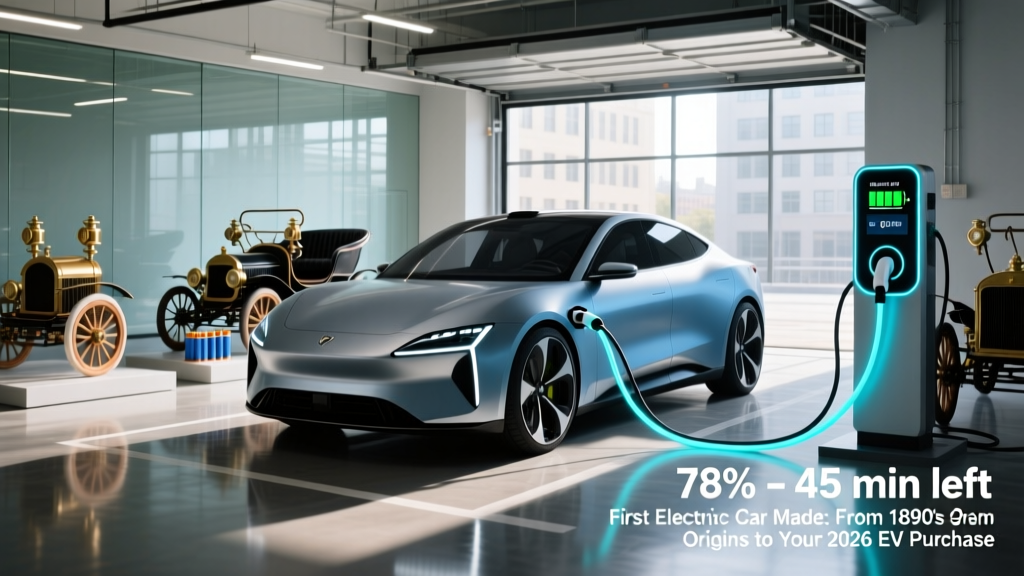
If you're researching the first electric car made, the quick answer is that the first practical electric vehicle was built by William Morrison in 1891 in Des Moines, Iowa — a six-passenger wagon capable of roughly 14 mph on a lead-acid battery. But if you landed here because you're actually weighing your first electric car purchase today, the real question is how far the technology has come and whether a 2026 EV fits your driving life, budget, and charging access.
The Short Answer
The first electric car dates to the late 1800s, but the modern EV era began with the 2008 Tesla Roadster (244-mile EPA range) and accelerated with the 2010 Nissan Leaf (73-mile range). Today's mainstream EVs deliver 250–350 miles of EPA range, DC fast-charge at 150–350 kW, and can qualify for up to $7,500 in federal tax credits under IRS §30D — a transformation that makes a first-time EV purchase genuinely practical for most drivers in 2026.
From Morrison's Wagon to Modern Lithium-Ion: A Brief Technology Timeline
Understanding where EV batteries started helps contextualize what you're buying today. Morrison's 1891 vehicle used heavy, inefficient lead-acid cells that offered about 50 miles of range and took overnight to recharge. For decades, internal combustion engines dominated because gasoline's energy density (~33.7 kWh per gallon, per fueleconomy.gov) was simply unmatched by any battery chemistry available.
The breakthrough came in stages:
- 1996–2003: GM EV1 — 80-mile range on NiMH batteries, leased-only program
- 2008: Tesla Roadster — 244-mile range, lithium-ion cobalt cells, ~$109,000 MSRP
- 2010: Nissan Leaf — 73-mile range, first mass-market affordable BEV (~$32,780 before incentives)
- 2017: Chevrolet Bolt EV — 238-mile range at $36,620, proving long-range could be affordable
- 2022–2024: LFP (lithium iron phosphate) chemistry went mainstream — lower cost, longer cycle life, no cobalt
- 2025–2026: NACS connector standardization, 800V architectures enabling 10–80% charges in 15–18 minutes
The practical takeaway: battery energy density has increased roughly 8x since the 1990s, while cost per kWh has dropped from over $1,000/kWh in 2010 to approximately $110–130/kWh at the pack level in 2026, according to BloombergNEF data. That cost curve is the single biggest reason EVs are now competitive with gas vehicles at purchase.
2026 EV vs. Gas vs. Hybrid: What the Numbers Actually Show
For a first-time EV buyer, the comparison that matters isn't historical — it's whether a battery-electric, plug-in hybrid, or conventional hybrid saves you more money over five years. Here's how three representative 2026 models stack up in the compact crossover segment:
| Metric | 2026 Hyundai Ioniq 5 (BEV) | 2026 Toyota RAV4 Prime (PHEV) | 2026 Honda CR-V Hybrid (HEV) |
|---|---|---|---|
| Powertrain | Battery Electric (NMC) | Plug-in Hybrid | Conventional Hybrid |
| EPA Range / MPG | 303 mi / 114 MPGe | 42 mi electric + 38 MPG gas | 40 MPG combined |
| Base MSRP | $42,600 | $44,500 | $36,350 |
| Federal Tax Credit (§30D) | Up to $7,500* | Up to $7,500* | None |
| Effective Price After Credit | ~$35,100 | ~$37,000 | $36,350 |
| Annual Fuel/Energy Cost† | ~$540 (home charging) | ~$680 (mix of electric + gas) | ~$1,350 (gas only) |
| Annual Maintenance | ~$300 | ~$550 | ~$600 |
| 5-Year Total Energy + Maint. | ~$4,200 | ~$6,150 | ~$9,750 |
* §30D credit eligibility depends on buyer income caps ($150K single / $300K joint), MSRP caps ($55K cars / $80K SUVs/trucks), and battery critical-mineral sourcing requirements. Verify current-year rules at irs.gov and consult a tax professional.
† Based on 12,000 miles/year, $0.14/kWh national average electricity, $3.40/gallon gas. Your costs vary by utility rate and local fuel prices.
The data makes clear: over five years, a BEV with home charging access saves $5,000–5,500 in energy and maintenance compared to a gas-only vehicle, and $1,500–2,000 versus a PHEV. The PHEV sits in the middle — offering electric-only commuting (42 miles covers most daily driving) with a gas engine for road trips, which matters if you lack reliable charging infrastructure.
Real Costs of First-Time EV Ownership: The Full Breakdown
Beyond the sticker price, first-time EV buyers need to budget for costs that don't appear in a showroom brochure. Here's a realistic first-year ownership cost breakdown for a typical 2026 BEV like the Ioniq 5 or Tesla Model Y:
| Cost Category | BEV (2026) | Gas Car Equivalent | Notes |
|---|---|---|---|
| Vehicle Purchase (after credit) | $35,000–$45,000 | $30,000–$38,000 | BEV premium narrowing; credit closes gap |
| Home Level 2 Charger Install | $800–$2,200 | $0 | 240V/40A circuit; panel upgrade adds $1,500–$3,000 if needed |
| Annual Energy/Fuel | $500–$700 | $1,200–$1,600 | Home charging at $0.14/kWh vs. $3.40/gal gas |
| Annual Insurance | $1,800–$2,400 | $1,400–$1,900 | EV premiums 15–25% higher on average |
| Annual Maintenance | $250–$400 | $500–$800 | No oil changes, fewer brake replacements (regen) |
| Registration (varies by state) | $100–$300 | $80–$200 | Some states add EV registration surcharges ($50–$225) |
The hidden cost most first-time buyers miss: home electrical panel capacity. If your home has a 100-amp panel that's already near capacity, adding a 40-amp Level 2 circuit may require a panel upgrade to 200 amps — adding $1,500 to $3,000 to your installation. Get a licensed electrician to assess your panel before purchasing an EV, not after.
What First-Time EV Buyers Must Know Before Signing
After testing and tracking dozens of EVs across model years, here are the practical realities that separate informed first-time buyers from disappointed ones:
Real-World Range vs. EPA Stickers
EPA range estimates are tested under controlled conditions. In real-world driving, expect:
- Highway driving at 70+ mph: 10–20% range loss vs. EPA (a 300-mile EPA vehicle delivers ~240–270 miles)
- Cold weather (below 32°F): 20–40% range loss due to battery chemistry limitations and cabin heating demands
- Moderate city/suburban driving: Often matches or slightly exceeds EPA thanks to regenerative braking
A 2026 EV with a 300-mile EPA rating is genuinely sufficient for most daily driving and road trips with planning — but if your commute is 80+ miles round-trip in Minnesota winters, you need more buffer.
Charging Speed: Peak kW Is Not Sustained kW
When a manufacturer advertises "250 kW DC fast charging," that's the peak rate the vehicle can accept at a low state of charge (typically 10–30% SoC). The charge curve tapers significantly above 50% SoC, and dramatically above 80%. A vehicle that charges 10–80% in 18 minutes may take another 20+ minutes to go from 80–100%. For road trips, plan your stops around the 10–80% window — that's where the speed lives.
Connector Compatibility in 2026
The industry has largely standardized on NACS (North American Charging Standard, originally Tesla's connector) for 2025+ models. If you're buying a 2026 EV, it almost certainly has NACS. Older CCS vehicles can access Tesla Superchargers via adapter, and Electrify America, EVgo, and ChargePoint stations are adding NACS cables. CHAdeMO is effectively dead for new vehicles.
Battery Longevity and Warranty
Federal law mandates a minimum 8-year/100,000-mile battery warranty for EVs (10 years/150,000 miles in CARB states like California). Most manufacturers warrant that the battery will retain at least 70% of original capacity during that period. Real-world degradation data shows most modern NMC and LFP packs lose 5–10% capacity over the first 100,000 miles — meaning a 300-mile EV will still deliver ~270 miles at the 8-year mark.
Decision Framework: Is an EV Right for Your First Electrified Purchase?
Choose a BEV (Battery Electric) If:
- You have home charging access (garage, driveway, or employer-provided Level 2)
- Your daily driving is under 80 miles round-trip
- You want the lowest per-mile operating cost and minimal maintenance
- You can plan road trips around DC fast-charging stops (every 200–250 miles)
- You qualify for the §30D tax credit (check income, MSRP, and sourcing rules)
Choose a PHEV (Plug-in Hybrid) If:
- You want electric-only commuting (30–45 miles covers most daily trips) but need gas flexibility for road trips
- You have Level 1 or Level 2 home charging but live in an area with sparse public DC charging
- You regularly tow, drive in extreme cold, or take long rural trips where charging infrastructure is unreliable
- You want to reduce emissions without fully committing to electric-only driving
Choose a HEV (Conventional Hybrid) If:
- You have no access to home or workplace charging
- You want improved fuel economy (35–50 MPG) with zero plug-in behavior changes
- You're in an apartment or street-parking situation where charging isn't feasible
Common EV Misconceptions — Addressed with Data
| Myth | Fact (with data) |
|---|---|
| "EV batteries need replacing every few years like phone batteries" | Modern EV battery packs are warrantied for 8 years/100,000+ miles and typically retain 90%+ capacity at 5 years. Replacement cost is $5,000–$20,000 depending on pack size, but full replacements are rare — most packs outlast the vehicle. (NHTSA tracks no widespread battery failure campaigns.) |
| "EVs are worse for the environment because of electricity generation" | Even on coal-heavy grids, EVs produce 50–70% fewer lifecycle emissions than gas cars over 150,000 miles, per Union of Concerned Scientists analysis. On the average US grid in 2026, an EV is equivalent to a gas car getting 90+ MPG in emissions terms. |
| "Charging takes too long for road trips" | A 350 kW-capable vehicle on a 350 kW charger adds ~200 miles in 15 minutes (10–80% SoC). Combined with meal/rest stops, this adds 15–25 minutes per 200-mile segment — noticeable but manageable. |
| "EVs can't handle cold weather" | EVs lose 20–40% range in sub-freezing temps — real, but solvable. Preconditioning (warming the battery while plugged in), heat pumps (standard on most 2026 EVs), and seat/steering wheel heaters mitigate the impact. Norway, where EVs represent 80%+ of new sales, averages 20°F winters. |
| "I need a 400-mile range EV to avoid range anxiety" | The average American drives 37 miles per day (fueleconomy.gov). A 250-mile EV charged at home overnight covers 99% of daily needs. Long-range batteries add $3,000–$8,000 to purchase price and 200–400 lbs of weight, reducing efficiency. |
Your First EV Purchase Checklist for 2026
Before you visit a dealership or configure an order online, work through these steps:
- Audit your daily driving: Track your actual miles for two weeks. If 95% of your days are under 80 miles, a 250-mile EV is more than adequate.
- Check your electrical panel: Hire an electrician ($100–$200 for an assessment) to confirm you can add a 240V/40A circuit. Budget $800–$2,200 for a standard Level 2 install, or $2,500–$5,000 if a panel upgrade is needed.
- Verify §30D tax credit eligibility: Check your AGI against income caps ($150K single / $225K head of household / $300K joint), confirm the vehicle's MSRP is under the cap ($55K for cars, $80K for SUVs/pickups), and verify battery sourcing compliance at irs.gov. Many 2026 models qualify for the full $7,500 as a point-of-sale discount.
- Test your route: Use PlugShare or A Better Routeplanner to map your longest regular trip. Identify DC fast-charging stations along the route and verify connector compatibility (NACS for 2026 models).
- Get insurance quotes before buying: EV insurance premiums run 15–25% higher than equivalent gas vehicles. Get actual quotes for the specific model and trim — premiums vary significantly between a Tesla Model Y and a Hyundai Ioniq 5 even at similar MSRPs.
- Consider total cost of ownership, not just MSRP: A $42,000 EV with a $7,500 credit, $540/year in electricity, and $300/year maintenance may cost less over five years than a $35,000 gas car with $1,350/year fuel and $600/year maintenance.
Frequently Asked Questions
Who made the first electric car?
William Morrison, a chemist in Des Moines, Iowa, built the first practical American electric car in 1890–1891. It was a six-passenger wagon with a top speed of about 14 mph. In Europe, earlier electric carriages were built by Robert Anderson (Scotland, ~1832) and Gustave Trouvé (France, 1881), but Morrison's vehicle was the first to demonstrate practical passenger capability.
Why did electric cars disappear after the 1890s?
Three factors: the discovery of cheap Texas crude oil, the invention of the electric starter (eliminating hand-cranking of gas engines) in 1912, and Henry Ford's mass-produced Model T at $650 versus $1,750+ for electric vehicles. Gasoline's energy density and the expanding road network made internal combustion dominant for a century.
How much does it cost to charge an EV at home in 2026?
At the US average electricity rate of $0.14–$0.17/kWh, fully charging a 75 kWh battery (roughly 250–300 miles of range) costs $10.50–$12.75. That's equivalent to paying about $1.20–$1.50 per gallon of gasoline. Over 12,000 miles/year, home charging costs $500–$700 versus $1,200–$1,600 for gas.
Do EVs qualify for tax credits in 2026?
Yes, but eligibility is complex. Under IRS §30D, qualifying new EVs can receive up to $7,500 as a point-of-sale discount. Requirements include: buyer income below caps ($150K single / $300K joint), vehicle MSRP under limits ($55K cars / $80K SUVs and trucks), and battery components and critical minerals meeting domestic-sourcing thresholds that tighten annually. Always verify current eligibility at irs.gov before purchasing.
How long do EV batteries actually last?
Based on fleet data from Tesla, Hyundai, and other manufacturers, modern lithium-ion EV battery packs typically lose 5–12% capacity over 100,000 miles and 5–8 years. Most packs are designed to retain 70–80% capacity at 150,000–200,000 miles. Federal law requires a minimum 8-year/100,000-mile warranty (10 years/150,000 miles in CARB states). LFP chemistry packs tend to degrade even more slowly but offer slightly lower energy density.
Can I charge a 2026 EV at a Tesla Supercharger?
Yes. Starting in 2025, most automakers adopted the NACS connector, and 2026 EVs ship with NACS ports natively. Tesla Superchargers (now simply called "Superchargers" with open access) are available to Ford, GM, Hyundai, Rivian, Volvo, and other NACS-equipped vehicles. CCS-equipped vehicles from prior model years can use adapters for Supercharger access.