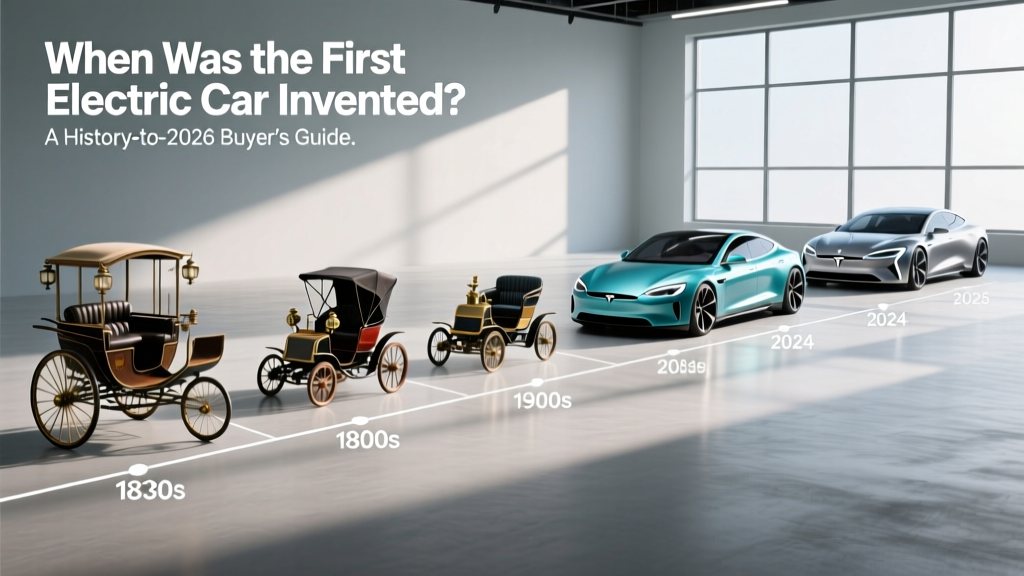
The Quick Answer: When Was the First Electric Car Invented?
The first crude electric vehicle was built around 1834–1835 by Vermont blacksmith Thomas Davenport, who created a small battery-powered model car. The first practical, passenger-carrying electric car emerged in 1890–1891, built by William Morrison of Des Moines, Iowa — a six-passenger wagon that could reach roughly 14 mph. By the late 1890s, electric cars outsold gasoline vehicles in the U.S., holding nearly 38% of the American auto market in 1900 before cheap gasoline and Ford's Model T ended the first EV era.
Understanding where electric cars came from isn't just trivia — it reveals why today's EVs are designed the way they are, and why certain myths (range anxiety, battery lifespan, charging inconvenience) persist from more than a century ago. This guide bridges the history with the 2026 buying decision: exact costs, real-world ranges, and a framework for deciding whether an EV, hybrid, or gas vehicle fits your life.
The EV Timeline: From 1834 to the Modern Era
Electric vehicles predate the internal combustion engine. Here's the timeline that matters for today's buyers:
| Era | Milestone | Why It Still Matters |
|---|---|---|
| 1834–1835 | Thomas Davenport builds first DC-motor EV model | Proves electric propulsion is viable before gasoline engines exist |
| 1890–1891 | William Morrison's 6-passenger electric wagon | First practical EV; sparks commercial production |
| 1900 | EVs hold 38% of U.S. auto market | Electric was once dominant, not alternative |
| 1912 | Electric starter eliminates hand-cranking gas cars | Kills EVs' key convenience advantage; market collapses by 1920 |
| 1996 | GM EV1 launched (modern era begins) | First mass-produced modern EV; nickel-metal hydride batteries |
| 2008 | Tesla Roadship ships with lithium-ion cells | Li-ion unlocks 200+ mile range, enabling today's market |
| 2010–2011 | Nissan Leaf and Chevy Volt debut | First mass-market BEV and PHEV; proves consumer demand |
| 2020s | LFP chemistry, 800V architectures, NACS standard | Lower cost, faster charging, connector unification |
| 2026 | Average new BEV EPA range: ~310 miles; peak DC charging: 350 kW | Range and charging largely solved for mainstream buyers |
The core engineering challenge — storing enough energy in a battery to drive meaningful distance — took 130+ years to solve. Lithium-ion batteries deliver roughly 5× the energy density of the lead-acid cells Morrison used, which is why a 2026 Hyundai Ioniq 5 carries an 84 kWh (usable) battery weighing ~850 lbs instead of the 2,000+ lbs of lead-acid that would store equivalent energy.
2026 EV Ownership: What the Numbers Actually Look Like
History explains the technology, but buyers need current data. Here's a snapshot of mainstream 2026 BEV ownership compared to a comparable gas vehicle, using a midsize crossover (e.g., Hyundai Ioniq 5 vs. Toyota RAV4 AWD) as the baseline.
| Cost Category | 2026 BEV (e.g., Ioniq 5) | Gas Crossover (e.g., RAV4 AWD) | Difference |
|---|---|---|---|
| Base MSRP | $42,600 | $33,400 | EV +$9,200 |
| Federal §30D credit (if eligible) | –$7,500 (point-of-sale) | $0 | EV –$7,500 |
| Effective purchase price | $35,100 | $33,400 | EV +$1,700 |
| Fuel/energy cost (15,000 mi/yr, 5 yr) | $3,450 (home L2, $0.14/kWh) | $9,375 (28 MPG avg, $3.50/gal) | EV saves $5,925 |
| Maintenance (5 yr) | $1,200 | $3,800 | EV saves $2,600 |
| Insurance (5 yr avg) | $9,500 | $7,800 | EV +$1,700 |
| 5-Year Total Cost of Ownership | ~$49,250 | ~$54,375 | EV saves ~$5,125 |
Key assumptions: home Level 2 charging at residential electricity rates, 15,000 miles/year, 5-year ownership. The §30D credit is subject to IRS income caps ($150K single / $300K joint), MSRP caps ($55K cars / $80K SUVs/trucks), and critical-mineral/battery-sourcing requirements that vary by model year. Confirm eligibility with a tax professional before purchase.
Where the EV loses: insurance runs 15–25% higher on average due to repair complexity and parts costs, and the upfront price premium persists even after credits for buyers who don't qualify for §30D.
EV vs. Gas vs. Hybrid: Which Powertrain Fits You?
| Metric | BEV (Ioniq 5) | PHEV (RAV4 Prime) | HEV (RAV4 Hybrid) | Gas (RAV4 AWD) |
|---|---|---|---|---|
| EPA Range / Tank | 310 mi (EPA) | 42 mi EV + 530 mi gas | ~580 mi total | ~475 mi |
| Real-World Highway Range | ~250–270 mi (70 mph, mild) | 35 mi EV + ~500 mi gas | ~520 mi | ~430 mi |
| Cold-Weather Range Loss (20°F) | –20% to –30% | –15% EV portion | Minimal | Minimal |
| MPGe / MPG Combined | 114 MPGe | 94 MPGe (EV) / 38 MPG (gas) | 39 MPG | 28 MPG |
| Home Charging Needed? | Strongly recommended | Recommended for EV benefit | No | No |
| Refuel/Recharge Time | 10–80% in ~18 min (DCFC) | 0–100% in ~2.5 hr (L2) | ~5 min | ~5 min |
| Base MSRP (2026) | ~$42,600 | ~$44,500 | ~$34,900 | ~$33,400 |
Real-world range honesty: The EPA 310-mile sticker on the Ioniq 5 assumes a mix of city and highway driving at moderate temperatures. Sustained 75+ mph highway driving drops range to roughly 250–270 miles. At 20°F, expect a 20–30% reduction (down to ~220–250 miles) due to battery chemistry limits and cabin heating loads, even with a heat pump. This is physics, not a defect — and it's why PHEVs remain compelling for cold-climate buyers without reliable home charging.
Common EV Myths vs. 2026 Facts
| Myth | Fact (with data) |
|---|---|
| "EV batteries don't last" | Modern NMC/LFP packs retain 85–92% capacity at 150,000 miles (per Recurrent Auto data). Federal warranty mandate: 8 years / 100,000 miles minimum to 70% capacity. |
| "Charging takes too long" | 800V-architecture BEVs (Ioniq 5, EV6, Lucid Air) peak at 240–350 kW, adding 10–80% in 18–22 minutes. Most owners charge overnight at home and rarely use DCFC. |
| "EVs are worse for the environment" | Union of Concerned Scientists analysis: EVs produce fewer lifetime emissions than gas cars in every U.S. grid region, even coal-heavy grids. Payback: 6,000–20,000 miles depending on grid mix. |
| "I can't drive an EV in an apartment" | True challenge — 30–40% of U.S. households lack home charging access. Solution: prioritize workplace charging, public DCFC corridors, or choose a PHEV. |
| "EVs are all expensive" | 2026 entry BEVs: Chevy Equinox EV ($33,000 base), Nissan Leaf ($29,000 est.). After §30D, effective prices rival gas compacts. |
Real-World Ownership: What First-Time EV Buyers Must Know
Before committing to a BEV, audit your specific situation. These are the factors that determine whether an EV will delight or frustrate you:
1. Home Charging Access
Level 2 home charging (240V, 7–11 kW) is the single biggest determinant of EV satisfaction. Without it, you'll rely on public DCFC or workplace chargers, which adds friction and cost (DCFC averages $0.35–$0.50/kWh vs. $0.14/kWh residential).
- Installation cost: $800–$2,500 for a 40A/48A Level 2 charger if your panel has capacity; $2,500–$5,000+ if you need a 200A panel upgrade.
- Circuit requirement: A 48A charger needs a 60A breaker. Hire a licensed electrician — never DIY high-voltage work.
- Apartment/condo reality: Check for shared charging infrastructure or nearby public options before buying.
2. Driving Patterns
If your daily driving is under 80 miles round-trip with home charging, a BEV is nearly frictionless. If you regularly drive 300+ miles in a day (road trips, rural routes), evaluate DCFC density along your routes using PlugShare or A Better Routeplanner — and consider a PHEV as a bridge.
3. Climate
Cold-weather buyers (sustained sub-30°F winters) should budget 20–30% range loss and prioritize models with heat pumps (standard on most 2026 BEVs except some base trims). Preconditioning the battery before DCFC is critical — it can cut 10–80% charge time by 30–40% in cold weather.
4. Battery Chemistry
LFP (lithium iron phosphate): Lower energy density, but longer cycle life, cheaper, and can be charged to 100% daily without degradation concerns. Used in Tesla Model 3 RWD, base Ford Mustang Mach-E.
NMC/NCA (nickel-based): Higher range per kWh, but best kept at 80% daily SoC for longevity. Used in most long-range trims.
Decision Framework: Should You Buy an EV, Hybrid, or Gas Car in 2026?
Buy a BEV if:
- You have reliable Level 2 home charging (or workplace charging)
- Daily driving is under 150 miles round-trip
- You qualify for the §30D credit (income + MSRP + sourcing)
- You want lowest long-term operating costs and minimal maintenance
Buy a PHEV if:
- You have home charging but also take frequent 300+ mile trips
- You live in a cold climate where BEV range loss is a concern
- You want EV-mode commuting (20–45 mi electric range) without range anxiety
- Public charging infrastructure on your routes is sparse
Buy an HEV (standard hybrid) if:
- No home charging access (apartment, street parking)
- You want MPG gains (35–50 MPG) without plug-in behavior change
- Budget is primary concern — HEVs cost $1,000–$3,000 more than gas equivalents
Stick with gas if:
- You drive under 8,000 miles/year (fuel savings won't offset EV premium)
- You tow heavy loads regularly (trailers, boats) — EVs lose 40–50% range towing
- You live in a charging desert with no realistic public DCFC access
FAQ: History Meets 2026 Ownership
Why did electric cars disappear after 1900?
Three factors converged: the 1912 invention of the electric starter (eliminating hand-cranking), Ford's mass-produced Model T at $650 (vs. $1,500+ for EVs), and cheap Texas crude oil. By 1930, electric cars had effectively vanished from the consumer market.
Who invented the first practical electric car?
William Morrison of Des Moines, Iowa, built the first practical passenger electric vehicle in 1890–1891. Earlier prototypes (Davenport 1834, Robert Anderson ~1832) were small models or carriages, not practical transport.
How far could the first electric cars travel?
Early 1890s EVs had a range of roughly 20–50 miles on a single charge, limited by heavy lead-acid batteries. By 1900, premium EVs like the Baker Electric claimed up to 100 miles — a figure that wouldn't be matched again by a production EV until the 2010s.
Is the federal EV tax credit still available in 2026?
Yes, but with strict rules. The IRS §30D credit offers up to $7,500 at point-of-sale for new EVs meeting battery-sourcing and critical-mineral requirements. Buyer income caps apply ($150K single / $300K joint AGI), and MSRP caps ($55K cars / $80K SUVs, vans, trucks) exclude luxury models. Eligibility changes yearly — verify on fueleconomy.gov before purchase.
How long do modern EV batteries last?
Real-world data shows 2020s-era NMC and LFP packs retain 85–92% capacity at 150,000 miles. Federal law mandates an 8-year/100,000-mile warranty (10 years/150,000 miles in CARB states) to a minimum of 70% capacity. Full pack replacement costs $8,000–$18,000 depending on the model, but catastrophic failure is rare.
What's the real-world range of a 2026 EV vs. the EPA sticker?
Expect 80–90% of EPA range in mixed driving, 75–85% in sustained highway driving at 70+ mph, and 70–80% in sub-30°F cold weather. A 310-mile EPA BEV typically delivers 250–270 miles on a 75-mph highway trip in mild weather, and 220–250 miles in winter.
The 190-year arc from Thomas Davenport's workshop to a 350 kW DC fast charger reflects a single engineering truth: electric propulsion was always superior — it just needed batteries to catch up. In 2026, they finally have. The remaining question isn't whether EVs work; it's whether your home, your routes, and your budget are ready for one today.